



Following last week’s Alaska summit, the Trump administration boasted that Russian President Vladimir Putin had made the
of allowing Ukraine to receive “NATO-style” security guarantees from the West, a development that was initially widely praised. However, Moscow clarified Wednesday that this would be
on giving Russia and China the power to veto any future efforts to defend Kyiv, rendering these guarantees useless.
Russian Foreign Minister Sergey Lavrov
at a press conference in Moscow on Wednesday that the Kremlin would accept international security guarantees for Ukraine only if they match what his government had proposed during the Istanbul
of early 2022.
During these earlier talks (but as far as we know, not in the current talks) Russian negotiators had demanded that Ukraine break all of its security alliances and “demilitarize” itself by shrinking its armed forces to a token size. In exchange, Ukraine would have received protection from a consortium of guarantor states, consisting of Russia and other partners, who would all have had the power to veto intervention from any other member.
“We will safeguard our legitimate interests in a firm and harsh manner,” said Lavrov at Wednesday’s press conference, stressing that discussing security guarantees without the Russian Federation is a “path to nowhere.” He further emphasized that China should be involved as an equal partner.
Although the Russian Foreign Minister erroneously stated that the Ukrainians had approved of the 2022 Istanbul arrangement, they never actually did so – and have steadfastly ruled out doing so since then. Security guarantees are worthless if the country that wants to invade you can block them.
In fact, acceding to these pseudo-guarantees would have been worse than receiving no assurances at all. If Ukraine’s allies were to defend Kyiv against a renewed invasion, while contending with, and ultimately ignoring, a legitimized Russian veto, the associated diplomatic inertia would almost certainly delay the deployment of military aid at the earliest and most critical stages of combat. Further, Moscow could frame this support as an illegal intervention and recast the west as the villain.
It doesn’t take a genius to understand this. Yet, following the collapse of the 2022 Istanbul talks, pro-Russian voices
for years that a peace deal would have been signed had it not been sabotaged by a “warmongering” west. Obscure technicalities, which can easily be misrepresented, are essential tools for propaganda and historical revisionism, it seems.
Given this context, the Trump administration’s negotiating team should have immediately clarified what Putin meant when he conceded to “NATO-like” security guarantees at last week’s Alaska summit, especially after he proposed including China in the scheme. It would not have been difficult to ask: “Do you expect to have veto powers here?”
Somehow, seemingly no one thought to do this — even though this was an obvious risk that some
,
, generally flagged right away when news of this “concession” broke. So, it seems that Putin once again scammed the west, and the Trump administration’s incompetent negotiating team fell for it.
But this was also not altogether surprising, because, when it comes to Eastern Europe, Trump’s team isn’t well-prepared.
Since January, two White House factions have emerged with respect to Ukraine. One side is represented by retired lieutenant general Keith Kellogg, currently the U.S. Special Presidential Envoy for Ukraine, while the other side by real estate mogul Steve Witkoff, who was originally appointed as Trump’s special envoy to the Middle East before his portfolio grew to encapsulate Russia as well. As of now, the latter appears to have more sway.
Kellogg is generally considered an ally of Ukraine and has decades of military and diplomatic experience. His daughter, Meaghan Mobbs, is also an army veteran and currently operates a humanitarian project in Kyiv,
, through which she seemingly keeps her father
of on-the-ground realities.
In contrast, Witkoff, who regularly praises Putin and
parrots Kremlin talking points
, had no diplomatic experience before his appointment earlier this year. He is a close personal friend of Trump’s, whose lack of relevant qualifications has been the
subject of international criticism
for months.
In a March interview with podcast host Tucker Carlson, Witkoff was
of the four Ukrainian provinces that Putin partially occupies and wants to fully annex, even though this basic information is essential to his job. Witkoff further claimed that referendums showed that the majority of these provinces’ residents want to join Russia — but, in reality, these referendums were
by the majority of members of the UN General Assembly in 2022. According to the BBC, election officials were escorted by Russian soldiers while they collected votes, causing those in their homes to
, “Were the guns there to protect you as you voted, or to cow you into voting?”
Then, earlier this month, Witkoff travelled to Moscow for another round of talks with Putin and returned claiming that the Kremlin was open to a “land swap” wherein Russian forces would retreat from Ukraine’s Kherson and Zaporizhzhia provinces. This prompted Trump to pause new sanctions and convene the Alaska summit, but it turned out that Witkoff seemingly “
” Putin, who had, in fact, wanted Ukrainian forces to withdraw. Such miscommunications are highly unusual for high stakes international diplomacy, to put it lightly.
Kellogg was
, leaving the American delegation without a babysitter. And so Witkoff announced on Sunday that the summit had been a success, and that credible security guarantees were on the table, which, based on Lavrov’s recent statements, does not appear to be true.
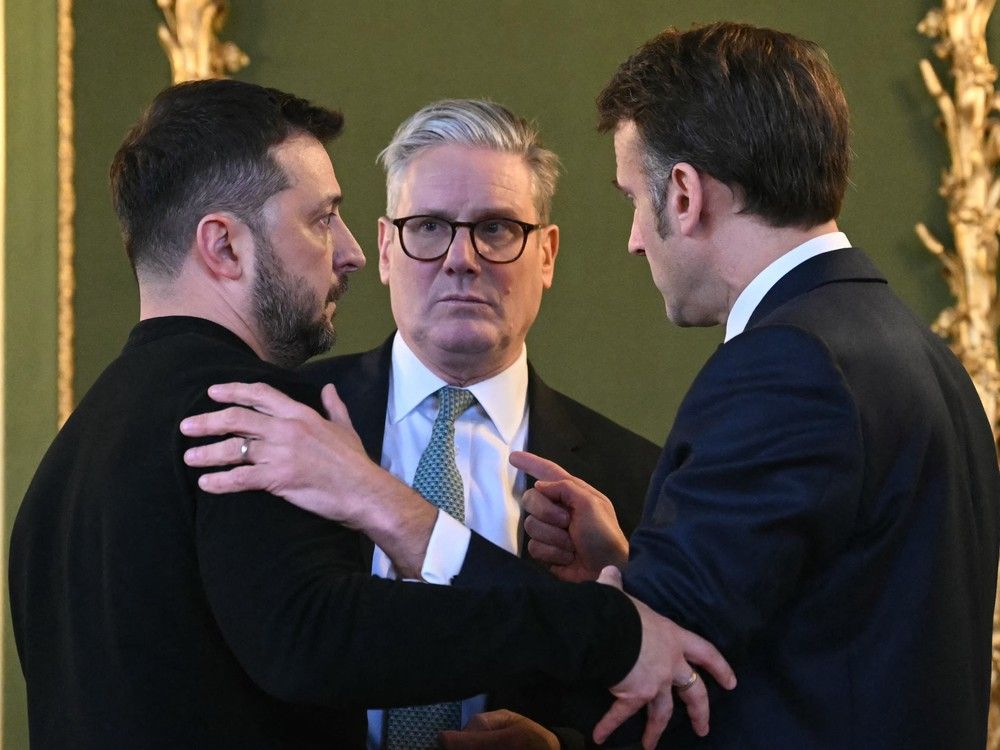
When Ukrainian President Volodymyr Zelenskyy
visited Trump at the White House on Monday
, flanked by some of Europe’s most powerful leaders, they spoke for hours about the
prospect of security guarantees
and seemed poised to make actual progress towards peace. But now it seems that much of that time was wasted, simply because Washington’s representatives lacked the rudimentary knowledge needed to identify Russia’s deceptions.
This pattern of mistakes has not gone unnoticed. Former officials, including those from the Trump administration, have called Witkoff a “
,” whose “
” has
the United States’ negotiating position. Yet he is only a symptom of a larger problem: an unserious administration that
outmaneuvered by its Russian adversaries.
National Post

