



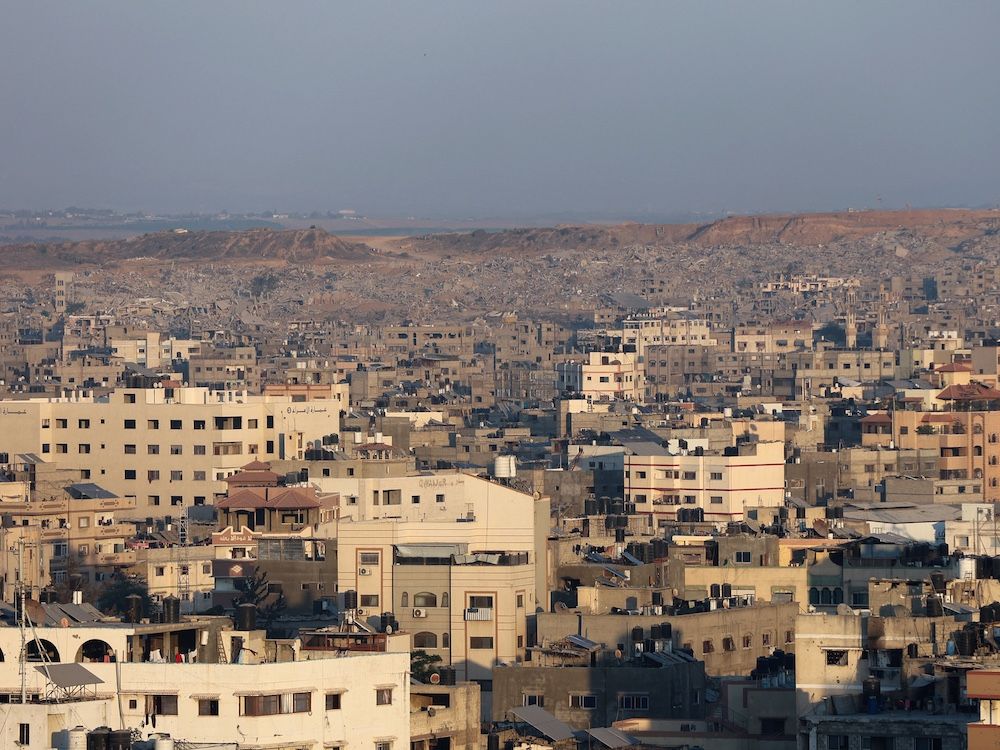
RAFAH, Gaza Strip — On Tuesday, Aug. 26, I joined a small group of journalists travelling from the Kerem Shalom kibbutz in southern Israel, crossing into the Gaza Strip and heading towards Rafah. Once a city of 270,000 at the southernmost area of the Strip, Rafah has been the focus of intense combat at various times since October 7.
Today, the city lies in ruins. Driving on a newly paved road — in a convoy of military vehicles with heavy protection — we passed through piles of twisted rebar, demolished buildings and rubble. The intact shell of one building stood, in stark contrast to the desolation.
After about 15 minutes we arrived at our destination — a massive humanitarian aid complex that was near completion. The Israel defence Forces’ international spokesman, Lt.-Col. Nadav Shoshani (who accompanied the group), explained that the Gaza Humanitarian Foundation (GHF), a U.S.-based not-for-profit, will operate the centre, which will have the capacity to provide millions of meals daily to displaced civilians.
The road we took hewed closely to the heavily fortified border with Egypt. It is also the path that aid trucks will use to deliver humanitarian supplies. Israel controls the road and area where the aid centre and the Al-Muwasi humanitarian safe zone are located, making infiltration by Hamas and criminal gangs difficult.
To date, the work of GHF in managing food distribution in the Gaza Strip has been sharply criticized, often due to factors over which the organization has no control.
Distribution sites are often situated too far from where civilians are based. The journey to obtain aid is, too often, a life-threatening endeavour. Compounding the hazard has been the scarce food supply. This has meant that distribution centres were open for very brief periods, until aid was depleted. And this led to panic and crowd surges.
Several weeks ago, Israeli Prime Minister Benjamin Netanyahu instructed the IDF to plan and undertake a massive assault on Gaza City. Located in the central part of the Strip, Gaza City has been less damaged, because it is believed that the remaining hostages (including 20 believed to be alive) are held there in tunnels 50 metres below the surface.
Rather than accept a partial deal for the release of ten living hostages (as well as bodies of some of those murdered in captivity), the Netanyahu government has now made clear that it will only accept a full deal, meaning the release of all hostages at once. In addition, Hamas must relinquish power and lay down its arms.
as well as the
and national security adviser, are questioning the wisdom of this strategy. After two years and multiple attempts to force Hamas’s hand, the terror group still stands, and the hostages languish. What, many are asking, will be different this time?
Many security professionals believe that Hamas will never surrender. Nor will it free the hostages, its core asset. IDF military action will only endanger the captives’ lives.
Civilians and soldiers will die. Hundreds of thousands will suffer.
Presently, the IDF is encircling Gaza City and encouraging civilians to flee to Al-Muwasi. Numerous reports indicate that Hamas
has been preventing this movement
by threatening civilians with death, and worse. Using innocents as shields is a core Hamas military strategy. And it has served the group well.
If civilians remain in Gaza City the IDF is constrained. The presence of hostages in the area further limits the scope of military activity. All of which means that the government’s strategy is a high-risk one that bets on Hamas buckling under pressure and surrendering.
But for a group that is impervious to the suffering of its own population and that has held off the mighty IDF for almost two years, that outcome would seem to be a fantasy that will remain unrealized. For Hamas, victory means that it remains in control of what is left of the Strip. That it retains its weapons. And that is possible only because it continues to hold hostages.
Netanyahu will never concede and submit to negotiations on terms he sees as being dictated by Hamas. He holds fast to his goals of “total victory” and the release of all hostages. And to achieve that, he believes he must attack Gaza City.
Anticipating civilian distress, the Netanyahu government has directed that the aid distribution capacity in the Strip must be enhanced.
The Muwasi-adjacent site will be operated by GHF and offer ready access to food and other life essentials in a safe, controlled environment. Civilians will walk a 500-metre path, flat and secure, far from Hamas fighters or criminal gangs. Once inside the complex they will receive food aid to last several days and within minutes return to their temporary shelters in Muwasi. To avoid panics and crowd surges the centre would be operational 24/7 if necessary and supplies will be delivered by truck using the same road we took. At a minimum, basic life necessities will be available.
Currently, approximately 800,000 civilians are living in the Muwasi zone. In advance of the IDF’s planned attack on Gaza City, it is expected that an additional million-plus civilians may soon relocate to the area. To ensure adequate food, water and other supplies, the IDF undertook the development of this new food distribution site, with additional centres planned.
Nevertheless, the wisdom of this next phase of the unending conflict is being
within Israel.
Eyal Zamir has been unequivocal in advising the political echelon that the Gaza City offensive will lead nowhere positive — hostages will not be freed, civilians will die and Hamas will live to see another day. It may well result in Israel occupying the Strip, an outcome very few Israelis want.
Earlier this week, Netanyahu invoked U.S. President Donald Trump’s support of the “all or nothing” approach. But Trump is impatient with this unending morass and also made clear that he expects this conflict to be resolved in the coming weeks.
Today, Israel’s position is that the time for a partial deal has passed. It is all or nothing. The only cards it has left to play are military pressure and, for now, the support of President Trump.
Both are big gambles.
Should Netanyahu accept a partial deal, the extremists in his coalition may bring down the government. But domestic pressure has been building on the prime minister to take the partial deal. So, after weeks of indecision, Netanyahu’s closest adviser, Strategic Affairs Minister Ron Dermer,
on Tuesday that acceptance of a partial deal may, in fact, not be ruled out.
This lack of certitude is either a tactic or it could reflect a simple truth — that the government lacks a strategy, which would explain the tensions between the IDF chief and the prime minister.
And then
a bombshell dropped late Wednesday night.
Israeli TV reported that Hamas has agreed to come to the table to negotiate a full and final deal, release all the hostages and end the war. Hamas has also indicated that it will agree to allow a group of technocrats to assume power in the Strip immediately.
But the terror group was silent on whether it would lay down arms. Within minutes of the Hamas announcement, Netanyahu
it as spin. Nothing new. He pledged to destroy Gaza City unless his terms are met. All hostages are returned. Hamas lays down arms and relinquishes power.
National Post
Vivian Bercovici is a former Canadian ambassador to Israel and the founder of www.stateoftelaviv.com, an independent media enterprise.

