



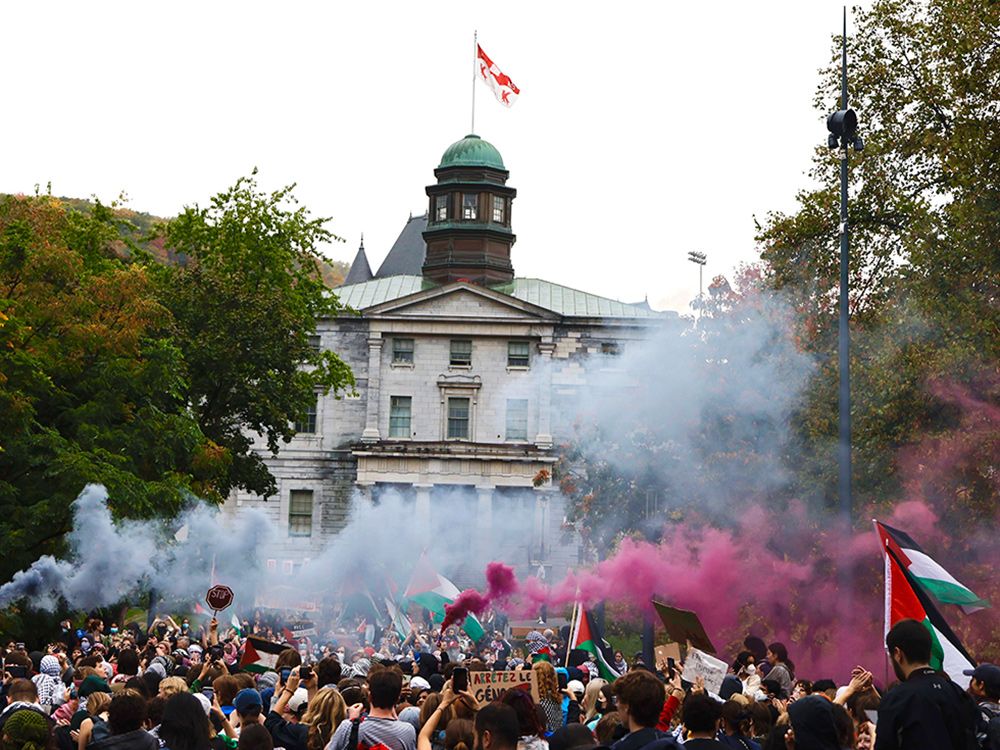
We have known for nearly three years now that antisemitism is rampant on Canadian university campuses, and this month two studies have confirmed it. The “Campus Antisemitism and Student Experiences” report indicates that 96 per cent of Jewish students on Canadian campuses “experienced or witnessed at least one instance of antisemitism over the previous 12 months,” while retired Ontario Court of Appeal justice Mary Lou Benotto’s review of Toronto Metropolitan University (TMU) found that “numerous students, faculty and staff stated that they no longer feel safe openly identifying as Jewish” on campus.
Another thing many of us are quite sure of is that these reports won’t lead to any serious reforms. Of course, there will be official statements about doing better, and faux handwringing about how to stop the hate that is festering at our universities. But as with other recent studies of antisemitism in Canada, that is likely where the response, if you can call it that, will end. Indeed, TMU has established a task force to respond to campus antisemitism, but not until 2027 — and, as Michael Geist notes , “nearly half of the committee’s members have signed public petitions opposing some of the recommendations.”
As usual, it is left to Canadian Jews and our allies to figure out what to do. So, here’s an idea: it’s time for a Canadian Jewish university.
There is no need to reinvent the wheel here — only to adapt models that are already working elsewhere to our national landscape. Take, for example, Yeshiva University, which offers a dual Jewish and secular curriculum and is ranked in the top 100 best universities in the United States. Yeshiva has seen a significant increase in transfer demands since October 7. So many students are looking to move there, often from Ivy League and other prestige campuses, that the university is now offering accelerated pathways for students fleeing antisemitism at their current schools.
Likewise, Touro University’s Lander Colleges have seen a 35 per cent rise in new students and a 60 per cent increase in transfers due to campus antisemitism .
In contrast, Brandeis University, another historically “Jewish” school, has seen no increase in enrollment since October 7. Unlike Yeshiva and Touro, Brandeis is avowedly non-denominational, and while Students for Justice in Palestine is not allowed on campus, the Jewish Bund is, and has organized several pro-Palestinian demonstrations.
There is already anecdotal evidence that some Canadians are looking to Jewish schools south of the border. In fact, the 2025 valedictorian at Touro’s Lander College for Men, is a Torontonian who chose the school because of its “rigorous academics alongside an environment that supported personal and ethical development.”
While cost is undoubtedly a barrier for many Canadians considering Jewish schools in the U.S., there are other, potentially more cost-effective, options open to them in Israel. And the data suggests many are already considering Israeli universities, which are, in several cases, already adapting to the phenomenon.
In 2025, the Technion in Haifa established a new undergraduate program specifically as a response to campus antisemitism. One Canadian Jewish student who had already been accepted to the University of Toronto chose the Technion instead, specifically because of the situation on Canadian campuses.
Meanwhile, Ben-Gurion University in Beersheba now has a dedicated unit designed for the increasing number of new immigrant students resulting from the global rise in antisemitism.
In the U.S. and Israel, universities with strong Jewish values are becoming refuges for Canadian students fed up with, and afraid of, rampant antisemitism on campuses here.
For Canada, the risks should be obvious. While the increasing talk among this country’s established Jewish community of moving to friendlier climes is worrying, the possibility of losing students is even more so: families selling homes and moving businesses is bad enough, but a generational brain drain is much worse — not only for Canada, but for the future of our Jewish communities here.
The problem is obvious, as is the institutional foot-dragging that will ensure the problem of antisemitism on campus is not solved in any useful way.
If we care about a Canadian Jewish future, one that our best and brightest young minds are willing to buy into, we will need to build the infrastructure that keeps them here. Perhaps we don’t need a dual-curriculum campus like Yeshiva or Touro (though, I believe Jewish study is instrumental to our existence). Maybe a non-denominational school along the lines of Brandeis could work in Canada because our Jewish community and historic background is different than America’s and less likely to be infiltrated by the far left, which is nowhere near as influential among Canadian Jews. Either way, we need a campus of our own because we are increasingly unsafe everywhere else.
When Canadian hospitals wouldn’t let Jewish doctors in, we built our own hospitals. When Canadian golf clubs shut their doors, we started our own clubs. We can, and should, do the same for higher education.
National Post

