


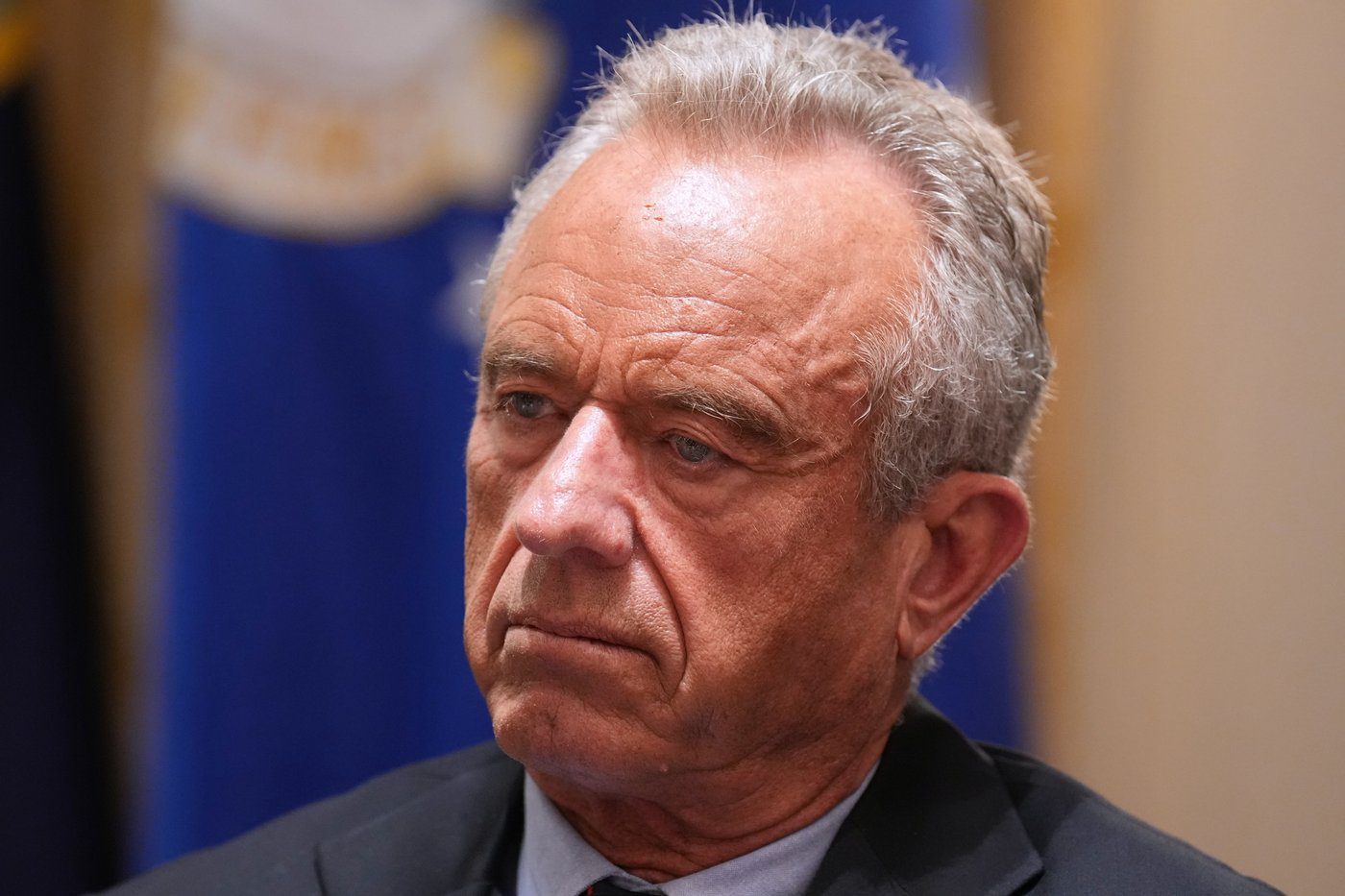
DES MOINES, Iowa (AP) — High-ranking Senate Democrat Ron Wyden has alleged that Health Secretary Robert F. Kennedy Jr. broke the law with recent phone calls urging third-party candidates to drop out of two Iowa congressional races.
In a complaint to the U.S. Office of the Special Counsel filed Monday, Wyden requested an investigation into whether the June calls violated the Hatch Act, a 1939 law that restricts certain political activities by federal employees. The Oregon Democrat said Kennedy acted inappropriately by interfering with elections that Trump’s Republican administration wants GOP candidates to win.
“Kennedy has spent sixteen months using his official position to undermine the health and well-being of his fellow Americans, and now he is using his official position to undermine the integrity of democratic elections too,” reads a statement from Wyden, the ranking member of the Senate Finance Committee, which plays a role in overseeing the nation’s health agencies.
The accusation comes as Trump has dispatched Kennedy to swing districts around the country as a key surrogate for the administration, promoting its widely popular efforts to encourage healthy eating and exercise. It takes issue with another task Kennedy reportedly did on behalf of the administration: calling Libertarian candidates to push them to drop out of two races where they could be spoilers for GOP candidates. At stake is control of Congress in a competitive midterm election year, where any win could be decisive in shaping the next two years of federal policy.
Spokespeople for Kennedy and the U.S. Department of Health and Human Services didn’t immediately respond to a request for comment.
Claims center on 2 competitive US House races
The calls Wyden references in the complaint include a June 8 call with Marco Battaglia, a Libertarian candidate running in Iowa’s 3rd congressional district, and a June 11 call with Rick Stewart, a Libertarian candidate running in Iowa’s 2nd congressional district.
They are among the three of Iowa’s four congressional districts that are expected to be some of the most competitive in the country, and Libertarian candidates in recent election cycles have drawn support from 2 to 3% of voters. Republicans in Iowa filed challenges to Battaglia and Stewart’s nominating paperwork, and Battaglia was removed from the general election ballot, while Stewart remains. Both cases are being appealed in district court.
“They don’t want our people in there. They feel we are spoilers,” Stephanie Berlin, chair of the Libertarian Party of Iowa, said Tuesday. “This is just another example of the major two parties trying to strangle us out of ballot access.”
Libertarian Party leader recorded a call with Kennedy
Berlin sat alongside Stewart when he spoke with Kennedy and was the one to record the call, which she said she interpreted as Kennedy offering quid pro quo even as he “skirted the line.”
Kennedy did not make any specific request of or offer to Stewart in the recording, according to a copy shared with The Associated Press. Kennedy said he could be Stewart’s “liaison with the White House” and suggested Stewart could, like Kennedy himself, “make an agreement that puts me in a position where I can make a real difference in people’s lives.”
“I can’t go into specifics because, you know, there’s legal prohibitions about that,” he said. “If it’s something that you want to work on together … if there’s other ways that you think you might be effective, you know, like I said, I will be your advocate.”
The Washington Post previously reported on Kennedy’s recorded conversation with Stewart.
Stewart told the AP it was clear that Kennedy wanted him to drop out, though he said he suspects Kennedy “did his best to stay on the correct side of the law.”
“That’s how all politics works,” Stewart said. “Everybody does their best to avoid breaking the rules, but they also do their best to go around the rules.”
Wyden was more explicit, saying Kennedy’s offer of federal employment to Stewart amounted to illegal quid pro quo and that Kennedy needed to be held accountable.
Battaglia also told the AP last month that Kennedy called him to encourage him to drop out of the race but he did not have a recording.
Watchdog group calls Kennedy’s comments a ‘clear violation’
Donald Sherman, president of the nonpartisan government watchdog group Citizens for Responsibility and Ethics in Washington, said there are several instances in the recording of Kennedy invoking his official position and responsibilities as health secretary. Sherman said that makes it a “clear violation” of the Hatch Act that’s worthy of investigation by the Office of Special Counsel.
“I don’t want to be fighting subpoenas for the next two years instead of improving America’s health,” Kennedy said in the call to Stewart. “So for me, there’s an immediate, pragmatic reason for this phone call.”
There are ways Kennedy could make a political call that do not violate the Hatch Act but he would have had to call from a personal phone from a personal office and would have had to avoid referring to the government or his government office, Sherman said.
“Invoking the White House specifically, referring to his official duties and his official role as HHS secretary, is where he blurs the line between whether he’s calling as a government employee or as a private citizen,” Sherman said. “That’s where the problem comes in.”
In the past, many other senior government officials have faced Hatch Act complaints. During the first Trump administration, the Office of the Special Counsel sent senior officials 15 warning letters about running afoul of the decades-old law. And Karine Jean-Pierre, former press secretary for President Joe Biden, was also found to have violated the law with references to “MAGA Republicans” during White House briefings. Penalties for Hatch Act violations are uncommon, and the Office of the Special Counsel did not recommend any fines or other punishments for Jean-Pierre.
Trump has taken steps in his second term to assert more control over independent agencies like the Office of the Special Counsel — a posture that could influence whether it acts on Wyden’s complaint. Early in his second term, Trump fired the head of the office. The Supreme Court ruled recently that the president can fire members of independent agency boards without cause.
Craig Holman, a lobbyist for the watchdog group Public Citizen who has himself filed Hatch Act complaints against Trump administration officials, said he doesn’t expect the office to act on what he considers a violation in Kennedy’s case.
“RFK using his official position, citing his official position, in his phone call and his connection to the White House and his ability to get the White House to provide favors – all of that would constitute a direct violation of the Hatch Act,” Holman said.
The Office of the Special Counsel could recommend that RFK be removed from his role, Holman added, “but I am not expecting that.”
____
Swenson reported from New York.
Hannah Fingerhut And Ali Swenson, The Associated Press

