



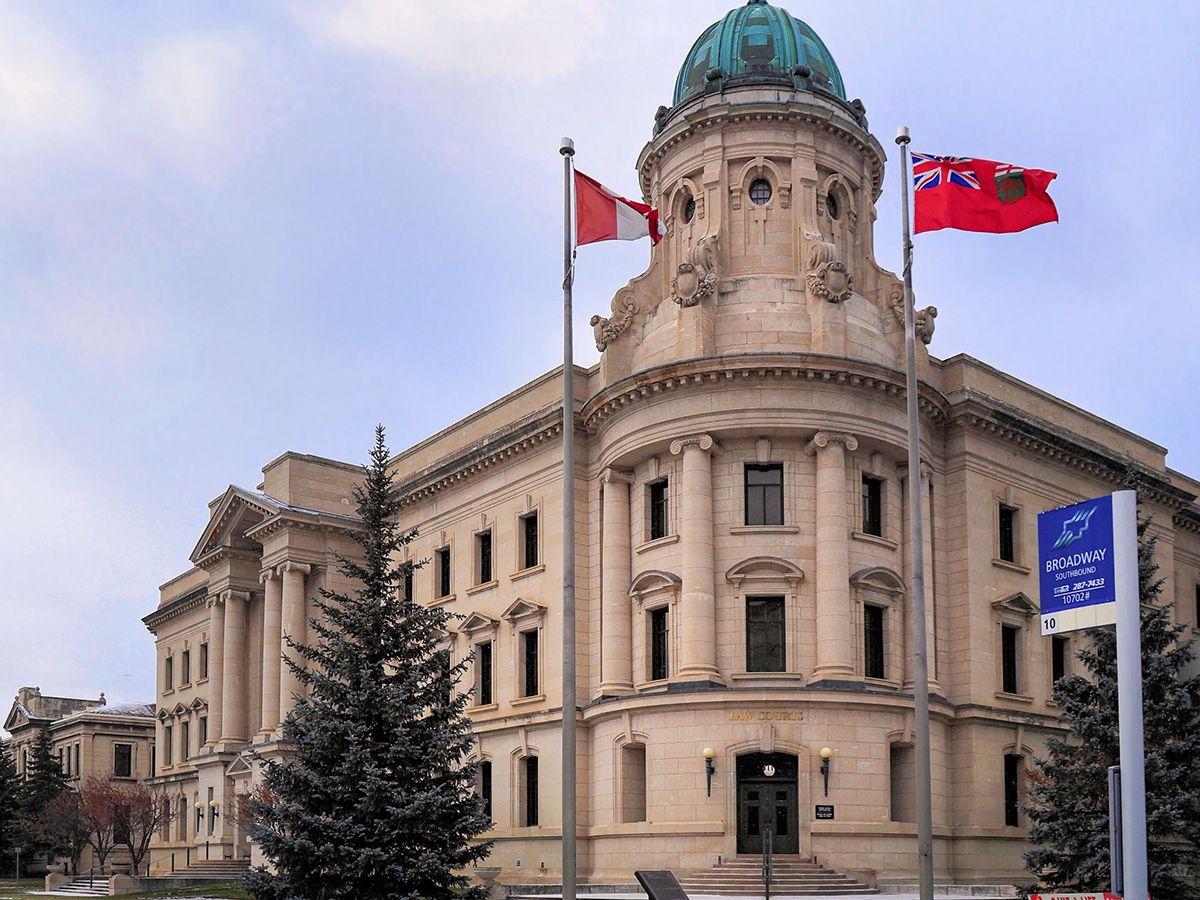
A Winnipeg judge has granted a conditional discharge to an Iranian-born chemist so he can avoid deportation for surreptitiously and repeatedly filming the backsides of two women at the lab where they all worked.
Seyed Reza Mir Heidari, who pleaded guilty in Manitoba provincial court to two counts of voyeurism, is living in Canada on a work permit that was recently extended until April 2027. He has applied for permanent residency, but that application is on hold because of the voyeurism charges.
His lawyer argued a conviction would make him liable for deportation.
“Given Mr. Mir Heidari’s lack of record, rehabilitative work done, his remorse and insight, the significant collateral consequences that could result from a conviction, and the fact he is well educated and has held a full time job long term, I am persuaded that it is in the public interest that he be able to move forward without a criminal record, so that he can continue being a contributing member to Canadian society,” Judge Catherine Carlson wrote in a recent decision.
The judge also handed Mir Heidari three years of probation.
She pointed out that a criminal record would hurt his ability to get a new job after the lab fired him and it would have significant consequences on his immigration status.
If Mir Heidari “is deported, he would be deported to Iran,” Carlson said in her Sept. 17 decision.
“Iran is at war with the United States. Mr. Mir Heidari’s wife is an American citizen. It is unlikely Mr. Mir Heidari would be able to go to the United States or that his wife would be able to go to Iran. The practical result is likely that Mr. Mir Heidari would not be able to be in the same country as his wife. That of course could be expected to have a detrimental impact on their marriage.”
The judge found that a conditional discharge was in Mir Heidari’s interest.
“But for this offence, he is a person of good character with no prior convictions. Specific deterrence is not required by a sentence, as in my view his arrest, being charged and navigating through the criminal proceedings is sufficient to address specific deterrence,” Carlson said.
“A criminal conviction may indeed have significant adverse repercussions in terms of job opportunities, immigration consequences, and as an adjunct of those, on his marriage. A sentence that would result in a conviction, given the significant professional and personal collateral consequences for Mr. Mir Heidari, would be crushing.”
Mir Heidari, 29, admitted that between Nov. 1, 2024, and Jan. 9, 2025, “he took photos and videos of two female co-workers in their mutual workplace,” said the decision.
“The photos and videos depicted the victims’ faces, backsides and buttocks. The victims were fully clothed.”
The Crown recommended Mir Heidari get a suspended sentence, with three years of probation. “The Crown says a criminal conviction in this case is needed to recognize the seriousness of the offences.”
The two women were both in their 20s at the time of the offences.
After they noticed he was filming them “from behind,” the women filed a formal complaint with their employer on Jan. 9, 2025, and “Mir Heidari was immediately suspended.”
The women contacted police two days later, who searched Mir Heidari’s apartment, seizing documents and his cell phone.
A forensic analysis of his cell phone located 55 images of the victims. Investigators also found 82 images and short videos in a folder on the phone dubbed “project session.”
While there were some duplicates, the images and videos “depict the victims’ faces, buttocks and backsides, all taken without their knowledge or consent.”
One of his victims “stated that this incident has changed her life forever, affecting her mental and physical health, her career and her sense of safety,” said the decision.
“Mr. Mir Heidari’s actions made her feel objectified and sexualized in a place where she was just doing her job. She is still scared about what was being done with the images, since they were beyond her control.”
His other victim “said that she felt violated by Mr. Mir Heidari’s actions. Watching him take photos on the video footage made her physically sick. His actions took away her sense of safety, dignity and ability to trust. She is now hyper vigilant.”
Mir Heidari, who was born in Tehran, relocated to Dubai with his family “when he was young, and he spent most of his formative years there,” said the decision.
His parents now live in Iran. His father sent him to Canada at the age of 17 to complete high school at the International College of Manitoba.
Mir Heidari later obtained a Bachelor of Science degree from the University of Manitoba, where he met his wife — a banker who lives in Minneapolis, Minn. — in 2017.
She is unable to work in Canada because her application for a work visa was denied. She returned to the United States in January 2026, after a removal order was issued.
Mir Heidari “says he is unable to work in the United States or even enter that country, as Iran is one of seven banned Muslim countries.”
“They are committed to their marriage, but … the future of their relationship is unknown given the uncertainties surrounding their residencies,” said the decision.
Mir Heidari “was experiencing a professional and a personal crisis” around the time of the offences, said the decision, which notes he was working long hours in a “toxic” environment.
“During this time, his wife’s inability to work in Canada meant they were apart geographically, which fractured their intimacy and communication,” it said.
“He also felt culturally isolated and lacked supports. Mr. Mir Heidari says he relied on pornography as a mechanism to cope with these challenges. He says his use of pornography is now more limited.”
Our website is the place for the latest breaking news, exclusive scoops, longreads and provocative commentary. Please bookmark nationalpost.com and sign up for our daily newsletter, Posted, here.

