


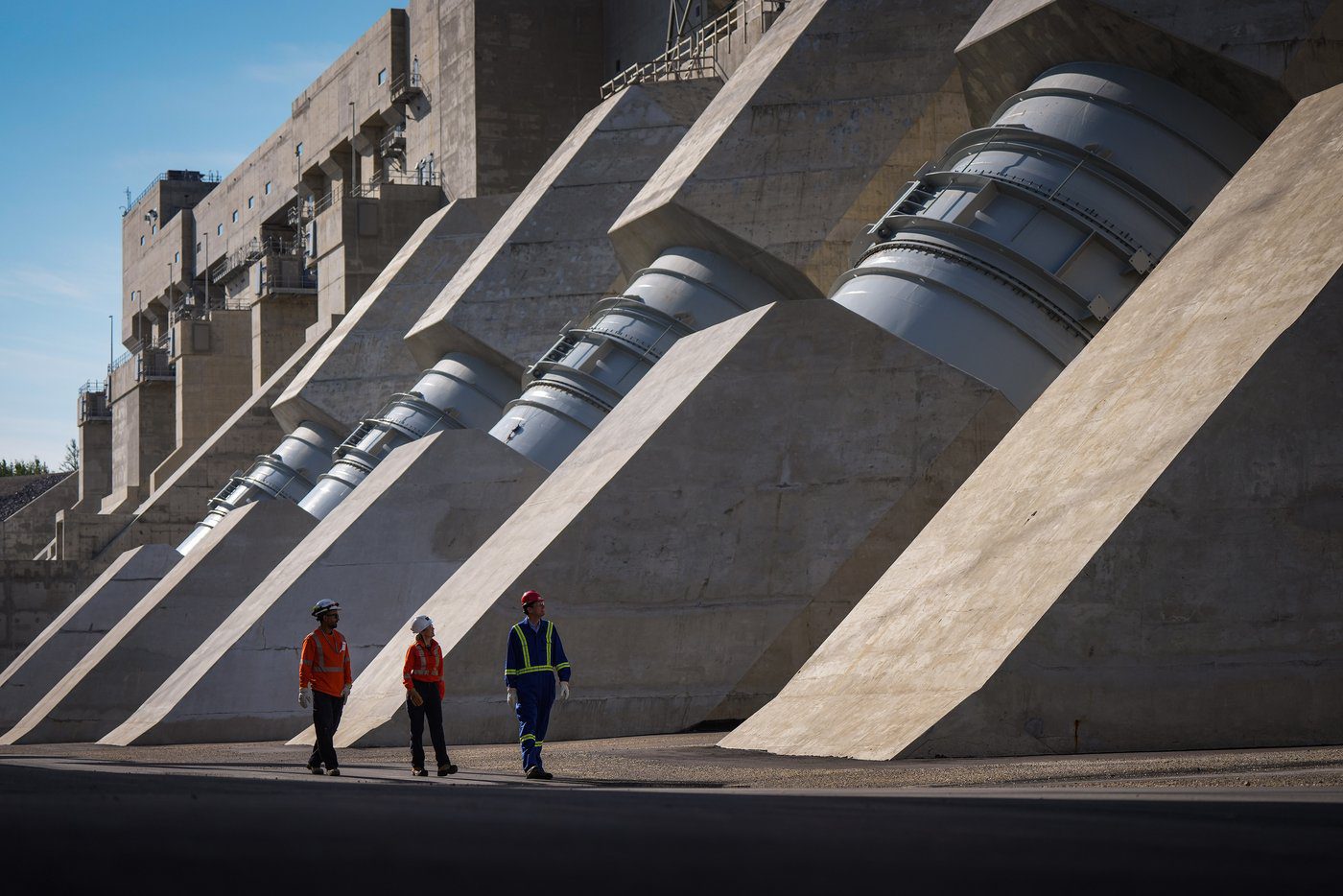
FORT ST. JOHN — The scale of the John Horgan Dam, the most costly engineering project in British Columbia history, is hard to fathom until up close.
The crest of the dam is more than one kilometre long. The six enormous pipes that channel water from the dam reservoir to power-generating turbines are each 11 metres in diameter. The powerhouse, spillway and dam buttress, or foundations, involve a total of two million cubic metres of roller-compacted concrete.
The buttress alone involves about 1.7 million cubic metres of concrete, more than five times the amount used to build the world’s tallest building, the Burj Khalifa in Dubai.
Perhaps just as impressive is the scale of the political reversal the dam previously known as Site C represents for the governing NDP, whose former leader, John Horgan, once criticized the project for being among “B.C. Liberal hydro boondoggles.”
Now, Horgan’s successor, Premier David Eby, is an avowed supporter of the project in northeastern B.C., which cost $16 billion.
Asked about the NDP’s Saul-to-Paul conversion on the dam, he answered in terms of the economic contest B.C. faces.
“The more electricity that we have in British Columbia, the greater economic advantage, because we can deliver cheap and reliable electricity compared with other jurisdictions,” Eby said Tuesday on his first tour of the dam, which became fully operational last August.
He said B.C. had some of the most affordable electricity in the world. “That gives us an advantage for industries, who want to operate both on costs, but also in terms of low-carbon pollution.”
The premier’s admiration for the project seems visceral, too. When Eby gazed at the giant pipes slanted along the dam wall, he gasped.
“Wow,” he said. “Very Star Wars.”
Wearing a red hard hat and blue fire-resistant overalls, Eby toured the facility for two hours, along with BC Hydro president and CEO Charlotte Mitha, journalists and others.
Located about 14 kilometres south of Fort St. John, B.C., the dam is the third power-generating dam along the Peace River in the northeastern corner of the province, a region whose economy, like nearby Alberta’s, revolves around energy and farming.
The other dams are the W.A.C. Bennett Dam, completed in 1968, and the Peace Canyon Dam, finished in 1980.
But the trio may soon turn into a quartet, in another indication of just how far the NDP has shifted in its stance toward new dams.
Energy Minister Adrian Dix said last month that the province was “seriously” considering a fourth Peace dam at the so-called Site E near the boundary with Alberta, with a generating capacity of up to 750 megawatts. Site E was originally proposed in 1958, along with Site C.
Dix also raised the possibility of an even bigger project with a 900-megawatt capacity near Bute Inlet northeast of Powell River, B.C.
He said the government would bring forward legislation to give it legal permission to do the necessary technical review for the dams.
Asked about the possibility of another dam along the Peace River, Eby said its benefits and costs would be debated.
“As much as possible, we are trying to answer those questions upfront around Site E or any other hydro project and ensure that the benefits outweigh the costs, and British Columbians will be part of the discussion.”
Ken Boon of Peace Valley Landowner Association, which unsuccessfully fought the John Horgan Dam, said in a recent interview that he couldn’t believe what he had been hearing from the government.
Boon said he lost most of his farmland, about 80 hectares, when construction flooded an 83-kilometre stretch of valley.
Dix’s comments left him shocked.
“I thought, we had seen the last dam built in the province, and maybe we have, but the fact that they are even going to consider building any more dams is, after the Site C experience, very disappointing.”
The premier’s visit to the dam comes more than a decade after the start of construction on the most expensive infrastructure project in the province’s history. It has been a rocky road.
When Horgan was his party’s energy critic, he said in January 2014 that British Columbians couldn’t “afford any more costly B.C. Liberal hydro boondoggles.”
Former B.C. Liberal premier Christy Clark gave the project its final go-ahead in December 2014, with construction starting about seven months later, despite years of objections from First Nations, farmers and environmentalists.
Horgan accused Clark of gambling with the provincial finances and questioned whether B.C. would even need the power.
Almost three years later, in November 2017, it was Horgan who told British Columbians that his government would push on with the project, because if it didn’t, it would leave the government $4 billion in the hole with nothing to show for it.
“Megaproject mismanagement by the old government has left B.C. in a terrible situation,” he said. “But we cannot punish British Columbians for those mistakes, and we can’t change the past. We can only make the decision for the future.”
As Dix’s remarks show, that future might include even more dams.
Eby said Horgan was a big believer in public hydro infrastructure, but also recognized the various impacts and costs of large dams.
“Premier Horgan famously said, ‘there are many positions on Site C,’ and he said, ‘I know, because I have held all of them,'” Eby said.
“Ultimately, he was a big supporter of the project and helped deliver it, and that is why the project is named for him.”
This report by The Canadian Press was first published July 14, 2026.
Wolfgang Depner, The Canadian Press

