



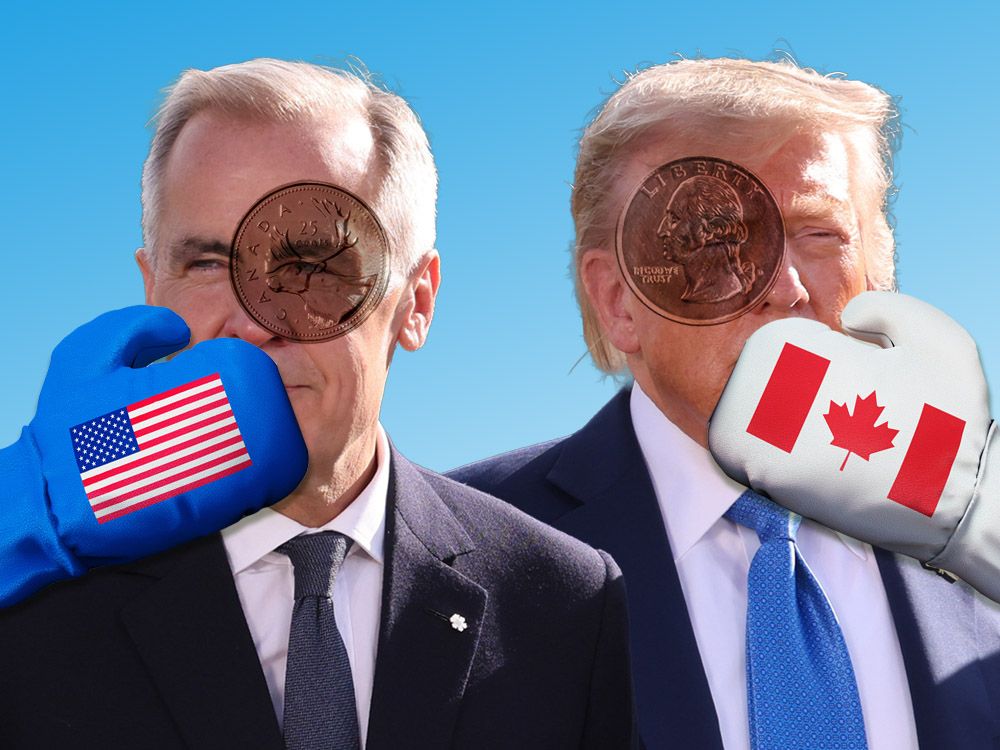
Following the breakdown in U.S.-Canada trade negotiations over the weekend, Prime Minister Mark Carney is now saying that Canada has no plans to reopen talks with Washington, and is prepared to continue the trade war right up until the end of U.S. President Donald Trump’s term in 2029. But there is a chance that the current trade conflict could outlast even Trump.
Watch the video or read the transcript below to learn more.
Despite the U.S. and Canada coming very, very close to a concord on trade, it fell apart at the 11th hour.
The result? 50 per cent tariffs on more than $28 billion worth of Canadian exports. And Canada pledging dollar-for-dollar retaliation.
Now, there is still reason to believe this might be temporary. Both sides get hurt in a trade war. Canada more so, obviously, just given our relative size as compared to the U.S. market.
But the American public has never really been on board with the Trump administration’s trade war on Canada. And this means that in an America that is already pretty incensed about affordability, a whole bunch of random things are set to become unreasonably expensive.
As just one example: Canada is famously a major supplier of left-handed golfing gear. Well, all that stuff’s getting hit with the 50 per cent tariff.
But, the White House has a lot on its plate. So what if they just … don’t return Canada’s calls about trade ever again?
That’s what Prime Minister Mark Carney seems to be banking on.
In his public comments after the talks fell apart, he said his plan now is to subsidize affected industries … possibly until Trump is no longer president.
Said Carney, “we will support these businesses for as long as it takes, in other words, beyond the life of this U.S. administration.”
That might be bluster, but it’s not like Carney is feeling any political consequences from this tack. And even if all the current tariffs remain, the macroeconomic effect is probably going to be minimal. Only about five per cent of our exports are getting hit with that big 50 per cent tariff.
It’s r uinous for some of those five per cent. As one example, sculptures and paintings are getting hit with the 50 per cent tariff. So if you’re a sculptor with a lot of American clients, this is devastating.
But the pain is still slight enough, on an economy-wide basis, that most Canadians won’t notice.
So the worst -case scenario is that the status quo keeps going for another three years. And the really, really worst-case scenario is that this doesn’t become an issue that magically dissipates at the end of the Trump Administration.
The history of Canada-U.S. trade going all the way back to the 19th century has been a roller coaster of protectionism, free trade and then protectionism again.
The situation that Canada has known for the last 30 years — free trade with the United States — is the exception, rather than the norm.
And how soon we forget that when the North American Free Trade Agreement first became law in 1994, its chief opponents were not right-wingers like Trump, it was protectionist left-wingers. The same kind of protectionist left wing that’s having a bit of a moment in the U.S.
So maybe this is a temporary trade war with the Americans until we can get back to broad, tariff-free trade again.
Or, maybe, after a couple years of this, we’ll find that U.S. governments — no matter what their political orientation — are actually kind of fine with a reality in which Canadian fishing rods, diamonds, paintings and sculptures, among other things, are mostly not seen in U.S. stores anymore.