



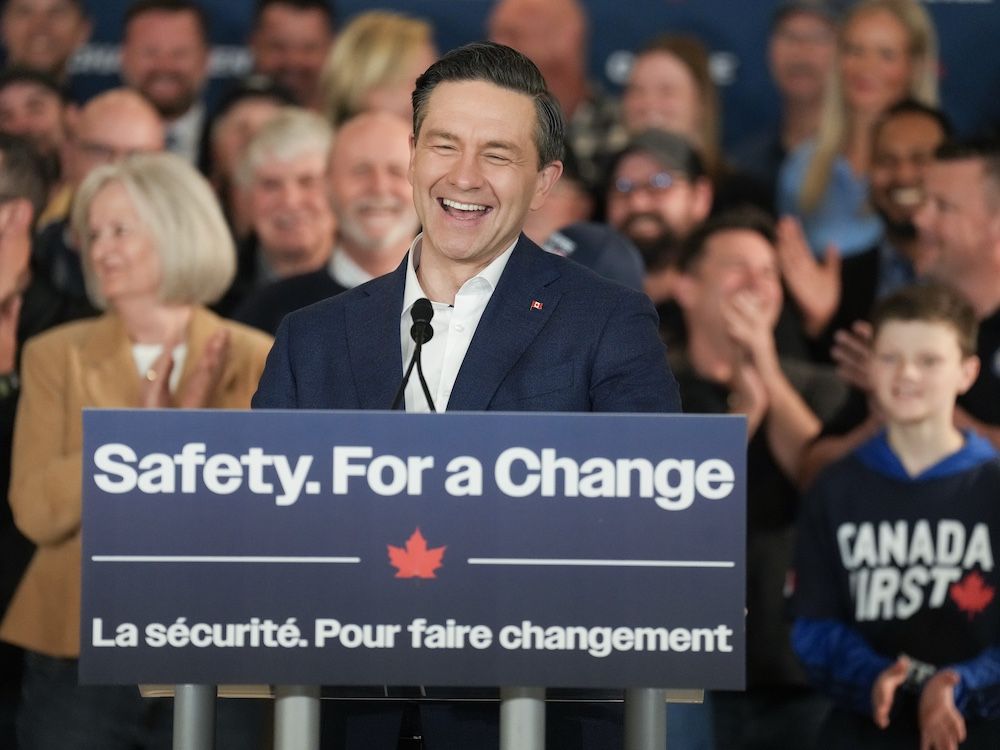
The election dust has settled, leaving the Liberals with a minority government. This has led to calls — from both conservatives and progressives — for Pierre Poilievre to step down as Conservative party leader. But these calls are premature, overlook the success of several of Poilievre’s policies — many of which were co-opted by the Liberals in order to win — and severely underestimate the Liberals’ incumbent advantage in the face of an unforeseeable natural disaster that plagued an otherwise normal Canadian election campaign — U.S. President Donald Trump.
In late December, 45 per cent of voters
by Angus Reid intended to support Poilievre’s Conservatives and their policies while only 16 per cent polled said they’d vote for the Liberals. Angus Reid referred to this as “The Federal Liberals’ New Year’s Eve Nightmare.” Until this point, Poilievre’s leadership was favoured. And, it turns out under his leadership Conservatives
42 per cent of the seats to 41.3 per cent of the votes. So, what likely happened to that other 3.7 per cent of the vote?
The failure of the Conservatives to form government is a product of a perfect storm — a turn cloak Liberal government switching from publicly mocking Poilievre’s policies to adopting them wholesale without acknowledging from whence they came, and the entrance of a chaos agent, whose tariff threats loomed large in the backdrop of this election, and whose trolling memes were such an offense to Canadian sensibilities that at least some of us appeared to forget why we wanted to vote the Liberals out in the first place.
It turns out one party’s nightmare is another’s winning lottery ticket.
None of this suggests that Poilievre should step down as party leader — quite the opposite — it suggests that he understands what’s important to Canadians so well that his opposition has to copy his ideas.
Yet, this hasn’t stopped critics from suggesting that nothing was, as one former Stephen Harper advisor put it, “
than Poilievre’s loss, suggesting that “enough of the electorate recoiled from a man who was unable to make the transition from polemicist to statesman,” and doubted his ability to lead in “one in the most critical moment in Canada’s modern history.”
But Poilievre’s polemics were clearly not a problem in late December, and they
during the campaign.
It’s also arguable that it was Liberal Leader Mark Carney who ran a highly polemical campaign against Poilievre. Carney pulled out all the stops to link Poilievre, without any evidence, to Trump.
In late March, in front of Rideau Hall, Mark Carney
that this election would be one where they were choosing between “a government that is unifying, standing up for Canada and is taking focused action to build a better economy” or one that promotes “want division and Americanism.” He continued, “That’s what Mr. Poilievre seems to be offering. Just endorsed by the premier of Alberta.”
This was in response to Alberta’s Danielle Smith suggesting that although there would be many disagreements, Conservative leader Pierre Poilievre would be “very much in sync with … the new direction in America” and that the two countries would “have a great relationship,” pointing to issues they’d have in common: “If we do have Pierre as our prime minister, then I think there’s a number of things that we could do together. Pierre believes in development, he believes in low-cost energy, he believes that we need to have low taxes, doesn’t believe in any of the woke stuff that we’ve seen taking over our politics for the last five years.”
Apparently, it would be just horrible if a Canadian Conservative prime minister had many disagreements on some things with U.S. President Donald Trump, but agreed on some other important issues. Isn’t that exactly what Canadians expect Carney will be doing?
Despite the fact it was Smith who made these claims, Poilievre suffered their damage.
Calling Poilievre a “
slick-haired populist with the razor-sharp mind and bunker mentality
,” Globe columnist Lawrence Martin argued that the Conservative leader was caught flat-footed to the Liberals who had been in power for 10 ten years. But of course, he wasn’t. He was caught flat-footed by a party that abandoned even one of their own most beloved policies, including the consumer carbon tax, to win, and by Trump, and those who unfairly accused him of being like Trump.
If roles had been reversed, and Conservatives had been in power for ten years when Trump’s threats began, they, too, would have benefitted from incumbency and the rally-round-the flag effect that the Liberals enjoyed.
The only difference is, of course, because of conservative policies, the country probably would’ve been in much better economic condition when it happened. In contradiction to ten years under the Liberals and a
, ten years under the Conservatives instead may have resulted in a stronger energy industry in Canada which we could have used to support our neighbours in Europe when they needed our help replacing energy from Russia.
The Liberals’ failure to secure a majority was in part, due to losses in Ontario, likely because they did not adopt
of Poilievre’s policies, specifically, in regards to public safety, crime, and immigration. These are some of the complaints Liberal MPs heard while canvassing lost ridings such as Vaughan-Woodbridge and
Markham—Unionville. Abacus Data pollster David Coletto suggested that crime (especially car theft) likely played a “subtle but effective role” in flipping York region to Conservatives. This suggests that in these and other Ontario ridings that flipped, Mark Carney wasn’t enough like Pierre Poilievre.
It seems strange to suggest that Pierre Poilievre should step down as leader when his policies actually worked for the Liberals and would have likely secured them a majority if only they’d taken more of them on. I see no evidence that any non-incumbent leader would have been able to withstand the Trump chaos factor which the Liberals leaned into. Poilievre should proudly stay on as party leader and fight the Liberals tooth and nail on their blatant hypocrisy. He should just do it with the confidence and subdued tone of Canada’s next prime minister. After all, Canadians may soon have buyer’s remorse.
tnewman@postmedia.com
X:

