



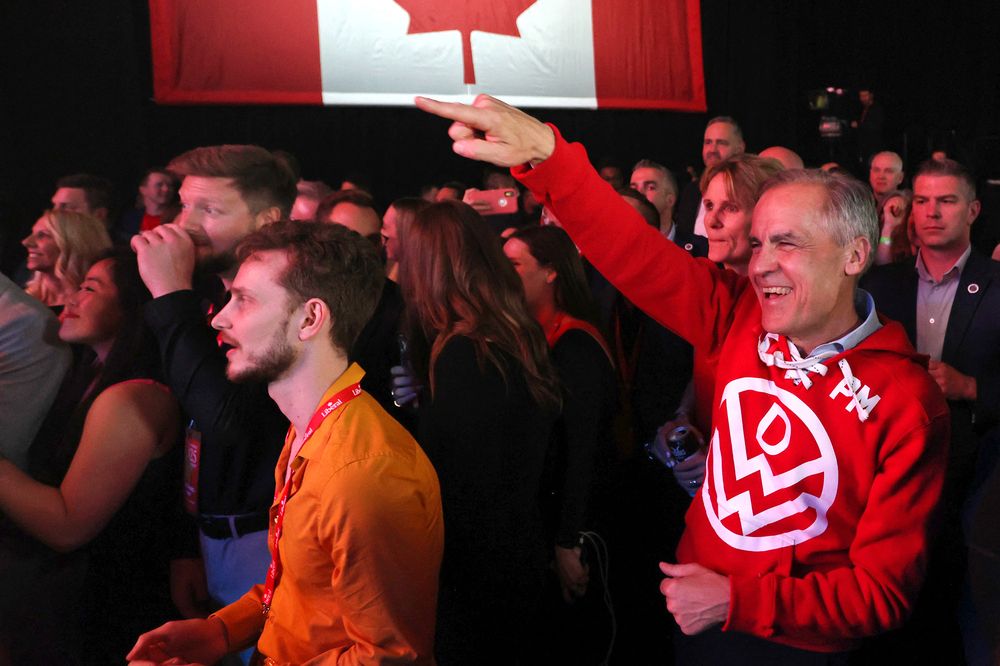
Early Tuesday morning, Liberal leader Mark Carney accepted a win for his party. How much of a win it was, was yet to be seen, because votes were still being counted in tight ridings across the country. But it looked as if it was, at least, a minority. T
hat lack of certainty about the size of his win didn’t stop Carney from taking a shot at Pierre Poilievre, whose seat was still in play at the time, not finalized due to an oversized ballot in Carleton. And he did this, ironically, only breaths apart from suggesting he has the values Canadians need, including kindness and humility. And because he spoke in a tone acceptable to Liberal Canadian sentiments, it didn’t seem to draw much, if any, criticism from election night pundits. He has convinced a large enough swath of the Canadian populace that we are at war with our American neighbours that such inherent value contradictions in himself and our country have ceased to be important.
Carney placed a heavy emphasis on Canadian values, the existence of which was ridiculed by the Trudeau Liberals when they entered the scene in 2015. This was taken up by CBC at the time, who appeared to take great joy in mocking then Conservative leadership hopeful, Kellie Leitch, for the mere suggestion they might exist, oh, and for the way she spoke. Ironic, given the uproar that was made, rightfully, by the Liberals and the rest of Canadians when a 1983 PC attack ad made fun of former prime minister Jean Chrétien for similar reasons.
The CBC, no doubt, celebrated Carney’s win on election night. How could they not? He called them “underfunded,” promising them $150 million in his platform. Until it was clear there was at least going to be a Liberal minority after 10 p.m., they were unsure whether or not the election outcome meant they’d have to be delivering their own eulogy, as Conservative Leader Pierre Poilievre had campaigned on defunding the broadcaster.
Why did the Liberals of the past decade all but refuse to acknowledge the existence of Canadian values up until now? Seemingly, it’s because they thought it in contradiction with their “diversity is our strength” message. But it didn’t have to be. Canada can be both a welcoming nation to immigrants while asserting core values, including not rushing to the streets to celebrate, for example, the horrific acts of October 7 in cities across Canada or accosting Jews in their Toronto neighbourhoods. These values should be easy to point to. But we cannot expect them from Carney’s Liberals no more than we could Trudeau’s.
So, which values did Mark Carney decide Canadians have? According to him, three: humility, ambition, and unity. He told the crowd during his victory speech, he’d do his best to “uphold them every day” as our prime minister, ending with a “You betcha” — a folksy phrase popularized by the film Fargo, which takes places in Minnesota, not Canada. This was an awkward choice, given the juxtaposition between Carney’s status as a
former governor of two central banks and global emissions targeting investment banker. It was so clearly an affectation that matched neither his middle-class Canadian upbringing, nor his likely hefty undisclosed assets. It’s as if he keeps trying new versions, caricatures of what he thinks Canada represents, from elbows-up to Mr. Dressup, to rural expressions, hoping one will fit. But they all hang off him like a poorly-hemmed suit.
Why these values? Carney said that Canada was in a crisis, but reassured his audience that “Canadians are ambitious. And now, more than ever, it is a time for ambition. It is a time to be bold to meet this crisis with the overwhelming positive force of a united Canada, because we are going to build. Build, baby, build.”
And there seems to be no shortage to what he thinks his Liberal government should be building including “hundreds and thousands of not just good jobs, but good careers in the skilled trades,” “an industrial strategy that makes Canada more competitive while fighting climate change,” “new trade and energy corridors,” and, again, making the promise to “build Canada into an energy superpower in both clean and conventional energy.” But we know he’s refused to repeal Bill C-69, the Impact Assessment Act, and he can’t even bring himself to say the word “oil.” When he did during one of the Liberal leadership debates, he struggled to even get the word out. As if saying it made our clean energy saviour feel dirty.
And where does the necessity of Canadian humility come into play? He continued, “I want to be clear. The coming days and months will be challenging and they will call for some sacrifices. But we will share those sacrifices by supporting our workers and our businesses.” He followed up with, “We do things because they’re right, not because they’re easy,” again, congratulating his supporters on their kindness. But it’s not clear what sacrifices he was referring to. More national debt and a larger deficit? More counter measures against the U.S., which will hurt Canadians and possibly cost more jobs? More pain from carbon taxes, perhaps this time buried? It’s not clear even Carney knows what he meant.
In addition to the lack of clarity on these “sacrifices,” the suggestion doesn’t fit the moment. We’re not in war times, so the language of rationing is odd. And we’re not currently in a crisis, as U.S. President Donald Trump’s tariffs keep getting softened, and even Carney says he plans to negotiate a new deal with him. One thing’s for sure, though I doubt Carney truly got the message, Canadians do not need to make any more sacrifices for Liberal policies like the consumer carbon tax, which they recently reduced to zero — not because of the burden it placed on Canadians — but because it was too divisive and unpopular for them.
Yet, Carney continued to use the word “fight,” arguing that: “our old relationship with the United States, a relationship based on steadily increasing integration is over. The system of open global trade anchored by the United States, a system that Canada has relied on since the Second World War, a system that, while not perfect, has helped deliver prosperity for a country for decades is over.”
To suggest that Canada’s relationship with the United States, as it has existed until now, is over for good, based on the chaotic choices of one American President who will be gone in four years does not seem wise or practical. But enough Canadians seem to agree with the prime minister, because what Carney said during this speech is what he’s been saying all along. Carney’s success hinged on an actual, foolish, and unhumble Canadian value — our deep-seated belief that we are somehow better than Americans, partially due to their ambitious natures. He sold us our own fiction, and it worked.
It now looks like Canadians’ concerns and values about women’s sex-based rights, the fool-headed administration of hormone blockers to children, the infiltration of toxic DEI into schools and workplaces rather than merit-based decisions, and anti-Israeli sentiment on campuses, streets, and neighbourhoods, among other things, will have to wait. As will concerns about Ottawa’s attacks on the resource industry, and issues of national unity. Carney has other ambitions.
National Post
tnewman@postmedia.com
X: @TLNewmanMTL

