



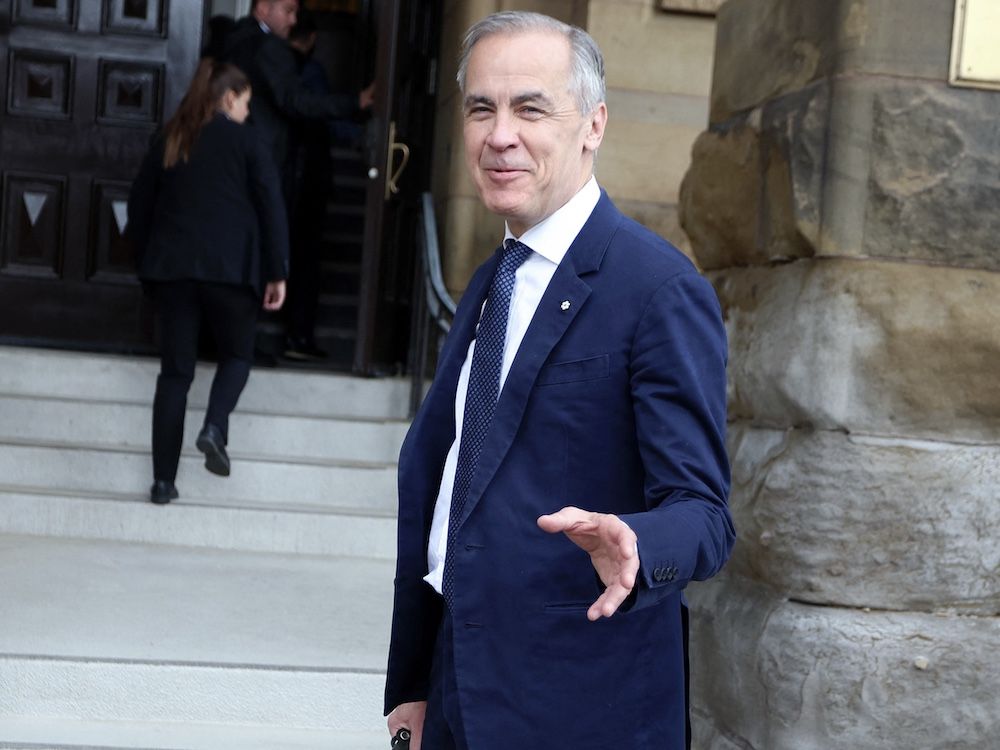
It’s a verdict that’s rapidly embedding itself as the answer to the riddle of the Liberal party’s revival from its vegetative state as recently as last December to this week’s election-day comeback, only a handful of seats shy of a majority in the House of Commons: Party standard-bearer Mark Carney owes his triumph to Donald Trump.
The notion is particularly popular in the United States. In Democratic party circles, especially, Canadians have lately become celebrated as plucky allies in the gallant resistance to their daft president’s jingoistic threats to break all the rules of global neoliberalism, annexing Canada along with Greenland in the bargain.
There’s definitely a case to be made for the proposition. Canadians are furious about all this, and a suave and worldly big-money asset manager should be presumed to possess a competence and dexterity that would definitely count as an advantage in the daunting work of muddling through the mercurial president’s tariff-war belligerence. Then again, Carney’s unique skill set would also lend itself well to the fashioning of elaborate masquerades of ad valorem equivalents, GATT Article 20 exemptions and other such resorts to the highly-specialized vocabulary of international trade pacts in order to camouflage a capitulation to the White House, or a suicidal deepening of economic dependence on China. You could dress these things up as masterstrokes of highbrow statesmanship.
But never mind that. The Liberals successfully marketed Carney as a kind of Svengali, and a significant body of voters bought it, so fair play to the Liberals.
It’s just that the presence of a dangerous president in the White House might not have been that much more significant in the scheme of things than the bizarre absence of someone else.
You’d never know it, but until just last month, Canada’s prime minister was Justin Trudeau. After Carney was formally anointed March 9 at the conclusion of the heavily ritualized Liberal leadership succession, Trudeau simply vanished from public view. He’d been prime minister for nearly a decade, and he was suddenly made invisible.
Everyone appears to agree that the just concluded federal election was one of the weirdest and most momentous ever. Carney has called the election “one of those hinge moments of history,” and it was. “Existential” is a word that came up a lot.
We know Justin Trudeau still exists. On March 17, he posted a selfie on Instagram. He was buying kitchen utensils at a Canadian Tire store, apparently in Ottawa. The Globe and Mail has cited unnamed sources who say Trudeau is renting a house in Ottawa’s Rockcliffe neighbourhood. That’s all we’ve heard from him.
The peculiarity of this state of affairs can be explained by the Liberal party’s understandable determination to induce a state of amnesia in the electorate, owing to the catastrophe of the Liberals’ more than nine years in power and the galloping unpopularity of Trudeau himself. By the final days of 2024, the Liberals’ approval ratings had been reduced to what pollster Angus Reid calculated at just 16 per cent.
It would be dead wrong to conclude that the threat of Trumpist inanity was merely an electioneering artifice manufactured by the Liberal campaign war room, but Carney did lean hard into Trump’s incitement of Canadian anxieties. Thus, the post-election verdict: Trump handed Carney a victory.
Global News: “It’s almost like a mania: How Trump won Carney the federal election.” The Washington Post: “Trump helped elect a liberal leader in Canada.” The BBC: “Trump made Carney’s turnaround victory possible.” Vox: “How Trump lost Canada.” Rolling Stone magazine: “Trump Inserts Himself Into Canada’s Election and Liberals Can’t Stop Saying Merci.” Le Monde: “Canadian PM Mark Carney wins snap election upended by Trump’s threats.”
Apart from some outliers, that’s pretty much the received wisdom. An exception, reported by the Montreal Gazette: ‘‘Mr. Carney owes one to Quebecers after election night,” according to Quebec premier François Legault. And he has a point.
Oddly, Canadians aren’t saying these things.
A deep dive by the United Kingdom pollster Focaldata for Politico found that while three-quarters of Canadian respondents said they had come to distrust the United States, 60 per cent of Canadians said “inflation and the cost of living” was their top concern as they considered how to vote, and only 39 rated Canada-U.S. relations as their big worry.
So if not Trump, then who does Mark Carney owe for his election victory? To some extent all those Bloc voters in Quebec who flocked to the Liberals, but across Canada it was traditional New Democratic Party voters that Carney should be thanking. If it weren’t for the self-destruction of Jagmeet Singh’s NDP, the Conservative Pierre Poilievre would be Canada’s prime minister today.
The NDP ended up with only seven seats, well below the threshold for “official” party status and all the benefits and resources that come with having at least 12 MPs in the House. That’s down from the caucus of 24 MPs who kept Truedeau’s minority government in power through the Liberals’ lowest standings in its approval ratings. That’s who Carney should be thanking: NDP voters who came too to late the realization that the Liberals were always going to be better at playing the politics of “progressive” postmodern leftism, because it’s a style that suits the Liberals’ base in the boardrooms, in the managerial caste, the public sector aristocracy, the faculty lounges and the corporate human-resources sector.
That’s what you get for abandoning the working class, in other words. From reducing themselves to the Liberals’ minority backstop in the House of Commons, the NDP is reduced again to playing an even smaller part in the Liberals’ legislative agenda, if they’re going to be relevant at all.
Apart from the campaign-period polemics, there wasn’t much of substance that separated the Liberals from the Conservatives in their proposed approach to Trump. Poilievre backed Ottawa’s countertariffs and made it plain that he was focused on the fate of ordinary working Canadians. And Trump made it clear that he held Poilievre in decidedly low esteem.
The Conservatives can be faulted for failing to articulate a patriotism that was fit for the purpose of the national mood. With or without Trump, there was bound to be an eruption of pent-up patriotism after nearly a decade of the Trudeau government’s tendency to encourage the idea that Canada is just a systemically racist, genocidal colonial settler-state.
But when the votes were counted, the Conservatives nonetheless registered a higher share of the popular vote than in any election this century. Their 41.4 per cent vote share was higher than Justin Trudeau managed to attract in his only Liberal majority government, in 2015.
That would have been more than enough to trounce Mark Carney were it not for the defection of all those New Democrats to the Liberals. So that’s what really accounted for Carney’s victory, when the rubber met the road. Donald Trump’s imbecilities mattered less than the overdue realization among quite a few New Democrats that their party was just a stand-in for the Liberals, that the NDP didn’t stand for anything “existential” beyond that. And so the NDP has pretty much collapsed, because if you don’t stand for something, you’ll fall for anything.
National Post

