


Prime Minister Mark Carney promised change, and today’s cabinet shuffle was his first test. But did he lose the “Just like Justin” tag once and for all? Not completely — and the west is unlikely to be happy about it.
Carney did return to the traditional Westminster model of a tiered cabinet, featuring a core of ministers and a phalanx of “junior ministers,” aka secretaries of state. The format allows ministers to focus on the big files while secretaries handle focused files, which are not necessarily connected to a department. Trudeau had abandoned the model, in part due to his desire to have gender parity in cabinet — something that Carney achieves at the core level, with 14 men and 14 women, but does not at the secretary of state level, which features 6 men and 4 women.
What wasn’t in cabinet was anyone from the opposition parties. There was some speculation as to whether members of the NDP would be in cabinet, to get the government over the 172-member majority threshold. That didn’t happen — perhaps because of the need to reward key players in the party, who would likely have grumbled had they been excluded to the benefit of floor-crossers.
And maybe, Carney doesn’t think he needs it. Former PM Jean Chretien quipped to CBC news, “we have a virtual majority.” Hmm.
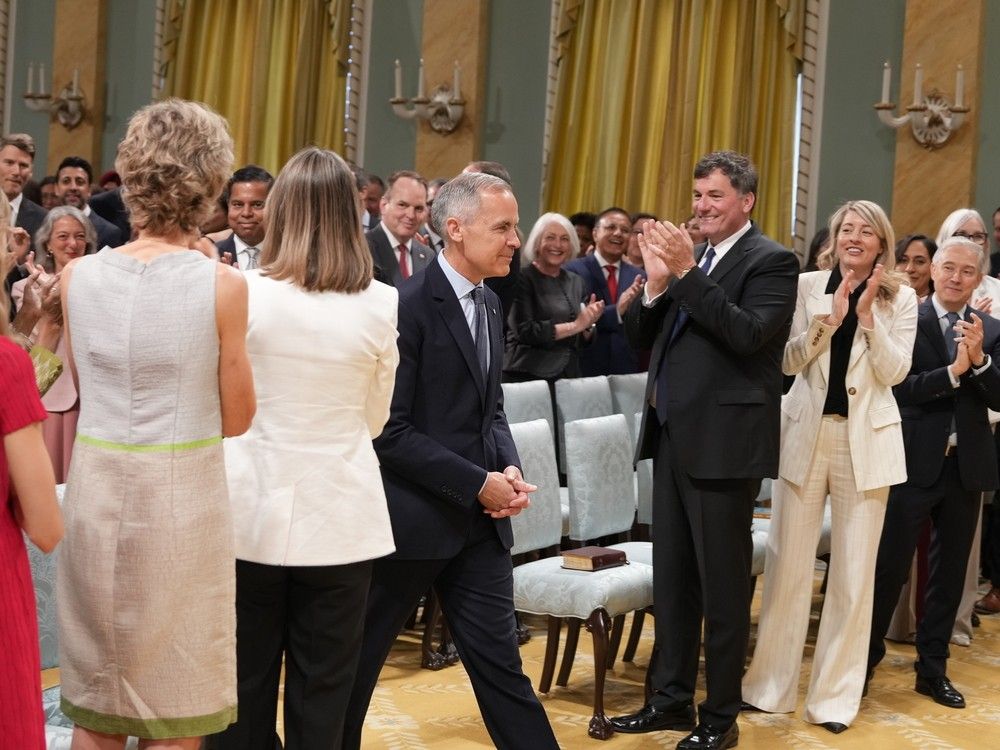
So who’s in and who’s out? Carney dropped eleven ministers from the previous cabinet, including Jonathan Wilkinson and Bill Blair. But the first row at Tuesday’s swearing-in looked highly familiar, maintaining the core of Trudeau’s former cabinet, albeit in different roles, including Chrystia Freeland, Steven Guilbault, Sean Fraser, Mélanie Joly, Anita Anand, François Philippe Champagne and Dominic Leblanc.
Freeland stayed on as minister of transport and internal trade. She had already been replaced at finance in Carney’s previous shuffle by Champagne, who remained in the portfolio in addition to taking on national revenue. Joly got industry and economic development for the Quebec region, vacating foreign affairs to Anand, while Hajdu took minister of jobs and families and economic development of northern Ontario. Guilbault remained minister of identity and culture. while Fraser became justice minister and attorney general and minister responsible for the Atlantic promotion agency.
The twinning of several key players with major regional economic development portfolios, notably that of northern Ontario, home of Premier Doug Ford’s pet project, the Ring of Fire, says a lot about Carney’s economic priorities — and his political ones. Economic development can be a highly partisan exercise, gaining favour for the party in power by doling out regional projects — and often requires cooperation with provincial governments.
But what about the West? It scored four cabinet seats and four secretary of state positions — less than the province of Quebec, which got nine positions. Prairies economic development Canada went to Edmonton MP Eleanor Olszewski, who is also minister of emergency management and community resilience, while fellow Albertan Jill McKnight got veterans affairs and associate minister of defence. Gregor Robertson, who gets the Housing portfolio, and Rebecca Chartrand, minister of northern and Arctic affairs and minister responsible for the Canadian Northern Economic Development Agency, hail from B.C. and Manitoba, respectively.
But the key portfolio of energy went to Tim Hodgson, MP for the Ontario riding of Markham—Thornhill. Hodgson has a background in clean energy as past Chair of Hydro One, but not in fossil fuels. In total, fourteen members hail from Ontario, including new faces such as Julie Dabrusin, who became minister of environment and climate change, Gary Anadasangaree from Scarborough-Rouge Park who got public safety.
It’s a cabinet for the economy, but the question is, whose? Carney has promised nation-building priorities, including pipelines and electrification corridors. Without strong western representation in cabinet, he had better tap other regional voices and experience for these key undertakings, not just to stave off Western ire — but to ensure that they are done right.
Postmedia News
Tasha Kheiriddin is Postmedia’s national politics columnist.

