



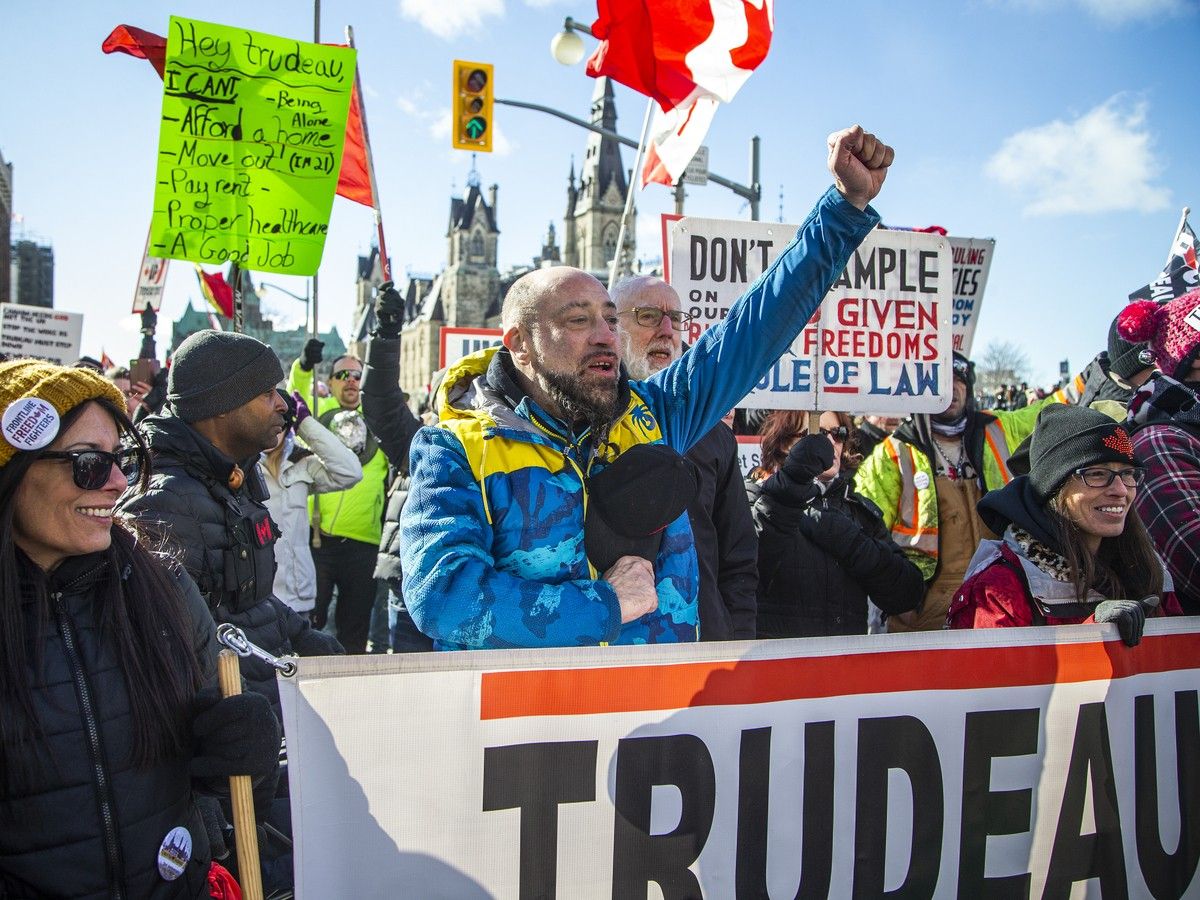
OTTAWA — Canada’s top court will decide once and for all if the federal government’s invocation of the extraordinary powers of the Emergencies Act during the 2022 Freedom Convoy was constitutional.
On Thursday, the Supreme Court Canada (SCC) announced it would hear the final appeal of two lower court decisions ruling that the invocation by former prime minister Justin Trudeau was unjustified as a way to stop the protests.
In its application for leave to appeal, the federal government argued that the Federal Court and Federal Court of Appeal applied the “wrong principles” and a “flawed approach” when they ruled that the government’s unprecedented decision to invoke the Emergencies Act on Feb. 12, 2022 was unconstitutional.
In January, the Federal Court of Appeal upheld a lower court decision that the Liberal government’s invocation of the Act to deal with lingering Freedom Convoy protests was unreasonable, unjustified and violated the Charter.
The challenge to the use of the act was brought forward by civil liberties groups such as the Canadian Civil Liberties Association (CCLA) and the Canadian Constitutional Foundation (CCF) as well as the provinces of Saskatchewan and Alberta.
In a statement Thursday morning, the CCLA vowed to defend its “historic victory” in both lower courts.
“For the CCLA, this case is not about the ‘Freedom Convoy’ protests,” the CCLA’s Anaïs Bussières McNicoll said in a statement. “It is about sending a clear message to this and future governments: even in times of crisis, no government is above the law.”
The case will also put a spotlight on SCC Chief Justice Richard Wagner. In March, he denied a request by a group opposing the use of the Emergencies Act to recuse himself due to comments he made in 2022 about the Freedom Convoy.
At issue for those requesting Wagner’s recusal were two sets of 2022 comments in which the chief justice called the Freedom Convoy protest the “start of anarchy” and said participants took Ottawa residents “hostage.”
But in a letter to parties in March, the SCC said Wagner had “concluded that there is no actual or reasonable apprehension of bias that would require his recusal under the applicable legal test.”
The 2022 Freedom Convoy protests lasted for weeks across Canada but focused particularly on Ottawa, with dozens of large trucks and vehicles blockading streets around Parliament to protest the government’s pandemic lockdowns and vaccine mandates. Protestors also blocked border crossings in Coutts, Alta., as well as access to the Ambassador Bridge in Windsor, Ont.
At the time, the government argued it needed the exceptional powers granted by the act to freeze some convoy participants’ bank accounts, compel tow truck companies to co-operate with local police clearing out the trucks, and mark parts of downtown Ottawa as a no-go zone.
Within one week of the act’s invocation, police forces from across Canada had assembled in Ottawa to push out protesters.
But in 2024, the Federal Court ruled that the powers were unnecessary to deal with the Ottawa protest as well as sympathetic blockades at two border crossings in Ontario and Alberta.
In his ruling, Federal Court Justice Richard Mosley determined that existing provincial and municipal powers were sufficient to address the disruptive protests.
In January of this year, the Federal Court of Appeal upheld Mosley’s decision, also finding that Trudeau’s cabinet did not have reasonable grounds to believe that the convoy created a national emergency.
“We are of the view that Cabinet did not have reasonable grounds to believe that a national emergency existed, taking into account the wording of the Act, its constitutional underpinning and the record that was before it at the time the decision was made,” wrote the court’s Chief Justice Yves de Montigny.
National Post
cnardi@postmedia.com
Our website is the place for the latest breaking news, exclusive scoops, longreads and provocative commentary. Please bookmark nationalpost.com and sign up for our politics newsletter, First Reading, here.