


LP_468x60
on-the-record-468x60-white

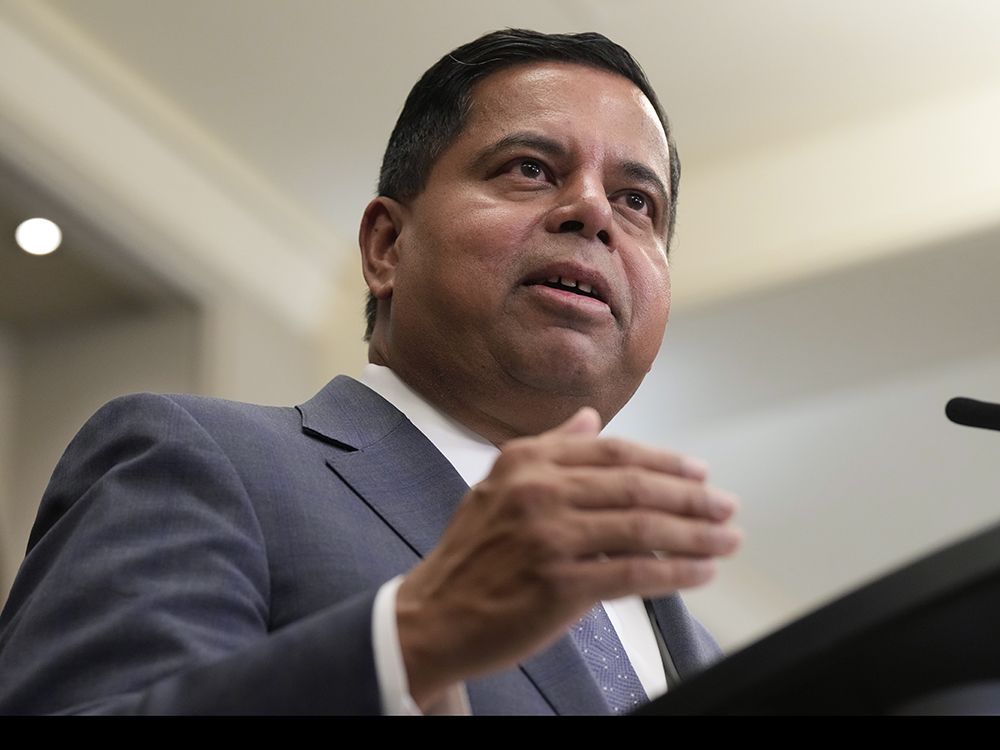
Federal Housing Minister Gregor Robertson speaks at a news conference in Stratford, P.E.I. on Aug. 19.

OTTAWA — Prime Minister Mark Carney promised months ago that his government would double Canada’s current rate of residential construction to reach 500,000 homes per year, but that target is “ambitious” according to Housing Minister Gregor Robertson.

At the House of Commons committee on finance on Monday, Robertson was being grilled on his government’s commitment by Conservative finance critic Jasraj Singh Hallan when he said that ramping up construction up to that level would not happen overnight.

“Canada is not building at that scale. That is a longer-term goal over a decade,” said Robertson, who served as mayor of Vancouver from 2008 to 2018. “That certainly will take many years to achieve, given the changes that need to be made in the industry.”

“At this point, we don’t have the labour force to manufacture at that scale,” he added.

According to Canada Mortgage and Housing Corporation (CMHC)’s latest numbers, the country saw 277,147 housing starts in September — a modest increase of 4.1 per cent over a six-month period driven by higher starts in Ontario, Quebec and the Prairie provinces.

Carney vowed in his housing plan to nearly double that amount on a yearly basis — over the next decade — in part thanks to its

new entity called Build Canada Homes (BCH) which is meant to build affordable housing at scale

for lower to middle-income Canadians.

The objectives are consistent with

former prime minister Justin Trudeau’s pledge, ahead of the 2024 budget, to “unlock” 3.87 million new homes

by 2031. That included a minimum of two million net new homes, on top of the CMHC’s forecast of 1.87 million homes by 2031.

When asked by Singh Hallan on Monday when would be the first year Canada would be able to build 500,000 homes, Robertson could not give a clear answer. He said it is “reasonable” to believe it could happen within 10 years, but it would still be a challenge.

“It’s still very aggressive and ambitious to get to 500,000 over the next decade, but that’s what we need to scale up to,” he said.

Robertson was on the hot seat as part of the House of Commons finance committee’s study on the government’s affordability bill, C-4, which aims to implement, among other things, a temporary GST rebate for first-time home buyers who are buying new builds.

The measure, the minister explained, would eliminate the GST on new homes up to $1 million and reduce the GST for new homes between $1 million and $1.5 million — which would help first-time home buyers save up to $50,000 on their first property.

Robertson said this rebate would apply to approximately 47,000 newly built homes annually and deliver as much as $3.9 billion in tax savings to Canadians over five years.

There are, however, some restrictions: first-time home buyers must be at least 18 years old and Canadian citizens or permanent residents. They will not be eligible if they have lived in a primary residence owned by themselves, their spouse or their common law partner.

But Conservatives have been arguing the Liberals’ GST rebate is a half-measure and instead suggested, in the last election, to axe the federal sales tax on all new homes up to $1.3 million — saving up to $65,000 — and not just to help first-time homebuyers.

“It wouldn’t help, for example, somebody who lost their house because of an affordability crisis. It wouldn’t help a young couple who have a condo who want to buy a house. It doesn’t apply to a senior who wants to downsize,” said Conservative MP Sandra Cobena.

But Liberals are arguing that their proposed GST rebate should be adopted to help developers sell their existing units and move onto building new homes.

Liberal MP Ryan Turnbull, who acts as parliamentary secretary to the minister of finance, mentioned there are many housing units under $1.5 million in his riding of Whitby, Ontario, that would qualify for the GST rebate but have been sitting on the housing market.

“We do have a glut of supply in Toronto, in the GTA market, and Vancouver as well. It would be good to see many of those homes sold to first-time home buyers in the near term,” replied Robertson.

Bloc Québécois MP Jean-Denis Garon asked if Robertson had advocated for more infrastructure funding in the upcoming budget for the municipalities that will see the housing supply swell in the coming years, arguing that provinces are strapped for cash.

“We can’t build new homes without the housing infrastructure,” said Robertson, while deflecting to Finance Minister François-Philippe Champagne for all budget-related questions. He is expected to table the document on Nov. 4.

National Post

calevesque@postmedia.com

Our website is the place for the latest breaking news, exclusive scoops, longreads and provocative commentary. Please bookmark nationalpost.com and sign up for our newsletters here.


Vehicles cross the Ambassador Bridge from Windsor, Ont.,, into Detroit, Mich., on Nov. 8, 2021.

Canadian snowbirds on their way to the United States may find a new wrinkle at the border this autumn. New regulations in the U.S. require fingerprints and photographs to be taken as part of documentation upon entering the country for an extended period. And there’s a $30 fee attached.

What are the regulations?

The

Alien Registration Form (G-325R)

was introduced by U.S. Citizenship and Immigration Services (USCIS) in April and requires most non-citizens who are in the country for 30 days or longer to officially register their presence and provide biographic information; i.e., a photograph and fingerprints.

Does this apply to snowbirds?

Yes. The requirement includes Canadians who spend winter months in the U.S.; retirees who spend part of the year there; Canadians visiting friends or family for a month or more; and Canadians working remotely from the U.S. for more than a month without a work visa.

What about shorter visits?

As a Canadian, if you are not planning to be in the U.S. for more than a month, you do not need to register your stay with USCIS.

Are children exempt?

Children under the age of 14 are exempt from fingerprinting, but still need to be registered by their parents if they are going to be in the U.S. for a month or more.

What is the cost?

According to a U.S.

Customs and Border Patrol

website, effective Sept. 30, 2025, the fee for

Form I-94

has increased to $30 per person from the previous $6. (Notably, this fee only applies at land border crossings.)

Isn’t it called form G-325R?

Yes. Form G-325R is the Alien Registration form, but the I-94 is your arrival-and-departure record, so you basically need both — one to register as a visiting alien, and the second to indicate you’re actually in the country. Getting the I-94 at the border is also when you’ll get fingerprinted and photographed.

What if someone enters the U.S. by air?

That changes things. According to

Richards Jurusik

, an immigration law firm operating in both the U.S. and Canada, Canadians who enter the U.S. by air are automatically issued an electronic I-94 free of charge on arrival, whereas those who cross by land are not.

Can you register as an alien after you arrive in the U.S.?

Yes. In fact, you must register after arrival, which you can do through the

USCIS website

.

Is there any way around the fingerprint requirement?

Yes, but it seems to be at the discretion of border agents, who are still getting used to the new rules. A

CBC investigation

that spoke to several Canadian snowbirds found a variety of cross-border experiences.

Some travellers were told they had to be fingerprinted and photographed and had to pay $30 each, while others were informed that an online application was available without the biometrics, and were free to choose that.

An immigration lawyer told CBC that some of the confusion stems from the fact that two agencies — Customs and Border Patrol but also U.S. Citizenship and Immigration Services — are involved.

It’s also true that the goalposts are moving quickly. The new regulations have all come into effect since last autumn, which is the last time most snowbirds would have travelled to the U.S.

The U.S. embassy in Canada notes on its website: “

Canadian citizens are generally exempted from the fingerprint requirement.” However, that site was last updated in March.

How important are the new rules?

Very. Failing to register or providing false information can lead to fines of up to US$5,000 as well as up to six months in jail, and/or deportation for fraudulent registration.

Our website is the place for the latest breaking news, exclusive scoops, longreads and provocative commentary. Please bookmark nationalpost.com and sign up for our daily newsletter, Posted, here.


Prime Minister of Canada Mark Carney speaks to supporters during a rally on April 23, 2025 in Surrey, Canada.

OTTAWA — Advocates are calling on the Carney Liberals to start with

the biggest line item

when deciding where to cut spending ahead of the upcoming federal budget.

Paul Kershaw, the head of

generational fairness group Generation Squeeze

, told reporters in Ottawa that the

$80-billion Old Age Security (OAS)

program desperately needed to be reined in, with federal spending hurtling toward a crisis point.

“(OAS) is now the single biggest driver of federal deficits. It costs $42 billion more than a decade ago and adds more to red ink than child care, than PharmaCare, than dental care, or defence,” said Kershaw.

Kershaw noted that the interim budget watchdog said

in a recent committee appearance

that the federal government was spending at an unsustainable rate.

Generation Squeeze is calling for OAS

payments to be reduced

for retired couples with incomes over $100,000. Under the current rules, couples with incomes

of up to $182,000

qualify for the full $18,000 benefit.

The group says its proposal would save Canadians $7 billion a year, while increasing the benefit for some single seniors.

Kershaw said that OAS has drifted too far from its original aim of “protecting insecure retirees” to “padding the comfort of affluence.”

“Let’s be clear, helping poor retirees is a duty. Subsidizing affluence is a waste,” said Kershaw.

He added that the billions saved from scaling back benefits for better-off seniors would be enough to lift most of the

400,000 Canadian seniors living in poverty

to an adequate standard of living.

Kershaw also called on Prime Minister Mark Carney to reject a

Bloc Québécois-led push

to boost OAS payouts for younger seniors, between the ages of 65 and 74.

“Prime Minister Carney’s first budget must resist the retiree lobby and the Bloc Québécois. Both are pressing Ottawa to pour billions more into (OAS) in ways that would do too little to help seniors that need it, and too much for those who don’t need the help,” said Kershaw.

Under the Bloc’s proposal, the maximum OAS payment for 65 to 74-year-olds,

currently around $740 per month

, would go up by 10 per cent to bring it in line with the maximum payment for seniors aged 75 and over.

A Bloc motion to increase OAS for all people aged 65 and up was

adopted by the House of Commons

last year, with the support of the Conservatives, NDP and Greens.

Bloc finance critic Jean-Denis Garon put the OAS proposal at the top of a

list of six non-negotiable demands

for the federal budget last week.

The Liberals are

three seats short of a majority

, and could use the Bloc’s 22 votes to give them some breathing room in passing the budget, set to be introduced on Nov. 4.

The Bloc’s OAS proposal would add

roughly $3 billion per year

to federal spending, according to figures from the Office of the Parliamentary Budget Officer.

Carney has said

the budget will deliver

“austerity and investment.”

Anthony Quinn, the president of the Canadian Association of Retired Persons, said that Kershaw was trying to spark “intergenerational warfare,” rather than put forward constructive ideas for bringing down the deficit.

“I think Mr. Kershaw is short-sighted, not understanding that we all become seniors if we’re lucky. And these programs are entitled to make sure Canadians are aging with dignity,” said Quinn.

Quinn said that Generation Squeeze’s OAS math didn’t account for various “costs of aging” such as at-home care and pricey medical devices and mobility aids.

According to a recent report from

RBC Wealth Management

, a healthy couple between 65 and 74 spends roughly $13,000 a year on health care. This jumps to $23,000 between 75 and 84, and $40,000 over the age of 85.

“There’s no guarantee that everyone is a rich, fat-cat senior, and that’s how Kershaw is framing all his arguments,” said Quinn.

National Post

rmohamed@postmedia.com

Our website is the place for the latest breaking news, exclusive scoops, longreads and provocative commentary. Please bookmark nationalpost.com and sign up for our daily newsletter, Posted, here.


Minister of Finance and National Revenue Francois-Philippe Champagne speaks during a press conference in Ottawa, on Monday, Oct. 20, 2025.

OTTAWA — The federal government’s upcoming budget will include plans for a new Financial Crimes Agency designed to improve Canada’s ability to tackle online scams, money laundering and other types of fraud, Finance Minister François-Philippe Champagne announced Monday.

In the latest in a series of pre-budget announcements, Champagne said Ottawa will take “bold action” in establishing the new agency because Canadians are besieged with a growing array of financial scams, including fake emails, ghost texts, phishing links, masked voiceover calls and other forms of fraud.

The new organization, first identified as a need about five years ago, will use a whole-of-government approach to specialize in fighting sophisticated plots and schemes, some of which are perpetrated by organized crime.

The new plan will be at the centre of the government’s new strategy to fight fraud and will be supported by new legislative changes to the Bank Act, scheduled to be unveiled this spring. The new legislation will require banks and other financial institutions to play a larger and more proactive role in detecting and fighting various types of fraud.

Speaking to reporters in Ottawa, Champagne said the new plan will “unite the expertise” of existing government organizations who are already tasked in various ways with fighting online scams and fraud.

The relationship between the new agency and existing government bodies in this space, however, is unclear, although Champagne did refer to taking a more co-ordinated approach. He did not specify if any existing government bodies would be folded into the new agency or if their roles might be supplanted. The existing groups include the RCMP, regional and local police, the Financial Transactions and Reports Analysis Centre of Canada (FINTRAC), the Office of the Superintendent of Financial Institutions (OSFI) and the Canadian Anti-Fraud Centre.

Anthony Ostler, chief executive officer of the Canadian Bankers Association, called the announcement “very welcome news” because online scams are such a growing threat that Canada needs to fight back with an agency that is entirely dedicated to the cause. A national organization will be better placed to implement best practices from around the world and “connect the dots” when scams target individuals across the country, he said.

“If we just have stuff spread across the country, the bad actors will continue to win.”

There’s little doubt, however, that online fraud is a growing threat. According to the Canadian Anti-Fraud Centre, Canadians were scammed out of $643-million in this way in 2024, almost three times the figure from just four years earlier. Only between five and 10 per cent of these types of scams are reported, the government said.

Champagne said that seniors, new Canadians and other more vulnerable populations are disproportionately affected.

Anthony Quinn, president of the Canadian Association of Retired Persons, said the new plan will “put some teeth” into the fight against online scams. In the past, Quinn said, Canadians’ best defence has been education and it has proven to be inadequate.

The government also said it will work more closely with financial institutions and other stakeholders to detect signs of abuse early, including the creation of a new, voluntary Code of Conduct for the Prevention of Economic Abuse that will be overseen by the Financial Consumer Agency of Canada.

A government press release said “economic abuse” — such as restricting access to money, sabotaging employment, or forcing debt — is an “under-recognized form of gender-based violence and financial harm.”

National Post

Our website is the place for the latest breaking news, exclusive scoops, longreads and provocative commentary. Please bookmark nationalpost.com and sign up for our daily newsletter, Posted, here.


Liam Og O hAnnaidh, a.k.a. Mo Chara, of the Irish hip-hop group Kneecap, leaves court in London, England, on Sept. 26, 2025.

OTTAWA

— A federal New Democrat is calling for a parliamentary committee to probe what led a parliamentary secretary to announce that an Irish hip-hop group had been banned from entering Canada. 

Jenny Kwan, the NDP MP for Vancouver East, has penned an open letter addressed to the Liberal chair of the parliamentary committee on citizenship and immigration, urging it to look into what she calls “serious procedural and accountability issues” surrounding the Sept. 19 announcement by Liberal MP and parliamentary secretary, Vince Gasparro.

In a video posted to X, Gasparro announced that, “on behalf of the Government of Canada,” the Irish hip-hop trio, Kneecap, had been banned from entering Canada, saying its members had

“engaged in actions” and made statements that Gasparro called “contrary to Canadian values and laws.”

“While the band has indicated publicly that they have not received communication or confirmation of that fact from (Immigration, Refugee and Citizenship Canada) due to the announcement from MP Gasparro, several concerts in Canada have currently been cancelled,” reads the letter from Kwan, which was sent late Friday to the committee clerk.

Kwan, who has brought the issue to the House of Commons during question period, said that neither Gasparro nor Immigration Minister Lena Metlege Diab has provided clarity about why the announcement was made or whether a ban is in place.

Gasparro has previously told reporters that he was acting on information that had been made available to him by officials, but referred any remaining questions to the government. 

The Centre for Israel and Jewish Affairs, a national advocacy group, welcomed his announcement at the time, after having launched an “action alert” back in July about the trio’s upcoming performances, citing concerns that included one of its members’

alleged display of a Hezbollah flag during a 2024 performance.  

That resulted in a terrorism charge against

Liam Óg Ó hAnnaidh, who goes by the stage name, Mo Chara,

which a U.K. judge recently dropped on the basis that the charge had been filed passed the required timeframe.

In her letter, Kwan, who is not a member of the committee because the federal NDP lacks official party status, said the incident “raises very serious questions about procedural fairness” and a potential misuse of authority.

Kwan said the announcement raises questions about the “discretion” that can be exercised by a minister or parliamentary secretary when it comes to cases involving performing artists, as well as the criteria the immigration department uses to deny entry to Canada, when no criminal record is present.

She wrote that the incident also touches on issues surrounding how such announcements can be made, as well as “the need to ensure that discretionary decisions respect the Charter of Rights and Freedoms and Canada’s international obligations, particularly regarding freedom of artistic expression.”

“To that end, I respectfully urge the committee to look into this matter,” Kwan wrote.

“Ministerial accountability includes the role of parliamentary secretary. It is critical that Canadians and the international community are reassured due process is safeguarded, so that public trust in the fairness and integrity of our immigration and cultural exchange policies is (reassured,)” her letter read.

Kwan said looking into the matter would also provide clarity to Canadians who bought tickets to see the band play in Toronto and Vancouver.

National Post

Our website is the place for the latest breaking news, exclusive scoops, longreads and provocative commentary. Please bookmark nationalpost.com and sign up for our politics newsletter, First Reading, here.


A pedestrian walks past a homeless encampment in Toronto, December 1, 2023.

Majority of Canadians (nearly 60 per cent) say they support communities declaring states of emergency in order to clear homeless encampments in parks and public spaces, according to a new poll.

Thirty two per cent of Canadians said they supported the tactic and 25 per cent said they somewhat supported it. “Men are more likely to support or somewhat support these initiatives than women,” according to the Nanos poll, published on Oct. 18. Three out of 10 Canadians opposed or somewhat opposed using a state of emergency to clear homeless encampments. Six per cent said they were unsure.

Canadians living in B.C. were most likely to be in support of removing the encampments, at just over 68 per cent, while residents of the Prairie provinces (Alberta, Saskatchewan, and Manitoba) were a close second, at just over 61 per cent. Residents of Ontario and Atlantic Canada (New Brunswick, Newfoundland and Labrador, Nova Scotia, and Prince Edward Island) were roughly the same, at nearly 57 per cent and nearly 55 per cent, respectively.

“Whether accepted or removed, many communities are grappling and debating what to do,” said pollster Nikita James Nanos, the founder of Nanos Research, in an emailed statement to National Post.

“People from B.C., men and older Canadians are the most likely to be supportive of clearing out homeless encampments in parks and public spaces.”

 City crews clean up Toronto’s Clarence Square Park in the early morning hours of Tuesday, Oct. 22, 2024.

Meanwhile, people living in Quebec were least likely to support the use of a state of emergency to clear homeless encampments, even though it was still nearly half, at around 48 per cent.

A state of emergency was declared in Barrie, Ont., last month to address encampments, the city said in

a news release

. The Emergency Act is invoked when there is an imminent threat to public health or safety.

“We are here to help those who want help and there are resources available today. If you refuse that help you cannot stay in these encampments,” said Barrie Mayor Alex Nuttal, adding that he would not allow “lawlessness to take over.”

He said the state of emergency gives the city access to resources for people who were living in the encampments, so they can get shelter or “rehabilitative help.” Resources would also be used to clean up the encampment sites, he said,

according to Barrie Today

.

In Ontario, Hamilton, Toronto, Ottawa and the Niagara Region

declared states of emergency due to the homelessness crisis in 2023

.

There have been arrests, fires, attacks and even deaths at encampments across the country. Sites have popped up in cities like Vancouver, Winnipeg, Toronto and Red Deer and more.

Earlier this month, a child was assaulted while playing next to a park where an encampment was set up in Winnipeg, the city said in

a news release

. Last week in Toronto, an encampment in the Kensington Market area was cleared, due to concerns about it being a fire hazard, The Canadian Press reported.

 A homeless encampment in Kitchener, Ontario at the corner of Victoria Street and Weber Street, Monday January 31, 2023.

In 2022, Vancouver police investigated

multiple stabbings

at an encampment in Crab Park. In 2024, police said a

man fatally stabbed two people

at an encampment in Kingston. In 2024, two Toronto women told National Post they had been

assaulted while walking near an encampment at Clarence Square

.

Toronto Fire Services said a man was found dead in June after

a fire at a North York encampment

.

Encampments are informal shelters and tents set up by people who otherwise do not have access to housing, according to advocacy group National Right to Housing Network. The group said there has been a major increase in encampments since the COVID-19 pandemic.

Advocates point to Canada’s systemic failure to provide adequate housing as one of the reasons encampments exist. “Meaningfully engaging encampment residents in decisions that affect them, respecting their rights, and finding permanent housing solutions must be the way forward,”

said

federal housing advocate Marie-Josée Houle in a letter to Canadian premiers in February.

The Nanos poll was commissioned by CTV News. There were 1,052 Canadians, 18 or older, who took part in the survey by phone and online between Sept. 29 and Oct. 1, 2025. The margin of error for this survey is ±3.0 percentage points, 19 times out of 20.

Our website is the place for the latest breaking news, exclusive scoops, longreads and provocative commentary. Please bookmark nationalpost.com and sign up for our daily newsletter, Posted, here.


In a moving post-game interview with Sportsnet's Hazel Mae, Toronto Blue Jays star Vladimir Guerrero Jr. said he was

If Toronto Blue Jays fans are feeling nervous about Monday night’s Game 7 against the Seattle Mariners, just know that Vladimir Guerrero Jr. — the team’s heart and soul and its best player so far in these MLB playoffs — says he was “born ready” for this moment.

In the moments after a crucial Game 6 win over the visiting Mariners at a sold-out Rogers Centre in Toronto on Sunday night, the Canadian-born first baseman came back to field level for a chat with Sportsnet’s Hazel Mae.

After discussing the game — including his team-leading sixth home run of the post-season and rookie pitcher Trey Yesavage’s dominance on the mound — Mae asked Guerrero Jr. if he was ready for the team to play just its second Game 7 in team history.

Before he could answer, a chorus of cheers from the thousands who stuck around brought a wide smile to his face as he looked about the ballpark, his awe at the fans’ appreciation evident.

“Hey, you asked me if I’m ready. I (was) born ready,” he said as the cheers grew louder. “I (was) born ready and I want it all for this city.”

The Jays’ have been using #wantitall on their social media posts throughout the playoffs.

The win was no doubt huge, but the superstar’s moment only further endeared him to the passionate fanbase.

“If this does not give you goosebumps, then I don’t know what else to tell you,”

Omer Osman, Toronto sports commentator and co-founder of a Toronto Raptors Instagram page, wrote on X

“Toronto sports got the best fans in the world.”

“That smile. It’s Everything,” added

Ali Pinkerton.

a retired teacher in Kingston, Ont.

“I feel like I want to run through a wall after hearing that speech,” wrote Ian Hunter, a contributed to BlueJaysNation.com.

Others, meanwhile, celebrated the work of the camera man.

“As a camera op, I smiled all the way through this. The op was on their game. Paying attention and seizing the moment,” opined

Rod Maldaner

, an Edmonton-based cameraman.

The last time the Jays played in a Game 7 was in 1985 and it’s still remembered as one of the most heartbreaking playoff shortfalls in the club’s history.

The club dominated the American League that season, putting up a 99-62 regular season record that still stands as the organization’s best. By Game 4 of the best-of-seven ACLA against the Kansas City Royals, Toronto had built a 3-1 series lead. However, the Royals battled back to tie the series and would go on to win Game 7 in Toronto and went on to win the World Series.

Our website is the place for the latest breaking news, exclusive scoops, longreads and provocative commentary. Please bookmark nationalpost.com and sign up for our daily newsletter, Posted, here.


The federal government concealed toxic water contamination in North Bay, Ont., for almost five years before warning residents of a dangerous chemical spill from the city’s airport and a nearby military base, according to records obtained by the Investigative Journalism Bureau.

In 2012, the Department of National Defence (DND) discovered the elevated levels of so-called “forever chemicals,” which are associated with

a growing list

of health issues including cancers, kidney disease, liver problems, altered immune function, birth defects and other serious problems, according to the newly uncovered records.

However, although the chemical levels found dramatically exceeded Health Canada guidance for drinking water at the time, DND did not inform local government officials about the public health threat until late 2016 — in apparent violation of provincial environmental law — and only revealed it publicly in 2017.

“It’s a government cover-up,” said Sébastien Sauvé, a professor of environmental chemistry at Université de Montréal who reviewed a summary of the documents obtained by the IJB.

“That’s the part that really hurts the most to me: people could have taken some steps to reduce their exposure, had they known,” Sauvé said.

The records, obtained using access to information law, include internal emails, test results, letters between government officials and internal DND reports.

“Forever chemicals” — scientifically

called PFAS

(per- and polyfluoroalkyl substances) — get their nickname from their resistance to destruction and ability to linger in the environment and human bodies for years without breaking down.

In North Bay, the toxic chemicals were released in firefighting foam during training drills held at the local airport and military base from the 1970s to the 1990s. Both facilities sit upstream of water wells that supply some local homes and the municipal water supply, which flows into taps across the city.

Even today, North Bay locals still grapple with levels of forever chemicals that often make their drinking water unsafe, according to the current federal

Health Canada water objective

for PFAS of 30 nanograms per litre (ng/L). In North Bay, DND adheres only to a less rigid provincial safety guidance of 70 ng/L, creating uncertainty for residents whose readings fall between the two different safety standards.

In a statement, DND spokesperson Cheryl Forrest said that the department had detected PFAS in surface water in North Bay in 2012. (“Surface water” refers to natural bodies of water in the area.)

However, she said DND had not recognized these surface-water test results as a threat to drinking water, because PFAS guidelines for surface water were not yet available to help authorities understand the results.

“Between 2012 and 2016, information and technical awareness and expertise on how to best manage PFAS was limited and evolving,” she said, adding that DND has regularly consulted with Environment Canada and government experts on managing PFAS.

“In North Bay, as soon as the potential risks and impacts to drinking water were recognized, DND contacted local and provincial officials to develop and implement a drinking water and expanded environmental monitoring program in the area and to offer sampling to residents in the area of concern,” the statement adds.

Experts call the government’s failure to inform the public a damaging abdication of its duty.

Revelations in the new documents “erode trust in our public system’s ability to oversee the health and safety of Canadians,” said Miriam Diamond, a leading forever chemicals expert at the University of Toronto.

“They had knowledge of elevated levels in surface water running downstream of the airport. The prudent thing would have been to test the drinking water.”

Locals living in North Bay’s contamination hot spots said that even after being alerted to the issue in 2017, they were not told that water testing near their homes years earlier — sometimes steps from their doors — had flagged alarmingly high levels of toxic chemicals.

Phil Arens, who bought a property on an affected local stream called Lees Creek in June 2013, said the backyard waterway — which he had grown up around — had been a major selling point. Little did he know he had made his purchase a year after the federal government had logged high levels of forever chemicals in the creek.

“I was drinking out of the creek since I was four years old,” Arens said. “I was full-on swimming in the creek … If they told me the creek had PFAS in it and I couldn’t drink the water, there’s no way I would have bought this house.”

Today, Arens’s home water well is contaminated with the same chemicals that taint the creek and other residential wells.

He said it made him angry to learn that the government knew for years that the water contained dangerous levels of chemicals. “When you have no potable water, it makes your property worth zero,” he said. “I’m trapped. I don’t want to live here anymore.”

Among the documents obtained by the IJB are numerous letters written by then-North Bay mayor Al McDonald to federal officials between 2018 and 2021.

Exasperated by the government’s lack of action on cleaning up the affected water supply, McDonald wrote to federal ministers and then-prime minister Justin Trudeau, demanding action.

“Our citizens’ health and safety is being ignored,” McDonald wrote to Trudeau in 2021. “The Government of Canada has known for years of this health situation and has not taken any real action to protect our citizens from this health risk.”

The current Prime Minister’s Office did not respond to requests for comment.

Today, McDonald says his efforts at the time were in vain because the city’s drinking water still hasn’t been cleaned up.

“We lost in the end,” McDonald said. “When I turn the tap on, I just see everybody in North Bay drinking that water … If people really knew how government worked, it would scare them.”

From the 1970s to the 1990s, DND firefighters staged training exercises at Jack Garland airport, which involved dousing fires with aqueous firefighting foam. The foam contained the same chemicals that continue to plague North Bay to this day.

Forever chemicals are present in a plethora of products, from nonstick pans to takeout containers, but some of Canada’s most troublesome hot spots are areas where firefighting foams have been used.

After being sprayed on fires, the foam leached into soil and water surrounding the airport and air force base, called 22 Wing. The tainted water then flowed downhill towards the city, contaminating creeks, wells, residential properties and Trout Lake, the main source for the city’s drinking water.

Residents long believed, based on media reports and official statements, that PFAS were first discovered in Lees Creek in either late 2016 and early 2017. Some residents told the IJB that in February 2017, federal officials knocked on their doors to advise them of the potential threat and to offer bottled water if their tap water tested above limits.

But a previously undisclosed 2016 report, written by the Royal Military College, shows a discovery of elevated PFAS dating back to 2012.

The report, which reviewed local PFAS test results, shows a DND sprinkler system containing PFAS had leaked, prompting officials to test Lees Creek. One test was placed downstream of the creek while another was placed upstream, closer to the airport and military base.

“Significantly higher concentrations were found (upstream) … indicating that additional PFAS sources were present and impacting Lees Creek at upgradient locations,” reads the report.

The report shows that military officials found that decades of training activity with firefighting foam at the airport had been contaminating the creek with PFAS over the long term. It specifically points to elevated levels at “several former firefighting training facilities, a fire hall and a mechanical shop located on the main portion of the base.”

Between 2012 and 2016, DND tested Lees Creek 18 times according to the report — often within 100 metres of local homes that used the creek and nearby groundwater for drinking water.

At least five of those surface water tests exceeded the federal Health Canada guidance values for drinking water at the time – 600 ng/L — for one type of PFAS. Readings for all types of PFAS combined reached as high as 1,600 ng/L, according to data obtained by the IJB.

That level is more than 50 times Health Canada’s current PFAS threshold of 30 ng/L and many times higher than the current Ontario standard.

Despite such alarming levels, a July 2013 DND internal memo shows officials did not feel the department had an “obligation to remediate the (PFAS) contamination, as the (PFAS) were used in accordance with the laws and accepted practices of the time.”

DND initially told the IJB that it could not comment on an “unidentified memo.” The IJB sent the full text of the memo to DND, but it did the department did not respond further.

Beginning in 2014, records show DND also conducted more than 20 tests near the military base, north of Lees Creek. More than half of those surface water tests failed the drinking water guidance values of the time.

In December 2016, DND informed the city and local health unit about the contamination. Two months later, in February 2017, officials finally disclosed publicly that contaminated water in North Bay could pose a threat to the population.

Joanne Penney lives in a bungalow on Carmichael Drive, which runs right along the edges of the military base where some of the PFAS samples were taken.

For years, she has noticed her property floods with water she says is coming from the base. Sometimes, she says, the water would take on a strange orange hue and foam up.

“I know we had it in our backyard,” where her drilled water well is also located, said the 59-year-old retiree. “The military used to practise there and … you’d have foam sometimes.”

The IJB found that DND tested surface water less than 100 metres from Penney’s backyard at least seven times beginning in April, 2014. One sample from October that year exceeded the then-Health Canada drinking water guidelines of 600 ng/L.

Told about the test results by the IJB, Penney called it “disgusting” that DND never revealed those tests to her. “Why didn’t they? …

They hide everything, so what are you going to do?”

Penney, who was diagnosed with breast cancer about five years ago, wonders whether environmental factors might have impacted her diagnosis, though that is not known.  She says she has struggled to find answers.

In a response to questions about undisclosed testing near the airport and the base, DND spokesperson Forrest said that at the time, around 2012, groundwater data “did not suggest the presence of significant groundwater impacts in the area that could affect private wells.”

“The high mobility of PFAS and its potential to travel long distances and move between surface water and groundwater to affect drinking water resources were not yet understood by the scientific community at that time and the importance of this possible connection was not expected based on our experience with traditional contaminants,” she added.

Liza Vandermeer, a former North Bay supervisor at the provincial Ministry of the Environment, said DND’s response was grossly inadequate, calling its overall handling of the situation “sloppy work.”

Citing the example of surface water contamination found by DND at Lees Creek, she said it would not take “rocket science” to figure out that the nearby drinking water was in danger. “The creek comes out less than a kilometre from the city’s drinking water intake,” she said.

“They’re not supposed to sit on the information until they know for sure whether or not it’s significant,” she said. “They’re supposed to be proactive. So them saying that they spent four years trying to figure out whether it was potentially risky, that’s nonsense.”

Ontario’s Environmental Protection Act states that anyone who causes the spill of a pollutant must immediately notify the province and the local government.

In its statement to the IJB, DND said it informed local and provincial officials “as soon as the potential risks and impacts to drinking water were recognized.”

But local and regional officials now say DND kept its 2012 contamination discovery secret.

Dr. Carol Zimbalatti, the medical officer of health for the

North Bay Parry Sound District Health Unit

, called DND’s almost five-year delay in disclosing elevated levels of forever chemicals to her office “concerning.”

“The lack of transparency and the fact that it impeded efforts to act, to mediate, to inform,” delayed the response of the city, the health unit and residents, she said.

The revelations have also complicated the relationship between the regional health office and DND, which are partners in the efforts to ensure public safety, she said.

“It is a little bit more difficult when the trust isn’t necessarily there,” Zimbalatti said. “When there isn’t trust, it makes conversations a bit more fraught, when you’re not sure of the level of transparency.”

The City of North Bay said it was not informed at the time of the 2012 discovery, and only became aware of the contamination in late 2016.

“At the time, the city understood that PFAS contamination had been identified in 2016,” said city spokesperson Gord Young in a statement. “From the outset, the city has acted in good faith and with the best interests of the community in mind, while navigating a complex situation it did not create.”

Ontario’s Ministry of the Environment, which is responsible for enforcing drinking water standards in the province, did not respond to questions about when ministry officials learned of the contamination.

Vandermeer, who once was an investigator at the Ministry of the Environment, where she was responsible for probing and prosecuting environmental offences, added:

“Anybody who works in environmental research or enforcement knows that if there’s a groundwater plume of contamination moving towards private wells, that the conscientious and responsible thing to do is to approach those property owners.

“These people are paid by the taxpayer to protect us, and they didn’t do their job. There was a cover-up and it’s unethical and I’m absolutely appalled, to be honest.”

DND did not respond to a question on whether it knew that several local homes drew drinking water directly from surface water found to be contaminated.

Kerrie Blaise, an environmental lawyer based in North Bay, said the DND delay in acknowledging the PFAS crisis surrounding the base and airport is “an environmental injustice.”

“That’s where you have a violation of a protection that is in place,” she said.

When the city finally learned its water was contaminated with PFAS, the biggest change was felt by the dozens of households that draw their drinking water from underground wells in the area south of the airport.

Some residents heard a knock on their doors from government officials who told them not to consume their water while their taps were tested for PFAS.

“Why is the military here?” Jennifer Arens recalls thinking when she saw a man in an army uniform step out of a military vehicle in the Arens’ driveway in 2017.

“Ever since they showed up that night, it’s been a stress weighing on us that we can’t drink our water. They have no solution for us besides dropping bottles of water off for the rest of our lives.”

DND said in its response to the IJB that it had provided bottled water to residents who had elevated PFAS levels, or had connected them to municipal water supplies or PFAS treatment systems at no cost. A 2021 document seen by the IJB indicates five homes were connected to the municipal supply in 2017.

Two residents spoken to by the IJB said they had been offered treatment systems but had not accepted them because they said a five-year limit had been attached to their guaranteed maintenance. None of the residents spoken to by the IJB had been connected to the local water supply.

And although DND offered free bottled water to North Bay households whose PFAS measurements exceeded government limits for drinking water, those limits quickly became outdated.

In 2017, when the disclosure was made to North Bay, the federal Health Canada guideline for drinking water concerned only two well-known types of PFAS — a limit of 600 ng/L of PFOS and 200 ng/L of PFOA.

The same year, Ontario brought in a much lower guideline of 70 ng/L for a total of 11 different types of PFAS. DND, however, persisted with the old federal Health Canada guidelines, and only adopted the Ontario guidelines four years later, in 2021. Once they did, more than a dozen homes were newly considered to be contaminated, in addition to five that had previously exceeded the old guidelines.

Then, last year, Health Canada unveiled the most stringent federal threshold to date: 30 ng/L for 25 different types of PFAS. DND has not yet adopted this threshold, and almost all North Bay tap water now exceeds these levels.

Today, many residents describe feeling like they live in a grey zone because they have water with contamination levels above the current federal Health Canada threshold but within the provincial limit that DND now adheres to.

Every once in a while, DND writes to residents whose tests fall within the provincial safety guideline of 70 ng/L. DND says it follows this level, rather than the stricter federal guideline of 30 ng/L, because the province has jurisdiction over the area.

“That’s like their get out of jail card,” says Joan Buckolz, who has lived south of the airport for more than 40 years. “It’s just the game they play.

In an example of the confusion faced by residents, an October 2022 test showed Buckolz’s drinking water well had a PFAS level of 40 ng/L, which at that time did not exceed provincial or federal guidelines. It still does not exceed the province’s threshold, but now exceeds Health Canada’s stricter guideline, which was introduced later.

Buckolz, who spends her own money on bottled water for her house, says the government’s response has been “too slow, too little.”

“It’s a catch-22,” she said. “You’re waiting for the limits to change because you keep hearing they’re going to change … until they do, they’re telling you everything’s all right.”

More than a year ago, Joanne Penney says DND told her its testing had logged PFAS levels in her drinking water that were within provincial guidelines. Since then, it has stopped testing.

Still, she and her husband spend hundreds of dollars on bottled water every month.

“We don’t even know if they’re telling us the truth,” she said. “We’re in a limbo.”

In a statement, Health Canada spokesperson Joshua Coke said that while the department creates health guidelines for drinking water quality, “provinces and territories … are responsible for implementing and regulating drinking water safety.”

“The drinking water objective represents a benchmark for all jurisdictions to strive towards; Health Canada recognizes that achieving the objective may take time given the technical complexity and cost of measuring and managing PFAS.”

For those residents whose water exceeds the provincial guidance levels, DND’s weekly bottled water deliveries are a reminder of the health threat surrounding their properties.

Dave Atkins says he can’t sell his house in good conscience because of the PFAS in his water well. He wasn’t surprised when reporters told him that tests 150 metres from his home found high levels of PFAS years before he was told.

“That’s the military for you. You’re on a need-to-know basis,” he said. “Even though we needed to know.”

Today, forever chemicals continue to flow down Lees Creek into Trout Lake, where they enter the municipal water supply and contaminate taps across the city. It’s a problem DND’s bottled water deliveries haven’t fixed.

When former North Bay mayor Al McDonald looks back on the letters he wrote to federal government officials between 2018 and 2021, he recalls the tumultuous – and failed – battle for accountability.

“I wanted the chemicals removed from our drinking water,” he told the IJB.

In a March 2018 letter to then-minister of National Defence Harjit Sajjan, McDonald said he felt “let down” and “summarily dismissed” by DND officials’ lack of response.

In a letter he later wrote to Trudeau, he said, “We understand that there is additional and significant information and studies regarding this file held by the Federal Government that is not being shared … I trust that you agree (that) to knowingly allow this contamination at the source to continue without remediation is unacceptable.”

In 2021, DND and the city struck a

$20-million deal

to clean up the soil at the airport.

“It felt like a victory in a battle, in a war that we lost,” McDonald said.

The most recently released testing data shows the city’s municipal water supply remains above the federal PFAS guideline of 30 ng/L but below Ontario’s standards.

Work to remediate the airport didn’t begin until last year, according to

local media reports

. It is not expected to lessen PFAS levels for nearly another decade, one official recently told the Globe and Mail.

The city has also requested federal funding to design and upgrade the water treatment facility to filter PFAS. The project would cost more than $150 million, the city said, adding that the full cost of addressing PFAS could reach 10 times its annual water and wastewater budget.

“The City believes the federal government has a clear responsibility to fund these efforts and expects that support will continue,” the city told the IJB in a statement. It said it has received no confirmation from DND regarding funding for the treatment plant overhaul.

DND confirmed it had received a request for financial assistance for a PFAS treatment system. It did not say whether any such funding has or will be granted. 

McDonald says the contaminated water he’s been drinking for most of his life provides a haunting reminder of what he ultimately failed to achieve.

“I think it’s way too late for me,” he said. “I think it’s probably way too late for people that have been drinking it for 20, 30 years. But that five-year-old that walks over and puts a glass under a tap and starts drinking it … That’s what I think about.”

— With files from Anu Singh, Jacqueline Newsome, Wendy-Ann Clarke, Olivia Harbin, Amber Ranson, Matisse Chik, Tomi Joseph-Raji and Sahaana Ranganathan.

(Main photo: Lees Creek, by Peter J. Thompson)

The Investigative Journalism Bureau (IJB) at the University of Toronto’s Dalla Lana School of Public Health is a collaborative investigative newsroom supported by Postmedia that partners with academics, researchers and journalists while training the next generation of investigative reporters.


Dominic LeBlanc, the minister responsible for Canada-U.S. trade, speaks with reporters at the Canadian embassy in Washington, D.C., Tuesday, Oct. 7, 2025.

OTTAWA — Dominic LeBlanc beat cancer.

Now, just five years later, Canada’s minister for Canada-U.S. trade is battling another malignant threat: U.S. President Donald Trump’s tariffs.

LeBlanc, the Carney government’s minister of just about everything, has spent much of this week in Washington, D.C. as the lead cabinet minister trying to navigate the choppy and unpredictable waters of the Trump administration’s trade policies.

In many ways, LeBlanc was an extreme long shot to be in this position as the cabinet’s point person tasked with one of the country’s most important challenges in decades. Known more for his charm, institutional knowledge and political skills than as a policy wonk or a details guy, LeBlanc was forced to step away from his role in former prime minister Justin Trudeau’s cabinet in 2019 while battling a rare form of non-Hodgkin’s lymphoma. He was told that he had about an 80 per cent chance of survival, but was given no guarantees.

At the start of this year, with his health now in check, his Liberal government also stared down its own mortality. With opinion polls showing a deficit of as much as 25 percentage points, the incumbents looked certain to flatline, instead of claiming the fourth consecutive mandate that they later won.

Then in April, LeBlanc survived another major challenge. Perhaps more closely linked personally with the unpopular outgoing prime minister than anybody in cabinet — he even babysat decades earlier Trudeau and his brothers — LeBlanc seemed like a strong candidate to be sacrificed as Carney put his own stamp on the Liberal cabinet.

Instead, LeBlanc was tasked with Canada’s bid — along with Carney and others — to land a critical trade deal with the mercurial, tariff-loving U.S. president.

Personal rapport helps with any negotiation or business deal, said Jamie Tronnes, executive director of the U.S.-based office of the Canadian think tank the Macdonald-Laurier Institute, but especially with this White House. LeBlanc is seen as a “disarming” person who has at times been able to reduce the tension during discussions with the U.S., Tronnes said.

“I think the Trump team has a rapport with Dominic LeBlanc,” said Tronnes.

 Dominic LeBlanc is pictured inside the Oval Office at the White House with U.S. President Donald Trump.

The opposite appears to have been the case during U.S.-Canada free-trade negotiations during the first Trump administration. The president made it very clear that he didn’t like either Trudeau or former foreign affairs minister Chrystia Freeland.

Trump later called Freeland “a whack,” “totally toxic” and “not at all conducive to making deals.”

A good rapport can help seal a deal, but in this case, Tronnes added, it may also have been important in helping the Canadians work out what the Americans even wanted in a trade deal with Canada. A few months ago, she said, Canadian negotiators seemed unclear on that point. “Now, I think they know what they need to do.”

For LeBlanc, there’s clearly no shortage these days of things to do.

As he prepared to make an appearance earlier this month before the Senate Committee on Foreign Affairs and International Trade, Sen. Peter Boehm, the committee’s chair, kidded LeBlanc about how long it took to include the list of his various cabinet jobs in the introduction: minister of internal trade; president of the King’s Privy Council for Canada; minister responsible for Canada-U.S. trade; minister responsible for intergovernmental affairs and One Canadian Economy.

LeBlanc is “living the dream” as a prominent cabinet minister with critical files, says Tony Clement, a former cabinet minister in Stephen Harper’s government and a friend of LeBlanc’s going back to their undergraduate days at the University of Toronto. “He’s thriving — he’s a key component of that government.”

“He’s Mr. Fix-It,” said Clement.

The Beauséjour, N.B. MP has clearly beaten the odds on a number of fronts. LeBlanc’s steady climb to the top of Ottawa’s political hill has left the 25-year parliamentary veteran as the minister responsible for today’s most important issue – and a number of other files. The unwritten hierarchy of a cabinet can change in a flash, but LeBlanc is now arguably the second most powerful member of the Carney government.

Scott Reid, a former Liberal adviser who has known LeBlanc since the late 1980s, described him as Carney’s one “indispensable” minister because of his wide range of skills and “the centrality of the Canada-U.S. file.”

LeBlanc is well aware of his good fortune.

“If I think where I was myself five or six years ago just in terms of health, or where we were politically a year ago, I feel super lucky to have the job I have now,” LeBlanc told National Post following a recent appearance before a Senate committee. “It’s super interesting and I hope I can make a contribution.”

When asked the inevitable question about whether his battle with cancer has changed him or his perspective on work, LeBlanc, now 57, says he doesn’t think so, other than a renewed sense of urgency that goes with being a cancer survivor.

“It sort of makes you not want to miss one day or one week of something that you appreciate and enjoy.”

Politics is in the family

Like his friend and future boss, Justin Trudeau, LeBlanc was born in Ottawa to a political family. A Liberal family.

The future cabinet minister came into the world on the same day in December 1967 that former prime minister Lester Pearson announced his resignation. His father Romeo was a cabinet minister under Pierre Trudeau, and later became Canada’s first governor general from the Maritimes and of Acadian heritage. His mother, Joslyn, was close with Margaret Trudeau, Justin’s mother.

After completing high school in Ottawa, Dominic LeBlanc earned a Bachelor of Arts degree in political science from the University of Toronto, before a law degree at the University of New Brunswick, and a few years later, a Master of Laws degree from Harvard University.

Friends from his undergraduate days at the University of Toronto say LeBlanc hasn’t changed much over the last few decades. He was, like now, charming, pragmatic, well-connected, and extremely funny.

“He’s an amusing guy to spend time with,” said Karl Littler, a former Liberal adviser who has known LeBlanc since their university days.

Clement, who also met LeBlanc while both were politically active undergrads, said he remembers fondly his friend joking that his family had won the “Lotto 649 of appointments” when his dad was named Canada’s governor general.

 Kirsten Hillman, Canada’s ambassador to the U.S. and Dominic LeBlanc, minister of Canada-U.S. trade and intergovernmental affairs talk with media at the G7 summit in Kananaskis on Monday, June 16, 2025.

Reid said LeBlanc can be underestimated because he’s so charming and funny, but that quick wit doesn’t mean he isn’t also very quick in absorbing a briefing or a file. “He has a fast download speed.”

LeBlanc, said Reid, has a rare combination of elite political skills, including an ability to speak about complicated policies in plain language without a script.

“He’s the class clown but he’s also the class president,” said Reid. “He’s one of the most interesting people I’ve ever known.”

After finishing his studies, LeBlanc worked briefly as a lawyer with Clark Drummie in Shediac and Moncton, N.B., before moving back to Ottawa where he soon followed his father’s footsteps into the world of politics.

Sen. John McNair, who worked closely with LeBlanc at Clark Drummie while McNair was articling, said the future minister showed many of the same skills as a young lawyer that he has since used as a politician, including an ability to see pragmatic solutions.

In 1993, LeBlanc landed a job on Parliament Hill working for Prime Minister Jean Chrétien, staying for three years.

In 1997, LeBlanc made his first foray into electoral politics, running for MP in the Beauséjour riding that he now holds. In that first attempt, however, he lost to New Democrat Angela Vautour before winning in 2000 and in eight subsequent elections.

Now seen as a fine practitioner of retail politics, LeBlanc spent the next few years rising the ranks of the Liberal caucus, becoming a parliamentary secretary in 2004 and taking a brief run at the party’s leadership in 2008 before dropping out to endorse eventual winner Michael Ignatieff. In 2015, he entered cabinet as the Trudeau government’s house leader. In the ensuing years, he held a wide range of roles, including cabinet posts at Public Safety, Fisheries and Oceans, Northern Affairs, and, briefly, Finance.

A number of LeBlanc’s key posts in government, such as leading the Liberal caucus, inter-governmental affairs or, like today, Canada-U.S. trade, have often called for somebody with great people skills and an ability to see others’ perspectives. That’s no different, Reid said, from LeBlanc’s current role on Canada-U.S. trade and a key interlocutor with the U.S. Commerce Secretary Howard Lutnick.

“He draws people,” Reid said of LeBlanc. “He’s incredibly likeable.”

A comeback story that almost never happened

After his cancer diagnosis, LeBlanc was told that he would need “very aggressive” chemotherapies and a stem cell donation via an allogeneic transplant — obtaining healthy stem cells from a donor who is not identical to the recipient.

Fortunately for LeBlanc, DKMS, the German-based international blood science organization, was able to pair him with a donor. Jonathan Kehl, a then-20-year-old from the Hesse state town of Bad Hersfeld, had registered as a potential donor while still in high school two years earlier.

After medical staff made the connection between LeBlanc and the young man “who saved my life,” LeBlanc has said that it took doctors a few weeks to figure out the right blend of chemotherapy drugs to get his cancer into remission. He was then referred to Maisonneuve-Rosemont Hospital in Montreal.

 Dominic LeBlanc is pictured alongside Prime Minister Justin Trudeau at a cabinet swearing-in ceremony at Rideau Hall in November.

Since then, Kehl and LeBlanc have spent time together in both Canada, where they went salmon fishing in New Brunswick, and in two years ago in Germany, where the Canadian politician and his wife, Jolène Richard, a former provincial court judge, met the Kehl family.

“He and I have a special bond,” LeBlanc posted on social media at the time. “Indeed, we have the exact same blood and immune system. Because three and a half years ago, he answered the call to donate some of his stem cells to a man whom he knew was very sick, but whose identity was not known to him at the time.”

LeBlanc said earlier this month that he and Kehl stay in touch through texts and video calls and that he hopes to visit the recent university graduate again in Germany. “It’s just a beautiful story.”

As he took a moment to reflect on his journey over the last few years, LeBlanc also still shows great appreciation for Trudeau’s decision to keep his cabinet seat warm while he was fighting the disease. It helped with the mental side of his recovery, LeBlanc said, to be able to look forward to regaining that part of his life.

Trump’s tariffs loom large

But today, his big battle is in Washington — and the stakes couldn’t be much higher for the Canadian economy.

During his recent Senate committee appearance, LeBlanc emphasized that a deal with the U.S. is certainly possible but that Canadians need to accept that the trade relationship between the two neighbours isn’t going back to the way it used to be any time soon.

“I do believe this is resolvable,” LeBlanc told the Senate Committee on Foreign Affairs and International Trade. “(But) the relationship with the United States has fundamentally changed and it will not magically go back to what it may have been a year ago or 25 years ago.

Canada’s economy has been increasingly struggling in recent months since Trump imposed tariffs on a wide range of critical Canadian exports, including core industries such as steel, aluminum, autos and softwood lumber. The government’s own Export Development Canada unveiled a report this week that forecast that Canada will be in a recession by the end of the calendar year.

LeBlanc said later that Canada has a two-track strategy in being open to either sectoral deals for industries such as steel, aluminum or softwood lumber, or a broader deal. He wouldn’t say which he thinks is more likely to occur. “Both tracks are still in discussions.”

With the greatest battle of his personal life to date in the rear-view mirror, LeBlanc is now a frequent flyer between Ottawa and Washington, taking on the greatest battle of his political life.

Canadians are hoping for a similar outcome.

National Post

Our website is the place for the latest breaking news, exclusive scoops, longreads and provocative commentary. Please bookmark nationalpost.com and sign up for our daily newsletter, Posted, here.


Conservative Leader Pierre Poilievre speaks during a news conference in Ottawa on Monday, July 14, 2025.

Bringing an end to diversity, equity and inclusion initiatives within Canada’s government, as proposed by Pierre Poilievre, would allow people to be chosen for roles based on merit and character, says the founder of a Canadian think tank.

“It goes to the basic question of what kind of society you want and what governments should be doing. Governments should not have bureaucracies whose job it is to discriminate based on skin colour, ethnicity, gender,” Mark Milke told National Post.

Milke is the president of Aristotle Foundation for Public Policy, which is dedicated to renewing a common-sense approach to public discourse and policy.

He said diversity, in general, within Canada “adds to the potential for greater understanding, for greater economic growth.” But used within the context of DEI, it can lead to restrictions of Canadian identity based on skin colour.

Milke’s comments come after the Conservative leader urged Canadians to show support in shuttering such programs within the government by

signing a petition

. Poilievre said he wants to “restore the merit principle” in a

post on X

.

A statement included in the Conservative party petition said it wanted to end “the billion-dollar DEI bureaucracies” and put “taxpayer dollars into services Canadians actually need.” It accused the Liberal government of wasting more than a billion dollars on “bloated” programs. It called out research funding in particular, saying it “must reward the best ideas – not identity checkboxes.”

“The Liberals are undermining academic freedom, silencing dissenting voices, and eroding trust in Canadian institutions,” by linking the funding to identity politics, according to the Conservatives.

DEI programs have cost taxpayers roughly $1.04 billion since 2016, according to

an article published by Blacklock’s Reporter

in September.

Supporters of DEI say that it celebrates multiculturalism, amplifies underrepresented voices, and drives systemic change, as the

organization DEI Canada describes

. Whereas its critics, like Conservative MP Jamil Jivani, have

called it, “superficial, empty, hollow virtue signalling.”

The principles of DEI, also referred to as equity, diversity and inclusion (EDI) in Canada, have

existed in some form within the country for decades

.

“There is a Canadian identity bound to this sense of multiculturalism and diversity,” said Geoffrey Leonardelli, a professor in the University of Toronto’s psychology department and Rotman School of Management. “These programs are intended to create a more meritocratic society.”

Although there is always room to improve, he said DEI programs are about “getting the greatest motivational contributions from people to further society’s goals.” He said they’re designed to help “equity deserving groups,” which tend to be women, people of colour, people with disabilities and Indigenous people.

“In Canada, discrimination is lawful as long as it is committed against the right groups — and in particular against straight white men,” said Queen’s University law professor Bruce Pardy

to National Post last year

.

“In Canada, legal equality has come to mean equity, not equal treatment. Equity means that different rules and standards will be applied to members of different groups. Equality rights have become weapons wielded by preferred groups to demand advantageous outcomes. Lady Justice’s blindfold has been ripped off and her thumb is on the scales,” he concluded in a

report

he authored, published by the foundation.

What DEI promises to do in theory is “wonderful” — but “what doesn’t make sense and what’s illiberal, anti-merit and anti-individual is picking people by ethnicity or race or background or gender, and saying you get preferred because of that,” Milke said.

The government has implemented many iterations of DEI programs within its various departments. According to a strategy by the

Canadian Security Intelligence Service

, its program “ensures fair treatment and opportunity for all employees” in the workplace and can “address systemic barriers, which prevent some employees from excelling, and reduces injustices which some groups face.”

One of the concerns of getting rid of DEI programs,

said Ontario lawyer Liliane Gingras

, is job loss. “I also worry about increased hostilities in the workplace and that some will feel emboldened to say out loud what they would typically utter only behind closed doors,” she wrote in February.

“If people lose jobs who are promoting DEI, so be it. There are better ways to earn a living than by discriminating against people based on their unchangeable characteristics,” said Milke. “It’s not the job of the government to create all sorts of jobs for the sake of creating jobs at the taxpayers’ expense.”

Conversations about DEI in the United States have been ongoing since U.S. President Donald Trump took office for the second time. Trump ordered the

end of DEI initiatives

in federal agencies and said shutting down such programs would also be enforced

within the private sector

.

“Ironically, when Americans do something and we become defensive in Canada, we get away from what should be the central question: Is this a good idea for Canada or not, right? And because, understandably so, many of us are not big fans of Donald Trump, then some people will dismiss positions,” said Milke.

But picking people for roles based on “irrelevant characteristics,” extends discrimination, rather than ending it, he said.

Getting rid of DEI would help Canadians by focusing on a remedy for real issues, like poverty, for example, said Milke. “You would focus on providing equality of opportunity, as opposed to saying to someone, ‘You can’t have this job because, according to today’s criteria, you look the wrong way.’”

Our website is the place for the latest breaking news, exclusive scoops, longreads and provocative commentary. Please bookmark nationalpost.com and sign up for our daily newsletter, Posted, here.