
LP_468x60
on-the-record-468x60-white

“Our vision is a world where we see disadvantaged children, including their families and other people in their community being embraced with dignity, compassion and opportunity,” says Carmine Nigro, chair of Friends of the Orphans Canada.

Carmine Nigro is best known in Toronto as a developer and businessman. He has chaired the LCBO and Ontario Place, serves on the board of Invest Ontario, and is principal of Craft Development Corporation. But, he says, his newest role is the one that means the most to him: chair of Friends of the Orphans Canada, a charity that funds schools, clinics and homes for vulnerable children across Latin America. Nigro spoke with National Post about Fotocan and his role in it. This interview has been edited for clarity and brevity.

How did you end up leading Friends of the Orphans Canada?

Approximately 20 plus years ago, in 1998, five of us got together and we had all done pretty good in life so we thought it’s time to pay it back. We were trying to figure out ways to pay things back and at the time one of our good friends Bill Van Haren had adopted a young girl from Guatemala.

We decided to take on a trip to Guatemala and see what was lacking there, and what we found was education was lacking. So we decided to go out and start building schools. When we started our group was called school friends.

After approximately three years, and maybe 15 or 16 schools, that were nothing fancy, just small educational facilities with two to three classrooms in Northern Guatemala and another place just south, in a town called Paramus, we connected with Nuestros Pequeños Hermanos, which is our little brothers and sisters, a group out of Mexico that was looking to expand in Guatemala. They were looking for a group like ours that was skilled in the building industry, so together we acquired a property in this little town Paramus just near Antigua, and we worked together with them and we started Friends of the Orphans Canada (FOTOCAN) and that was approximately in 2004.

I was always just on the board of directors and it was this year that I was appointed as chair, and my goal is to mentor young people through adversity and education, to help them achieve their dreams. And I feel very strongly that if we can educate the younger generation, they’ll be self-sufficient‚ so teach him how to fish instead of giving him fish.

What exactly is Friends of the Orphans Canada?

Our vision is a world where we see disadvantaged children, including their families and other people in their community being embraced with dignity, compassion and opportunity by providing essential needs, food, shelter, education, health care.

We strive to create a nurturing environment, where we hope these young lives flourish and transform themselves through the education we provide. And it is not only education where they become a lawyer or a doctor, we have trade schools where we teach how to bricklay, do concrete work, fix small engines, do automotive repair.

What moments from FOTOCAN projects have stayed with you?

One of my proudest moments was when we started in 2004, we took on a project that would take 10 years to come to fruition. So every year we would go back to this same project, we would go in for two to three weeks, we worked night and day, and built it, and once the school was built we were out of there.

But my proudest moments was going back to Paramus, and seeing the first few schools and the dormitories, and to see the kids utilizing, the teachers teaching in the classroom that I built, that was my proudest moment.

There’s a photo of you playing soccer with kids on the website, what’s the story behind it?

When we would go down, we would actually live, eat and do everything, the kids did. We stayed on the premises, whether it was in tents or in the classrooms that were converted to two bedrooms for us. And we would organize games so that the kids could get to know us better, through soccer and through helping us work. So that’s the reason we were playing soccer, to build the camaraderie between them and us.

Have you witnessed difficult or tragic moments in this work?

We have a home in Haiti and on a regular basis, there’s kidnapping, not of our children, but of the women that are cooking for the kids and the school teachers, and trying to get them back is a big struggle. That’s been my biggest dilemma .

Do these kids remind you of your own immigrant journey?

100 per cent. The only difference is a lot of these kids, their parents either have mental health issues or their mothers are single moms who can’t handle these kids and so they come to our homes.

You’ve spoken about the importance of education, yet you didn’t finish high school. How does that shape your perspective?

To my mom and dad, education was assuring that, you know, we got out of this poverty because we weren’t lacking food, but before my mother bought me a pair of running shoes she’d have to think 10 times. So things didn’t come easy to me.

My parents thought through education, we can get a good job, become a doctor, a lawyer, dentist or something like that. And as immigrants that was their dream and I disappointed them by not finishing high school and going on to university. But later on in life, you start seeing things in a different light and I decided you know what they were right. My goal now is to try to educate as many kids as humanly possible.

Our website is the place for the latest breaking news, exclusive scoops, longreads and provocative commentary. Please bookmark nationalpost.com and sign up for our daily newsletter, Posted, here.



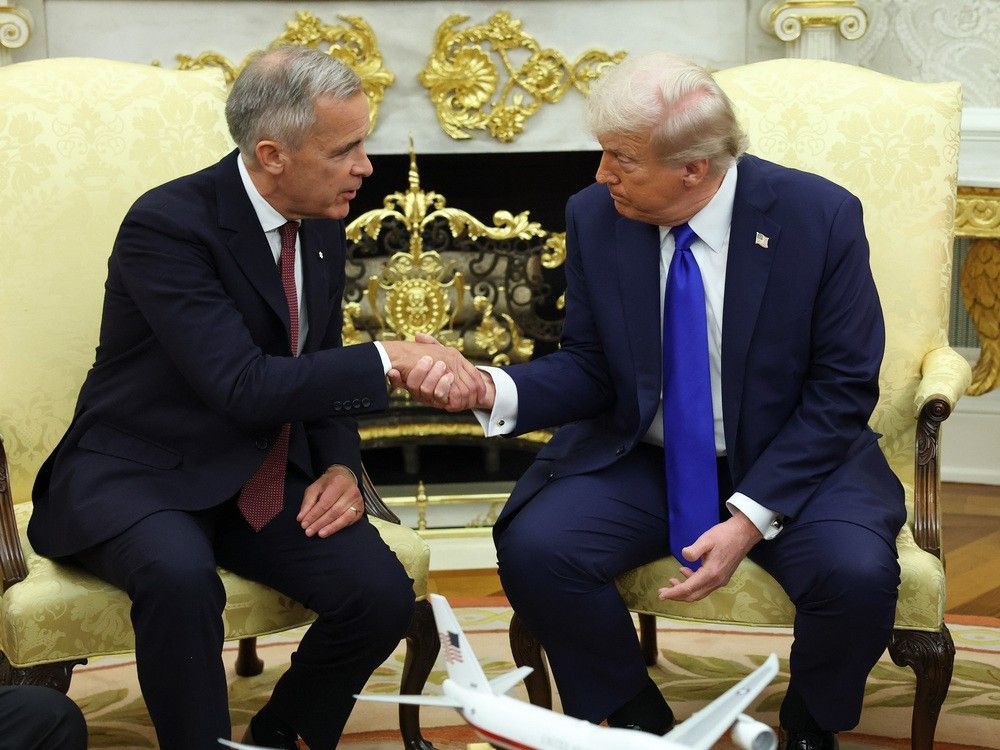
Prime Minister Mark Carney arrives to meet U.S. President Donald Trump at the White House in Washington, DC, on May 6, 2025.

Most Americans still see Canada as a solid trading partner and Prime Minister Mark Carney as a respected leader despite the ongoing trade war, a new Leger poll has found.

Two thirds of Americans (66 per cent) view Canada as either a good (39 per cent) or very good (27 per cent) partner for trade with the United States, while just nine per cent see Canada as a bad (seven per cent) or very bad (two per cent) partner.

“If I were the Canadian government,” Andrew Enns, the executive vice-president at Leger, told National Post, “I’d go, okay, it’s not a bad place to be when, at some point, we got some heavy lifting to do with the U.S. government on some big issues.”

A respondent’s political affiliation influenced their views. While 80 per cent of Democrats see Canada as a good (34 per cent) or very good (45 per cent) trading partner, only 64 per cent of Republicans feel the same (49 per cent said “good” and 15 per cent said “very good”). Just three per cent of Democrats see Canada as a bad or very bad trading partner, while 17 per cent of Republicans do.

“I suspect Republicans are taking their cues from President (Donald) Trump and probably recalling some of the things that President Trump has said, that we’re not as nice as we come across,” Enns said. “If you’re a (Canadian) government official, and you’re down in a meeting with people in Washington, in the administration, when you meet with Democrats, you’re probably going to have a friendlier meeting compared to when you meet with Republicans.”

Tensions between the United States and Canada have escalated since President Trump returned to the White House in January and proceeded to repeatedly

call

then-prime minister Justin Trudeau a governor and refer to Canada as the 51st state. Trump has also

imposed

tariffs on Canadian exports and said the northern border is porous and

exploited

by drug traffickers.

Despite the ongoing tensions, Prime Minister Carney came ahead of other political leaders surveyed, with 33 per cent of Americans having a favourable opinion of him, ahead of French President Emmanuel Macron (30 per cent), Mexican President Claudia Sheinbaum and British Prime Minister Keir Starmer (both with 29 per cent), the leaders of Germany and Japan, both with 27 per cent, and Israeli Prime Minister Benjamin Netanyahu (26 per cent). China’s Xi Jinping (12 per cent) and Russia’s Vladimir Putin (10 per cent) came last.

“I was a bit surprised by Mr. Carney’s personal rating,” Enns said. “Interestingly, in relation to other leaders, he comes across as actually quite good. Tops the list.”

Americans view Carney in a noticeably better light than former prime minister Justin Trudeau. The last Leger study gauging American attitudes, which was taken back in January, less than two months before Trudeau left office, revealed less than a quarter (24 per cent) had a favourable opinion of him.

Americans named Great Britain (17 per cent) and Israel (14 per cent) as their country’s foremost allies, ahead of Canada (12 per cent), which Enns said shows the difference between the popularity of political leaders versus nations themselves. Enns said Canada’s ranking outside the top two was a point which should trigger some thought among federal leaders in Ottawa.

“I’d look at this question and go, I’m not sure I’m super happy that we’re suddenly third place behind Great Britain and Israel in terms of being perceived by the American public as being a good friend and ally,” Enns said. “We shared the longest undefended border for quite a long time without any issues.”

Russia came in fourth with just four per cent, followed by Japan and Mexico (both with three per cent). However, large shares answered “none” (18 per cent) or “don’t know” (24 per cent).

Enns encouraged Carney to leverage his favourability “to speak directly to Americans” to convey that Canada has “been a really good trading partner.”

The poll also found that less than half (39 per cent) of Americans have a favourable view of Trump, while 48 per cent have an unfavourable view.

The online poll of 1,014 Americans was conducted between Aug. 29 and Aug. 31, 2025. A margin of error cannot be associated with a non-probability sample in a panel survey for comparison purposes. A probability sample would have a margin of error of plus or minus 3.1 per cent, 19 times out of 20.

Our website is the place for the latest breaking news, exclusive scoops, longreads and provocative commentary. Please bookmark nationalpost.com and sign up for our politics newsletter, First Reading, here.


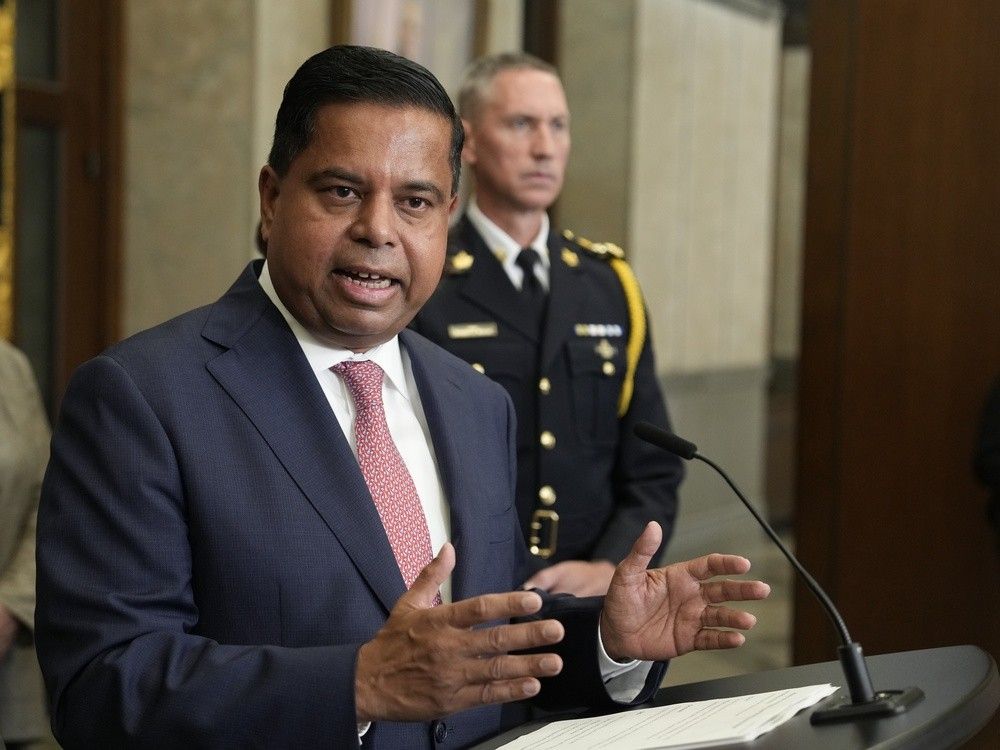
Finance and National Revenue Minister François-Philippe Champagne.

OTTAWA — Work is underway for an upcoming review on whether the tariffs Canada applied to China’s electric vehicles, steel and aluminum should remain at the current rates, the federal finance minister’s office has confirmed.

A spokeswoman for François Philippe-Champagne says imports of these Chinese products “have declined significantly since their imposition,” adding that the government had committed to review these surtaxes one year after they were implemented last October.

“Officials are currently undertaking work on this review, including an assessment of China’s policies and trade practices, and whether the scope of the surtaxes, as well as the surtax rate, remain appropriate,” Audrey Milette said in a statement to National Post, late Thursday.

“The government will continue to provide updates as relevant.” The review itself is set to begin next month.

The statement comes the same day that the Prime Minister’s Office announced it was sending a representative on an upcoming trade mission to China and lands amid

pressure from Western premiers

to drop its tariff on Chinese-made electric vehicles in an effort to see China lift its

tariff on canola

.

In August 2024, former finance minister and deputy prime minister Chrystia Freeland announced measures that the government characterized as designed to “level the playing field” for Canadian workers in both the steel and aluminum industries and the auto sector.

Starting that October, it implemented a 25 per cent surtax on Chinese steel and aluminum as well as a 100 per cent surtax on Chinese-made electric vehicles.

The Liberal government said the measures were in response to unfair competition and labour practices from China, particularly when it came to electric vehicles, given that China is the world’s largest exporter.

Officials heard that Canada’s importation of Chinese electric vehicles, which are the cheapest to buy, posed a threat to the future development of the North American market in the sector.

Its decision to levy a 100 per cent tariff on Chinese electric vehicles followed suit with an earlier move by former U.S. president Joe Biden, whose administration hiked its own tariffs on these vehicles to 100 per cent.

U.S. officials had also cited potential national security concerns related to how these vehicles were internet-connected.

Earlier on Thursday, the Prime Minister’s Office announced that Kody Blois, Carney’s parliamentary secretary, would be traveling to China as part of a trade delegation led by Saskatchewan Premier Scott Moe to address numerous “trade irritants,” including tariffs on Canadian canola.

China’s decision to levy a 76 per cent tariff on canola seed has been viewed as coming in direct response to Canada’s levy on Chinese electric vehicles.

Both Moe and Alberta Premier Danielle Smith have been calling on the federal government to remove its tariff on Chinese electric vehicles in an effort to see the dispute resolved.

The Prime Minister’s Office, in the statement announcing Blois’s travel, said it was taking steps to protect the jobs tied to Canada’s canola industry and would be announcing “additional measures in support of Canadian producers shortly.”

Sources say Carney is expected to make a wide-spanning, national-level economic announcement on Friday in Toronto, where Carney has spent the past two days meeting with his cabinet before the House of Commons resumes on Sept.15.

On Thursday, Industry Minister Mélanie Joly said there would be an announcement “in the coming days” to support Canadian industries hit by U.S. President Donald Trump’s tariffs.

Speaking to reporters on Wednesday, Carney said there was room for trade to grow between China and Canada, namely in agriculture.

“We have differences with China, different approaches to a variety of things, but they are our second largest trading partner,” he said.

“Look at the issues around canola at present and our broader agricultural export:  pea protein, other aspects and fisheries. We’re going to work hard to get that right,” he added.

“Within that context, there may be areas where… we can expand the commercial relationship with things that China does well.”

Our website is the place for the latest breaking news, exclusive scoops, longreads and provocative commentary. Please bookmark nationalpost.com and sign up for our politics newsletter, First Reading, here.


Prime Minister Mark Carney speaks to the media, at the Liberal Cabinet Retreat, in Toronto, Wednesday, Sept. 3, 2025.

TORONTO — “Tough” budget decisions, public service adjustments, incoming aid for sectors hardest hit by U.S. tariffs and the latest on ongoing trade negotiations with President Donald Trump were all on the menu for the federal Liberal cabinet meeting this week.

Prime Minister Mark Carney’s cabinet met on Thursday for the second day of a two-day retreat at a hotel in the Toronto neighbourhood of North York.

Media were permitted to be at the hotel, but ministers and their staff were kept far from reporters’ eyes and ears. The only leaks came from parts of the hotel ceiling during particularly hard rain Thursday morning, rather than from government sources with information to share.

Over the summit, cabinet heard from pollsters on the “mood of the country,” head of investment funds on private-public collaboration, and top energy executives and Scotiabank Chief Economist Jean-François Perreault on the country’s economic outlook.

It also heard from former Australian prime minister and the country’s current ambassador to the U.S. Kevin Rudd on how to best deal with Donald Trump’s administration.

Tough budget decisions and public service ‘adjustments’

The day after Carney said his government’s first budget would be a

mix of “austerity and investment,”

Finance Minister François-Philippe Champagne admitted that he is looking down the barrel of difficult budgetary choices.

“Will there be tough choices to make? Definitely. Is the nation ready? I would say, yes,” Champagne told reporters. “In our campaign, we said we’re going to spend less so we can invest more. And you know, people understand that.”

When asked where or what his government might cut, Champagne demurred. But he argued that the growth of government spending in recent years under the Liberals was not sustainable and needed to be reined in.

Asked if that meant there would be cuts to the public service, he replied that there would be “adjustments” as part of the 15 per cent cuts imposed on all departments and agencies within three years.

“Adjustments” are bureaucratese for layoffs. According to the government’s website,

work force adjustments

are “when the services of one or more indeterminate employees will no longer be required beyond a specified date due to a lack of work, the discontinuance of a function, a relocation in which the employee does not wish to participate or an alternative delivery initiative.”

LeBlanc won’t set deadline for new U.S. trade deal

After busting the self-imposed deadline of July 21 and then Aug. 1 for a new trade deal with the U.S., it appears the Carney government is done with dates.

Speaking to reporters on Thursday, Dominic LeBlanc, the minister responsible for Canada-U.S. trade, refused to set a new deadline for the end of negotiations with the Donald Trump administration.

“I like you very much and I understand that you are looking for this kind of detail,” he told reporters, refusing to detail which level of tariffs were being discussed for certain sectors.

“We are working hard to make progress because we understand the importance for workers in all regions of Canada,” he added.

LeBlanc told reporters that Canada’s ambassador to the U.S. Kirsten Hillman was in Washington D.C. this week to work on smaller, sector-specific deals on key tariffed industries like steel, aluminium, softwood lumber and autos.

Joly promises help for sectors hit by tariffs within days

If you’re in a Canadian sector impacted by U.S. tariffs, help is on the way, says Industry Minister Mélanie Joly.

Speaking to reporters on Thursday afternoon, Joly said there would be an announcement in the coming days for industries hit hardest by U.S. President Donald Trump’s tariffs, namely aluminium.

She said the government is evaluating potential major projects as a way to boost local steel, aluminium and lumber industries and offer them some stability in the coming years.

“There is also a difference between large companies and smaller businesses. What we see is that small businesses are also affected by this unpredictability, and so we must be there to help them,” Joly added.

Sources say Carney is expected to make an announcement in Toronto on Friday morning.

Head of controversial U.S. think-tank drops out

The Liberals made waves within progressive circles when they announced that the head of the Heritage Foundation, a controversial right-wing U.S. think-tank with deep connections to top Republicans, would speak to cabinet about how to deal with the Trump administration.

The Heritage Foundation is behind Project 2025, a right-wing policy roadmap that proposes slashing much of the U.S. public service, cracking down on undocumented immigrants and replacing top civil servants with conservative loyalists. Though Trump has denied any connection to the project, his administration has implemented many of its proposals.

Hours before Heritage Foundation President Kevin Roberts was slated to speak to cabinet, the Prime Minister’s Office announced that Roberts’ office said he could no longer attend. The unsigned statement did not provide a reason.

Major public service union upset at austerity

A day after Carney promised an austerity budget, the head of the largest federal public service union finally responded. And she was mad.

“Let me be clear: Prime Minister Carney’s austerity agenda is lazy, reckless and short-sighted and puts everyone in Canada at risk,” said

Public Service Alliance of Canada (PSAC) President Sharron DeSousa.

“Carney’s government has a choice — it can be forward-looking and a model employer that creates good jobs to strengthen our economy and build a resilient Canada, or it can continue to use old-fashioned, ineffective and lazy approaches like austerity that just don’t work.”

Pierre Poilievre says federal government is a ‘fat man’

Carney can’t cut into the federal government fast enough, Conservative leader Pierre Poilievre told reporters in Toronto Thursday. Poilievre argued that the Liberal government needs to focus on cutting red tape, regulation and “bloated bureaucracy”.

“Right now, the government has become a fat man and the private sector is a skinny man that is carrying that fat man up an increasingly steep hill. And that skinnier man is about to collapse under the weight of the gargantuan Carney Liberal government,” he told reporters.

“It’s time to put that government on a diet.”

National Post

cnardi@postmedia.com

Our website is the place for the latest breaking news, exclusive scoops, longreads and provocative commentary. Please bookmark nationalpost.com and sign up for our politics newsletter, First Reading, here.


Canada's Felix Auger-Aliassime returns a shot during the quarterfinal round of the U.S. Open tennis championships on  Wednesday, Sept. 3, in New York. He plays in the semi-finals on Friday.

Even losing can feel like winning sometimes. Just look at Canadian pro-tennis players participating in the U.S. Open.

Felix Auger-Aliassime

has made his way into the men’s singles semifinals. Walking away from the court on Friday a loser will still mean $1.26 million in his pocket.

And that’s in American dollars. (All amounts mentioned hereafter are in U.S. dollars.)

The only other Canadian still in the running is Ottawa’s Gabriela Dabrowski. She and her doubles partner, New Zealand’s Erin Routliffe, advanced to the women’s doubles final, also on Friday.

If they lose, they still stand to share $500,000, $1 million if they win.

They play their final before Auger-Aliassime takes to the court. It will be hectic evening for Canadian tennis fans. 

How much has the U.S. Open pot grown?

This year’s total pot for players at the U.S. Open is

a record $85 million

.

The tournament generates significant revenue from worldwide broadcasting rights, sponsorships, ticket sales, and related activities. It is the biggest annual earner for tennis professionals.

In 2024, the total pot was $70 million. However, a

21 per cent increase in the winnings this year

is still only about 15 per cent of the tournament’s approximate $560 million revenue haul.

Meanwhile, the winners for the individual men’s and women’s tournaments will walk off the court with the largest winning payouts in the sport

$5 million, up from $3.6 million in 2024.

The

tournament’s prize money

has grown for participants other than the winners too. The upgraded purse for individual players has jumped too: runners-up get $2.5 million, up 39 per cent; semi-finalists $1.26 million, up 26 per cent; quarterfinalists, $660,000, up 25 per cent. Round of 16 competitors get $400,000, up 23 per cent.

Aside from increasing the prize money, the U.S. Open also looked to lower the out-of-pocket expenses incurred by players. Competitors are given a $1,000 travel stipend and two rooms in the player hotel or $600 per day if they choose to stay elsewhere. Players also get free racquet-stringing for up to five racquets per pound. All this adds up to $5 million in player support.

How does the U.S. Open compare to other major tennis tournaments?

In comparison with other major pro-tennis tournaments, U.S. Open prize money simply dwarfs them.

Wimbledon pays a total of $72.7 million. The French Open pays $65.4 million and the Australian Open pays $62.9 million.

This year’s U.S. Open pay hike came after top players hired World Tennis Association chief executive Larry Scott to speak to the event organizers, advocating for a bigger slice of the tournament revenue pie.

Team sports in the U.S. generally give players close to 50 per cent of the profit, while tennis players generally receive only 15 per cent and 20 per cent of U.S. Open revenue, according to

The New York Times

. But the tournament is the only Grand Slam regularly filling

a 20,000-plus seat stadium

every night, with significant ticket sales contributing to the overall income.

It’s annual setting in New York City, with media and business connections, also boosts its commercial appeal.

What are Auger-Aliassime’s chances?

Seeded 25th, Auger-Aliassime will now meet top seed Italian player, Jannik Sinner. However, Auger-Aliassime’s quarterfinal win wasn’t pretty. Instead, it was “an absolute grind,” according to

SportsNet

. He appeared slow in the early going, much slower than he had been in wins during the third and fourth rounds.

Auger-Aliassime has a career high singles ranking of No. 6, which came in November 2022. But he has spent most of the last two years outside of the top 20 and dropped as low as to No. 36 in April 2024.

He came into this U.S. Open ranked No. 27. As of Wednesday, his provisional ranking is No. 13.

What about Dabrowski?

Canadian

Gabriela Dabrowski

is in her second final in three years, alongside Kiwi Erin Routliffe. She is the last Canadian woman left in the U.S. Open and

one win away from her fourth career Grand Slam women’s doubles title.

The Can-Kiwi duo prevailed to win in the 2023 U.S. Open.

What has happened to other Canadian entrants?

The other big women’s doubles match-up involving a Canadian was

Leylah Fernandez

and legendary American player, Venus Williams. They lost in the quarterfinals on Tuesday, earning $125,000 each.

Canadian

Denis Shapovalov

fell short of a win in his third round match, taking home $237,000. Shapovalov has reached as high as number 10 in the world rankings. The 26-year-old Canadian has since slipped to number 29.

The newest Canadian tennis phenom,

Victoria Mboko

ended her U.S. Open debut early, losing in the first-round on Monday. Nevertheless, she walked away adding $30,000 to her bank balance.

It was her first match since claiming the National Bank Open title in Montreal earlier this month.

Our website is the place for the latest breaking news, exclusive scoops, longreads and provocative commentary. Please bookmark nationalpost.com and sign up for our daily newsletter, Posted, here.


U.S. President Donald Trump, right, and Prime Minister Mark Carney at the G7 Summit in Kananaskis, Alta., on June 26.

Terra Nord’s paintings often feature natural themes, but this year, Donald Trump inspired a more political edge to her work. When the U.S. president provoked Canadians with his “51st state” rhetoric and tariffs, Nord created products to meet the moment.

“I hit a few Canadian designs that really took off this year,” she said, referring to her images of a beaver riding a Canadian goose with statements like “Tariff this, hoser.”

While the Terrace, British Columbia-based artist saw a brief but “enormous boom” in Canadian sales, especially for those political designs, the vast majority of her sales have gone to U.S. customers for the three years she’s been in business.

Nord, 37, has largely shipped her U.S.-bound parcels duty-free because the contents, valued under US$800, qualified for the de minimis exemption. That waiver for low-value goods shipments, however, was suspended last week by Washington, leaving global exporters scrambling as they face duties and higher shipping costs.

Nord and many other small business owners and exporters have suspended shipments to the U.S., at least for now, as they face this latest hiccup amid the U.S.-Canada trade war.

Clouds gathering?

Canada is facing economic headwinds, including slowing GDP growth and persistently high unemployment.

The economy contracted significantly more in the second quarter than economists expected, with GDP decelerating by 1.6 per cent, according to Statistics Canada. The total annualized growth for January to June was modest, at just 0.4 per cent.

While the unemployment rate has held steady, it has done so at an eye-watering 6.9 per cent. Nearly 41,000 Canadians lost their jobs in July, and 83 per cent of those – some 34,000 jobs – were once held by young people, aged 15 to 24.

Business owners, meanwhile, are cutting spending and delaying hiring decisions.

Merchant Growth, a lending company specializing in finance solutions for small businesses, recently surveyed 150 of its clients and found that the majority of them are making changes. A whopping 76 per cent have cut spending, 38 per cent have delayed hiring, and over half of them believe the economy is in dire straits.

“Sixty-one per cent of the business owners we surveyed believed we were in a recession,” said David Gens, CEO of Merchant Growth, noting how that was a couple of months ago. “It’s only gotten worse since then.”

While some economists believe Canada is at risk of recession — it’s not officially there, as the country has avoided two consecutive quarters of negative GDP growth — it’s definitely a tough time for small businesses.

Corinne Pohlmann, executive vice-president of advocacy for the Canadian Federation of Independent Business (CFIB), pointed to how demand for virtually everything has gone down.

“One of the biggest barriers right now for a lot of small companies — that’s keeping them from growing — is that customer demand has been decreasing quite a bit over the last six months.”

“Everybody’s holding onto their dollars a little bit more.”

While U.S. tariffs have been largely absorbed by Canadian businesses so far, she said, “the additional financial strain from that and from losing duty-free shipping will only exacerbate their challenges.”

 Terra Nord shows off a T-shirt featuring one of her new designs inspired by U.S. President Donald Trump’s “51st state” rhetoric and tariffs on Canadian goods. Although she normally ships mostly to U.S. customers, the new designs sparked a boom in Canadian sales. Courtesy Terra Nord.

Strained balance sheets

As a result of trade pressures, Merchant Growth is seeing a lot of lending activity this summer, a time when business is usually slower. More and more small businesses — those with revenues under $5 million annually — are increasingly seeking financing options to boost their working capital.

“We’ve seen growth of about double what we saw last year at the same time,” Gens said. He noted that the firm’s average loan is $40,000 and that it funded about $230 million in loans last year.

Small companies need more working capital to adjust to the changes they’re being forced to make. This involves either getting certified to send goods duty-free by becoming Canada-US-Mexico Agreement (CUSMA) compliant, establishing new supplier relationships to qualify for CUSMA compliance, raising prices, or finding new markets.

Most of the small businesses that relied on the de minimis exemption for shipping never bothered to seek CUSMA compliance because it didn’t affect their bottom lines. Now it does.

To get certified, businesses must account for where the components of their products come from – the more that originate from Canada, Mexico, or the U.S., the better. For most products, the required threshold is 62.5 per cent. But given that it’s a self-certification process, and that businesses could be subjected to audits, Pohlmann said business owners should seek professional guidance to reduce their risks.

If products that Canadians are exporting include too many elements from further afield, they may want to shift to CUSMA-compliant suppliers to save on duties. But finding these suppliers takes time, and shifting involves its own challenges.

“You don’t have credit yet with that supplier, so you’re gonna have to pay up front for everything,” Gens said

Alternatively, simply paying the added duties and broker fees, said Pohlmann, would mean having to charge customers more. “It’s going to take a product from being 20 or 25 bucks to being 40 or 50 bucks, suddenly overnight,” she said, noting how many owners are trying to figure out how to navigate the added costs without losing customers or eating into their already thin profit margins.

Another option is for small Canadian exporters to start marketing their products to alternative markets. But, again, this takes time and money. CFIB members have reported that they expect it would take up to nine months to shift customer bases, said Pohlmann.

Having adequate working capital, Gens explained, is important for filling the gaps between finding these new consumers and getting paid.

In search of lifelines

Many experts have emphasized the need for federal support to help small businesses navigate this tough period.

Merchant Growth recently asked its members what they would most like to see by way of federal help. Unsurprisingly, given their business focus, the No. 1 demand was access to more credit and liquidity. Bank loans are expensive, but government loans can be made at better rates and for longer terms, Gens noted.

Other items on the wishlist included permanent tax relief, expansion of the small business deduction limit, a refundable credit for supply chain diversification, as well as wage and hiring incentives, rent subsidies, and a lighter regulatory burden.

Pohlmann’s CFIB, meanwhile, says that loans like those from the Business Development Bank of Canada – which are meant to be easier to access to deal with the tariff costs – are fine, but not ideal. Provincial loans are also available, but they tend to require a lot of investment up front from the borrower, which excludes smaller businesses.

“A lot of our members and small businesses in general are still trying to pay off COVID debt,” she said. “So the last thing they want to do is add more debt to get through yet another crisis.”

Instead, the CFIB is trying to get Ottawa to see beyond lending – namely by returning some of the money raised from retaliatory tariffs to small businesses. Before Prime Minister Mark Carney cancelled these retaliatory duties on Sept. 1, the government raised billions.

“Much of that (money) came from smaller companies,” Pohlmann said. “We’d love to see some of that money returned to small companies to help address some of the challenges they’re facing as a result of these tariffs.”

Carney has yet to announce any de minimis-related relief measures.

The CFIB recommends that the money be returned in the form of a rebate or tax cut. Eliminating the small business tax rate, for example, could help businesses reinvest in their facilities and get through the tough period, she said.

Hazy outlook

A CFIB survey of its members showed that 19 per cent feared they would not be able to survive another six months of tariffs without facing difficult decisions – either closing shop, laying people off, or finding a new business model. But, Pohlmann said, that data was collected before Carney cancelled the retaliatory tariffs, which could offer some relief.

What would help even more, however, is getting to a point where there’s some certainty again in U.S.-Canada trade. Ideally, that involves Carney and Trump reaching an agreement, preferably one with fewer tariffs, Pohlmann said.

Barring that, “we need to make sure there are supports out there for small businesses that have been directly impacted and hurt by these just as much as some of those larger companies,” she added.

Like many Canadian exporters, Nord faces a choice: She must decide whether to get CUSMA certified so she can ship her art to U.S. customers duty-free – or find another way to pivot and thrive. For now, she’s designing a colouring book with animals engaging in human activities – without a beaver, goose, or tariff in sight.

National Post

Our website is the place for the latest breaking news, exclusive scoops, longreads and provocative commentary. Please bookmark nationalpost.com and sign up for our politics newsletter, First Reading, here.


Onlookers stand behind a police line as Municipal Civil Defense personnel inspect the area surrounding the wrecked Gloria funicular on September 04, 2025 in Lisbon, Portugal.

A Canadian citizen was among the 21 people injured in a fatal streetcar crash in Portugal’s capital city, the head of Lisbon’s Civil Protection Agency told reporters, The Canadian Press is reporting.

Authorities in Lisbon are still trying to determine how the historic Elevador da Glória funicular derailed and crashed into a building on Wednesday evening.

The death toll from the tragedy climbed to 16 on Thursday after two of the injured died in hospital, according to the

Associated Press.

National Post has contacted Global Affairs Canada to confirm a Canadian was on board and injured.

Victims ranged from a three-year-old toddler to adults up to age 65, some from Portugal, while many were tourists from throughout Europe, South Korea and Cape Verde.

 The wreckage of the Gloria funicular is pictured the day after an accident killed 16 in Lisbon, on September 4, 2025.

Emergency crews had all the people extracted from the grisly crash site within two hours.

The Elevador da Glória, one of three in the city, is a 19th-century national monument and a major tourist draw in Lisbon, linking Baixa to Bairro Alto. At its summit is Miradouro de São Pedro de Alcântara, a historic terrace offering panoramic views of the city.

“It lets you turn a steep climb into a romantic moment and was opened in 1885 as the second of its kind in the city,” the city’s tourism website describes it. “Although it was only electrified in 1915, it still retains its original characteristics.”

Carris, the company that operates the streetcar, said regular maintenance had been performed and pledged full cooperation with the investigations underway. The city’s other funiculars are out of service while they undergo inspection.

Portuguese President Marcel Rebelo de Sousa declared a national day of mourning on Thursday while Lisbon Mayor Carlos Moedas decreed three days of “municipal mourning.”

“I extend my heartfelt condolences to all the families and friends of the victims,” Moedas wrote on X.

Our website is the place for the latest breaking news, exclusive scoops, longreads and provocative commentary. Please bookmark nationalpost.com and sign up for our daily newsletter, Posted, here.


Whether you own your home may affect what you deem to be a comfortable annual income, according to a new survey.

For many Canadians, an annual household income of $100,000 is necessary to feel comfortable, according to a new survey.

However, the amount required to feel at ease differs depending on age, the size of a given household, whether they own their home and where they live.

In June, Canadian magazine,

MoneySense

, teamed up with Leger Marketing research to survey more than 9,000 Canadians living in 79 different Canadian cities. The survey canvassed five income options between $74,200 up to $250,000.

$100,000 was the most popular option, chosen by 37 per cent of survey respondents. The next biggest group, 25.8 per cent, chose $150,000. Somewhat fewer respondents, 23.8 per cent, chose $74,200. Much smaller groups opted for the higher options of $200,000 (8.5 per cent) and $250,000 (4.9 per cent).

According to

Statistics Canada

, $100,702 was the average disposable income for Canadian households in 2024.

Looking to individual incomes, the

top 10 per cent earners in Canada

earn at least $125,945 annually. To be in the top 25 per cent, the amount to reach is $81,184. Individual Canadians earning between $57,375 and $114,750 are considered middle-class.

How does the cost of living impact income comfort?

The adequacy of income is linked to the cost of living, which changes over time. For example, $100 in 2020 is equivalent to $118.14 today. In other words, it would take $118.14 to buy the same goods/services today that took $100 in 2020. But Canadians whose wages have risen accordingly should fare better.

Canada’s major banks look at “affordability” based on the rule that average shelter costs should not exceed

30 per cent of gross household income

.

However, there are additional measures of affordability such as transportation, food, utilities, clothing and leisure.

CareerBeacon

looks at affordability based on those measures, as well as renting rather than owning a home. It looked at Canadian cities with populations of 50,000 or more and looked at the annual income required for an individual to be comfortable in each.

The results vary from about $58,000 to over $106,000. Perhaps predictably, the most expensive cities are set near major job centres such as Toronto and Vancouver, while more affordable cities are outside large metro areas and have lower housing demand.

The cities requiring the highest incomes to feel financially comfortable are:

Richmond Hill, ON – $106,536

Milton, ON – $106,392

Whitby, ON – $105,624

Coquitlam, BC – $104,928

North Vancouver, BC – $103,512

The cities where comfort comes with a lower income are:

Trois-Rivières, QC – $57,936

Sherbrooke, QC – $64,920

Medicine Hat, AB – $70,416

Fredericton, NB – $71,784

Sault Ste. Marie, ON – $72,744

How does inflation affect the buying power of income?

The adequacy of income

fluctuate

s with inflation. Statistics Canada tracks inflation by keeping tabs on the prices of a so-called “basket” of goods and services. The prices of these items add up to an average known as the

consumer price index

, or CPI.

Inflation was close to 2 per cent per year for 25 years – until COVID-19 hit. In 2022, inflation surged above 8 per cent – the highest since the 1980s. Then when the economy reopened, Canadian demand for goods and services surged, hindered by supply chain disruptions that drove prices higher and left many Canadians struggling.

In 2022, the

Bank of Canada

began an aggressive campaign to tame inflation, with 10 interest rate increases in less than two years. It worked.

How have annual incomes in Canada kept up with inflation – or not?

Still, the news still hasn’t been good for all Canadians, especially with regard to increasing income to deal with increased cost of living.

Wages increased amid the higher-income brackets, with those Canadians often coming out last five years with bigger investment portfolios boosted by the higher interest rates. (When interest rates rise, most stock prices tend to fall, making them more affordable.)

“Based on our analysis, the price of the basket of goods and services has increased by 15 per cent since 2019, but disposable income has increased by 21 per cent, supported by government transfers, wage gains and net investment income, thereby improving the purchasing power of most Canadian households,” said Parliamentary Budget Officer Yves Giroux in a 2024 press release.

However, he conceded that “since 2022 rising inflation and tighter monetary policy have reduced purchasing power for lower-income households.”

Our website is the place for the latest breaking news, exclusive scoops, longreads and provocative commentary. Please bookmark nationalpost.com and sign up for our daily newsletter, Posted, here.

Swimmer Kristian Gkolomeev.

“We are the vanguard of Superhumanity!” the rebel exclaims from the stage. It is an audacious brag — a stomp on the grave of purity, hypocrisy and Darwin.

“In 50 years,” he prophesies, “we will look back and realize that biology was never the ceiling!”

In response, the be-knighted Olympic champion in the 1,500-metre run — and current president of World Athletics — clutches his antique ideals to his bosom and offers a tender bon mot:

“Bollocks!”

It is the sweltering summer of 2025, a fateful year of supermen and tipping points in human progress — or human degradation, depending on your point of view. The rebel is Aron Ping D’Souza, a 40-year-old Chinese-Indian-Australian scion via Oxford Law with a ninth-floor office on Madison Avenue in New York City.

The skeptic is Lord Sebastian Coe, Olympic track champion and advocate for “Clean Sport,” though sport, as we all know, has been dirty for decades.

“We are here to move humanity forward, to redefine what humanity can be, with audacity,” D’Souza announced in Las Vegas in May, unveiling his

Enhanced Games

, which will be inaugurated next spring in Sin City — where else? — with sprinting, swimming and weightlifting events for the methodically, medically, unashamedly, triumphantly doped. Rock ‘Em Sock ‘Em combat sports, D’Souza posits, will come later.

Funded to the tens of millions by billionaires who aspire to achieve immortality in their own lifetimes, D’Souza is out to demolish nothing short of the Olympic Games themselves, and to make a trillion dollars selling anabolic steroids and other performance-enhancing pharmaceuticals. His backers are, among others, Donald Trump Jr.’s venture-capital fund and the transhumanist founder of PayPal and Palantir

Peter Thiel

, who has poured many millions of dollars into ventures to transcend mere mortal flesh. (A profile of D’Souza in The Financial Times reported that “Silicon Valley insiders” refer to him as Thiel’s “professional son.”)

“Want To Evolve Humanity?” lures the Enhanced Games website, trolling for new hires for this enterprise, which aims to “push the boundaries of human performance.” There will be no testing for banned substances. All entrants will be paid for taking part and they cannot use illegal drugs such as heroin or cocaine.

“Clown show!” sneers a man named Travis T. Tygart, CEO of the U.S. Anti-Doping Agency.

In a two-part series, we are going to dig deeper than mere boasts and insults into the current state of the human future, from the Enhanced Games (Part 1) to “wearable robotics” (Part 2). Competitive sport is a metaphor for “progress” that quantifies achievement in milliseconds, and the Olympics are an easy target. But around the world there are millions of men and women who cannot sprint at all, cannot swim, cannot stand, cannot caress the people they love, and they also await their shot at superhumanity.

“There are some people out there who aspire to be Homo sapiens,” D’Souza has said, encapsulating his, and Thiel’s, core belief. “They aspire to live, suffer, age and die. But I believe that through technology and science, we can overcome this.

“Today, we stop apologizing for progress and embrace it!” D’Souza announced at the Vegas kickoff.

“We’re ripping off the Band-Aid!” choruses the Canadian Olympic bobsledder who is one of the very few women in a leading role with the Enhanced Games. This is Christina Nathalie Smith of Calgary, from whom we will hear quite a bit.

“It’s a movement! It’s a revolution!” Smith tells me.

“Behold, I teach you the Übermensch: he is this lightning, he is this madness!” cries Friedrich Nietzsche in Man and Superman. “I screw up all the time! But that is being human! And that’s my greatest strength!” says the Man of Steel, in this year’s blockbuster movie.

Time will tell whether Aron D’Souza turns out to be Martin Luther or Lex Luthor. What is certain is that the merger of men and medicines and machines is coming for all of us, and nothing will ever be the same.

“There’s no going back,” says Smith, endorsing what D’Souza calls “a new vision of sport and science and human potential … normalizing and celebrating performance medicine.”

“Your Path to Superhuman Starts Here,” the Enhanced website’s featured product page promises, offering a place on a waiting list for a forthcoming “Testosterone Protocol” for US$19.

“You are defining ‘Superhumanity’ by blood chemistry alone,” I challenge D’Souza when I meet him on Madison Avenue.

“Why would we want to be Human 1.0?” he ripostes.

To the titled barons of Olympia, pharmaceutical performance enhancements are kryptonite — bad for business — unless the Chinese are using them, or the East Germans and Sovietskis of old. (They said the same thing about professionals, then caved when Michael Jordan and Magic Johnson dribbled into Barcelona ’92.)

D’Souza and Trump Jr. and Thiel and their ilk are out to demolish Olympic duplicity, snobbery and bribery. But so far, their ground troops are a meagre handful of Samsons on steroids — athletes past their prime who are willing to risk excommunication from the five-ringed cathedral to try to clip a blink off the world record for the 100-metre dash or the 50-metre freestyle and earn a million-dollar gratuity from the promoters of this endeavour.

“Every great institution when it was first proposed was met with a storm of negativity,” D’Souza tells me in Manhattan, playing defence. “Look at Martin Luther and Protestantism — they would have burned him at the stake. Martin Luther King? The idea that we have civil rights was an outrageous concept in the 1960s. Artificial intelligence? If you survey the American people, most of them are very negative about its impact on our society. But someday we will say, ‘How did we live in a world without enhancement?’”

At press time, only five athletes — all swimmers, none Canadian — have cast their lot publicly with the Lords of the Syringe and their big-bucks world-record bonuses.

“I’ll juice to the gills and break it in six months,” gushed one of them, a retired, 34-year-old Aussie and three-time Olympic medallist swimmer named James Magnussen.

“The future isn’t for those who watch the clock, it belongs to those who break it, who step outside of time,” said Aron D’Souza in Vegas.

In a practice run, Magnussen touched the timer a few hundredths short of the million-dollar prize in the 50-metre freestyle swim. But in February, a Bulgarian-Greek Olympian swimmer named

Kristian Gkolomeev,

who won multiple NCAA championships for the University of Alabama a decade ago, decided to roll with the pharma tide and spent two months injecting a craft brew of what D’Souza and Christina Smith et al would prefer that we not call “drugs.” They favour “enhancement.”

The drugs — and a high-tech swimsuit that for some reason is not allowed in Olympic competition — did their job. The challenger beat the existing mark in the 50-free by 00.02.

“I feel,” Gkolomeev said, “kind of like a superhuman.”

“Moronic,” said Lord Coe of anyone and everyone enhancing for the D’Souza rebellion.

In late August, the Enhanced Games filed a US$800-million antitrust lawsuit against its detractors for what it claims is an illegal campaign to make athletes boycott its event. The lawsuit was filed in federal court in New York, naming World Aquatics, USA Swimming and the World Anti-Doping Agency as defendants.

The lawsuit keys on a rule adopted by World Aquatics earlier this year that threatens to banish athletes who compete in “sporting events that embrace the use of scientific advancements or other practices that may include prohibited substances and/or prohibited methods.”

“Excellence should always be rewarded, and these exceptional athletes deserve exceptional compensation. We’ll continue to fight for all athletes to ensure they receive it,” D’Souza says in

a statement.

‘A revolution for athletes’

We are chopsticking Singapore noodles on the banks of the Bow River in Calgary’s old Chinatown, and Christina Smith’s eyes are welling with tears. It’s not the curry — it’s our conversation about the Ancient Olympians of the Peloponnesus and how valiantly they strived.

Those naked grapplers and runners whose exertions we admire on pottery jars from the sixth-century BC set the tone for the young men and women who still surrender their best years to sweat and obsession and a longshot chance at a golden token. But what matters to Smith, who will turn 57 on Christmas Day and who finished ninth in the inaugural two-woman bobsleigh at Salt Lake City in 2002, is how little money most 21st-century athletes earn.

It is D’Souza’s promise to pay every Enhanced Games entrant just for showing up that has Smith on board as his associate director of community relations.

“I think that some things come up emotionally when you think of that,” she says. “And I think it’s more that I found a voice. And there’s often in sports, when I look back, that I didn’t have a voice.

“This has been really uplifting and empowering. It’s essentially a revolution for athletes to be able to stand up and say, ‘You know what, we’re worth something.’ And so, when I think about my position, I also think about it as a role that I get to actually speak to athletes that have been through hardships or have been accused, for example, of doping, whereas their circumstances really all vary.

“Some may be blatant, others may be very, very safe, so minor, but (they’re) treated as criminals.”

Smith says that she asked 40 people from her Olympic and post-Olympic career — including her coach and her brakeman — if they would consent to be interviewed for this article, and nearly every one of them said no.

“There was huge hesitation around being somebody who would say, ‘Stand up and share your voice,’” she says.

“You’re out there all alone now,” I tell her.

“Yeah. And there’s no going back. But I feel that when you know what’s going on, I would much rather stand for what’s right and be alone than to stand behind something that is wrong and look the other way.”

“Why do you think that, the last time I looked, only five athletes have signed up for the Enhanced Games?” I ask.

“Well, there’s concerns about perception. There are concerns that all the hard work that they’ve done previously would be tainted, as if they had done it enhanced all along,” Smith says.

“But whether they’re with us or not, all athletes should be recognized and paid. The athletes who are under our umbrella should be proud that they are role models to showcase their hard-work ethic and their transparency of what they’re doing.

“A lot of them are actually reaching out to us, which is really positive. However, let’s say there is a difference between the regular population, who’s really keen, and the calibre that we’re looking for.

“I have a lot of people wanting to be like, ‘Use me.’ I tell them, ‘That’s not what we’re looking for. We’re not looking for guinea pigs,’” Smith says.

“When you competed, you never wanted to be called a cheater, did you?” I ask.

“Never. Even from a young age, I knew that if there are rules and you break them, that is cheating. And the thing is that in the Olympic Games, they have rules. And if you break those rules, you’re cheating.

“And so, our rule is that you have to be transparent and above board with what you’re doing to your body. What it comes to, at the end of the day, is that our rules are different.”

The fact is that the old rules were scant deterrence. Even in the elite and rarefied world of bobsledding, Smith says, “looking back at the men’s program, you would see the transformation over the summer, the definition and the bulk. Well, they were recruiting Olympic sprinters! I was always so naive. They would tell me that, ‘Oh, they’ve been at their grandpa’s farm running after chickens.’”

“If in 2002 someone had said, ‘Take this pill, no one will ever know and you’ll win a gold medal,’ would you have taken it?” I ask.

“No, no, not a chance. Actually, when I was on the edge of retiring, I was struggling with an injury and a powerlifter guy came up to me and said, ‘Christina, how bad do you want to get back?’ And I looked at him and I felt shivers going through my body and I said, ‘Not that much.’ I went home and I felt icky, like somebody would even think that I would do that.”

Christina Smith’s Alberta license plate is OLMPIAN. She is passionately, existentially attached to the brand. And now this.

“I know it’s a tough situation,” she says in Calgary’s Chinatown. “Parents might be thinking, ‘Why would we want Christina to be in front of our children?’”

Beyond the limits of naturally existing humans

“When you took steroids, did it make you feel superhuman?” I ask Richard Singh of Paris, Ont.

“Honestly, honestly, it definitely did,” he replies. “There’s definitely a euphoric feeling to knowing that all the effort you put in is going to work, right? There’s definitely a superhuman element to that. I’m a huge comic book fan. I would define a superhuman as somebody who is beyond the limits of naturally existing humans.”

I am in Waterloo, Ont., in a handsome home whose garage-load of iron discs and bars and chains suggests a medieval torture chamber, not the apparatus of gentlemanly competition. Singh is a former champion in the discipline of powerlifting, one of the few major international “amateur” sports that has divided itself into two separate but equal divisions: one for the chemically enhanced, and one for the certifiably clean. (Powerlifting branched off from Olympic weightlifting half a century ago, diverging in lifts and equipment — and eventually in the permitted or banned use of steroids.)

My host, Bruce McIntyre, founding president of the Canadian arm (and what an arm!) of the World Powerlifting Congress, was one of the non-users. His friend Singh was not.

“We run an untested group, so we don’t care what you do,” says McIntyre, who spent his professional life in computer software. “And then we run a tested group where, if you get caught, you can’t lift again in the tested and you’ll lose all your records.”

“Why did you choose to use steroids?” I ask the prodigious Singh, who is a professional poker player by trade. (He says that many pro poker players take Adderall and other pharmaceuticals to sharpen their concentration, but there are no drug tests or banned substances.)

“I set benchmarks for myself to do certain things, tested, and I never really entertained the thought of using any kind of enhancement,” Singh testifies. “But I took what I did very seriously. And to put in the hours I did training and the time I spent eating all the right things and all the massages and chiropractic and all those things, I just asked myself, what did I want to accomplish? It kind of became a necessary thing. I decided to do it because I wanted to lift the absolute highest amount I can do. I wanted to push myself to the absolute end. And it’s a very necessary tool to do that.

“There’s definitely a stigma around it,” he admits. “But I’m sure anybody who’s been around for a couple of years knows that the best in the world would still be the best in the world if everybody was clean. I’ve never found a drug or compound that will lift the weight for me.

“I never felt like it was somehow cheating or underhanded. I mean, the nice part of what we do is that you can compete on an even playing field untested.”

“We’re saying, ‘Great, everybody should be able to lift,’” McIntyre adds. “If they want to take on the risk associated with the enhancement process, cool. And then for those that don’t — and there’s a bunch of us that don’t — we don’t really care.”

A market for human enhancement

Charles Darwin, realizing that he was besieging the Book of Genesis, vomited nearly every day. But Aron D’Souza, messing around with Übermensch, is as hale as a hurdler.

“Why did I pick the Olympics?” he muses on Madison Avenue. “Because no one watches Formula Two, everybody watches Formula One. Nobody watches minor-league baseball, everybody watches major-league baseball. There is no point in creating a second-tier sports franchise. If we’re going to embark on a journey, it has to be the premier competition.”

He claims to have the business angle of putting the Olympic Games out of business all figured out.

“Imagine it’s Los Angeles in 2028 and the announcer is saying, ‘Now, the eight fastest natural men in the world are going to try to break Usain Bolt’s natural world record,’” he suggests to me. “But then the other announcer goes, ‘Um, are they going to break the enhanced world record?’

“That changes the dynamics. I don’t think NBC will pay billions of dollars to broadcast a second-tier sporting competition.”

“Will they pay you a billion dollars?” I ask.

“We don’t want it. We make money in a completely different way. We make money by selling pharmaceutical drugs. We make money by bringing a market for human enhancement into existence.”

“How do you have an Olympics without flags and anthems and teams?” I naysay.

“The beauty of what we do is that we’re a company and I make the decisions. As we go forward, we can add teams and nations. The Chinese dislike the Olympic system, and Russia’s been kicked out completely for a decade now. How interesting is the Olympics if it’s only Denmark and Sweden?

“Our opening ceremony will be about the march of human progress. Winning medals at the Enhanced Games will be a proxy for the economic and technological prowess of a nation,” D’Souza says.

“What if the IOC caves and says they’re not going to have drug testing in L.A.?” I ask.

“I would probably go to my grave a happy man because that would mean our business of selling enhancements would be very successful, and also it would mean that we achieved a moral victory.

“The IOC has a lot to lose,” D’Souza reckons. “They’ll throw everything that they have at us. But they’ve had a 120-year monopoly, and they’ve abused their position and everyone knows it.”

The prohibited list

Ken Kotyk

is a farm boy from a dot called Rama on the Saskatchewan flatlands who aspired to live in three dimensions. He ended up on the Canadian Olympic four-man bobsled team that missed out on a bronze medal at Torino in 2006 by nine one-hundredths of a second, which is about how long it takes a rattlesnake to strike.

Now, at the age of 44, Kotyk is trying to make the team for the Milano Cortina Winter Olympics in 2026.

“If there was something made by some company above board and they said, ‘We make this, you take this, you’ll be there,’ and it would give you the nine one-hundredths,” I ask him over tea on Calgary’s tony 17th Avenue South, “would you do it?”

“I wouldn’t do it,” Kotyk answers. “And I know I wouldn’t do it because I already looked up some stuff that I thought was going to take — some peptides to just heal my body — and they were on the

prohibited list

. So, I was like, well, I can’t take that.”

“Who gets the right to draw up the prohibited list?” I ask.

“Someone was asking me the same question today. They’re like, ‘Who’s making the list? Who’s drawing the line?’ I don’t even know where the line is. If we’re talking about being ‘pure’ pure, then it would be taking nothing, it’d just be eating food. There’d be no creatine, there’d be no vitamins, it would just be water and food, and that would be it.”

“Yeah,” I concur. “But what’s in the food?”

“I grew up on a farm, so I guess I’m assuming food’s just food.”

“How would you define the word superhuman?” I ask the once and maybe-future Olympian.

“I’d say maybe people that are in the elite of the elites in whatever sport that they’re in,” Kotyk answers. “Maybe not even sport. It could be like Einstein — that’s superhuman.”

Advances in science, technology, medicine, have come through sports

“Intrigued,” says

Patrick Jarvis

, an upper-arm amputee, Paralympic competitor at Barcelona ‘92, and former president of the Canadian Paralympic Committee. “I am not so quick as to just say right or wrong.

“The gut reaction, if you’re in a position of power and influence, you take a stand right away, and it’s probably a moral stand. Or self-protective, because then you get into that whole avenue of who’s really benefiting in these major organizations.

“I was even more intrigued by leaping back to a study that had been done with Olympic athletes that showed that 90 per cent of them would give up their life to win a gold medal. It was crazy. So, I was intrigued by the morality and the ethics of these Enhanced Games.

“But I’m also very intrigued because of my natural affinity for parasport and people with disabilities. And because advances in science, technology, medicine, have all come through sports.

“When you take a look at how many institutions have become incredibly powerful and wealthy off the backs of athletes’ performances, that was another thing that intrigued me when I heard that there was this huge prize money.

“That seems appropriate. Give it to the athletes. If you are an athlete and not in the top eight, that’s quite an inducement,” Jarvis says.

“At one point, you were the one who made the rules,” I note.

“Right,” Jarvis concurs. “I think that when there are rules and standards and parameters, you get this abhorrence and this outrage when somebody’s caught because the public’s expecting the rules to be followed.”

Now comes Aron D’Souza and his tribe, raising their own money and making their own rules in a world where Ideas + Investment = Power.

“Fifty years from now, that might be where we head, but right now there seem to be too many things against them,” Jarvis says. “But you know, on a philosophical bent, I look at the horrible things in the world, such as war, but so many technological advances come from war, right?”

It is worth mentioning in this context that the word “superhuman” often is applied to parathletes like Patrick Jarvis, even though these women and men might reasonably be considered physically diminished from birth or by injury or accident rather than enhanced. For example, when the Paralympics came to London in 2012, Britain’s Channel 4 television network heralded its coverage with the tagline, “Meet the Superhumans,” then repeated the campaign for the 2016 and 2020 Games with, “We Are the Superhumans,” and, “Super. Human,” respectively.

Yet, according to a 2022 survey of Canadian Paralympians conducted by researchers from Western University, most Paralympians reject the term altogether. The study quotes an athlete named “Janice” as saying this: “I would never say I’m superhuman by any means. Just someone who loves to play sports and has a good time with it. That doesn’t make me a superhuman.”

“This isn’t bathtub science,” Aron D’Souza insists. “Why should we accept our biological limits? Why should glasses be allowed and not EPO (erythropoietin)? Performance enhancements very obviously work — why should we ban technology that works?

“What is the next age of mankind?” he muses. “I think there are only two options: there’s the artificial age where AI is superior and man is inferior, or the enhanced age, where the point of all technology is to enhance the human condition.

“I can see an age in which, just as we have hip-replacement surgery and it’s commonplace, that humans will choose to enhance themselves long before disability sets in. There’s going to be this blurring between man and machine.”

And that’s exactly where we will go in Part 2.

Olympics for everyday people

So many critics like Lord Coe & Co. have decried Aron D’Souza’s baby as “The Bad Games” that one may wonder, “Why doesn’t somebody invent something that we could call ‘The Good Games.’”

Former Canadian World Cup soccer player Helen Stoumbos of Guelph, Ont., already beat the world to it. Stoumbos’s

Good Games

just celebrated their 2025 instalment, luring more than 1,500 competitors and 20,000 spectators to Guelph in late June for a festival of spectator and participatory sport that enfolded everything from pro-calibre beach volleyball to “walking soccer” for older adults to a three-legged race.

“My Good Games are for fun and enjoyment,” Stoumbos tells me in Guelph. “I call them ‘the Olympics for everyday people.’ But I don’t know if I would call what they are doing ‘The Bad Games’ because I think they’re just opening up a door to something that’s being done and they’re showing it off rather than hiding it. But then I’m like, where does that end? Five years down the road, are you going to have heart issues or other issues from the drugs?

“Where do we cross that line to just accepting it? There will be kids watching and looking up to these athletes and thinking, ‘That’s what I want to do,’” Stoumbos says.

“Can a needle make you superhuman?” I ask.

“If that needle then allows you to train harder, which means your mind then can push harder, and you’re able to do feats that were not possible before, then it would make you more superhuman than previously.”

For those who want to go beyond

“I’m as squeaky clean as they come — I was clueless about all of this,” agrees Christina Nathalie Smith, of Aron D’Souza’s Enhanced Games.

“I was petrified to even eat poppyseed salad dressing, just in case something would show up in a urine sample as opioids. I lived so, so strict. Everything was bland. My meals were plain. Doping wasn’t even on my radar. I never thought about it. It never crossed my mind.

“But after I retired, I looked back and started noticing the contrast. I’d remember:  that girl on the other team, she had a deeper voice, she came from powerlifting … And it disheartens me.

“Did I also compete in an environment where my teammates, or my friends from other countries, were doing it?

“I don’t want to know.”

She begins to cry again.

“It’s upsetting, you know,” she says. “There’s so much pressure on athletes. So much incentivizing by countries. Fame and fortune.

“I think there has to be two avenues: One for those who want to stay natural — I want them to have a platform to show how good they can be.

“And another side — for those who want to go beyond, to be ‘superhuman.’

“Do it safely. Don’t hide it.

“We need to give people access — to do it properly and safely.

“The people who recruited me said, ‘We’re going to allow steroids. We’re going to make enhancement legal. There won’t be drug testing — but there will be health testing.’

“To me, that’s a dream world.”

“Isn’t this just a clown show?” I ask, quoting the CEO of the U.S. Anti-Doping Agency.

“They don’t know any better. And if they do, they’re afraid of us.”

The Pharmaceutical Games

Nietzsche again:  You have your way, I have my way. As for the right way, the correct way, the only way, it does not exist.

“Honestly, I think it’s a horrible idea,”

Jungle Jim Hunter

is saying. “I believe it sends all the wrong messages to a world culture that desperately needs good ones.”

Hunter, 72, is another Saskatchewan farm boy who headed for the hills. In his downhill-racing prime, he was the vanguard of super-insanity, leading the Crazy Canucks onto the World Cup and Olympic podiums, addicted to what I defined at Lake Placid in 1980 as “the mechanics of controlled abandon.”

Now a friend whom he has known for decades has signed on for the biotics of controlled injection.

“We’ve spoken many times at various runs and walks, and I didn’t even know Christina had made the move until a couple of months ago,” Hunter tells me in Calgary. “But every time she asked me to get involved, I said, ‘Christina, I can’t. You know what I’ve done with kids. This is sending all the wrong messages to them. I can’t — for all the reasons I stand for.’

“I know my Olympic history. I knew what (Pierre) de Coubertin tried to do — inspire the youth of France and the world,” he says of the 19-century father of the modern Olympics. “I thought the Olympics were on the right track, doing the right thing. But now, personally, I believe every Olympic athlete, by the end of their career, feels exactly what Christina is talking about. It’s rare to find an Olympian who doesn’t carry some resentment unless they’ve drunk the IOC Kool-Aid and fully bought in.

“That ‘Band-Aid’ she’s referring to? It will eventually get ripped off. I paid my own way to become an Olympian. I know what it takes to get there. I know how many times I ate food other people were about to throw away at ski lodges — that’s how badly you have to want it.

“What D’Souza is trying to do is exactly what I predicted back in 1988 — that it was only a matter of time before all athletes would say, ‘If you want us to come to the Games, you’ve got to pay us.’ That still hasn’t fully happened, but it’s coming.

“These will become the Pharmaceutical Games — and that’s sad. I’ve been training kids since 1997. Kids today are in worse shape than when I started, and they were in bad shape back then. This is just another rabbit trail — another way to put drugs in the hands of kids who shouldn’t have them.

“I think this will be another trend that comes and goes. It’ll have its moment, and then it’ll be over. But I could be wrong. I have no doubt they’ll set records. I have no doubt about that. But I don’t believe it will make the IOC cave in.

“I think we’re going to see athletes die in the arena. Guys so strong, so powerful, that others will be killed by them.

“Isn’t there any bastion left where we demand people play fair? We get furious when our kids aren’t treated fairly or don’t play fair. Why would we want someone to win a medal that’s tainted? We should be going the opposite way. East Germany was drug-infested. They didn’t last. Just because you put pharmaceutical science behind something doesn’t mean people will care the way you think they will.

“I’ve always taught every athlete I’ve ever worked with: no one can go beyond 100 per cent. The real ‘superhuman’ to me is the person who gets as close to 100 per cent of their capacity as possible.

“Even getting to 80 per cent is something.

“I don’t think the world will buy into this idea.

“If you gave me a ticket to these new Games, I’d throw it away — right into the garbage can.”


United Conservative Party MLA Jason Stephan.

OTTAWA — Alberta United Conservative Party MLA Jason Stephan is doubling down on his

call for a referendum

on the province’s independence next year, saying the vote would be a critical expression of popular will.

Stephan said in a wide-ranging interview with the National Post that it’s time for Albertans to have their say on the province’s future in a united Canada, after a decade of punitive Liberal policies has brought the province to a breaking point.

“Alberta has unfortunately suffered greatly under the government that we have in Ottawa, and I’m very much in favour of a robust public discussion about something that has impacted Albertans so deeply,” said Stephan.

“I think a referendum would be a very important part of that conversation because it would give Albertans a chance to weigh objective facts and choose accordingly.”

Stephan wouldn’t say how he’d vote in said referendum.

“I’d look to arm myself with the truth, as best as I understand it, and then make a decision based on the merits. My hope would be for each and every Albertan to do the same,” said Stephan.

He did say that the question proposed by the pro-independence Alberta Prosperity Project (APP) — “Do you agree that Alberta shall become a Sovereign country and cease to be a province of Canada?” — is a fair one to put to Albertans.

“I do have faith and confidence in the merit of the question the (APP) has put forward. It’s pretty clean, clear and unambiguous,” said Stephan.

He said he disagreed with the decision of Alberta’s chief electoral officer, Gordon McClure, to

refer the question to the courts

, a move that means that APP canvassers won’t be able to start collecting signatures until winter at the earliest.

Stephan said that the judicial review itself reflected a troubling pattern of courts

overreaching into legislative domains

, a trend he hopes to help beat back in his new role as the UCP government’s parliamentary secretary for constitutional affairs.

He was appointed to

the constitutional affairs post

in late May, two weeks after becoming the first Alberta MLA

to publicly call for

an independence referendum.

Stephan, a lawyer by training, said that activist judges could be a canary in a coal mine indicating a coming crisis in Canada’s constitutional order.

“Our judiciary is a very important institution (but) when we see courts moving into areas that are clearly outside of our lane, that’s where you start to see an erosion of trust among the public,” said Stephan.

“If you compare our country to a house, I think of our Constitution as the foundation. Once that foundation erodes, unfortunately, it puts the whole house at risk of caving in.”

Stephan raised a number of eyebrows, including

among his fellow conservatives

, in July when he

said in a press release

that Alberta should cut ties with King Charles III.

He was unrepentant when asked about the statement on Wednesday.

“Symbols matter. Having a figurehead king makes it easier for us to have a de facto king between elections.” Stephan was referring to the period between Prime Minister Mark Carney’s victory in the Liberal leadership race in March and when he faced the broader electorate in a federal election in April.

Stephan said that he favoured a system of “checks and balances”, like the one used in the U.S., but did allow that President Donald Trump has tested that system’s limits.

“Unfortunately, the current president sometimes acts in ways that we haven’t seen from other presidents (but) I don’t think I’d define the U.S. system and its success by reference to one president,” said Stephan.

He said that one thing the Founding Fathers got entirely right was the concept of a government by and for the people.

“I’m a pretty big fan of the principle of popular sovereignty,” said Stephan.

Stephen that he sees his role in a future referendum campaign as an honest broker of information, rather than a cheerleader for one side or another.

“If there’s lying or fear-mongering, I will speak up to refute that,” said Stephen.

“I think it’s my duty to speak the truth as best as I understand it. I’ve done that and I will continue to do that.”

National Post

rmohamed@postmedia.com

Our website is the place for the latest breaking news, exclusive scoops, longreads and provocative commentary. Please bookmark nationalpost.com and sign up for our daily newsletter, Posted, here.