LP_468x60
on-the-record-468x60-white

Canada's Liberal Leader Mark Carney (L) gestures towards Conservative Leader Pierre Poilievre (2nd R) during the French-language Federal Leaders' debate at Maison de Radio-Canada in Montreal, Quebec, Canada, on Wednesday.

OTTAWA — Strawberries became an unexpected topic at

Wednesday night’s French debate

in Montreal, with three of the four party leaders saying they’ve stopped buying American berries amidst trade tensions.

“I buy Quebec strawberries, and I do my own shopping by the way,” Bloc Québécois Leader Yves-François Blanchet told debate moderator Patrice Roy, when asked to name one U.S.-made product he no longer buys.

Blanchet’s aside was a cheeky shot at Liberal Leader Mark Carney, who acknowledged to Radio-Canada earlier this month that he doesn’t

buy his own strawberries

anymore, now that he has a staff to do his daily chores as Canada’s prime minister.

Not to be left out, NDP Leader Jagmeet Singh told the moderator that he now goes out of his way to buy a range of Canadian-grown produce, including both strawberries and apples — a fruit Conservative Leader Pierre Poilievre famously chomped on in

a viral 2023 video

.

“I do my own shopping, and I cook at home,” Singh said, one-upping Blanchet.

“Everybody is eating a lot of strawberries today,” quipped Roy following Singh’s response.

Poilievre called the lighthearted exchange a “delicious conversation” and added that Canadian sourced beef is the top sirloin in his household.

“I buy Canadian beef, it’s the best beef in the world,” said Poilievre, who grew up

in Alberta’s cattle country

.

“But I never buy American strawberries either,” he added.

For his part, Carney said that he’s stopped buying U.S. beer and wine — though the LCBO’s

ban on American booze

prevents residents from purchasing those products.

The English debate is scheduled for 7 p.m. ET on Thursday.

National Post

rmohamed@postmedia.com

Get more deep-dive National Post political coverage and analysis in your inbox with the Political Hack newsletter, where Ottawa bureau chief Stuart Thomson and political analyst Tasha Kheiriddin get at what’s really going on behind the scenes on Parliament Hill every Wednesday and Friday, exclusively for subscribers. Sign up here.


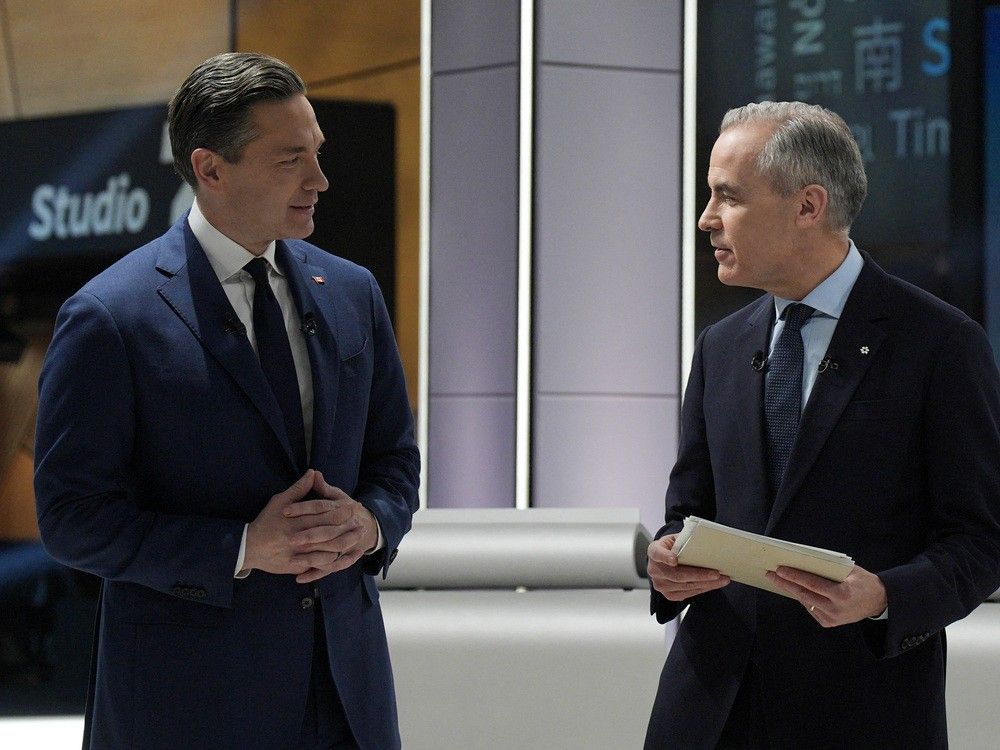
Canada's Liberal Leader Mark Carney (R) and Conservative Leader Pierre Poilievre chat following the French-language Federal Leaders' debate at Maison de Radio-Canada in Montreal, Quebec, Canada, on April 16, 2025.

OTTAWA — What is going on with the polls this

federal election

campaign?

Click here to review the Q&A with Leger pollster Andrew Enns.


Things are looking tighter between Mark Carney’s Liberals and

Pierre Poilievre

’s

Conservatives

with just over 10 days left before the votes are tallied. That’s still a massive and shocking shift for the Tories, who had held a strong lead for over a year before

President Donald Trump

began threatening Canada’s economy and Liberals brought in

Carney

as their new leader, after the resignation of the unpopular Justin Trudeau in January.

How did the Conservatives suddenly fall into second place, despite the fact that their polling support numbers are higher than they’ve been for the last two elections?

In fact, some Conservatives are skeptical that the polls truly reflect the reality on the ground, given that

Poilievre has been holding massive rallies

, at times with more than 10,000-people strong, and Carney’s campaign has been unsettled by controversies and gaffes. Are the polls really capturing all the Conservatives’ supporters who tend to be younger and have been less politically engaged in the past?

Meanwhile, the

NDP

’s support appears to have collapsed compared to previous campaigns and the

Bloc Québécois

is struggling to keep up with the Liberals for support in Quebec. Where have these supporters gone, and why did they suddenly switch so early in the campaign? Does that also mean they could switch back? What happened to Quebec’s strong nationalist voters?

Well, it depends who you ask. Different pollsters are showing different results, with some polls even showing the Conservatives tied with the Liberals or in the lead. The latest Postmedia-Leger poll also shows that Liberal support is overwhelmingly based on fear of Trump, while Conservative support is heavily based on hope for a better future. Results from various pollsters nevertheless show consistently that Carney is perceived by more voters to be able to handle the tariff war with Trump, while Poilievre is considered stronger on domestic issues including cost of living, immigration, and law and order.

Andrew Enns, executive vice president of Leger, the official pollster for Postmedia and the pollster with a consistent record of accuracy answered reader questions on Thursday. The latest Postmedia-Leger poll came out Wednesday, and Andrew took questions about it, about what’s really happening with the polling this election campaign, and how pollsters are measuring support given the difficulty in reaching certain segments of the population.
The conversation was moderated by Stuart Thomson.

This is a historic election and a lot could still change in the next 10 days. Review Enns’ answers in the comment section below.

National Post


Conservative Leader Pierre Poilievre has said his government, if elected, would use the notwithstanding clause in the Charter to pass a law allowing judges to give mass murderers consecutive sentences.

As Canadians are set to mark the 43rd anniversary of the Charter of Rights and Freedoms on Thursday, Pierre Poilievre promised this week that his government would invoke a never-before-used section at the federal level to keep mass murderers in prison until death.

The Conservative leader first

pitched the idea of utilizing Section 33

last year, but his new pledge comes as Canadians are about to head to the polls with crime and safety still a major issue, even in the shadow of Donald Trump’s tariffs and the ongoing affordability crisis.

However, unlike those issues and others influencing decisions on April 28, it’s likely that for many voters, the complexity of the notwithstanding clause may require added context as a campaign topic.

Here’s what you need to know.

What is the clause, and how was it meant to work?

Without delving into an eye-glazing history of the

Charter

’s 1982 signing and proclamation, the notwithstanding clause — sometimes called override power — is a “legislative instrument” added at the behest of the provinces to allow “provincial legislatures or the federal department to declare that an Act … shall operate notwithstanding certain provisions in the Charter of Freedoms,” explained Dave Snow, University of Guelph political science associate professor, whose areas of focus include criminal justice and constitutional law.

“To be frank, most of the important rights — your fundamental freedoms in Section 2, your legal rights in Sections 7 through 14 and your equality rights in Section 15.”

 The Canadian Charter of Rights and Freedoms.

Sections dealing with language, mobility, and democratic rights are untouchable.

The clause can only be applied for five years at a time, after which government must vote to re-enact the law. With mandated four-year election cycles, this allows the public to weigh in on government’s use of power.

When and where has the clause been used before in Canada?

It’s never been used at the federal level, though members of parliament have brought forward private bills, none of which have passed.

Last year, Bloc Quebecois MP MP Denis Trudel put forth a bill that would effectively put into law the reasonable time limits established by the Supreme Court in its 2016 Jordan decision by

invoking the clause to create an exemption

to those deadlines to primary designated offences — the most violent and serious crimes under Canada’s Criminal Code.

Provincially, however, it’s been used 27 times to varying degrees of success, mostly by Quebec (17), the chief critic of the Charter and the only province other than Saskatchewan to successfully use the clause for the first 15 years of its existence.

The most famous use of the clause, Snow said, was in 1988 when Quebec invoked it to circumvent the Supreme Court’s ruling in the

French-only signage case.

After that, “there’s this big gap between 1989 and 2018 when only one province outside of Quebec passes a law invoking” the clause, Snow pointed out.

That was Alberta, which successfully used it in a 2000 bill to limit marriage to a man and a woman, only to have it rendered useless because matrimony is under Ottawa’s constitutional purview.

In 2018,

Saskatchewan became the first province to use it since 2005

, though it was later deemed unnecessary, after which Quebec employed it again, and Ontario did so twice. Saskatchewan was the last to see it succeed on a law surrounding parental consent with regards to pronouns or names their children use at school.

“The polling data I’ve seen shows that, as an abstract thing, Canadians tend to be more opposed to (the notwithstanding clause) than in favour,” Snow told National Post. On

Saskatchewan’s most recent

, however, he said “most polling showed that more people favoured the use of it than did not, not just in Saskatchewan, but everywhere in Canada.”

Still, Snow insisted that it’s unexpectedly become a “Quebec thing” in recent years as it’s been used to promote French language and culture.

 Dave Snow, University of Guelph political science associate professor.

What does the clause have to do with mass murderers?

For first-degree murder in Canada, there is a mandatory 25-year sentence before parole eligibility.

In 2011, the Stephen Harper-led government brought in

a sentencing provision

giving judges the power to apply consecutive life sentences for individuals found guilty of multiple murders.

Two likely come to mind for Canadians: 2014

New Brunswick Mountie-murderer Justin Bourque

and Alexandre Bissonnette, who massacred six Muslim people at a Quebec mosque in 2017.

Bourque got 75 years before parole, while Bissonnette was dealt 40.

However, both sentences were reduced to the standard

25 years without parole

, and the Harper-era provision was neutered following the

Supreme Court’s unanimous 2022 ruling

against the Crown’s appeal to make Bissonnette wait 50 years for parole eligibility.

Multiple murderer Alexandre Bissonnette ruled eligible for parole after 25 years — not 40

“Under this provision, a court has the power to sentence an offender to imprisonment for life without a realistic possibility of parole for 50, 75 or even 150 years,” wrote the nine judges, led by Justice Richard Wagner.

“In other words, in the context of multiple first-degree murders, all offenders to whom this provision applies are doomed to spend the rest of their lives behind bars, and the sentences of some offenders may even exceed human life expectancy. Not only do such punishments bring the administration of justice into disrepute, but they are cruel and unusual by nature.”

Toronto criminal defence lawyer Danielle Robitaille, who served as an intervenor on behalf of the B.C. Civil Liberties Association in the case, said the decision, which she heralds as “eloquent and moving,” firmly established that everyone — “even the vilest criminal” — is owed a shot at rehabilitation within Canada’s justice system.

“What the court found is that what’s important for the system in a life sentence is that you don’t extinguish the possibility of parole, even though everyone concedes that in these cases of multiple murder, it’s extremely remote that parole would ever be granted and we’ve seen that with our most notorious historical cases of multiple murders,” she told National Post.

 Lawyer Danielle Robitaille.

Snow countered, saying the decision made assumptions about Canadians’ feelings regarding stacked sentences without any evidence of those feelings.

“It’s in these instances where I think it’s perfectly appropriate, whether I agree with the policy or not, for Parliament to say ‘we disagree with this interpretation of rights, we disagree with the way the Supreme Court has determined what both cruel and unusual punishment is, and what a reasonable limit on that is, and we’re going to offer an alternative interpretation.’”

How are Pierre Poilievre and the Conservatives proposing to use the clause?

Poilievre, who cited both Bourque and Bissonnette when making the campaign commitment, said a Tory-led parliament would use the notwithstanding clause to restore the sentencing provision.

“The worst mass murderers should never be allowed back on our streets,”

he said Monday morning

. “For them, a life sentence should mean what it says: a life sentence. They should only come out in a box.”

The Conservatives say the victims’ Charter rights and those of their families forced to testify and relive the trauma at mandatory parole hearings, along with the rights of law-abiding Canadians, are at risk from murderers potentially released.

In their view, a murderer’s punishment should be proportional to the number of people they killed.

“I will use the Charter to protect the Charter,” said Poilievre, who also vowed to only use Section 33 to “fight crime.”

On the campaign trail, NDP Leader Jagmeet Singh said he was already worried about the provinces using the clause “more and more,” while Liberal leader Mark Carney called it a “very dangerous step” that could lead to further “politicization” of criminal justice.

“We have a Charter of Rights and fundamental freedoms in this country, and it’s the responsibility, in my view, of the prime minister of the government of Canada to defend that Charter, those fundamental rights.”

Because few, if any, would stand up for the rights of a mass murderer like Bissonnette, Robitaille recognizes most voters will feel strongly about the topic. But she’s critical of the clause being used to stoke the already “inflamed passions of the Canadian public.”

“Because it’s precisely in this context that the constitutional balance is set up in a way that the Court is responsible for safeguarding and protecting the most outcast, the most vulnerable, protecting the minority against the rage of the majority.

“To use and wield the section to usurp that protection, I think, is irresponsible and distasteful.”

Her biggest fear is seeing Canada’s justice system start to resemble that of the United States, where prisoners are sometimes given sentences longer than any human could imagine living.

Snow disagreed, downplaying any notion of long-standing rights being infringed and said it can be good for a democracy to have elected representatives disagree with the courts on this particular issue.

Politicians leaving everything to the courts, he said, sidesteps a degree of responsibility on topics on which Canadians should be engaged and informed in the event the court gets it wrong.

“I think we’re a healthier country when we at least debate the merits of having some involvement from our democratically elected representatives on these contentious issues of rights, on which I should say reasonable people disagree, reasonable judges disagree, and which in this instance is of a very new interpretation by the Supreme Court of Canada just three years old.”

Our website is the place for the latest breaking news, exclusive scoops, longreads and provocative commentary. Please bookmark nationalpost.com and sign up for our daily newsletter, Posted, here.


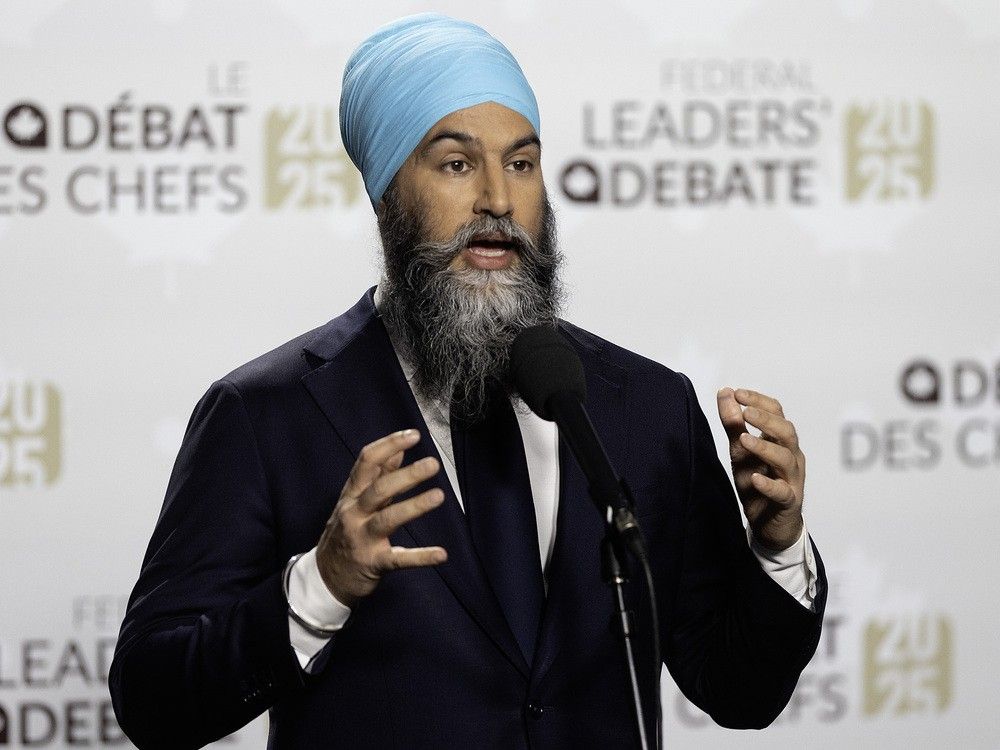
NDP Leader Jagmeet Singh following the French federal leaders' debate in Montreal on April 16, 2025.

OTTAWA — The microphone was cut only once during the French-language debate on Wednesday night, and it was to stop NDP Leader Jagmeet Singh from speaking.

Near the end of the debate, Singh accused other leaders of wanting to cut health care when Radio-Canada veteran anchor Patrice Roy, who was moderating the event, said he needed to move on to other subjects because time was limited.

Roy called Singh’s name two times, before counting to three. Singh didn’t stop.

“Cut the mic,” Roy told his producers. Turning to the NDP leader, he said he had let him go on a little longer earlier in the debate, but added he now needed “to speed it up”.

Two minutes later, Singh was asked about Quebec’s controversial use of the notwithstanding clause to protect the French language. He said he agreed with the need to protect French and quickly pivoted to attack Roy, whom he accused of silencing him.

“During this debate, I tried to raise the question of health a few times and Mr. Roy stopped me several times,” he said. “Look at the time on the clock,” he added.

The clock indeed showed that Singh had spoken the least out of all the four leaders on stage at 18:46 minutes. In comparison, the others were closer to 22 or 23 minutes.

“It’s a question of identity in this country. I’m passionate about questions of health and every time I tried to speak about it, Mr. Roy stopped me. It’s unfair,” Singh added.

The moderator said the subject of health came up earlier in the debate but ultimately let the NDP leader say his piece about how he believes other leaders will cut health care.

In the end, Singh ended up speaking for a total of 22:10 minutes, whereas the other leaders spoke closer to 25 minutes.

In his closing remarks, Roy apologized for having cut his microphone.

Speaking after the debate, Singh said he felt very “passionate” in the moment.

“Ultimately, the (time) difference wasn’t as big, but initially I was worried about it,” said Singh about the original time discrepancy between him and the other leaders.

The leader of the New Democrats said he was “really proud” that he was able to make the case to Canadians that his party would “stand up” for free and universal health care.

“It is so fundamental to who we are as a country. We fundamentally believe that we should take care of each other, and health care represents that value. So, I raised that,” he said.

Singh said he spoke with Roy after the debate and there was no bad blood between them.

The English-language debate is set to take place Thursday evening at 7 p.m. ET.

National Post

calevesque@postmedia.com

Get more deep-dive National Post political coverage and analysis in your inbox with the Political Hack newsletter, where Ottawa bureau chief Stuart Thomson and political analyst Tasha Kheiriddin get at what’s really going on behind the scenes on Parliament Hill every Wednesday and Friday, exclusively for subscribers. Sign up here.

Our website is the place for the latest breaking news, exclusive scoops, longreads and provocative commentary. Please bookmark nationalpost.com and sign up for our politics newsletter, First Reading, here.



As the Dragoons entered Leeuwarden, rain and the sound of isolated gunfire echoed through empty city streets.

On April 15, 1945, the Royal Canadian Dragoons (RCD) liberated the city of Leeuwarden, Netherlands.

As they entered the city, rain and the sound of isolated gunfire echoed through empty streets. Though there was not a big battle, Noakes points out that no one knew at the time that this was the tail end of the war. Everyone was still on high alert. Though there were still German troops present, the sight of Canadian armoured vehicles was a sign to them that Leeuwarden was liberated.

When the Germans withdrew, crowds began to cheer and wave flags as they welcomed the Canadians.

Now, 80 years to the date, the SC Cambuur football club is celebrating the town’s liberation with the unveiling of a special jersey inspired by the Dragoons’ classic uniform.

The uniform features the Canadian Maple Leaf pattern design and the Dragoon’s badge — a springbok antelope running through a grassy plain, symbolizing the regiment’s involvement in the South African War.

The announcement comes from

X

, where SC Cambuur revealed a short video narrated by 100-year-old veteran Jim Parks, a veteran of the Royal Winnipeg Rifles.

The RCD is a senior armoured regiment of the Canadian Army and Canada’s first full-time cavalry unit, forming one-third of the Regular Force and part of the Royal Canadian Armoured Corps.

It originated as the “Cavalry School Corps” on Dec. 21, 1883, and amalgamated with the Canadian “Mounted Rifle Corps” in June 1892, and was redesignated as the “Royal Canadian Dragoons” on May 24, 1893.

Dr. Jeff Noakes, a Second World War Historian at the Canadian War Museum, described the Dragoons as a reconnaissance regiment.

“An important part of the work is intelligence,” Noakes said. They are on the ground to see what the situation is, where the enemies are, and to look for potential obstacles that can delay their advance, he said.

The liberation of Leeuwarden began in April 1945, when the Dragoons were tasked to disrupt German communications and assist in the liberation of the Friesland Province in the Netherlands.

On April 10, the Dragoons continued through the province and toward its capital, Leeuwarden, with the task of cutting off main communication routes coming to and from the city and to capture it if possible.

Leading up to April 14, the Dragoons advanced northwest of Leeuwarden and liberated small Dutch villages along the way. They managed to cut German communications in Leeuwarden and established a connection with the Dutch resistance within the city.

On Sunday, April 15, 1945, the Dragoons liberated Leeuwarden.

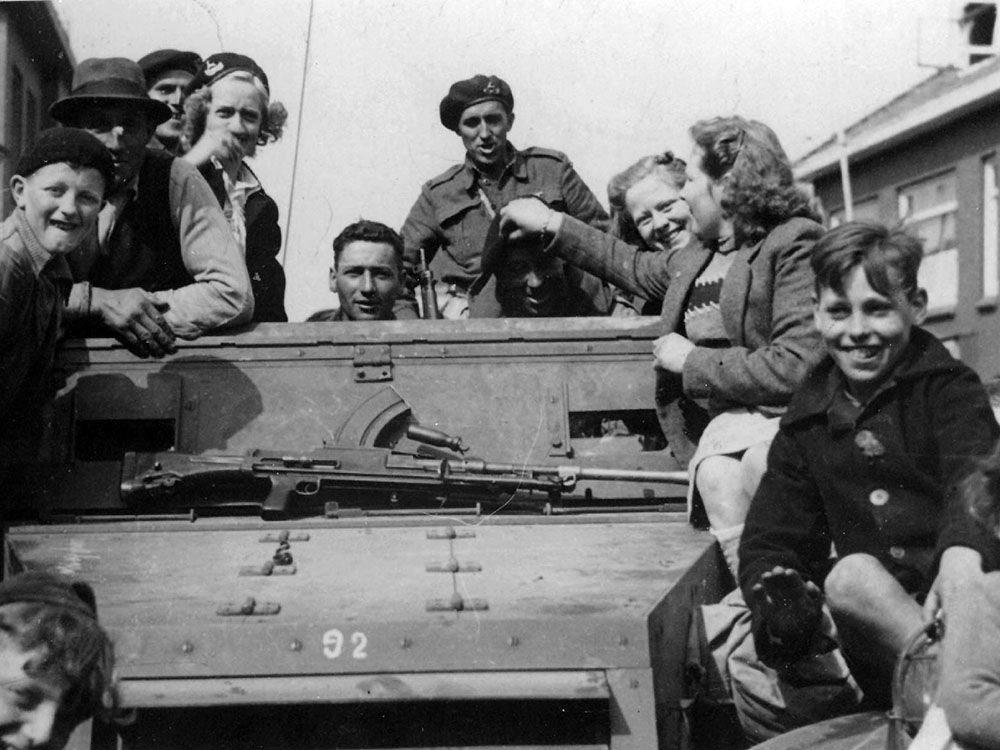
 Leeuwarden residents celebrate as Dragoons roll through the liberated city in 1945.

The liberation of Leeuwarden is celebrated annually, and the Dragoons are still welcomed as heroes when they visit the city.

The commemoration for the 80th year of the liberation of Leeuwarden included a parade in Petawawa, Ont., where the base of operations for the Dragoons is located, and the flying of the Leeuwarden flag at their headquarters, while the flag of the Dragoons was flown by the city of Leeuwarden to mark the occasion on their side of the Atlantic. Leeuwarden Mayor Sybrand Buma visited Petawawa for the parade.

Noakes said that people from both countries would call the museum and ask about the liberators of their communities or if their relatives helped with the liberation of the Netherlands.

The shirt is a collaboration between Adidas and SC Cambuur and is a limited edition. However, at the time of publication, due to popular demand, it has been restocked and can be purchased until Aug. 23 for 80 euros.

According to their website, the SC Cambuur will wear the jersey in their match against Vitesse, another football club, on April 25.


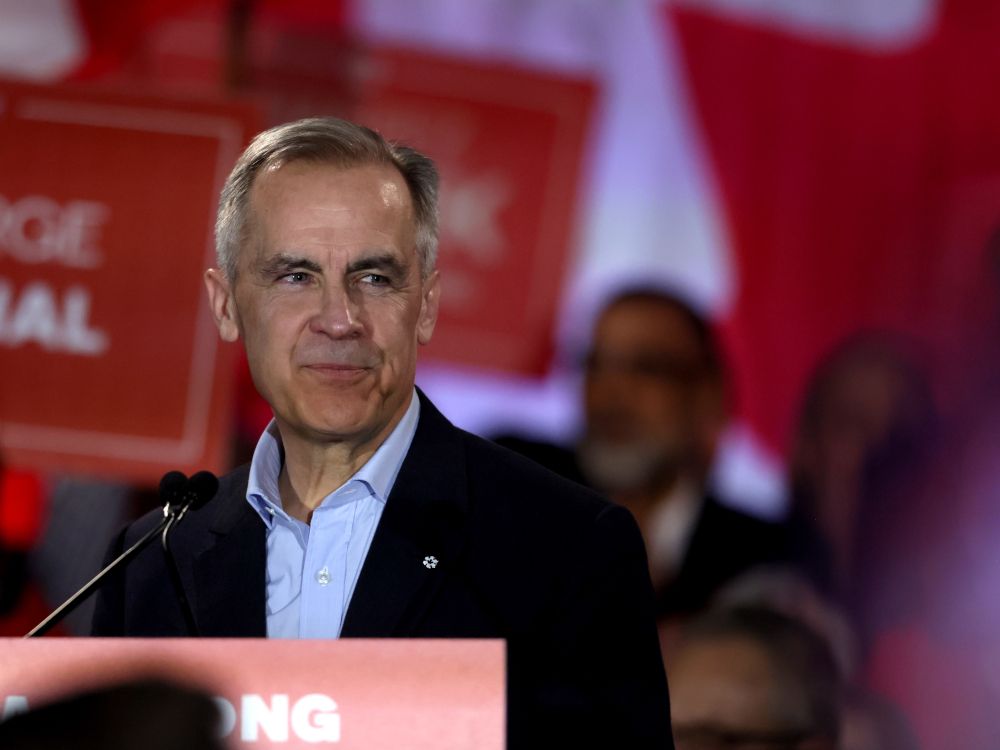
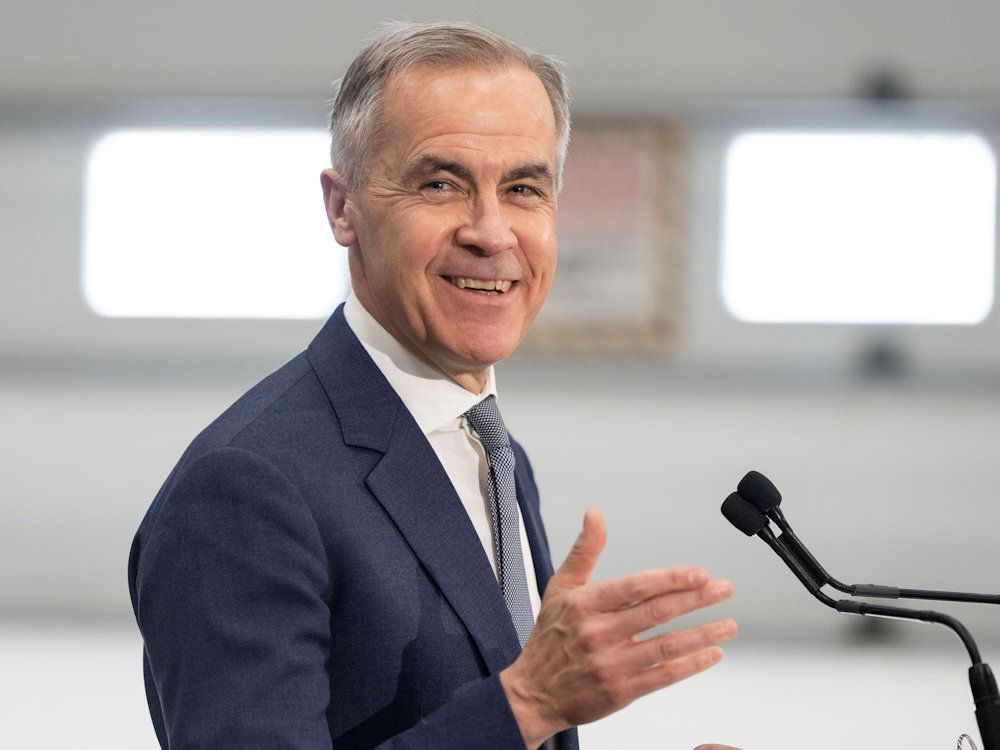
Liberal Leader Mark Carney during a rally at the Red and White Club in Calgary on Tuesday, April 8, 2025.

Second in a series of profiles of the major party leaders.

Now that Donald Trump has won two presidential votes, though he notoriously claims three, it is easy to forget how disorienting the Brexit referendum was to the political and economic establishment, and how similar a shock.

Brexit happened not long before the first Trump win in 2016, and it seemed to announce a new era. It took down a British prime minister who had argued, alongside the Governor of the Bank of England, Mark Carney, that leaving the European Union was a terrible idea for the U.K., tantamount to economic self sabotage, ginned up by a chaotic new populism that tugged on modern conservatism from the farther right.

So it fell to Carney, now Canada’s Prime Minister seeking his first election to public office, to use monetary policy to absorb those shocks. And he did. There were recriminations about him being a doomsayer, and accusations of being so unclear on interest rates that he got tagged with the “unreliable boyfriend” nickname in the financial press. But it could have been a lot worse. Doom was dodged.

Canada faces similar economic fears today, and similar imperatives to resolve volatile geopolitics with economic reality. These have transformed Carney from a long-running Liberal daydream to the front runner in the polls.

“Has there ever been a prime minister with a résumé so suited for this job, at least on the economic management side? But at the same time there has never been a prime minister so inexperienced,” said Elizabeth Goodyear-Grant, professor of political studies at Queen’s University and director of the Canadian Opinion Research Archive.

Running a central bank or hedge fund is different than governing a country like Canada. There is less visibility, and fewer regional and provincial balances to strike, Goodyear-Grant said. Carney’s career has been an escalating series of jobs managing money and setting rules behind the scenes for others to follow, but he has less experience playing them out himself before the public, and barely a few weeks experience as a governing party leader.

Carney studied at Harvard and Oxford, and worked for the investment bank Goldman Sachs in London and Tokyo before serving both Liberal and Conservative governments in Canada as an economic policy advisor. He was Governor of the Bank of Canada through the 2008 financial crisis, and on the strength of Canada’s resilience, became the first non-British Governor of the Bank of England (he holds Irish citizenship, and became British in 2018, but has started the process of renouncing both to be solely Canadian). He later took up roles in global climate and finance with the United Nations, and in the private sector with Brookfield Asset Management and fintech firms Stripe and Bloomberg.

“I find him fascinating,” with his “long flirtation” with the Liberal Party, and the obvious sense that he was only interested if he could have the top job from the get-go, said Jim Farney, professor of political studies at the University of Regina, director of its graduate school for public policy, and an expert in the politics of Canadian social conservatism.

“He clearly has a global network and global sense of Canada and thinks of us in that global setting. We haven’t had a PM except arguably Trudeau père with that sensibility,” Farney said. “It’ll be interesting to see what his team looks like when he gets to make it himself. He has no problem making big changes quickly. The question is how does that run into official Ottawa, which is more hierarchical, with more stress on a leader’s ability to make decisions.”

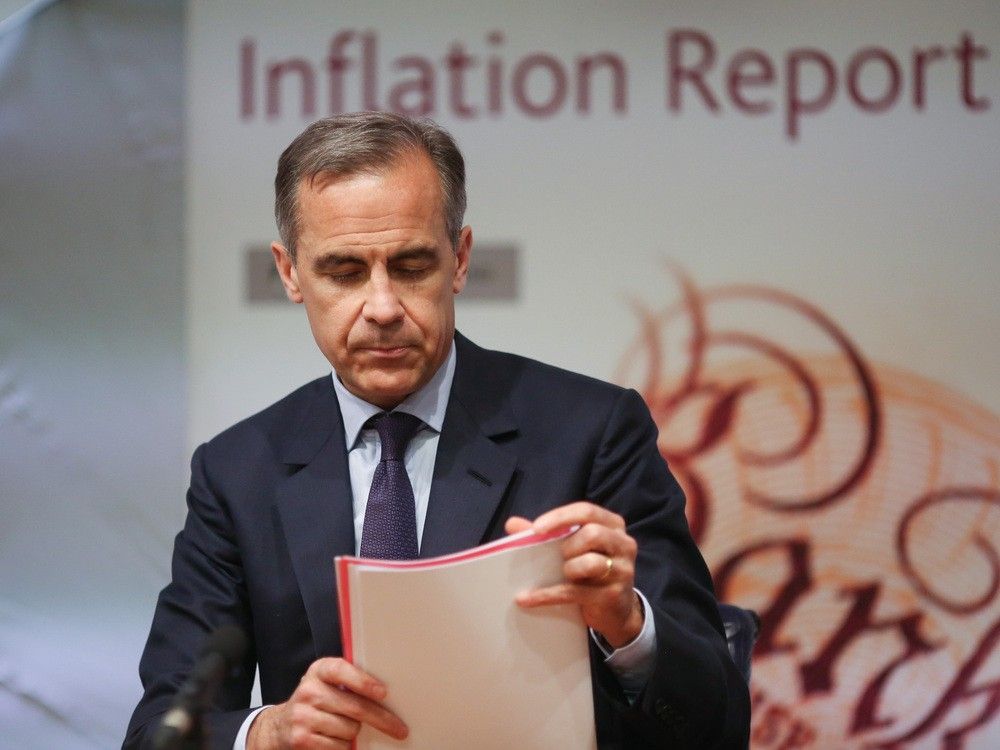
 Mark Carney, former governor of the Bank of England, adjusts papers during the bank’s quarterly inflation report news conference in the London, U.K., in 2016.

Farney said chiefs of staff under Stephen Harper, for example, usually went about 18 months. What would it mean to be chief of staff to Carney, he wondered, or finance minister? Farney said he is likewise unclear how Carney will relate to provincial premiers and Indigenous leaders, with

his poor French

and inexperience in brokering political compromise.

“I haven’t seen how he behaves in those primus inter pares (first among equals) settings,” Farney said.

“Somewhere Michael Ignatieff is screaming,” said Tamara Small, professor of political science at the University of Guelph. The same things that tanked Iggy arguably apply to Carney too: the “Just Visiting” slogan, that sense of elite entitlement, of swanning into politics as if it’s a step down, the wonky inexperience with campaigning. “They both use words like mendacious,” Small joked.

Everyone knows the Liberal Party of Canada loves a clever Oxbridgian who is handsome enough for television but also a bit of a nerd. No sooner did Ignatieff vanish after the 2011 election did they start looking to Carney, who seemed to tease with his silence. That flirtation lasted well over a decade, popping up in the media every time Justin Trudeau seemed to wobble.

But now it’s looking like Canadians in general will also warm to the archetype, if they think the moment is right for a prime minister with Harper’s economic policy sense but not his wooden affect, and Trudeau’s global celebrity without the melodrama.

That’s Carney’s current image to the wide centre-left of the Canadian electorate. Smart as Harper, less cringe than Trudeau. Polls suggest it is a sweet spot, though the real test remains.

Canadians do not usually vote mainly on foreign affairs, not since free trade in 1988, and even more rarely on a single issue, not since conscription in 1917. This election

is set to be an outlier

.

“We are going to vote on a nationalistic posture toward foreign affairs. It won’t last forever, but it’s strong now. People are still in the throes of trying to figure it out,” Small said. Carney’s novelty helps him, because he looks good on paper, his bio full of what his main rival Pierre Poilievre has called “trophy titles.”

On the key issue of energy policy, Carney gives the impression of trying to strike a tricky balance between quickly making Canada a self-sufficient energy superpower, while also

being non-committal on new pipelines

.

It has not been an easy sell. For a former UN special envoy on climate action and finance, he has barely mentioned climate change in the campaign. And his vagueness

has amplified concern

, such as telling an audience in Calgary he would accelerate federal approval of major infrastructure projects and streamline provincial and Indigenous buy-in with a “one project, one review” approach, but then telling an audience in Quebec: “We must choose a few projects, a few big projects. Not necessarily pipelines, but maybe pipelines, we’ll see.”

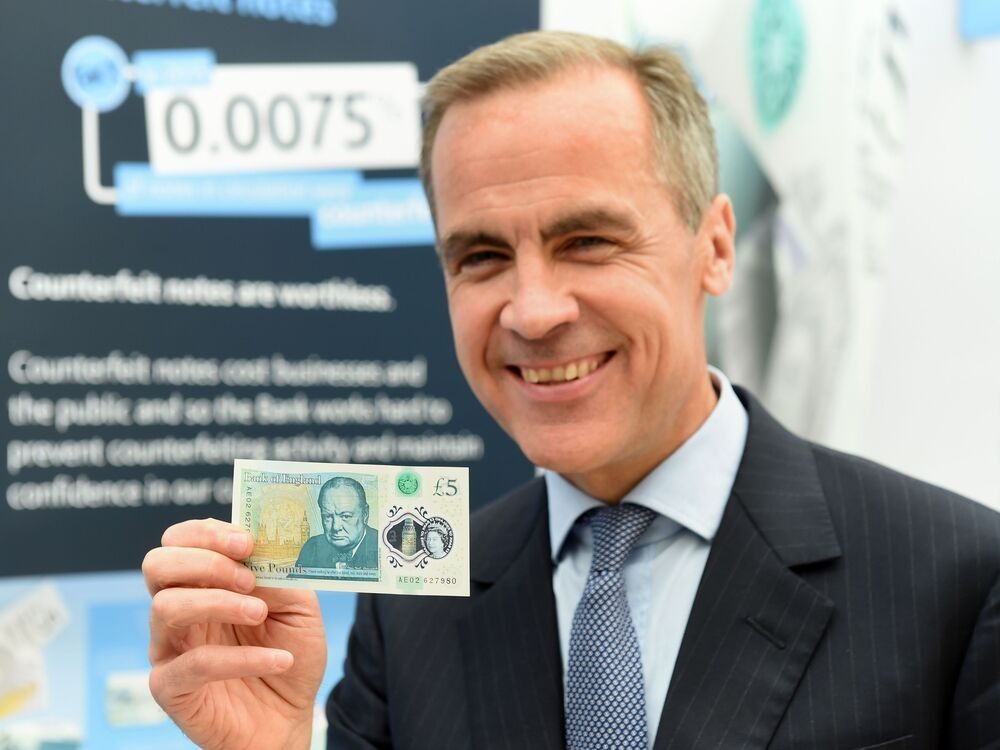
 Carney poses with a banknote bearing the image of wartime leader Winston Churchill at its unveiling by the Bank of England in 2016.

Things look good for Carney if voters stay worried enough to wonder things like which candidate knows best how to negotiate trade policy with Europe, and decide that’s him.

The polls reflect this

. But Small describes that recent movement of public opinion to Carney and the Liberals as conditional, a tentative endorsement in theory.

“A serious gaffe could be the end of it,” Small said. “If he gives people a reason not to vote for him, they won’t.”

It would not be just a gaffe, like his

flubbing the name of his own candidate

Nathalie Provost and appallingly getting the name of École Polytechnique wrong in mentioning the 1989 massacre there (he said it was Concordia), but a more revealing one, something that cuts to the core of his image and somehow damages it.

It does not appear his campaign missteps have yet risen to this level, though they have come close.

Goodyear-Grant said she saw a sharpness and impatience in Carney’s

angry and imperious snap

at CBC journalist Rosemary Barton about his own assets and his compliance with conflict of interest rules, such that even his body language seemed to say, “Why are you asking me this stupid question?”

“Look inside yourself, Rosemary,” Carney said, condescendingly. “You start from a prior of conflict and ill will.”

“This is a guy who seems at home where speaking sharply is fine, as long as you can back it up. That’s not politics though,” Goodyear-Grant said. “That’s not how Trudeau would do it.”

There was also a bumbling response to a

question about offshore tax havens

, such as those used by Brookfield under his leadership. After a rally in Calgary, he claimed he had not heard a heckler use the word “genocide”

in regards to Gaza

, to which he replied “I’m aware, which is why we have an arms embargo.”

Even his explanation in stilted French on Radio-Canada that he is not personally boycotting American groceries such as strawberries because, as prime minister, he

does not buy his own groceries

, could have dented the popularity of a certain sort of candidate, the sort who should know the price of milk. But none of these seemed to hurt Carney. It already seemed unlikely he did much grocery shopping.

Gaffes have to mean something. For Robert Stanfield dropping the football in 1974, the real worry was that he was old. For Stockwell Day in his wetsuit on a jetski in 2000, the real worry was that “this guy’s all flash,” as Small put it. And so in those cases, the polls moved accordingly.

For a Carney gaffe to be truly damaging, Small said, it would have to play on the central worry that he’s not actually able to stand up to Trump.

Even the plagiarism claim about his PhD thesis,

first reported by the National Post

, seemed to do little more than remind people he had a doctorate in economics from Oxford, albeit with a few sentences that had previously been published verbatim elsewhere. It made headlines overseas, in Britain especially, and gave Poilievre some attack lines, but it didn’t move the Canadian polls.

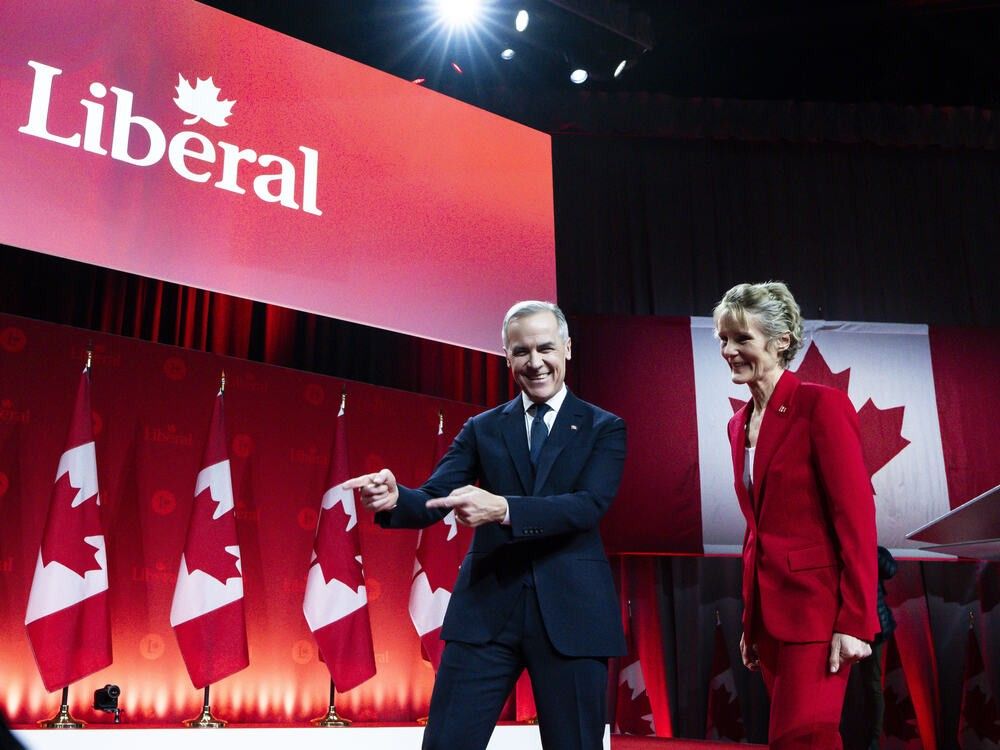
 Carney walks with his wife Diana Fox Carney, after being announced the winner at the Liberal Leadership Event in Ottawa, on March 9, 2025.

On the other hand, the scandal of Liberal staffers who got caught

planting fake buttons

with provocative Trumpist slogans at a Conservative conference, and then were “reassigned” within the campaign, threatened to linger as an awkward reminder that the people behind Carney are the same ones who were behind Trudeau, the same party most of the country so recently soured on.

“People who are giving Carney a look are people who have voted Liberal in the past and just couldn’t do Justin Trudeau,” Small said. “I don’t think people who were committed to the Conservatives seven months ago are people who have swung to Carney.”

One advantage, once voters start looking closely, is that, although Carney is clearly of the global financial elite, he did not start out there.

“He’s got a bit of the self-made man thing going for him,” Goodyear-Grant said. The silver spoon accusation does not land as well on Carney as it did on Justin Trudeau, who was famous as a child, and even the question of Carney’s early life draws more comparison than contrast with his rival Poilievre, as both grew up in Alberta.

One of Carney’s long-standing family friendships from his time in Ottawa is with Catherine McKenna, a former MP and Trudeau cabinet minister in environment and infrastructure, who now runs a climate consultancy.

She remembers being on the road toward Banff in October 2007 and hearing on the radio that Harper’s Finance Minister Jim Flaherty had chosen Carney to succeed David Dodge as Governor of the Bank of Canada, and knowing it was a good hire.

“People talk about him like he’s a bureaucrat,” McKenna said. “He’s also really smart.”

Later they interacted when she was minister. “He understood climate as an economic issue,” she said. McKenna recalled Carney coming to Toronto to speak to business leaders in 2016, and how everyone wanted to hear him talk about Brexit, this cataclysm that threatened to shake the foundations of Britain’s economy. But instead he talked about moving the economy forward, about the risks and costs of climate change, and about the economic opportunity of clean energy.

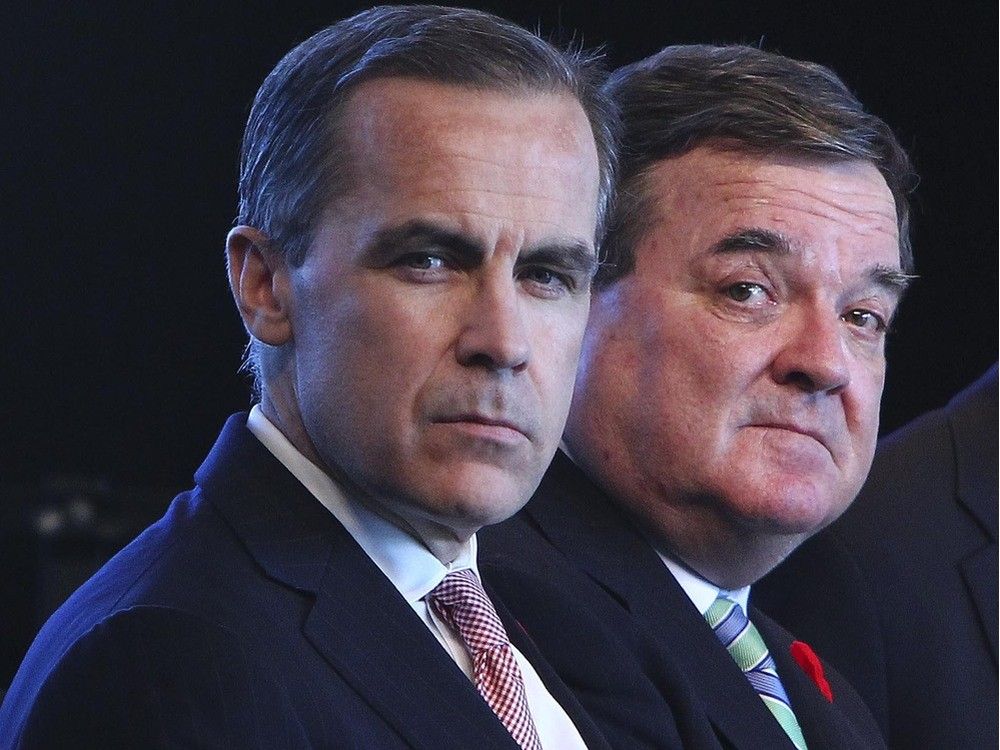
 Jim Flaherty, former Minister of Finance and Mark Carney are seen together during an event at the Canadian War in Ottawa Nov 7, 2012.

She sees a parallel to Canada’s strategic situation today, starting its separation from America as Britain separated from the European Union.

“There’s a definite parallel between Brexit and the situation we’re in,” McKenna said. “The reality is these are complex problems.”

“He’s very clear headed, and he understands the Canadian economy but more importantly he understands the global economy,” McKenna said. Where Trump is volatile and capricious, Carney is “outcome focused,” she said. “He is not someone who is going to bend or concede.”

Carney has been drawing this same parallel on the campaign, that he has experience being in an economic pressure cooker with strong political dimensions, and averting catastrophe through sound judgment.

“The U.S. is harming themselves with these tariffs, OK. It takes some time for that to filter through, just like it took some times for the impacts of Brexit to filter through to the U.K. economy. But I have seen this movie before. I know exactly what’s going to happen,” Carney said at a rally.

 Although Carney is clearly of the global financial elite, he did not start out there.

This wrongfoots the opposition because Conservatives cannot easily lean on their party’s good reputation for fiscal management as their winning issue “because the rival has more,” Goodyear-Grant said.

There’s a third parallel, less obvious but still relevant, Farney said. After the financial crisis of 2008, many Western democracies saw a renewal of the radical right, fuelled by high debt and stagnant economies. Farney said Canada was largely insulated from that trend because of a tightly disciplined Conservative Party under Stephen Harper, with sound economic management that kept the economy afloat, and a resource boom that mollified politics in Western Canada. But a political storm was rising that would later blow through Britain and then America, first as Brexit, then as Trump.

So this new global trade war, seemingly off and on like a teenage romance, is Carney’s “third time around” with managing the economic volatility of hard-right populism, and also his “most challenging,” Farney said.

Regardless whether he gets to face it as prime minister, Carney has already turned Canadian politics upside down.

“Justin Trudeau’s legacy could be saved by Mark Carney, and Donald Trump ironically,” Small said. “Because even if the Liberals don’t win this election, they’re not going to be destroyed.”

Read Jagmeet Singh’s profile. Next: Pierre Poilievre.

Our website is the place for the latest breaking news, exclusive scoops, longreads and provocative commentary. Please bookmark nationalpost.com and sign up for our politics newsletter, First Reading, here.


Left to right: Jagmeet Singh, Pierre Poilievre, Mark Carney and Yves-François Blanchet.

The leaders of Canada’s major federal parties face off tonight in the first nationally televised debate of the

2025 election campaign

. The French-language debate, a key opportunity to win over francophone voters, will air Wednesday at 6 p.m. Don’t speak French? No problem. The National Post is livestreaming an English-dubbed version of the debate, below, alongside live discussion and analysis from our Ottawa bureau.


<meta name="vf:container_id" content="d1744a7d-1737-475c-be6c-946e7e4d8606” />
<vf-livestory class="viafoura" vf-container-id="d1744a7d-1737-475c-be6c-946e7e4d8606“>

Liberal

Leader

Mark Carney

,

Conservative

Leader

Pierre Poilievre

,

NDP

Leader

Jagmeet Singh

and

Bloc Québécois

Leader

Yves-François Blanchet

will take the stage in Montreal for what could be their final chance to win over undecided voters before Canadians cast their ballots on April 28. With polls showing a tight race between the Liberals and Conservatives, the NDP and the Bloc will be battling to put their parties back on the national agenda and we’ll be following every moment live, right here.

Review the live coverage from National Post reporters Catherine Lévesque, Antoine Trépanier, Christopher Nardi, and Ottawa bureau chief Stuart Thomson in our live blog, above, starting at 6 p.m. tonight. Can’t see the blog? View it on the National Post


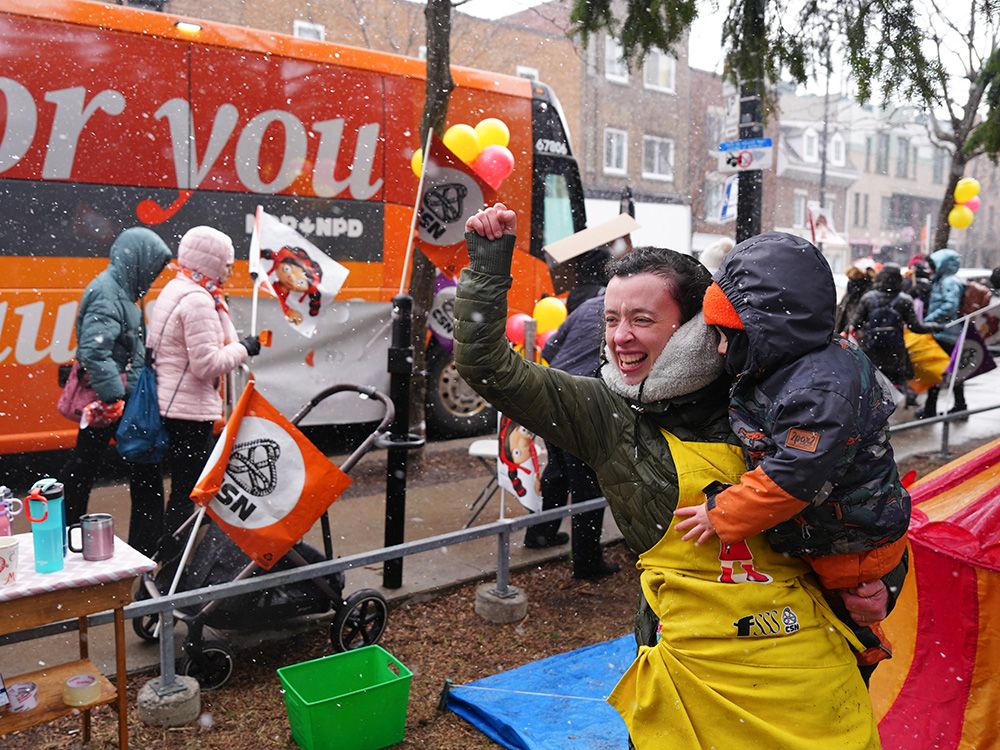
An NDP bus is parked behind FSSS-CSN CPE Daycare Workers as they form a picket line in Montreal on Wednesday, April 16, 2025.

MONTREAL — Striking day-care workers gave local NDP candidates a noisy welcome when they showed up with coffee and doughnuts at a picket line on a chilly Wednesday morning.

Workers, who are in a pay dispute with Quebec’s ministry of families, chanted “Solidarité,” banged drums and waved rattles. Supportive parents squeezed their kids back into snowsuits amid flurries and falling temperatures, about five minutes before they needed to go pee (it is an immutable rule).

NDP Jagmeet Singh was absent. His team said he was “under the weather” and resting ahead of Wednesday evening’s French-language debate. But local candidates Craig Sauvé, Julie Girard-Lemay and Nima Machouf were embraced by workers, even though their union, FSSS-CSN does not officially endorse a federal party.

The striking thing was that the picket line was made up entirely of women.

Once upon a time, male-dominated unions backed the NDP reflexively, but those days are gone. In the 2025 general election, unions are taking a far more transactional approach to the relationship.

Fourteen Canadian labour unions

have backed Pierre Poilievre’s Conservatives and his “boots not suits” plan

to boost skilled-trades apprenticeships. Those endorsing a party that has not always been friendly to organized labour include police associations, plumbers, electrical workers and boilermakers.

The NDP has retained the support of the country’s biggest union, CUPE, the United Steelworkers and the Amalgamated Transit Union, which together account for one million workers.

In previous elections, Unifor, the country’s largest private sector union, has championed strategic voting to block Conservative candidates. But in 2025, it is pushing for candidates who will “stand up to Trump” — a mix of Liberals and New Democrats.

But it is clear that the relationship between the NDP and union members, if not their leaders, is strained.

A forthcoming article in the Canadian Journal of Political Studies, co-authored by Larry Savage and Jonah Butovsky of Brock University, and Daniel Westlake of the University of Saskatchewan, suggests the changing landscape of party-union relations has made the NDP’s challenge more difficult. Canada Election Study data suggest members of union households were 19 percentage points more likely to vote NDP than non-union members in 2008, but that margin had shrunk to just seven percentage points in 2019 and 2021.

Cracks in the union affiliation reflect a broader disillusionment among male voters generally. The

most recent Abacus Data poll

has support among all voters for the NDP at nine per cent, but that number dips to seven per cent among men (compared to 12 per cent of women).

CES data suggest 13 per cent of men voted NDP in 2021.

One reader who wrote to me, Lorne Morrison, said he has voted NDP in the past but won’t do so this time because it has morphed from the “party of the worker to the party of identity politics.”

He pointed to the party convention in Hamilton in 2023, when the co-chair, Sylvie Sioufi, a senior CUPE executive, told delegates that the convention had 

special speaker priority rules.

“Please remember to give space to those who face systemic barriers and discrimination, including women, Black, Indigenous and racialized folks in particular, people with disabilities and 2SLGBTQIA+ folks,” she said.

“If you identify with a gender other than men for the purpose of the equity-seeking rule, you will have received a yellow card.”

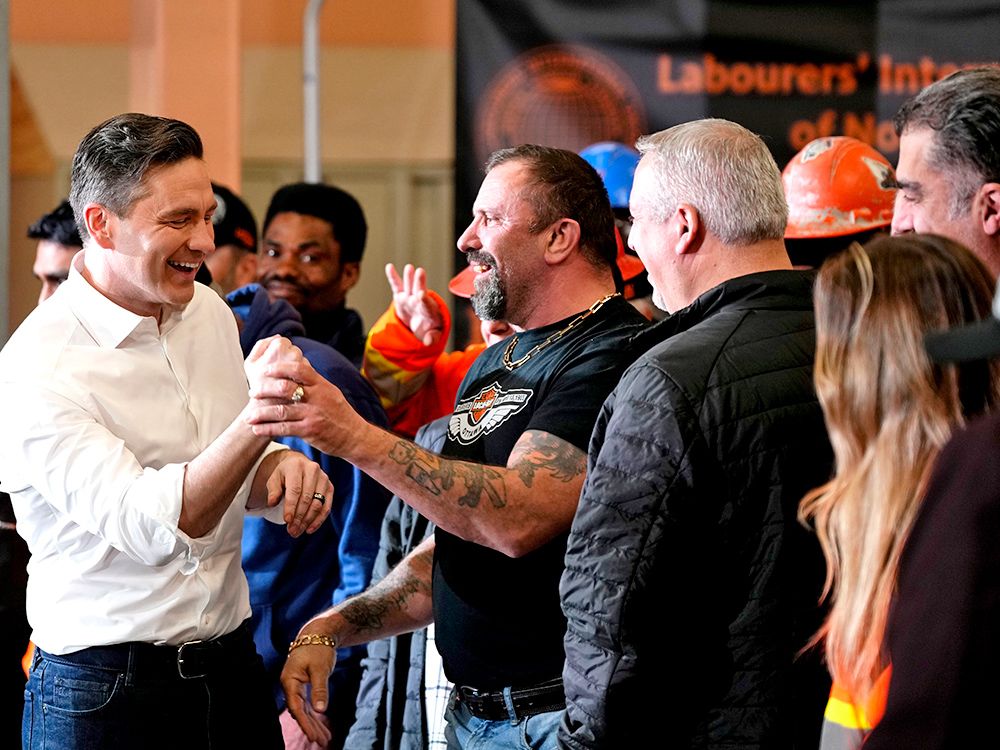
 Conservative Party Leader Pierre Poilievre jokes with union members as he heads to the lectern to speak at a pre-election event, at a Labourers’ Union training centre in Ottawa, on Friday, March 21, 2025.

Morrison said it meant that those with a yellow card spoke first, and white men went to the back of the line.

“If they don’t want to hear from me at their conference, they aren’t going to hear from me at the ballot box,” he said.

Brock University’s Savage said he is less convinced that male union voters have been pushed out of the NDP. “New Democrats have always been left on social issues,” he said.

Rather, it is a shift in the ideological opposition to organized labour by provincial and federal conservative parties that has encouraged blue-collar, male-dominated, skilled trades unions to endorse them. “They’re not threatening to decertify them anymore,” he said.

Savage and Westlake’s research on 

whether union endorsements actually matter

 found that, outside of Quebec, 37 per cent of members are “somewhat” or “much more likely” to vote for union-endorsed candidates. (In Quebec, the number was 27 per cent). That number rose or fell, depending on how satisfied the member was with his or her union.

Veteran New Democrats like 

Don Davies

, the five-term MP and current candidate in Vancouver Kingsway, have pointed out that the party has a track record of defending workers and their families by pushing recent Liberal governments to adopt paid holidays for federal workers and introduce legislation against replacement workers for regulated industries (which

was passed last year in the House of Commons unanimously

but has been opposed in previous iterations by the Conservatives, 

most recently in 2016

).

Lorne Morrison said he sees the departure of leader Jagmeet Singh as the “first step in the NDP’s road to recovery.”

Singh leaving seems more likely to happen than not. But whoever succeeds him has a big job convincing blue-collar men in particular that the NDP is the party of the worker — and that yellow cards are a thing of the past.

National Post

jivison@criffel.ca

Get more deep-dive National Post political coverage and analysis in your inbox with the Political Hack newsletter, where Ottawa bureau chief Stuart Thomson and political analyst Tasha Kheiriddin get at what’s really going on behind the scenes on Parliament Hill every Wednesday and Friday, exclusively for subscribers. 

Sign up here

.


Canadians may never know the extent of mould-related health problems plaguing some who served aboard Royal Canadian Navy frigates as Veterans Affairs is not tracking the problem and legal action that aimed to shed light on the issue has been denied.

A Federal Court judge has shot down a proposed class action case led by a former Royal Canadian Air Force captain who claimed “dangerous levels of toxic mould” in one of the navy’s frigates caused him serious ongoing health problems because Veterans Affairs Canada has already compensated him for the same injury.

A Veterans Affairs spokesman said Wednesday the department tracks injuries, but not their source.

Félix Dunn joined the military in 2006. The air combat systems officer was stationed aboard HMCS Vancouver, a Halifax-class frigate that can carry helicopters, from June until December of 2016, when he started experiencing respiratory issues.

“In my view, (Dunn’s) claim in this case relies on the same factual basis that led to compensation being paid to him by (Veterans Affairs Canada),” Justice Cecily Y. Strickland wrote in a recent decision out of Ottawa.

“That is, the presence of mould on a (Canadian Armed Forces) ship to which the plaintiff was exposed in the course of his CAF duties causing him injury. Thus, the compensation paid or payable to him is a bar to the action against the Crown because it is made on the same factual basis.”

Another insurmountable hurdle, the judge noted, is that while Dunn was still in uniform, he never filed a grievance with the military’s dispute resolution scheme

to contest the issues alleged in his claim.

The Attorney General of Canada brought the successful motion striking Dunn’s statement of claim for his proposed class action on behalf of former members of the military and those still in uniform.

“It certainly was a blow,” Dunn’s lawyer, Brian Murphy, said of Strickland’s ruling.

“We thought we had a pretty good argument. But I guess it didn’t work out.”

At least 20 people — mostly former sailors who served aboard different frigates — had expressed interest in joining the proposed class action, Murphy said. “The whole nature of a class action is there are probably so many more.”

The military is not admitting health problems were caused by mouldy frigates, Murphy said. “Not in the confines of this litigation, for sure, no they’re not,” he said. “At the end of the day we may have proved there was mould, but they would say he’s been compensated, it doesn’t matter.”

The federal government’s win “was legal, it was technical, if you like,” said Murphy. “It wasn’t on the whole merits of things, that’s for sure.”

The navy has said that it is doing everything it can to mitigate mould in its frigates, including updating ventilation system controls on warships.

“They claimed to have it sorted out and then we started hearing more about these kinds of cases,” said Ken Hansen, a military analyst and former naval commander.

“I know they’re still working on it; there’s still people leaving the fleet with respiratory problems.”

The mould issue “came about because, in the Halifax-class frigates anyway, they added a lot of heat-generating electronics when they modernized the ships and gave them their life extension,” Hansen said, noting the Canadian military did not sufficiently heed warnings that adding electronics to the frigates would require more ventilation.

The extra heat they produce “picks up and holds moisture,” he said.

“Then, when you get into an area where the water is cool or cold on the outside, it starts condensing all this moisture back into the solid part of the environment (creating the) perfect environment for growing mould,” Hansen said.

The court heard that during Dunn’s “service on the HMCS Vancouver, he began experiencing chills and fever, along with a cough, burning and tightness in his chest, and fatigue. He claims that he was treated with antibiotics while onboard but never fully recovered. Further, that he discovered what he believed to be black mould growing from the fittings in the pipes on the ship. Shortly thereafter he was diagnosed with exercise-induced asthma, sleep apnea, and chronic rhinitis.”

Dunn told the court “that since first developing these symptoms on the HMCS Vancouver, he has never fully recovered, he continues to experience violent swings in temperature and chest pain when breathing, that his overall quality of life has been compromised, and that his ability to perform any physically demanding activities has been severely limited.”

Dunn applied to Veterans Affairs “for various disability benefits, including pain and suffering compensation, critical injury benefit as well as rehabilitation services and vocational assistance programs for veterans,” between March 2019 and August 2022, Strickland wrote in her decision, dated April 9.

He submitted a request for permanent release from the military in May of 2020. “He stated this request was due to his permanent lung issue caused by the exposure to mould on HMCS Vancouver,” said the judge.

Less than three months later, Dunn filed his statement of claim for a proposed class action on behalf of people who served on Canadian warships from Jan. 1, 2000 onward, who had been “exposed to mould, toxins, and other airborne contaminates throughout the course of their service,” said Strickland’s decision.

Dunn claimed that the military “was aware, or should have been aware, of the dangerous levels of toxic mould on a number of its ships, that it breached its duty of care to maintain its property so that it was safe and, failed to take reasonable measures to ensure that preventable and foreseeable harm did not occur,” said the decision.

Dunn was medically released from the military Sept. 1, 2022.

According to military records, as of Dec. 7, 2023, Dunn had received $167,052 in pain and suffering compensation. He’s getting ongoing monthly payments of $628 for same.

Dunn had also received $22,390 in income replacement benefits. He’s getting ongoing monthly payments for same of $1,516.

Motions to strike claims “serve an important screening or gatekeeping function,” Strickland said.

“They are essential to effective and fair litigation and prevent unnecessary effort and expense being devoted to cases that have no reasonable prospect of success,” said the judge.

Lawyers for the federal government argued Dunn’s proposed class action claim should be barred “because it is in respect of the same injury, damage, or loss for which compensation was paid or is payable to the plaintiff and the entire proposed class.”

Dunn’s lawyers acknowledged the rules against “double recovery,” said the decision, but they asserted “his claim does not arise merely from exposure to mould, it arises from the CAF’s conduct, which has resulted in consequences separate and distinct from the damages suffered by the proposed class.”

Dunn’s claim contended “that several members of the CAF failed to act, or maliciously and intentionally withheld information when presented with detailed information about the rampant toxic mould growth on (Canadian frigates) and intentionally placed the members in said toxic environments. Thus, the alleged injuries and events are not identical to those for which compensation was previously awarded.”

Dunn argued that “he and the proposed class are not seeking double or enhanced recovery for medical disabilities diagnosed for compensation under a disability pension. Rather, they seek compensation for the intentional infringement of the Charter right to security of the person.”

But the judge wasn’t buying it.

The Crown Liability and Proceedings Act, “reflects the sensible desire of Parliament to prevent double recovery for the same claim where the government is liable for misconduct but has already made a payment in respect thereof,” said her decision.

“In this case, the event is exposure to black mould. Whether framed in terms of negligence, systemic negligence, or breach of fiduciary duty, the compensation paid and the damages sought all stem from that same event,” Strickland said.

Murphy, Dunn’s lawyer, hasn’t decided yet whether to appeal Strickland’s ruling. “I’m expected to have a little meeting with my clients next week.”

Our website is the place for the latest breaking news, exclusive scoops, longreads and provocative commentary. Please bookmark nationalpost.com and sign up for our daily newsletter, Posted, here.


In determining what differentiates a good day from a typical one, University of British Columbia psychology research has discovered that we don’t like to work more than six hours a day.

“We found that working for up to six hours had no impact on whether people rated their day as better than usual. When individuals worked for more than six hours though, the effects rapidly turned negative,” says Dunigan Folk, Ph.D. candidate at UBC, in a February 2025

research paper

. Folk’s team also included researchers from the University of Basel in Switzerland.

 When individuals work for more than six hours, the impact can rapidly turn negative on whether they consider a day “happy,” according to UBC research. Getty Images

They used data from the 2013 and 2021 versions of the American Time Use Survey (ATUS), to identify “clear tipping points” that differentiate better days from typical ones.

The study looked at over 100 activities involved in ATUS participants rating their day as “better” than a typical day versus the “same” as a typical day. The ATUS is an annual cross-sectional survey of the United States population in which participants are asked to reconstruct their previous day.

According to the researchers, a “recipe” for a good day could mean not working for more than six hours a day, a short commute, as much time with friends as possible, and no more than five hours of sports. On the other hand, a day is usually spoiled by relaxing in front of a screen.

Time spent working ranked as one of the most important variables in predicting whether people had a good day, ranking third in 2013 and seventh in 2021. Working was relatively inconsequential for up to six hours, at which point it quickly became negatively associated with having a good day.

Commuting was also within the top 20 most important variables in both 2021 and 2013, according to the researchers. Notably, in 2021 brief (15-minute) commutes showed a slight positive association with having a good day, potentially because there may have been emotional benefits from getting out of the house during the COVID-19 pandemic. Other than this brief initial boost in 2021, the effects of commuting were increasingly negative until the 90-minute mark.

The researchers point out that very few people reported commutes of greater than 90 minutes in 2021 (1.63 per cent) or 2013 (2.38 per cent).

General socializing was identified as an important activity for having a good day. However, after the two-hour mark socializing had little influence. Unsurprisingly, perhaps, the researchers highlighted that “time spent with friends, in contrast, had an almost boundlessly positive effect.”

Turning to sports and exercise, as well as relaxing and leisure, these activities were rated as important in both 2013 and 2021, but there was a significant difference between the two.

 Friends playing pickleball. According to UBC research, time spent on sports and exercise has been positively associated with having a “good day” up until approximately five hours. Getty Images

Time spent on sports and exercise was positively associated with having a good day up until approximately five hours in, at which point additional time did not increase its impact on the likelihood that the survey participants had a good day.

“Surprisingly, spending any amount of time on relaxation and leisure negatively impacted the probability of having a good day, and it was most detrimental in 2021,” say the researchers.

The researchers blame screen time for this result. “A likely explanation for this finding is that ‘watching television and movies’ accounted for most of the minutes people spent on relaxation and leisure in both 2021 (70 per cent) and 2013 (72 per cent).”

The researchers say their findings were largely consistent across individuals, which is “particularly striking given how broadly the activity categories were defined.” For example, an hour of working, could involve dull data entry or an invigorating brainstorming session. Even without those crucial distinctions, the researchers say their models still predicted good versus typical days with “up to 65 per cent accuracy.”

Survey participants were asked to rate their day with respect to their own determinations of a typical day. The aim was to reduce the likelihood that the findings here are influenced by demographic variables such as wealth or education. Instead, “good days were simply days where people reported feeling better than they normally do.”

Taken together, say the researchers, the results “suggest that good days emerge from the constantly shifting value of time. Each minute in a day represents a choice between competing opportunities, with clear tipping points when benefits diminish and costs mount.”

By understanding those points for common activities, “we now know more about the recipe for a good day, and by extension, the recipe for a good life.”

Our website is the place for the latest breaking news, exclusive scoops, longreads and provocative commentary. Please bookmark nationalpost.com and sign up for our daily newsletter, Posted, here.