LP_468x60
on-the-record-468x60-white

Premier Danielle Smith speaks at the 2025 Rotary International Convention to welcome countries from all over the world at the Scotiabank Saddledome in Calgary on Saturday, June 21, 2025.

OTTAWA — David Parker, the founder of conservative activist group Take Back Alberta, said on Monday morning that, by the end of the day, Albertans would know the strength of the province’s budding independence movement.

“It’s not great,” he

tweeted shortly before midnight

, as the

last of the results

trickled in from Olds-Didsbury-Three Hills.

The rural Alberta riding, one of three up for grabs in Monday’s provincial byelection, was closely watched for

a potential separatist breakthrough

.

In the end, the two pro-independence candidates on the ballot took home a respectable 19 per cent of the vote, but fell short of both major parties.

According to preliminary results, the UCP’s Tara Sawyer won easily with 61 per cent of the vote with NDP candidate Bev Toews taking home 20 per cent, edging out Republican Party of Alberta leader Cam Davies by 365 votes.

Davies told the National Post that the third-place finish won’t break his spirits.

“I see a lot of talking heads and pundits and pollsters that are all quite vigorously calling for us to pack it in. And I hate to be the bearer of bad news for them, but we’re just getting started,” said Davies.

He said

going into the byelection

that he was aiming for about 20 per cent of the vote.

Davies, who favours Alberta becoming an independent constitutional republic, concedes that the Alberta Republicans’ name and red colours may have tethered it too closely to U.S. President Donald Trump.

“(The branding) certainly did cause questions about what we were,” said Davies.

“Did it leave an opening for others to spread misinformation? Absolutely it did.”

Davies pushed back against assertions throughout the campaign that he wants Alberta to enter the U.S. as the 51st state, a claim he flatly denies.

Davies, who lives in south Red Deer, said he’ll be running in the next provincial election but hasn’t decided which riding he’ll contest.

Wildrose Loyalty Coalition candidate Bill Tufts finished well behind the top three with just over one per cent of the vote.

Most of the riding overlaps with Olds-Didsbury, where pro-independence candidate Gordon Kesler won

a surprise byelection victory

in 1982, becoming the only separatist to ever sit in Alberta’s legislature.

Pro-independence candidates won a

combined six per cent

of the riding’s vote in the last provincial election.

Jeff Rath, a lawyer with the pro-independence Alberta Prosperity Project, said that the easy UCP win was a testament to party leader and Premier Danielle Smith’s continued popularity with the party’s grassroots.

Rath says this popularity extends to the majority of the UCP’s base

that supports Alberta independence

.

“Even at APP events, when Danielle Smith’s name gets mentioned … people applaud and they’re very supportive of her,” said Rath.

Rath said that the province’s separatist movement is “appreciative” of Smith’s move in April

to lower the threshold

of signatures needed to trigger a referendum on independence.

He also said he expects Smith to come out in favour of independence once it’s advantageous for her to do so.

“She’s a pragmatist,” said Rath.

Thirty-five per cent of UCP voters view Smith as a separatist, according to a recent poll from Pollara Strategic Insights.

Rath said he wasn’t concerned by the Alberta Republicans’ showing in Olds, and didn’t think the Alberta independence movement needs a new party considering how comfortable most of those voters are with the UCP.

National Post

Our website is the place for the latest breaking news, exclusive scoops, longreads and provocative commentary. Please bookmark nationalpost.com and sign up for our daily newsletter, Posted, here.



Roads across parts of the United States are reportedly buckling due to extreme heat.

A video shows the moment a vehicle was launched into the air as a heat wave reportedly caused the road to buckle in Missouri, a state in the Midwestern region of the United States.

It was captured by Cape Girardeau resident Albert Blackwell on June 22, with temperatures that day reaching 92 degrees Fahrenheit, or nearly 34 degrees Celcius,

according to the National Weather Service

.

“Everyone was in shock, myself included,” said Blackwell to National Post over email on Tuesday. “I’ve seen small buckles, but never anything like this. Just two seconds later and that car probably would have been rolled.”

Blackwell, who runs a local weather page, said he had previously taken a video of the initial buckle in the road and noticed cars scraping their front ends. While he was in the area, he had about 20 minutes before he had to pick his daughter up from work, so he decided to go back to get a better view.

“I had no idea the road was about to buckle even more,” he said. “I wasn’t filming long when the road popped sending the car airborne. I then stopped recording and called it in to authorities to get the road closed.”

The driver of the vehicle had pulled over and Blackwell said he went to check on its occupants. Crews in the area worked to repair the damage,

local news station KFVS 12 reported

.

The driver was “understandably shaken,” said Blackwell.

“She had no chance to stop. Her car looked brand new before this. The landing did some damage to her vehicle,” he said, adding that the full extent of the damage would need to assessed.

There was a passenger in the car as well who was also confused by the event, said Blackwell, although the passenger remained “very calm.”

“You get the moisture underground, and everything kind of comes together. It’s just, everything swells up and has nowhere to go but up,” assistant director for the Cape Girardeau Public Works Department Brock Davis told KFVS.

As of Tuesday morning, a heat advisory is still in place for many cities in the state, with daily heat index values of 100 to 107 degrees Farenheit, or nearly 38 to nearly 42 degrees Celcius. The advisory is expected to remain in effect until Friday evening.

Roads in other states also reportedly suffered from the heat. Around 50 incidents of “pavement buckling due to extreme heat” were reported over the weekend in Wisconsin,

per local news station WISN 12

. There were also reports of roads buckling in South Dakota, Colorado and Nebraska,

according to Fox 8 News

.

In general, extreme heat warnings and heat advisories have been issued in many parts of the eastern U.S., per the National Weather Service.

 A woman drinks from a water bottle as she makes her way in New York City on June 23, 2025.

“When temperatures rise to certain values, the physical composure of many items will naturally start to break down or change,” the

Weather Network reported

.

Meanwhile, in Canada, some provinces are also

feeling the heat

.

Ontario Provincial Police closed down part of Highway 402 in the Plympton-Wyoming area, east of Sarnia, due to “unsafe road surface conditions,” it said in a post on X on June 22.

Environment Canada has issued heat warnings for parts of Nova Scotia, Ontario and Quebec as of Tuesday morning.

In cities such as Toronto, Ottawa and Montreal, the weather agency says humidex values of 40 to 45 degrees Celcius are expected.

Our website is the place for the latest breaking news, exclusive scoops, longreads and provocative commentary. Please bookmark nationalpost.com and sign up for our daily newsletter, Posted, here.


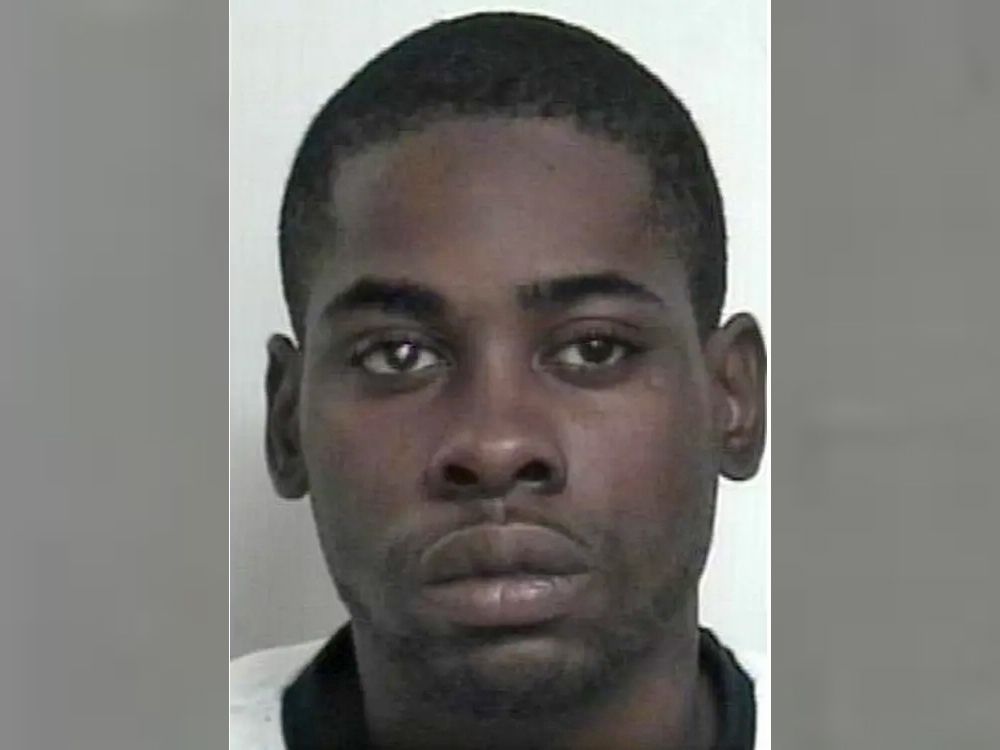
Sean Lenworth Anthony Spence, a Jamaican man sentenced to life in prison for an

A Jamaican man sentenced to life in prison for an “execution style” killing north of Barrie in 2007 will get a shot at early release under Canada’s “faint hope clause.”

Sean Lenworth Anthony Spence didn’t pull the trigger, but he planned the murder of Jonathan Chambers over $52,000 Spence blamed him for losing in a drug deal Chambers arranged. Spence was convicted of first-degree murder and sentenced to life in prison with no chance of parole for 25 years for kidnapping and killing Chambers, who had introduced Spence to buyers who pretended they were in the market for 1.5 kilograms of cocaine, but then paid with fake money and escaped with the drugs.

After serving more than 15 years of his sentence, Spence applied to Ontario’s Superior Court of Justice for a “faint hope” hearing before a jury so he can ask that his parole ineligibility period be reduced.

“While it is ultimately up to a jury to determine whether or not Mr. Spence may apply for parole sooner than the 25 years imposed as part of his sentence, I cannot say that his application is doomed to failure. On a balance of probabilities there is a substantial likelihood that the application might succeed,” Justice Mark Edwards wrote in a recent decision out of Barrie.

“Mr. Spence’s application is granted, and a jury shall be empaneled to hear his application.”

Chambers was killed March 7, 2007.

“Two vehicles were stopped on the side of a country road north of Barrie,” said the judge’s decision, dated June 18.

Spence was in one vehicle. Four individuals, including Chambers, were in the other.

“Mr. Chambers exited the vehicle and was then shot in the head by Andrew Turner. The two vehicles left the scene. Chambers was dead at the roadside. His body was discovered later that day,” Edwards wrote.

“Everyone in the two vehicles (was) eventually caught and charged. Three of the individuals pled guilty to manslaughter. One of the individuals pled guilty to being an accessory after the fact to murder. Mr. Spence was tried on a charge of first-degree murder in a judge alone trial. He was convicted on that charge and sentenced to the mandatory term of life imprisonment without eligibility for parole for 25 years.”

The decision notes Spence had been sentenced to four years for a previous robbery where he used an imitation firearm and wore a disguise.

Spence successfully appealed that conviction, but the Crown took his case to the Supreme Court of Canada and won on Dec. 2, 2005, restoring his conviction.

However, Spence was out on bail, awaiting the Supreme Court decision, and he went on the lam. It wasn’t until September 2008 that he was arrested in the United States in connection with the killing of Chambers.

While Spence did not pull the trigger, his trial left “no doubt that the execution of Mr. Chambers was done at the direction of Mr. Spence. The killing of Mr. Chambers arose out of the loss of $52,000 that Mr. Chambers had caused, or had an inability to account for, to Mr. Spence,” Edwards said. “Mr. Spence developed a plan that effectively resulted in the kidnapping of Mr. Chambers and getting Mr. Chambers into a car and then ultimately to the site of his murder.”

In court documents, Spence often goes by the first name Lenworth, rather than his given forename of Sean.

Spence was “the driving force behind the drug deal that was catalyst to this murder,” reads a summary of the Crown’s position. “That Mr. Spence had a motive to kill as a result of the failure of said deal and that he ordered that Jonathan Chambers life be terminated as a way to save face and to send a message.”

Spence, 46, “is not a Canadian citizen and if he is released, he is subject to a deportation order,” the judge said in his recent decision.

Spence lived with his parents in Jamaica until he was 12, “when he moved to Canada to live with his grandparents,” Edwards said. “He was primarily raised once he was in Canada by his grandmother although he moved in with his father as a teenager.”

His 2024 “psychological risk assessment report indicates that Mr. Spence’s plans … would have him returning to Jamaica where his family apparently owns a farm controlled by one of his brothers. The same report indicates that Mr. Spence hopes to rebuild his life in Jamaica by working towards postsecondary education.”

Spence stayed out of trouble in prison.

“There is no evidence that he has ever been subject to periods of disciplinary segregation,” said the judge. “For all intents and purposes Mr. Spence has a clean discipline record which is in stark contrast to his criminal record prior to his incarceration.”

A psychological risk assessment from last year placed “Spence in the low moderate to moderate risk category for general recidivism in the high-risk category for violent recidivism. Mr. Spence had a long-standing history of criminal behaviour and had a violent criminal history leading up to the current offence that occurred when he was 27 years of age.”

Spence worked while in prison, furthered his education, and “has also participated in a number of programs aimed at his rehabilitation,” said the decision.

Spence “has been active in his religious faith and a letter from Imam Habeeb Alli, the Muslim faith chaplain at the Beaver Creek Workworth Institution notes as follows: ‘I am willing to engage with him on his understanding of the faith upon reintegration. Mr. Sean Spence is a caring person and remorseful of his previous crimes. I support him for faint hope clause as this will help them reintegrate into society as a law-abiding citizen earlier than the given date.’”

One of Spence’s guards at Beaver Creek, Shirley Osei, has worked with him for about three years.

“Mr. Spence is described by officers as a model offender who exemplifies good behaviour and follows all institutional rules and policies. Spence has remained incident and charge free since I started working on his unit and is not seen as being a part of the offender subculture,” Osei wrote in a letter of support.

“Lastly, I strongly believe that Spence is a motivated individual who is doing whatever it takes to rehabilitate back into society and to return home to his family.”

The court saw victim impact statements from Chambers’ father, mother, sister, and brother. “All of the statements speak to the continuing impact that the murder of Mr. Chambers has had on his family,” said the judge.

The victim’s mother, Nancy, told the court “Jonathan’s death left a void that can never be filled. How do you heal a broken heart is my question. The pain of losing him was heartbreaking. There is no escape from the memories of his absence from the holidays that he loved so much should have echoed, to the milestones he never reached. He was robbed of his future, and we were robbed of his presence.”

The court heard that “Crown counsel largely opposes Mr. Spence’s application for three reasons: the gravity of the offence; Mr. Spence’s lack of remorse; and the fact that Mr. Spence if released and deported would avoid a significant part of the sentence originally imposed on him and would have no supervision once he is deported to Jamaica.”

If Spence “is ultimately successful in his faint hope application and thus allowed to apply for early parole, the subject of deportation and any subsequent supervision are matters that the Parole Board of Canada will ultimately have to consider in relation to the risk to the public,” said the judge.

Our website is the place for the latest breaking news, exclusive scoops, longreads and provocative commentary. Please bookmark nationalpost.com and sign up for our daily newsletter, Posted, here.


Israeli Deputy Minister of Foreign Affairs Sharren Haskel, at Toronto's Queen's Park on June 4, 2024.

OTTAWA — One of Israeli’s highest-ranking politicians says she understands that many people could be feeling déjà vu as the West faces another war in the Middle East over the threat of weapons of mass destruction.

The Toronto-born Sharren Haskel, now Israel’s junior minister of foreign affairs, was herself a young enlistee in Israel’s armed forces (specifically the border police) when then U.S. president George W. Bush and a coalition of allies invaded Iraq in 2003, vowing to destroy weapons of mass destruction, that were later found to be non-existent.

And she’s not a fan of war, she said.

“I’ve seen things that I don’t wish anyone to see,” Haskel, 41, told National Post on Monday.

“I’ve been in positions that I would never want my own daughters to be in.”

But public opinion studies have documented

an “Iraq War hangover”

driving anti-war attitudes among millennials, born between 1981 and 1996.

A 2019 Ipsos study study tracking

more than 16,000 millennials

across 16 countries, including the U.S., found that three-quarters believed that most wars could be avoided. Respondents from war-affected countries were more hopeful than others that future wars could be avoided.

But Haskel said that Iran poses a much graver threat today than Iraq did two decades ago.

“The two cases are extremely different,” she said, noting that Iran’s advanced

nuclear enrichment and ballistics missile programs

have been well-documented by several international bodies and governments, and that they pose a “double existential threat” to international security.

Prior to this month’s Israel and U.S.-led attacks on Iranian nuclear sites, the International Atomic Energy Agency (IAEA) estimated that Iran

had enough raw material

for nine nuclear weapons.

Haskel said that the fear of a repeat of the disastrous Iraq war has made the U.S. and other Western countries too hesitant to use force against an intransigent Iran.

“We’ve seen in recent years, and because of (Iraq), how the international community have been chasing up a diplomatic solution,” said Haskel.

“But unfortunately, this enemy that you’re facing was growing to a monstrous size while deceiving the international community.”

Iran signed what looked to be a breakthrough nuclear deal with the U.S. and other world powers in 2015, but it has

repeatedly violated the terms

of this agreement. The

IAEA reported in 2023

that Iran’s stockpile of enriched uranium was 30 times more than the maximum permitted under the agreement.

Haskell encourages younger adults who were hung up on the surface-level similarities to 2003 invasion of Iraq to take a longer view of history.

“I would try and lead them to spend a little less time on social media and read a few more history books. In particular, books about the years leading up to the Second World War,” said Haskell.

“When people say that history repeats itself, it’s very clear during these times as well … the European countries (after the First World War) were so desperate to avoid another world war that they tried to convince themselves that what the Nazis were saying wasn’t really what they were saying.”

One prominent politician who’s given voice to his generation’s war-skeptical sentiment is 40-year-old U.S. Vice President JD Vance.

Vance, who was deployed to Iraq in 2005,

later called the war “disastrous.”

He’s since called for the U.S. to limit its exposure to foreign conflicts, such as

Russia’s invasion of Ukraine

.

The vice president said over the weekend, after the U.S. bombed

three Iranian nuclear sites

, that the U.S. was not at war with Iran but “

with Iran’s nuclear program

.”

Haskel said she didn’t have a problem with Vance’s description of the U.S.’s involvement in Iran.

“I think you should ask the Americans to make the Americans’ case,” said Haskel.

National Post

rmohamed@postmedia.com


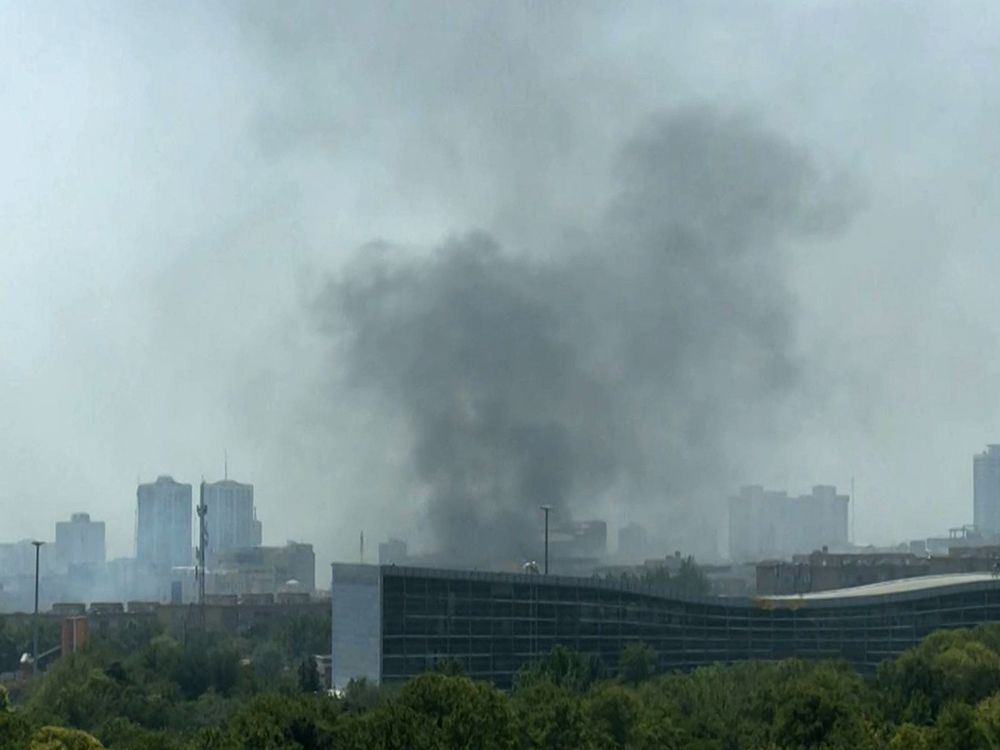
A plume of smoke billowing after Israeli strikes in Tehran, posted on social media on June 23, 2025.

JERUSALEM — U.S. President Donald Trump announced on Monday night that Israel and Iran have agreed to a ceasefire that will take effect on Tuesday morning at 7:00 AM.

“CONGRATULATIONS TO EVERYONE! It has been fully agreed by and between Israel and Iran that there will be a Complete and Total CEASEFIRE (in approximately 6 hours from now, when Israel and Iran have wound down and completed their in progress, final missions),” Trump wrote on Truth Social.

Trump’s post was not clear on the sequence of events leading to the draw down. “Iran will start the ceasefire and, upon the 12th Hour, Israel will start the ceasefire and, upon the 24th Hour, an official end to the 12 Day War,” he wrote.

Officials in Jerusalem and Tehran did not immediately comment.

Iran’s missile attacks have killed 24 people and injured over than 1,300. The Israel Tax Authority has received more than 25,000 damage claims related to buildings.

Israel launched preemptive strikes against Iranian nuclear sites on June 13, citing intelligence that Tehran had reached “a point of no return” in its pursuit of nuclear weapons. According to Israeli defense officials, Iran has developed the capacity to rapidly enrich uranium and assemble nuclear bombs, with sufficient fissile material for up to 15 weapons.

Israeli intelligence also exposed a covert program to complete all components of a nuclear device. The strikes marked a dramatic escalation in what officials describe as a broader Iranian strategy combining nuclear development, missile proliferation, and proxy warfare aimed at Israel’s destruction.

On Monday, Israeli expanded its strikes to include assets tasked with securing the Iranian regime’s hold on power, including internal security forces and Tehran’s notorious Evin Prison.

On Monday night, Iran launched missiles at the Al Udeid U.S. Air Base in Qatar in retaliation for American strikes on nuclear facilities in Fordow, Natanz and Isfahan.


Mugshots of Edward Rosenberg in December 2024.

Another swindling salesman who was ripping people off in a large Toronto investment fraud has been sent to prison in the United States, nearly ending prosecutions against a rapacious band of coloured diamond conmen.

Edward Rosenberg used the alias Ed Rose when working the phones in a telemarketing boiler room on Toronto’s Finch Avenue West. The salesmen there for Paragon International Wealth Management, Inc. defrauded more than $21 million from hundreds of victims in Canada and the United States.

Details on the great Paragon swindle and the crooked life of one of its notorious Toronto fraudsters, Jack Kronis, is the focus of a long investigative feature in National Post published last summer,

called Jack of Diamonds

.

Rosenberg, 60, was arrested in December when

he drove to the United States

for a day trip with a friend. It was a shock for everyone.

Rosenberg was unaware he was wanted in the United States and was surprised when he was arrested at the border in Buffalo, said Mitchell Worsoff, his Toronto lawyer. U.S. authorities had not made any move to arrest or extradite Rosenberg over the years while he was secretly wanted.

Rosenberg was among those originally charged with fraud by Toronto police in 2018 for Paragon’s diamond swindles. Court heard that it stretched from 2013 until a Toronto police raid in 2018.

Charges against the men were later dropped in Ontario when the case was instead turned over to the U.S. Department of Justice to prosecute, because many of the victims were Americans.

While U.S. prosecutors proceeded with indictments against James Gagliardini, Michael Shumak, Jack Kronis, and Antonio Palazzolo — all Toronto area men who had agreed to plead guilty — Rosenberg was not prepared plead guilty to the allegations. After a voluntary interview with the FBI in Cleveland in 2022, Rosenberg was allowed to return to Canada without charge or restriction.

The other Paragon men were told to surrender to U.S. authorities, which they did.

Nobody knew that another indictment was secretly filed under seal against Rosenberg and another man in November 2022.

Since his arrest, Rosenberg has been held in custody. He was granted a public lawyer after telling a judge he didn’t have the money to pay for his legal defence.

At Rosenberg’s next court appearance, his U.S. lawyer told the judge that Rosenberg was looking to resolve his case quickly. In courtrooms, that’s usually code for negotiating a plea deal and that was confirmed in April when Rosenberg changed his plea. He pleaded guilty to a charge of conspiracy to commit wire fraud.

His U.S. lawyers told the judge that Rosenberg was hired to be a salesman at Paragon in 2017 and played a small role in the company’s large fraud, saying: “He was at the bottom.”

“Mr. Rosenberg is a man of strong moral character that made a serious mistake. Mr. Rosenberg is a compassionate and caring man. His participation in a conspiracy to defraud investors and customers is truly anomalous behaviour.”

Letters to the judge say Rosenberg is a rabbi who worked with grieving families and people with illness.

His former wife told the judge that Rosenberg has been a devoted father to their two children: “Despite working long hours both as a car salesman and clergy member, he made every effort to be involved in their lives, driving them to extracurricular activities, attending school functions, and spending meaningful time with them.”

His lawyer also told court that Rosenberg is a rabbi. His sister called him “a reverend” who married people and worked at funeral homes in a letter of support sent to the judge. A family friend said he “has helped many people in his role as Rabbi. He manages to console people through their grief. He has married many couples.”

A letter to the judge on letterhead for “Toronto Metropolitan Synagogue,” described in the letter as a “small but tight-knit congregation,” now defunct, said Rosenberg served as clergy there over two decades.

His name does not appear in the Ontario government’s database of the province’s nearly 22,000 registered marriage officiants.

His lawyer in the U.S. did not respond to a request for comment prior to deadline.

In May, Rosenberg was sentenced to 34 months in a U.S. prison — two months shy of three years.

He was placed in FCI Elkton, a low security federal correctional institution in Lisbon, Ohio, about a five-hour drive south of Toronto. A restitution hearing to determine how much he needs to pay back to victims was scheduled for next month but has since been pushed to August.

“I’m bothered by the sentence because that’s a significant sentence and if this was that significant a case to the U.S., they should have employed extradition proceedings,” said Worsoff, his lawyer in Canada.

“They were silent the last two years. He went in for an interview. Nothing came of it. And if it’s such a serious matter you think that they’d follow up and say we have a warrant for your arrest, make arrangements to turn yourself in, and, if not, we’re going to commence extradition proceedings.”

Meanwhile, the unsealing of the indictment against Rosenberg revealed the U.S. prosecution’s allegations against yet another man.

Ravi Poddar, a 45-year-old Mississauga, Ont., gem broker whose company claims to be Canada’s largest wholesaler of coloured diamonds,

was accused of being the silent partner

behind Paragon.

Poddar was in Canada when Rosenberg tripped up at the border. There has been no public activity on the U.S. prosecution against Poddar, according to U.S. court files.

Poddar earlier told the Post the accusations against him are false.

The diamond investment scheme, outlined in several Paragon court cases, used aggressive lies and salesmen’s tricks to persuade victims to buy coloured diamonds and jewelry as investments, claiming they were far more valuable than they really were. Victims were then milked of more money over months by salesmen insisting they needed to pay more to push their initial investment to a huge payday — a promised jackpot that never came.

Gagliardini was sentenced

to 56 months in a U.S. prison in October.

Shumak was sentenced

to 60 months in February.

Jack Kronis was sentenced

last year to 37 months in prison. Antonio Palazzolo has not yet been sentenced.

• Email: ahumphreys@postmedia.com | Twitter:

Our website is the place for the latest breaking news, exclusive scoops, longreads and provocative commentary. Please bookmark nationalpost.com and sign up for our newsletters here.


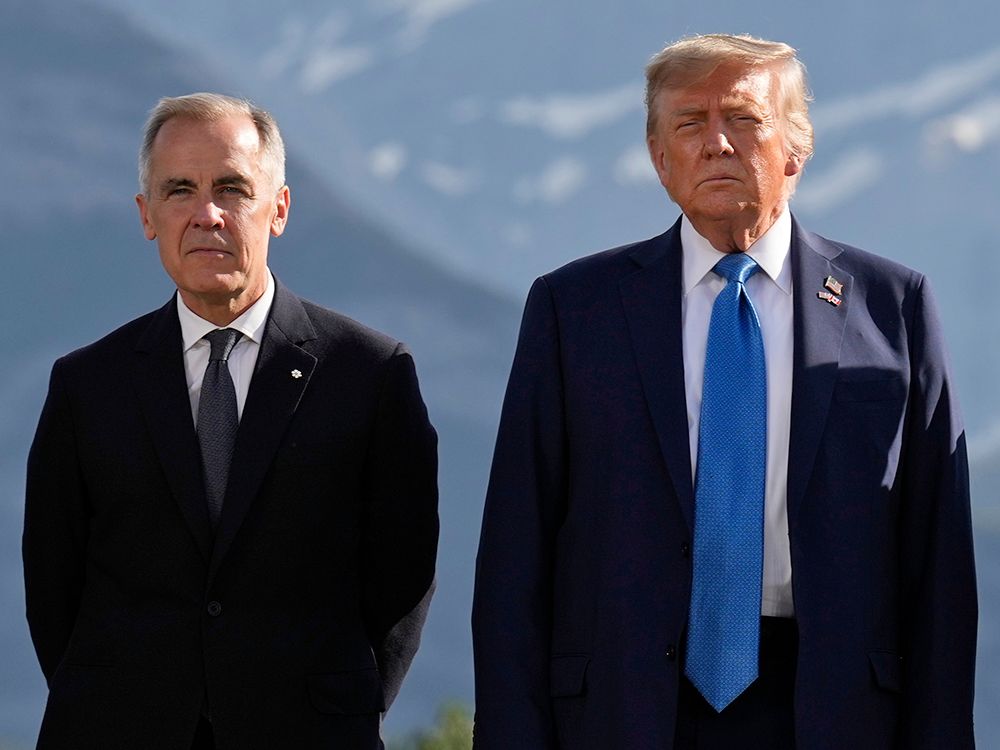
Prime Minister Mark Carney and U.S. President Donald Trump pose during a group photo at the G7 Summit in Kananaskis, Alta., on Monday, June 16, 2025.

OTTAWA — Prime Minister Mark Carney lowered expectations on Monday about reaching an agreement with the United States for an economic and security pact by July 21.

Speaking in Brussels, where he signed a defence partnership with the European Union (EU), Carney was asked which options Canada would be considering, besides higher tariffs on U.S. steel and aluminum, if he does not strike a deal with U.S. President Donald Trump within the next 30 days — as agreed to during the G7 summit last week in Kananaskis.

“We’ll do what’s right for Canada,” he said. “We’re working hard to get a deal, but we’ll only accept the right deal with the United States. The right deal is possible, but nothing’s assured.”

Carney said earlier this month his team was in “intensive discussions” with the U.S. and held off on further retaliation on additional tariffs of Canadian steel and aluminum, pending those discussions. In an interview with Radio-Canada days later, the prime minister hinted he was hoping to come to an agreement with Trump during the G7 summit.

But the summit in the Canadian Rockies passed without an agreement to end the tariffs, and both men agreed to

pursue negotiations toward a deal within the next 30 days.

Days later, Carney announced

a series of measures that would come into force on July 21

should both countries not come to an agreement — including increasing the existing counter-tariffs on U.S. steel and aluminum, blocking U.S. producers from competing for federal procurement projects and addressing global overcapacity in these sectors.

Politico has reported that

the Trump administration has “a lot of fish to fry” given all the trade deals his administration is trying to strike with other countries to lift reciprocal tariffs, and with all the deadlines on the horizon, Canada might simply not be a top priority.

In fact, the U.S. Trade Representative’s Office recently circulated a draft “agreement on reciprocal trade” with the EU,

according to the Wall Street Journal,

which included concessions to existing regulations such as its Digital Markets Act, its carbon-based border tariffs, methane rules and more.

The President of the European Commission, Ursula von der Leyen, said she would not go into details of the trade negotiation but said she was “very clear” that topics that touch the sovereignty of the decision-making process in the EU are “absolutely untouchable.”

“Of course, we discuss tariff lines, we discuss non-tariff barriers, like standards and norms, for example. We discuss strategic purchases. We discuss all these topics, but where it is the sovereign decision-making process in the European Union and its member states that are affected, this is too far,” she said.

On Monday, Carney said that Canada would continue diversifying its trade relationships “with like-minded partners, reliable partners, partners that are aligned with our values” irrespective of the outcome of the talks of a new deal with the Trump administration.

For instance, Canada just signed a security and defence partnership with the EU, considered a first step in joining the ReArm Europe Plan/Readiness 2030 initiative which will “create significant defence procurement and industrial opportunities for Canada,” according to a press released issued by the prime minister’s office.

“It begins here, and you see the ambition in this partnership and the scope of ambition, and that’s the future of trade,” said Carney.

He continued: “The future of trade is digital. The future of trade does take carbon into account. Carbon is trade, right? The future of trade, it does have this defence cooperation. It is consistent with industrial policy, recognizing that industrial policy amongst allies.”

“That’s the future of trade, not a narrow discussion on tariffs,” Carney said in an apparent shot at Trump’s comments at the G7 that he is a “tariff person” which he called “simple” and “easy,” and that Carney has a “more complex idea” of international trade.

Carney, however, sidestepped a reporter’s question about whether he felt more comfortable in Brussels than in Washington — by talking about the weather and the food.

In doing that, he also took an impromptu shot at the fine dining in Canada’s capital.

“In terms of relative comfort, well, it’s very hot in Washington right now and very humid. I’m sure that dinner will be better — with all due respect to our American friends, it’ll be better than would be in Ottawa. The dinner will be better tonight,” he said.

After his trip to Brussels, the prime minister will be departing to The Hague for the NATO Summit where allies are expected to sign off to an increase in defence spending of five per cent of their respective GDP — although it is still unclear if the timeline will be 2032 or 2035.

National Post

calevesque@postmedia.com

Our website is the place for the latest breaking news, exclusive scoops, longreads and provocative commentary. Please bookmark nationalpost.com and sign up for our newsletters here.


Tankers are seen at the Khor Fakkan Container Terminal, the only natural deep-sea port in the region and one of the major container ports in the Sharjah Emirate, along the Strait of Hormuz, on June 23, 2025.

Among the many concerns surrounding the ongoing conflict involving Israel, Iran and the United States is the state of the Strait of Hormuz, a vital shipping lane for much of the world’s oil and natural gas. Here’s what to know.

What is the Strait of Hormuz?

The Strait of Hormuz is a narrow channel of water that connects the Persian Gulf with the Arabian Sea (and beyond that the Indian Ocean). It is bounded on one side by Iran, and on the other by Oman and the United Arab Emirates. About 167 kilometres long, it is only about 50 kilometres wide at its entrance and exit, and just 33 kilometres across at its narrowest point. Since territorial waters typically extend 22 kilometres from the mainland, this puts part of the strait in both Iranian and Omanian waters.

Why is it important?

According to

CBS News

, more than a quarter of all oil shipped by sea in 2024 and the first quarter of 2025 travelled through the Strait of Hormuz. This amounted to about one-fifth of all oil and petroleum consumption worldwide. The strait also accounted for about one-fifth of the world’s liquefied natural gas (LNG) trade last year.

Close to 40 per cent of the oil that has passed through the strait daily came from Saudi Arabia — the most of any country — while most of the LNG was from Qatar. Other oil-producing nations that use the strait include Iran, Iraq, Kuwait, Saudi Arabia and the UAE.

What could Iran do to disrupt traffic there?

A report by

Britain’s Guardian newspaper

notes that the most likely disruption would be in the form of mines laid in the shipping channel and primed to explode or launch a rocket from the seabed if they detect passing traffic.

However, it notes that laying the mines would be a dangerous job, since any attempt to do so would likely come under attack from American and/or Israeli forces.

Sir Alex Younger, former head of the U.K.’s intelligence agency MI6,

told the BBC

that a blockade of the strait by Iranian ships was another possibility, adding: “Closing the strait would be obviously an incredible economic problem given the effect it would have on the oil price.”

How likely is this?

It’s worth noting that Iran has repeatedly threatened over the years to close the Strait of Hormuz, but has never actually done so. The nearest it came was in the late 1980s, when so so-called “tanker war” saw attacks on Kuwaiti and other oil tankers. This led to U.S. warships escorting tankers through the region for a while.

Opher Baron

, a distinguished professor of operations management at the Rotman School of Management at the University of Toronto, said that closing the strait could harm Iran’s economy as well as others.

“There are ways to let your ships go through when you close it but it’s complicated,” he said.

On the other hand, he noted that Iran “has its back to wall, more than past events. They may now take steps that they didn’t take in the past.”

Others are less concerned. An

analysis by Reuters

noted that, since the 1980s, several overland pipelines have come online in the region leading to the Red Sea port city of Yanbu, Saudi Arabia, and the Fujairah oil terminal in the UAE, which is just outside the Strait of Hormuz.

What is likely to be the effect on gas prices?

Oil prices are already up over the uncertainty caused by the

U.S. attack on Iran

.

Baron said the longer the conflict continues, the higher prices will go, and that a blockade of the strait could cause an even sharper spike.

“The uncertainly that it adds … is going to create some increases in price, and I think this will stay for quite a while,” he said.

Gas prices have already risen in the past week, in part due to the threats in the region. “A step like this is escalating things rather than de-escalating it,” he said. “So I’m afraid it’s going to have a longer impact, and we could see gas prices 20, 30 per cent that what they were a couple of weeks ago.”

Our website is the place for the latest breaking news, exclusive scoops, longreads and provocative commentary. Please bookmark nationalpost.com and sign up for our newsletters here.


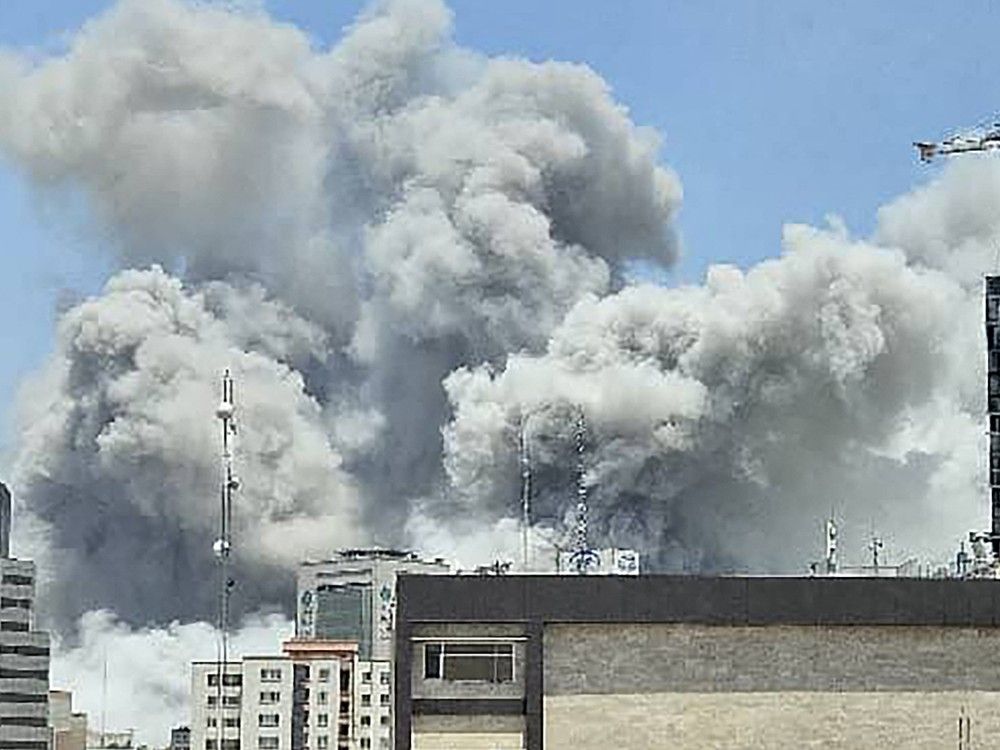
Israel hit Iran's capital of Tehran with airstrikes on key targets early Monday morning. Among them, but not pictured here, was a digital clock counting down to the predicted destruction of Israel.

Israel said it employed “unprecedented force” to attack key targets within Iranian Supreme Leader Ayatollah Ali Khamenei’s regime on Monday morning.

Among them, Minister of Defence Israel Katz said, was the “Destruction of Israel” clock in Tehran’s Palestine Square — a digital billboard that has been counting down the days until the promised “annihilation” of Israel since 2017.

Other targets in the capital included the headquarters for the Islamic Revolutionary Guard Corps’ international security and its militia arm, the Basij, as well as Evin Prison, where “political prisoners and opponents of the regime” end up,

Katz posted to X

. The co-ed prison has a history of abusing, ignoring and violating the human rights of some inmates, mainly women.

The clock’s timer dates back to September 2015 when Iran, trying to ease Western sanctions, struck a deal with the U.S., China, the U.K., France, Germany and Russia that it would limit and reduce its uranium enrichment. Parts of the agreement included a 25-year timeline.

Khamenei, in a speech to followers after, suggested that the timeframe shouldn’t alleviate Israel’s concerns in the interim.

“Firstly, you will not see next 25 years,” he was quoted in

an X post to his account

. “God willing, there will be nothing as Zionist regime by next 25 years.

“Secondly, until then, struggling, heroic and jihadi morale will leave no moment of serenity for Zionists.”

About 20 months later, on June 18, 2017, demonstrators unveiled a clock to mark Quds Day — an annual event meant to support Palestinians and oppose Israel, established in 1979 by Ruhollah Khomeini, founder of the Islamic Republic of Iran.

In red digital lettering presented in Persian, English and Arabic, the clock displays the number of days above the text “Left before the destruction of Israel” and a repetition of Khamenei’s statement.

The words are presented on an Israeli flag intersected by a fist painted green, red and white.

When it debuted, it gave Israel 8.411 days until its destruction, which would be roughly 25 years from the date that Khamenei predicted — Sept. 9, 2040, what will be the last day of Rosh Hashana, Judaism’s new year and the first of the high holy days on its calendar.

While the Israeli Defence Force has specified more of the targets that were struck, it did not independently state the countdown billboard had been hit by an airstrike.


People attend France's annual street music festival, the Fete de la Musique, on the Seine river banks on June 21, 2025.

A total of 145 people in France were reportedly assaulted with syringes while attending a country-wide street music festival over the weekend.

The festival, called Fete de la Musique, took place at locations across the country and attracted millions of festival-goers, according to French media such as

France24

and

RFI

. Overall, there were 12 arrests related to the syringe attacks, the interior ministry said.

On June 21, Paris firefighters said they were receiving a large number of calls related to high attendance at the festival in

a post on X

. According to Paris police, there were 13 cases of people saying they were pricked in the capital,

The Guardian reported

. It was not revealed by authorities what the contents of the syringes were; however, the interior ministry said some victims were taken to hospital for toxicology tests. French publication

France Info reported

that investigations were opened after three victims, including an 18-year-old boy and 15-year-old girl, became ill.

 Music enthusiasts gather for free concerts on the banks of the Seine river during France’s annual street music festival, the Fete de la Musique, in Paris on June 21, 2025.

Meanwhile, François Grosdidier, the mayor of Metz, a city in northeastern France, said there had been a “call for syringe assaults” on social media in the major cities where the festival was taking place. At 9:15 p.m., Grosdidier said the first such assault was reported in Metz. The victims were approximately 15 young girls between the ages of 14 and 20 years old.

Using video footage of a suspect, police were able to identify and arrest him. Grosdidier said he hopes the investigation will help authorities identify other assailants.

Grosdidier also said that police arrested an individual who slapped a young girl and broke up some fights in the area, likely provoked by alcohol consumption. He posted a series of photos from the festival that showed him speaking with authorities.

French media such as

Le Monde

as well as The Guardian corroborated Grosdidier’s point that there were calls on social media platforms to assault festival-goers with syringes.

The attacks were wide-ranging, with four arrests in the southwestern city of

Angoulême

and roughly

50 victims

. In the Normandy region, several women in Évreux and Rouen were reportedly pricked with needles,

per French media site Ici

. Investigations were opened and it was not immediately clear if the syringes had any substances inside them.

In the city of Tours,

Ici reported

that there were 13 people who were victims of a syringe attack. There were also attacks reported in the

northeastern city of Thionville and commune of Sarreguemines

.

 People watch as the Paris 2024 Olympic cauldron tethered to a balloon flies above the Tuileries garden at sunset during France’s annual street music festival, the Fete de la Musique, in Paris on June 21, 2025.

In Vesoul, a commune in eastern France, the local trade association posted

a warning on Facebook

.

“For several months, numerous cases of syringe attacks have been reported throughout France, often during festivals or soirées,” the caption of the post said in French, adding that the syringes could be filled with dangerous substances. A video accompanying the post said that those pricked with a syringe may feel suddenly ill or suffer from dizziness. It urged festival-goers to be vigilant.

There were more than 370 people detained throughout the festival weekend across France for a variety of charges, according to Agence France-Presse.

Our website is the place for the latest breaking news, exclusive scoops, longreads and provocative commentary. Please bookmark nationalpost.com and sign up for our daily newsletter, Posted, here.