LP_468x60
on-the-record-468x60-white

One of around 300 Red Light cameras  installed in the  City of Toronto. The cameras were put in intersections with high collision and fatality rates.

Two Toronto drivers who saw their red light camera tickets put on hold because it took too long to get their cases into court are out of luck because the justice of the peace who handled them initiated the stays himself and didn’t give the city a heads-up that he was going to press pause on the charges.

The justice of the peace, who is not named in the appeal, stayed cases against Henry Shein Canada and Lisa Lee-Tucker because they exceeded the 18-month window to get provincial court matters in front of a judge. But the cases against both of them were revived after the city successfully appealed the stays to Ontario’s Court of Justice, which ordered new trials for both drivers.

“What happened here is that the justice went a step too far,” Justice David Rose wrote in a recent decision.

In a precedent known as the Jordan rule, the Supreme Court of Canada set a presumptive ceiling of 18 months for provincial court trials and 30 months for superior court trials, after which delay is considered unreasonable unless exceptional circumstances are proven.

Rose conceded both cases took too long to get to court, saying the justice of the peace was “entirely right that the delay in the cases before him engaged (Jordan) concerns on their face.”

But Rose had problems with the way both cases were handled.

“It was reversible error for the court to initiate a stay of proceedings on its own motion,” Rose said.

“A trial judge must be careful and reluctant to bring their own motions because of a perceived unfairness to one or the other party …The discretion should only be exercised rarely and then with extreme care, so as not to interfere with the adversarial nature of the trial procedure or prejudice the accused.”

Canada and Lee-Tucker’s cases “have a commonality,” which is why the appeals were heard together, Rose said, noting both drivers had someone appear for them at early resolution meetings after requesting them.

Red light camera tickets in Toronto are $325.

Canada got his at 1:33 p.m. on Aug. 23, 2022, in the intersection of Bloor Street and Ossington Avenue. Lee-Tucker got hers at the intersection of Sheppard Avenue and Leslie Street in September 2022.

Canada’s early resolution meeting was slated for July 10, 2024. Lee-Tucker’s was July 17, 2024.

By the time Canada got to court, his ticket was 22 months old.

Fairly early on in his appearance that day, the justice of the peace said, “I do not find that it’s appropriate that these cases proceed. So that’s the angle I’m working at.”

The justice of the peace pointed out there was no need to wait for a Charter challenge when an “abusive process” is clear. “This is not fair play.”

When Canada’s lawyer appeared at the early resolution hearing by telephone, the justice of the peace noted it was Canada’s first time before the court with the charge “well exceeding the Jordan ceiling.”

The justice of the peace used his own common law authority to stay the proceedings. “That’s everything. You may disconnect,” he told Canada’s lawyer on the phone. “There’s no conviction, no finding of guilt. No fine. Drive careful.”

Lee-Tucker’s ticket was also 22 months old by the time her case reached an early resolution hearing.

“I cannot in good conscience accommodate an application, resolution or to be rescheduled in a trial court to add further delay on top of an unlawful delay,” the justice of the peace said at the time, entering a stay on that charge as well.

Lee-Tucker’s husband, Chad, appeared by telephone during the brief court appearance.

“First time before the court. Judicial stay of proceeding applicable. Case collapses,” said the justice of the peace. “You may disconnect.”

The justice of the peace “was clear at the outset of the day that any case that exceeded 18 months of delay would be stayed on the court’s own motion and without one being requested,” Rose said.

But the law indicates it is “essential” that before a judge hears an application to stay charges, the prosecution must be given notice, Rose said.

“Beyond the statutory requirement to give notice before an accused may seek a stay of proceedings it is incumbent on the trial justice to remain impartial as between the prosecution and defence.”

A trial judge “has a duty to see that an unrepresented accused person is not denied a fair trial because he is not familiar with court procedure,” Rose said.

But that must be limited to what is reasonable, Rose said. “Clearly it cannot and does not extend to his providing to the accused at each stage of his trial the kind of advice that counsel could be expected to provide if the accused were represented by counsel. If it did, the trial judge would quickly find himself in the impossible position of being both advocate and impartial arbiter at one and the same time.”

Our website is the place for the latest breaking news, exclusive scoops, longreads and provocative commentary. Please bookmark nationalpost.com and sign up for our daily newsletter, Posted, here.


Alberta Premier Danielle Smith announces Alberta Next panel details at Heritage Park as Business Council of Alberta president Adam Legge listens on Tuesday, June 24, 2025.

OTTAWA — Alberta is pitching that provinces collect more tax dollars and Ottawa less, in its latest volley against the federal equalization program.

The idea was put forward on Tuesday

in an explanatory video

posted to the website for the newly launched

Alberta Next panel

.

The video proposed that the current fiscal arrangement in which Ottawa collects

roughly 60 per cent

of all tax revenues be flipped on its head.

“What if we cut out the middleman and instead had provincial governments

— that are responsible for delivering health care, education and social services — collect around 60 per cent of all taxes(?)” asked the narrator.

The clip draws inspiration from an unlikely source, pointing to a fiscal decentralization scheme recently floated by Quebec.

“Quebec has already proposed having the federal government let provinces keep GST revenue generated in their provinces in return for ending the federal health transfer … Why not apply that same logic to all federal transfers?”

“Less money collected and wasted in Ottawa, less federal transfers with only a modest amount of equalization for the smallest provinces and territories that actually need it.”

The three-minute video leads to an online survey on the equalization program geared to Alberta residents.

The idea of swapping health transfers for GST revenue was

one of 42 recommendations

put forward to Quebec’s government last fall by a special advisory committee on constitutional issues.

Alberta currently receives

more than $8 billion

annually from Ottawa through major federal transfers.

Alberta Premier Danielle Smith said shortly after April’s federal election that she

was no longer willing

to “subsidize” larger provinces like Ontario and Quebec through the federal equalization program.

That was never the intent of equalization, and it needs to end,” Smith said in an early May address to Albertans.

Total equalization payments will reach

a record $26.2 billion

in the 2025-26 fiscal year, with Quebec taking home slightly more than half.

Smith has recently called for the equalization program to be downsized and reconfigured

to prioritize the needs

of smaller provincial economies like Manitoba and the Maritime provinces.

Alberta hasn’t received an annual equalization payment since the 1964-65 fiscal year and, according

to one recent study

, has seen less than 0.02 per cent of all payments under the program since its inception in 1957.

Sixty-two per cent of Albertans voted

in a fall 2021

referendum for equalization to be removed from Canada’s Constitution.

Daniel Béland, the director of McGill University’s Institute for the Study of Canada, said he’s “not optimistic” about Alberta’s suggestion that larger provinces stop receiving equalization programs in exchange for greater tax collection powers.

“This idea of cutting Quebec out of equalization is politically a non-starter,” said Béland.

“I mean, it would create a very strong backlash in (Canada’s) second-largest province. That’s 78 seats in the House of Commons.”

“The logic of equalization is not about size, but about fiscal capacity on a per-capita basis,” added Béland.

He also said that there was little basis for the comparison between health transfers and equalization payments.

“Health transfers bring provinces together because they have a shared interest in getting more money from Ottawa. With equalization, there are explicit winners and losers,” said Béland.

Equalization is one of six topics to be studied by the Alberta Next panel, a group led by Alberta’s premier to challenge what it considers federal government overreach.

Other topics include the Alberta Pension Plan, a provincial police force and constitutional changes.

Smith named University of Calgary economics professor Trevor Tombe, an expert on equalization, to

the panel on Tuesday.

The premier has said that ideas and discussions from the panel will be used to shape questions put forward to Albertans on next year’s referendum ballot.

National Post

Our website is the place for the latest breaking news, exclusive scoops, longreads and provocative commentary. Please bookmark nationalpost.com and sign up for our daily newsletter, Posted, here.


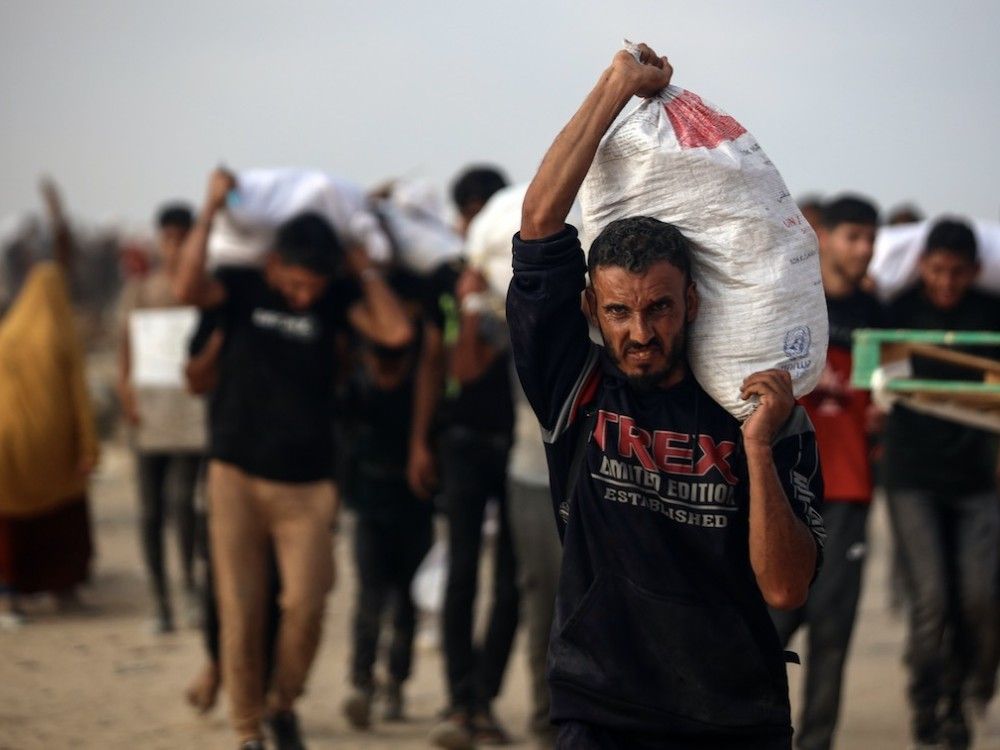
TPS-IL spoke to experts and people on the ground to understand what is really happening with the food supply in Gaza.

Jerusalem, 25 June, 2025 (TPS-IL) — Hamas are controlling the food supply as a tactic to garner more teenage recruits, an aid worker in Gaza and experts have told The Press Service of Israel.

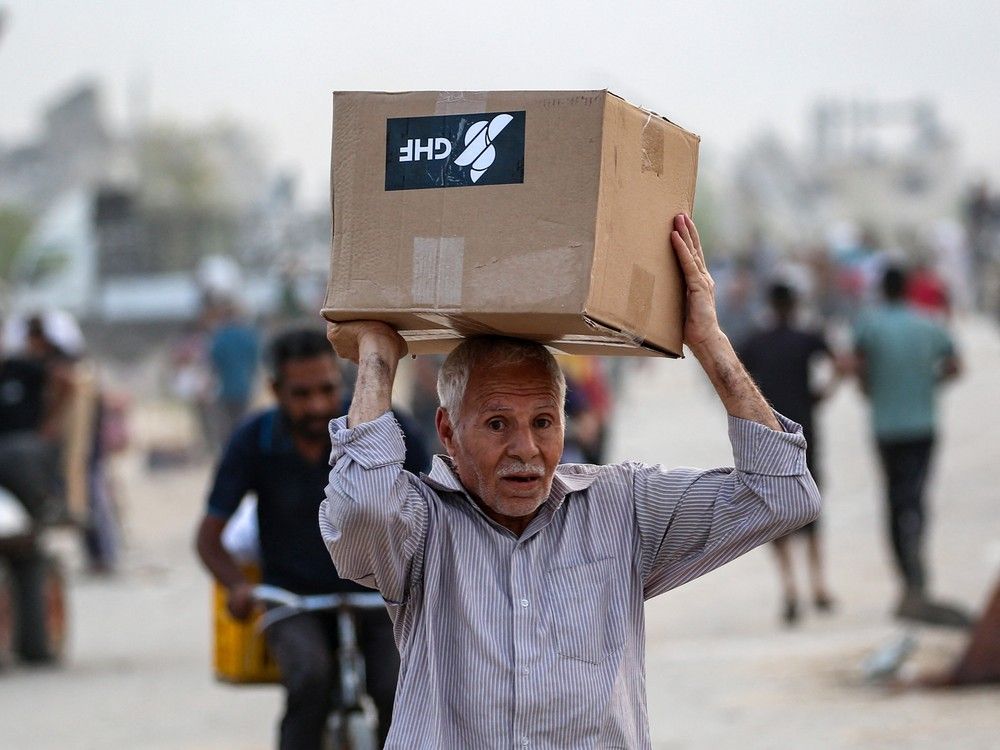
In recent weeks, claims of a famine and repeated pressure on Israel to provide food for people in the Gaza strip has led to the establishment of the Gaza Humanitarian Foundation (GHF), an American-funded initiative that works alongside Israel to feed Gazans.

As the focus of world news shifted to the Iran-Israel conflict, TPS-IL spoke to experts and people on the ground to understand what is really happening with the food supply in Gaza.

“Hamas control aid, it’s one of their things. We see it all, Hamas act physically. This is not intelligence,” a member of Coordinator of Government Activities in the Territories (COGAT), told TPS-IL. “…Hamas takes the aid in Gaza.”

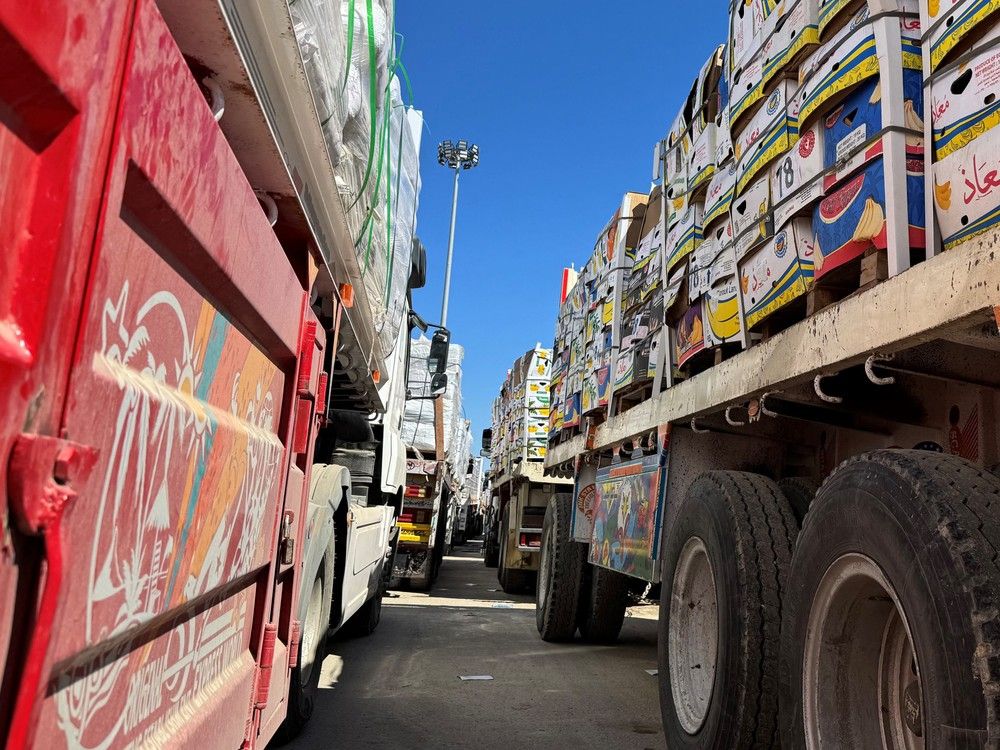
 Trucks carrying humanitarian aid line up on the Egyptian side of the Rafah border crossing with the Gaza Strip on Sunday after Israel suspended the entry of supplies into the Palestinian enclave. Israel said on March 2, that it was suspending the entry of supplies into Gaza.

COGAT works to get the food trucks into Gaza. GHF works alongside them, and many other security contractors to deliver meals, something the UN aid agencies are vocal in opposing, claiming that to work with Israel lacks “impartiality.”

GHF claims to have delivered more than 42 million meals to date, and continues to operate daily, despite having five of their volunteers allegedly murdered by Hamas while doing so.

One expert told TPS-IL that Hamas controls the strip with the aim of ensuring teenagers end up in their ranks. Dr. Igal Shiri, who works at the counterterrorism institute Meir Amit, said: “Hamas completely control the area (the Gaza strip).

“Even though there is the massive attack, and you can see Aza is destroyed, with most of Gaza under bombing, they continue to control the civilians. They still control the area with aggression, even under attack.

“Every little bit of food – they stole it. When they get the food, they get the power. The young people in Gaza are not working.

“There is no school, no university, and they have no effective way to earn money, so Hamas has the power.”

He went on to explain that the control starts with the food, but eventually infiltrates every aspect of life in Gaza: “It’s a problem because they still control Gaza, even after 18 months of war.”

Accurate recruitment figures for Hamas are not obtainable due to the unreliability of Hamas reporting, but Joe Biden’s Secretary of State Antony Blinken said in January that the U.S. government believed Hamas had recruited almost as many as it had lost since the beginning of the ongoing Israel-Hamas war.

Other sources claim as many as 15,000 new recruits were added to the group since October 7.

Shiri continued to outline how Hamas use media manipulation to wildly exaggerate claims of starvation, which eventually trickles down into them controlling food supplies: “It’s a narrative that they’re starving.”

“If they really cared (about providing for their people and building a country), they would build schools and factories, but they put thousands of billions into constructing tunnels and we have to think why? For 20 years, all they thought about was October 7.

“We got pictures from inside, you can see the food. So they are not starving, but its good to say you are and show pictures of children in the hospital, because that gives them power.”

 The Gaza Humanitarian Foundation says at least five of its workers were killed and some are feared to be taken hostage following an attack by Hamas terrorists on Wednesday night.

Another expert, Dr. Nesya Rubinstein- Shemer, who wrote a book on Hamas’s ideology and is a professor of Middle Eastern Studies at Bar Ilan University, told TPS-IL that the control of food has been a tactic of terror groups even before Hamas was founded.

She explained: “The history of Hamas goes back further than it’s establishment in 1987; their roots began as a branch of the Muslim Brotherhood in 1928 in Egypt.

“The Muslim Brotherhood was founded on the (Islamic ideological) basis of ‘dawah’ – the concept of conquering the hearts of the people and reaching for a firm basis in the population, before trying to achieve a role in the state.

“Muslim Brotherhood belongs to political Islam. The end goal is to gain political power, but they believe that to do that, they first have to gain control over the population.

“Muslim Brotherhood did this first, because the population had it very hard from a social point of view, so they established social structure to help society and provide places to eat, food for the poor, medical treatment, summer camps for youth – a whole kind of social engagement with the population to gain control and support.

“The main aim was to achieve ideological support, to achieve help from the population in whatever they need.

“After eight years, they established 150 branches all over Egypt, because this is what the population needed, so this is how they gained influence.”

This, she said, is where Hamas garnered it’s food-control tactics: “Hamas did the same in Gaza, before it was established.

“Ahmed Yassin was the establisher of Hamas, but before they were established in 1987, in 1973, Yassin established another organization El Mujjma El Islami – this organization gained control of the population through the establishment of institutions like mosques, kindergartens, schools, and he offered aid in clothes, and food.

 A Palestinian Hamas supporter holds a portrait of Sheikh Ahmed Yassin during a demonstration at the Burj el-Barajneh Palestinian refugee camp in Beirut in 2004.

“Then came the Hamas movement. Hamas now has perfect control over the population because they control food and humanitarian aid. Many people from Hamas worked in UNWRA.

“The message put out by Hamas to the people, over time was that ‘if you are loyal to Hamas, you can get what you need like fuel, medical supplies, food’ – basically everything Israel gave them over the years.”

She went on to detail how Hamas continue to use food to maintain control: “Hamas are acting as a gatekeeper to the food supply. Additionally, if you (regular Palestinians) resist Hamas, you will be the last in line (for food).”

Finally, she told TPS-IL how Hamas use the image of starvation to maintain control: “Now what they’re doing is perpetuating the narrative of hunger in the world.

“They have Al Jazeera in six languages, which works 24/7 in supplying pictures. Hamas don’t care if the population die and suffer – on the contrary, it serves them, because then the world sees and it is translated into political pressure on the world to step in.

“Jihad also means fighting through media. This makes all the countries isolate Israel because it is demonized in the world media. This is very problematic.

“Hamas presents the idea of liberation and people don’t understand they are a terror organization. People don’t know the meaning of ‘the river to sea’.

“Hamas is a murderous terrorist organization, which pretends to fight for the liberation of Palestine…

“Since 2005, there wasn’t a single (Israeli) soldier in Gaza – they (Hamas) chose to take money and make tunnels and to buy missiles in order to attack Israel. They are not freedom fighters, and there is no solution (to be made with them).

“Now the situation is very problematic because they use world media to create a bad image of Israel and it’s challenging.”

GHF was contacted for comment.


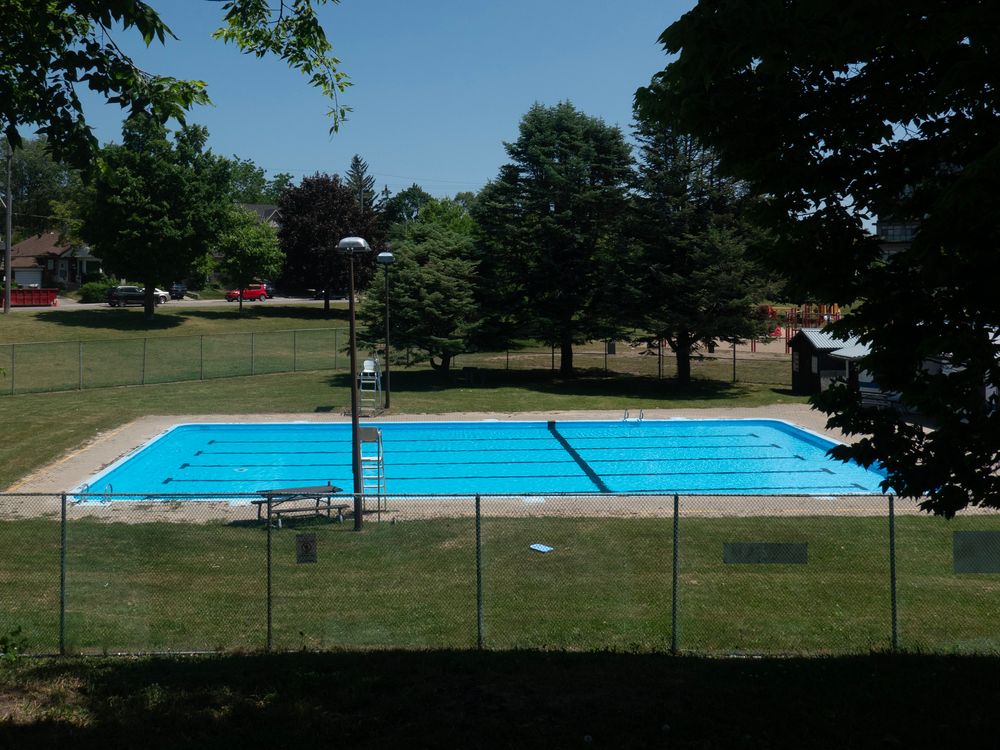
A Toronto public pool stands closed on Monday, June 23, 2025.

It’s the stuff of bureaucratic nightmares. Earlier this month, the City of Toronto announced that 15 of its outdoor pools would be opening a week early as part of a

planned extended season

, with the rest slated to start operations on June 27.

Then on June 20, with temperatures in the city soaring, it gleefully posted to X that all its outdoor pools would open the following day. “Summer & outdoor pools, a perfect duo if there ever was one,” the post read, bedecked by cheerful emojis.

And then, almost as quickly, it poured cold water on the idea. Or maybe it was hot water?

“Given provincial requirements related to heat and humidex (45C+) protocols, some outdoor pools had intermittent closures today to ensure staff health and safety,” the city posted to

its X account

on Sunday. “Staff remained on site to re-open pools as soon as possible. Please check individual pool web pages for updates.”

The closure was not well received by sweltering Torontonians, and no less a citizen than Brad Bradford, councillor for Beaches-East York, took to social media on Monday to complain.

“When it’s hot out, the pools have to be open, full stop,” Bradford said in an

almost two-minute video

that showed him outside the locked gates of several outdoor municipal pools.

“Now yesterday, with the humidex of over 40 degrees, the city of Toronto was actually locking people out,” he continued, rattling a gate. “Only in the city of Toronto would they close pools because it’s too hot. You can’t make this stuff up.”

Bradford was equally vocal about who was to blame. “The mayor got caught unprepared for the summer weather that we experience every year,” he said, noting that other cities, including Montreal and Mississauga, didn’t experience any closures.

Mayor Olivia Chow

issued an apology

later in the day. “We noticed that as temperatures rose, health and safety standards came into effect that closed a few pools,” she said. “We apologize for that. This cannot happen again. When it’s hot outside, residents need to be able to get out to the pools and cool down.”

Pushing back on the notion that provincial laws were to blame for the closure, Ontario Premier Doug Ford told

Newstalk 1010 radio

during a call-in: “There was no minister of labour inspector that called up and said shut down the pools.”

He added: “She’s citing maybe the labour rules … those labour rules are specifically for hard-working people … pouring asphalt as opposed to sitting by a swimming pool they can jump in any time and cool down.”

Chow

took to X again

on Monday, stating: “To ensure pools stay open, and avoid the intermittent closures experienced yesterday due to health and safety rules, here are the actions we’re taking immediately.”

They including: deploying additional lifeguards to manage rest and work schedules; more shade structures; and having medical professionals checking in or stationed on site.

“Pools need to be open during a heat wave,” she concluded. “That’s obvious to us all. We’re making sure we have the resources to keep them safe and healthy for City workers and the public alike. We’re fixing it now. Pools are open as normal.”

Chow also posted a copy of a

two-page motion

titled “Addressing Gaps in the City’s Heat Relief Strategy.” It included directives for addition supplies of bottled water and water trucks, and a request for a report by the end of the year “with a review of the City’s heat relief strategy and recommendations for improvements, including restoration of previously offered services like 24/7 cooling centres, and consideration of the creation of a Chief Heat Officer.”

The City of Toronto maintains a web page with information on all its

swimming and water play facilities

, including a list of closures and service alerts.

National Post has reached out to Councillor Bradford and Mayor Chow for additional comments.

Our website is the place for the latest breaking news, exclusive scoops, longreads and provocative commentary. Please bookmark nationalpost.com and sign up for our newsletters here.



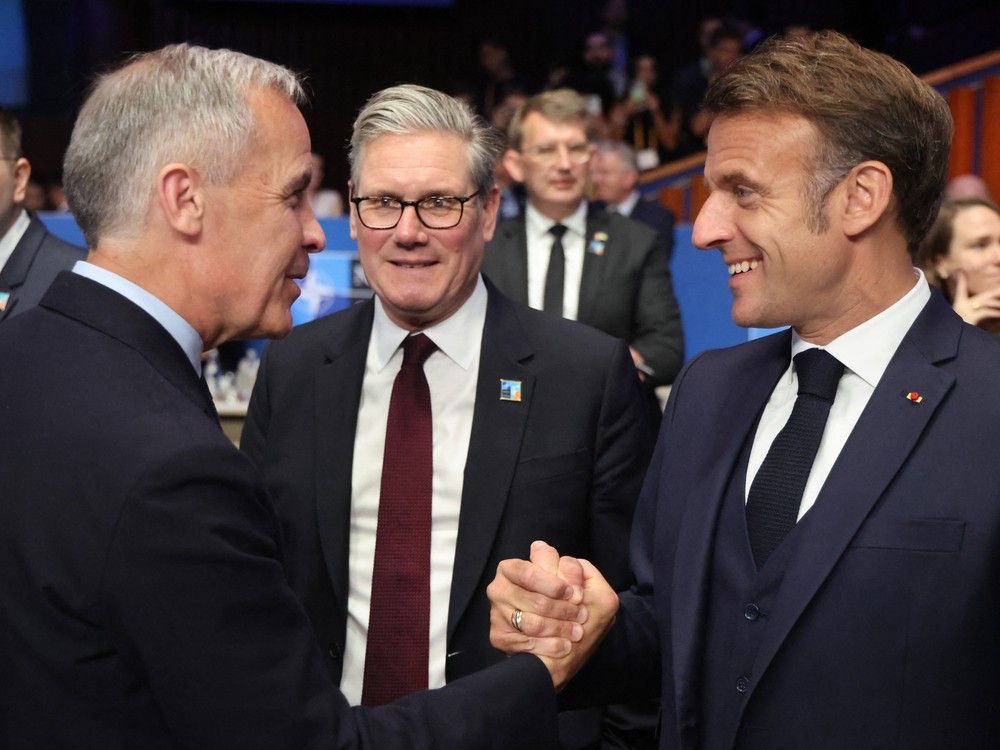
France's President Emmanuel Macron (R) shakes hands with Canada's Prime Minister Mark Carney (L) as Britain's Prime Minister Keir Starmer (C) looks on before the start of the North Atlantic Council plenary meeting at the North Atlantic Treaty Organisation (NATO) summit in The Hague on June 25, 2025.

OTTAWA — Even before it hits the 2014 NATO target of two per cent, Canada is committing to a new NATO target of boosting its defence and military spending to five per cent of its GDP — or $150 billion each year in total — within ten years.

Following a two-day NATO summit in the Netherlands, Prime Minister Mark Carney confirmed Wednesday that the alliance of European countries, the U.S. and Canada had agreed to significantly increase the sizes of their military and boost defence infrastructure spending within a decade.

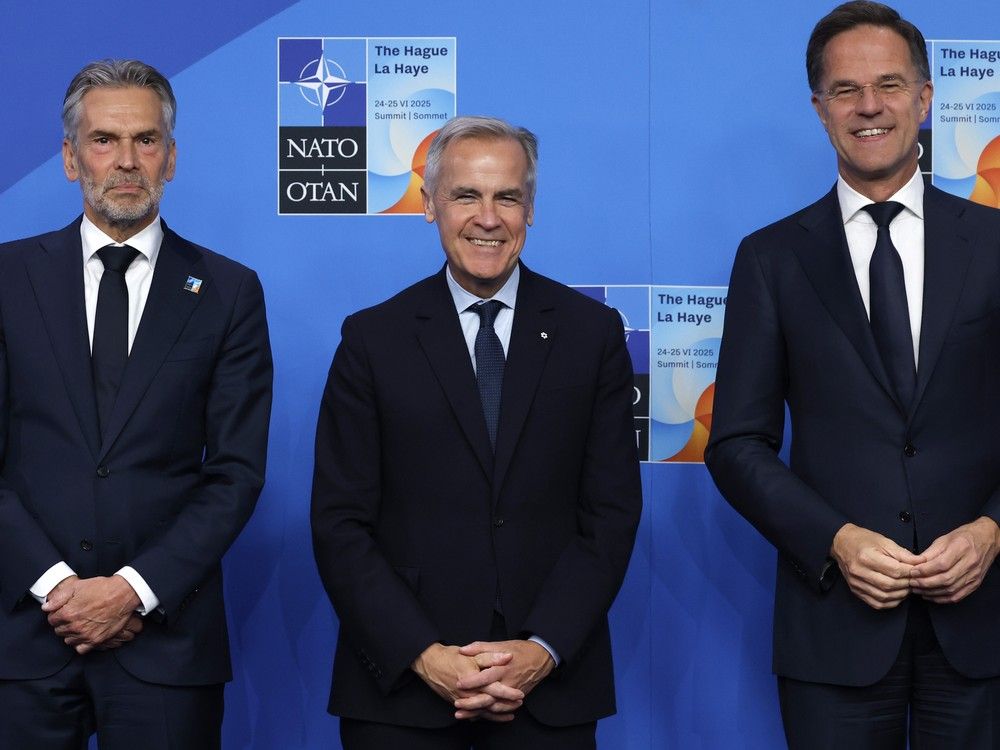
 Prime Minister of Canada Mark Carney (C) poses for a photo with NATO Secretary General Mark Rutte (R) and Netherlands’ Prime Minister Dick Schoof (L) on the second day of the 2025 NATO Summit on June 25, 2025 in The Hague, Netherlands.

The new target, which was the product of significant pressure by U.S. President Donald Trump, will be split in two portions: 3.5 per cent dedicated to military spending and 1.5 per cent on defence infrastructure investments.

During an interview with CNN Tuesday evening, Carney said the new target — should Canada ever hit it — means the government will eventually be spending roughly $150 billion per year on defence. “It’s a lot of money,” he acknowledged.

During a press conference Wednesday, Carney said that the target is designed to respond to current and growing threats from Russia and other hostile countries. But he said the target could be adjusted in years to come and the geopolitical situation evolves.

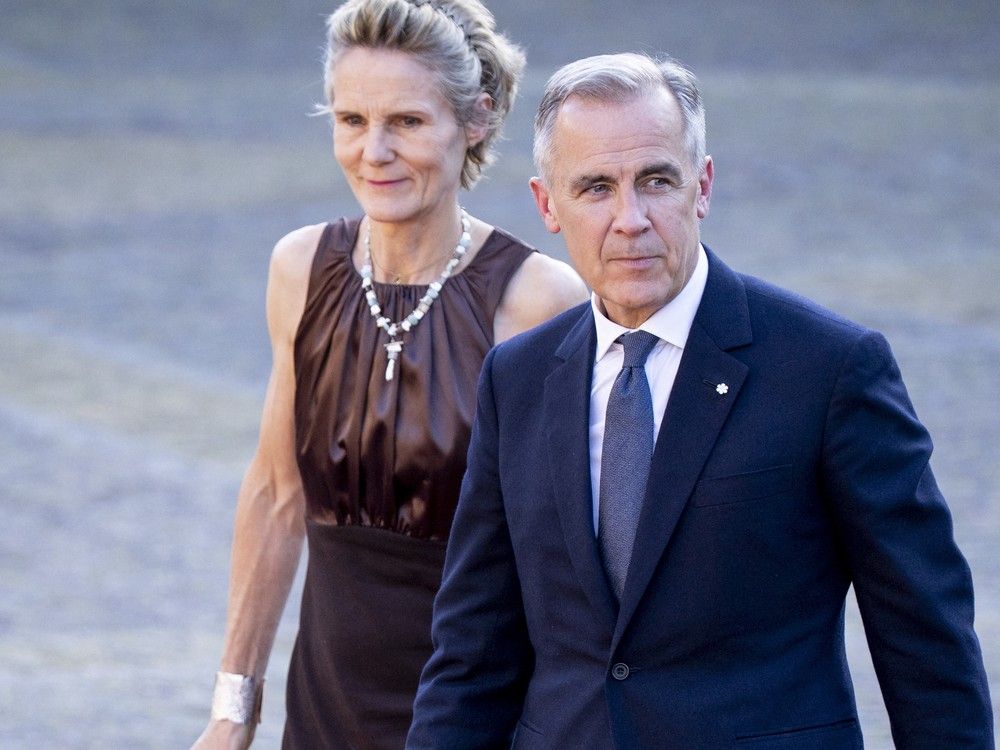
 Canada’s Prime Minister Mark Carney (R) and his wife Diana Fox Carney arrive for a social dinner at the ‘Huis ten Bosch’ Royal Palace during a North Atlantic Treaty Organization (NATO) Heads of State and Government summit in The Hague, on June 24, 2025.

“We are protecting Canadians against new threats. I wish we didn’t have to… but we do have to and it is our core responsibility as government,” Carney said.

“The fact that we’re united, the fact the United States is fully behind this, the fact that we’re working together is going to reduce the threat environment 10 years from now,” he added.

Earlier this month, Carney promised that Canada would hit its 2014 NATO commitment of dedicating two per cent of its GDP to defence spending by the end of the 2025-2026 fiscal year.

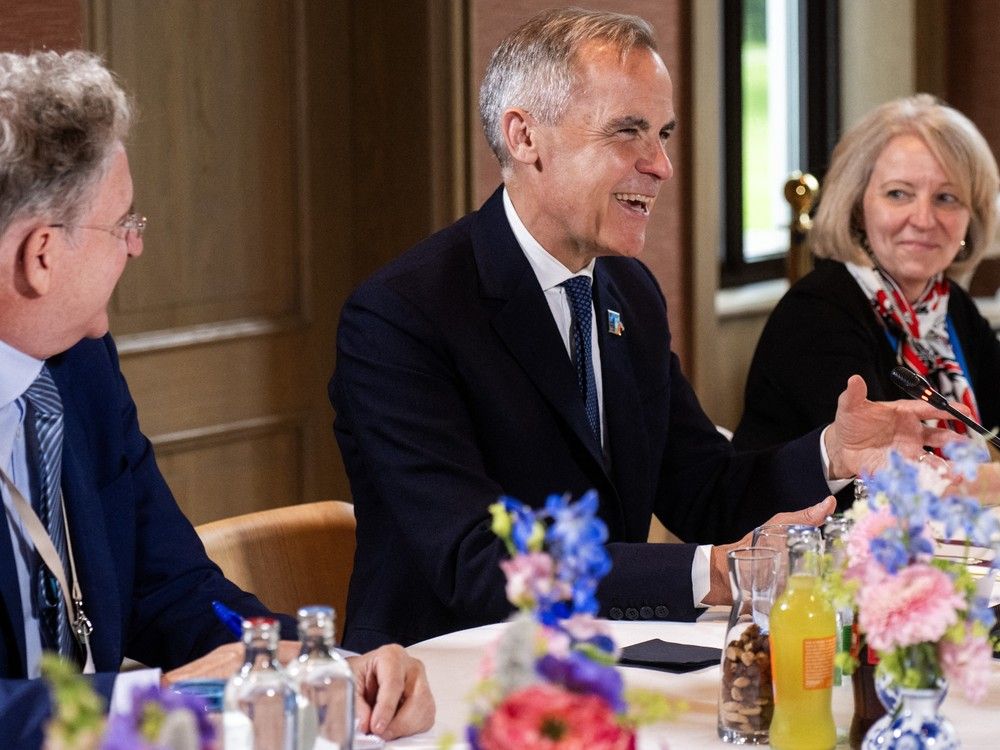
 Canada’s Prime Minister Mark Carney attends a meeting with Netherlands’ prime minister at the Catshuis on the sidelines of a North Atlantic Treaty Organization (NATO) Heads of State and Government summit in The Hague on June 24, 2025.

More to come.

National Post

cnardi@postmedia.com

Our website is the place for the latest breaking news, exclusive scoops, longreads and provocative commentary. Please bookmark nationalpost.com and sign up for our politics newsletter, First Reading, here.


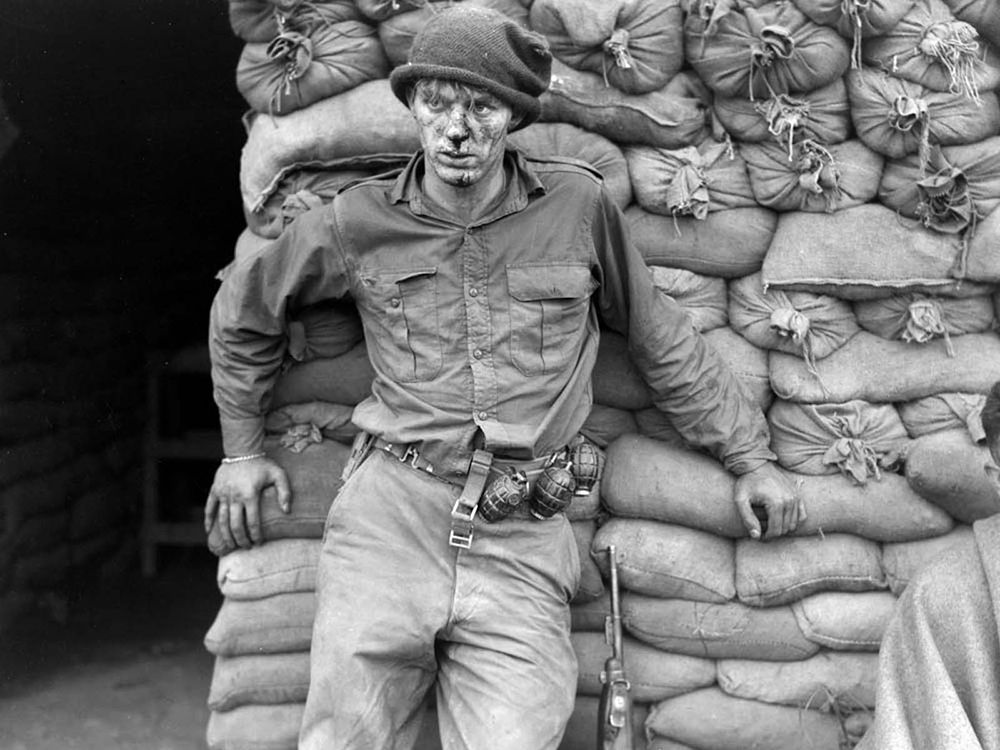
Private Heath Matthews of Charlie Company, 1st Battalion, Royal Canadian Regiment, awaiting medical aid after night patrol near Hill 166. Date: June 22, 1952.

In the photograph, the young soldier looks past the camera lens. Blood stains his face from shrapnel wounds. Grenades hang from his belt, his rifle is beside him. He is leaning against sandbags, but appears somehow coiled for action, resting but not at ease, his expression enigmatic, as if he had just witnessed something barely believable for the first time.

His company had just made a fighting retreat, under mortar attack from Chinese forces, from a patrol near Hill 166 west of the Jamestown Line in Korea, near the present day border between North and South. Two Canadians were killed, and two dozen injured.

It was the early morning of June 23, 1952, and as he waited for medical aid at this field clinic, Pte. Heath Bowness Matthews originally of Alberton, P.E.I., a signaller with Charles Company, 1st Battalion, The Royal Canadian Regiment, was becoming an iconic figure in Canadian history.

The photographer looking at him, Sgt. Paul Tomelin of Alberta, had arrived in Korea with the 25 Canadian Public Relations Unit as an experienced chronicler of war, with battleground experience in the Second World War in Europe, where he was also a stretcher bearer.

Tomelin had been assigned to this patrol, but could not use a flash at night, so he photographed tracer fire during the fight, then waited near the aid post for casualties. He noticed Matthews and raised his camera, starting to focus on the seam of his shirt, to ensure he was also focused on those eyes. He would later recall Matthews showed an expression of disgust, as if about to turn away from the intrusion. Tomelin gestured, asked him to please stay, and squeezed the shutter.

“And the strange part of it is, that normally a picture as important as that one seemed to be, I would take a second one. But somehow or another I felt that it was there. And it was there,” Tomelin said, according to a first-person account in the Canadian Encyclopedia.

Tomelin would later write in the Ottawa Citizen: “Based on my research of published war photographs, I claim this is the only face of war photograph of its kind that expresses the soldier’s feeling of awe, bewilderment, confusion, despair, exhaustion, fear and gratitude for having survived.”

Both photographer and subject are dead, and both lived to old age, but their public legacy is this image that unites them and “captures something both timeless and awful,” said Timothy Sayle, a historian of international relations at the University of Toronto. “These photos capture something that resonates with us,” he said.

Today, 75 years after the Korean War began on June 25, 1950, with invasion of the South by the North, then quickly spiralled into a stalemated proxy war by United Nations allies against communist expansion, the photograph stands as a photojournalistic masterpiece, on a level with the raising of the American flag at Iwo Jima in 1945 or the sailor kissing the nurse in Times Square on Victory over Japan Day.

Like those famous photos, it is not without a little controversy of its own over the circumstances of its taking, and over the degree to which a photographer observes or creates his scenes (Tomelin asked Matthews to stay put, so it is in that sense a posed portrait), even about who the subject is (that last controversy is now settled; it is Matthews). But like the Tomb of the Unknown Soldier, this photograph titled The Face of War and preserved in the Library and Archives Canada, also has a rare capacity to evoke deep meaning in the Canadian psyche, and to somehow convey a universal human experience of war. This young man could have been anyone.

Unlike the other iconic war photos from the Great War and the Second World War, however, this photograph is an icon of a conflict that is overshadowed in Canadian remembrance, even sometimes forgotten, lacking both the apocalyptic grandeur of the world wars and the proximity of Afghanistan in national Canadian memory.

Korea was an ideological war, an episode of the Cold War. Freed from Japanese colonization after the Second World War, Korea was divided between the Soviet Union and the United States. No one on the United Nations side that Canada joined was fighting to liberate North Korea. This was a proxy war against communist influence. Negotiations to end it began almost as soon as the fighting started. There was no satisfying victory, just a stalemate that continues more or less to this day. Andrew Burtch, the post-1945 historian at the Canadian War Museum points out that it was first nicknamed the Forgotten War in the popular press in 1951, before it even ended.

By the winter of 1952, a few months before this image was taken, the back and forth of the early dynamic fighting was largely settled, Burtch said. The North’s initial offensive had been turned back. The pushback had been pushed back in its turn by China, supporting the North. The battlegrounds had become fixed into static defence lines along hills separated by no man’s land in the valleys. It had become, Burtch said, “a war of patrols.”

The Chinese were seasoned fighters, skilled in ambush tactics, and many patrols ended in disaster and fighting withdrawals for the United Nations side, as in the case of Matthews’ patrol, in which Cpl. P.J. Nolan and Pte. W.F. Luxton were killed in action, according to the unit’s contemporaneous war diary, provided by Burtch.

The Canadians who fought were a new generation of soldiers, many of them too young to have fought in the Second World War, including Matthews who enlisted for Korea at age 18, but old enough to be inspired by the cultural appreciation of those who did.

It was also a new era of wartime news photography, said Jonathan F. Vance, who teaches Canadian military history, its commemoration and social memory at Western University. People had become used to seeing powerful images on newspaper front pages, and many of the military controls put in place about what could be shown were developed in the Second World War, mindful of photography’s power to shape public opinion.

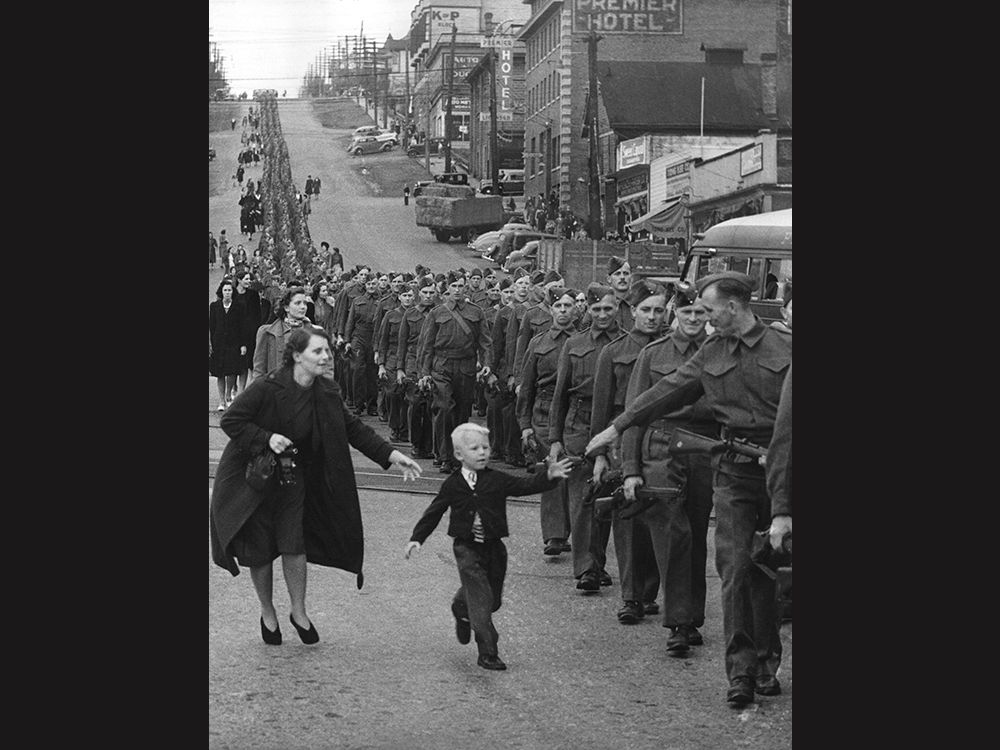
It is a military tradition full of problems. For example, Raising the Flag on Iwo Jima and The Falling Soldier from the Spanish Civil War have long been suspected of being staged. Raising a Flag Over the Reichstag, depicting Russian soldiers in Berlin in 1945, was similarly exploited for Soviet propaganda, with its journalistic details obscured, such as the identity of the soldiers. A Canadian Battalion Go Over the Top, depicting soldiers climbing from a trench in 1916, was widely published as a real battle but was in fact an earlier training exercise. At least Wait for Me, Daddy, the famous 1940 image of soldiers deploying from British Columbia with a little boy running after his father, is more or less what it appears to be. For the rest, reliability sometimes stands in inverse proportion to fame.

 “Wait for me, Daddy” 1940 by Claude P. Dettloff.

“A lot of most famous war photos are not what we once thought they were,” said Vance. “I think they were done for propaganda purposes in mind, so if they weren’t perfect in the first instance, they had to be made perfect.”

But the Matthews portrait was different. “It was simply a record of an individual at a time,” Vance said. “It’s not propaganda because I’m not sure what it would be propaganda in favour of.”

Curiously, the effect is almost to render him anonymous, and the scene timeless and placeless. The subject has no identifying kit, no badges or shoulder stripes. It would take an especially keen eye to read any information in his grenades or rifle. He could be anyone. Vance said that is its strength.

It also admits of different readings. The most common is something like the shell shock of the Great War or the “thousand yard stare” of Vietnam, the physical manifestation of psychological trauma in dark, heavy, almost unseeing eyes.

“But also, if you come at it differently, you see a guy exhausted after a job well done,” Vance said. “You don’t know if the battle went well or poorly, what side won, what was behind the fight. It’s a personal visceral glimpse at war but it’s essentially value neutral.”

“You can read anything into it that you want, which is its power. There’s no fixed meaning,” Vance said.

“It’s got that Mona Lisa quality where you don’t quite know what he is thinking,” said Burtch.

When it was published in newspapers across North America, the photo quickly became famous as “The Face of War.” A Montreal Star story on July 4, 1952, for example, ran the caption: “Blood, grime and bone-deep weariness etch the face of Pte. Heath Matthews, 19, of 2315 Hingston Avenue, in this picture taken after he completed a combat patrol in Korea with the 1st Battalion Royal Canadian Regiment. Pte. Matthews, son of Mrs. Maude Matthews, was reported wounded June 24. His injuries were not believed serious.”

Many years later, in 1994, a Korean War exhibit at the Canadian War Museum would bring to light the minor controversy over the soldier’s identity.

Pte. Herbert Norris of Kingston, Ont., was also a signaller in Charles Company in Korea, and had been giving talks about the war and identifying himself as subject of The Face of War. This came to wide attention through media coverage of the exhibit, including the museum’s presentation of a framed print to Norris at a gala. Faced with a growing scandal, the museum looked more closely into it, and based on evidence from archives, police facial recognition experts, and the confirmation of both Tomelin and the person who processed the film, concluded they had made a mistake. The Face of War was Matthews.

It left Norris feeling disrespected, he would later tell the Kingston Whig-Standard. He was not the only Korea veteran to feel this way. Even during the war, when U.S. President Harry Truman called it a “police action,” rather than a war that had not been formally declared, many veterans of Korea felt their contributions were inadequately respected.

“That really stuck in the craw of a lot of veterans to hear it characterized that way,” Burtch said.

 Members of the 2nd Battalion, Princess Patricia’s Canadian Light Infantry carry a wounded soldier from battle during the Korean War.

Korea was an unpopular war, and Sayle said it was a main reason the Democrats lost the 1952 U.S. election. It was especially worrying to Canada, though in a slightly different way, Sayle said.

The Korean War was “exceptionally significant” in international relations, Sayle said. It transformed European security. It led to the deployment of Canadian and American forces in Europe with NATO, anticipating conflict with the Soviet Union.

“The actual continental commitment begins because of the attack in Korea,” Sayle said.

So Canadians were alarmed to see American forces bombing defenceless villages in Korea, and came to wonder whether they would also fight that way if hot war came again to Europe. The concern reached the cabinet level, and Sayle shared a declassified message from Canada’s minister of national defence to his American counterparts, warning of the “magnificent ammunition” for enemy propaganda and the risk to military morale posed by using heavy artillery and large bombers against villages; by naming missions things like “Operation Killer;” and by using racist slurs for South Koreans, the same ones that would later be notorious among American soldiers in Vietnam.

There is a valid argument to be made that Canada was fighting to protect South Korea, Sayle said, but the way the conflict played out “robs the war of any satisfying heroic narrative, especially because it ends in armistice rather than true peace. There’s no closure for the public. There’s no celebration, no Victory in Korea day,” Sayle said.

Over the following years, as Korea slipped from immediate memory into modern history, there was another shooting war in Southeast Asia that coloured its remembrance. Korea was in that sense “in the shadow of Vietnam,” Sayle said.

In the 1980s and 1990s, when there was an “explosion of memory” of the Second World War, as Sayle puts it, this sharpened the contrast with Korea, leaving its veterans sometimes overlooked, out of the Remembrance Day spotlight.

“Just because of the historical nature and context I think we can understand why it was forgotten, but that doesn’t excuse the forgetting of these veterans and their experiences,” Sayle said. As this photo illustrates and reminds, any individual soldier’s experience of war is “indivisible,” Sayle said.

Seventy-five years since the forgotten war began, this photo is still able to convey that experience, and to imprint it in the Canadian memory.

Our website is the place for the latest breaking news, exclusive scoops, longreads and provocative commentary. Please bookmark nationalpost.com and sign up for our newsletters here.


The boiler room at Paragon's offices in Toronto, where Antonio Palazzolo and other telemarketers contacted clients and potential fraud victims.

A Toronto-area conman skipped his sentencing hearing in a U.S. court, for helping swindle more than $21 million from hundreds of victims, after prosecutors alleged he kept scamming people even after his arrest and guilty plea.

Antonio Palazzolo, 67, did not appear in U.S. federal court in Cleveland on May 8, when he was expected to be sentenced for the large, sophisticated investment swindle pulled by a gang of Toronto-based conmen.

What was supposed to be his long-delayed sentencing hearing after his guilty plea in 2022 turned into an abrupt five-minute session when Palazzolo failed to join Judge J. Philip Calabrese, two U.S. prosecutors and his own lawyer in court.

Calabrese said an arrest warrant would be issued, making him a fugitive.

If Palazzolo had shown up, he would have heard prosecutors tell the judge that the U.S. government no longer supports a reduced sentence because “he has continued to engage in similar fraudulent conduct since pleading guilty in this case,” according to a government memo filed in court a week before the hearing.

Prosecutors said Palazzolo kept pulling an almost identical fraud as the one he pleaded guilty to while he remained free in Canada on an unsecured US$20,000 bond while awaiting his sentencing.

As his hearing approached, three victims contacted U.S. authorities, two claiming he had ripped them off for big bucks and another that Palazzolo was trying to defraud him as recently as late April, the judge was told.

One victim showed the government an invoice from Palazzolo for US$10,000 for a pink diamond dated April 24, according to court records. That’s just two weeks before his scheduled court date.

Palazzolo’s sentencing in Ohio was scheduled after his wire fraud conspiracy conviction from his time as a crooked salesman with Paragon International Wealth Management, Inc., a Toronto firm where he went by the alias John Carson. He and other conmen duped victims in Canada and the United States into buy coloured diamonds for much more than they were worth.

The great Paragon swindle and its cavalcade of conmen is the focus of

an in-depth investigative feature

in National Post published last summer, called Jack of Diamonds.

The new allegations say that after a Toronto police raid on Paragon’s Finch Avenue West telemarketing offices in 2018, Palazzolo kept tricking gullible investors into sending him huge sums for low-value stones using his own company, called Pavillion Diamonds International.

Alleged victims complained to investigators of a scheme that played out the same as the one pulled at Paragon.

Customers were contacted by phone and convinced to make a small purchase of a pink diamond and were later lied to about how much that gem had increased in value in order to convince customers to send much larger sums of money — over and over — in hopes of a promised big payday that never came, court was told.

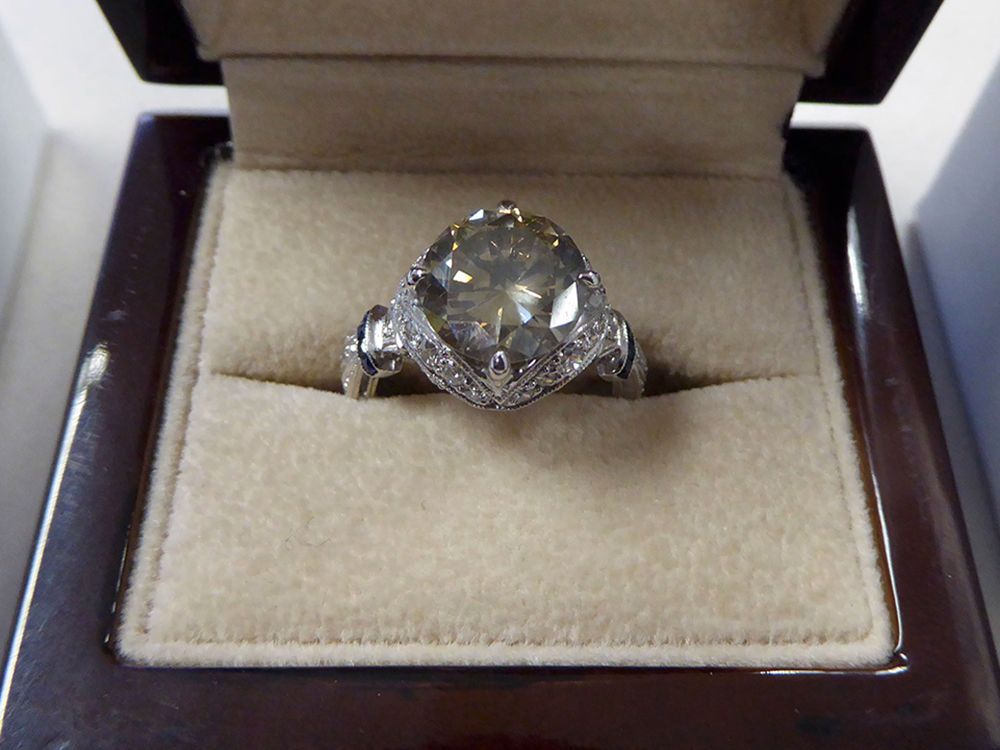
 A ring seized by police from a vault in Paragon’s office.

After a series of payments from one new complainant, the customer’s adult daughter became concerned and discovered his involvement in the Paragon fraud. She then secretly recorded a phone call with Palazzolo, prosecutors said. On the call he allegedly said he was the owner of Pavillion Diamonds.

She asked him if the name Paragon meant anything to him. He allegedly told her he had worked there but had been “exonerated” from any wrongdoing. She then called the FBI. Palazzolo’s contact with that complainant allegedly stretched from 2018 until 2023, which was after his guilty plea.

Another customer said he was convinced to spend US$115,000 in April 2022 on a diamond that a Pavillion salesman promised would double in value within a year, prosecutors alleged.

In June 2024, long after his guilty plea, Palazzolo allegedly contacted that customer again with an offer to sell the diamond for a payout. There was a catch. The customer had to first purchase another diamond for US$63,700 because the purported buyer wouldn’t purchase anything less than two carats of diamond weight.

The man sent him the money, court heard.

Prosecutors said the government could no longer support lowering Palazzolo’s recommended sentence for accepting responsibility, as often happens when someone pleads guilty.

“A defendant’s commission of new crimes related to the offense of conviction while on bond is inconsistent with acceptance of responsibility,” James Lewis, Assistant United States Attorney, wrote in the prosecution’s sentencing memo. “Given that Palazzolo has continued to engage in similar fraudulent conduct since pleading guilty, the government opposes Palazzolo receiving any reduction for acceptance of responsibility.

“The impact of this crime on Paragon’s victims was profound.”

Palazzolo was born in Rome, Italy. He got married at the age of 23 and had two children.

After living in several countries, he moved to Canada in 1991, court heard. He completed high school in Toronto and lived in Pickering, just east of Toronto, at the time of his arrest.

At a hearing in 2022 in Cleveland when he pleaded guilty on a video link from Canada, he said he didn’t have a job.

“I am helping my wife in her business,” Palazzolo said at his sentencing hearing. “We are formally separated, but we live in the same house. So, I help her with her business, and I do everything at the house.”

Palazzolo’s wife’s business is an online jewelry store, court was told.

At that 2022 hearing, prosecutors itemized his duplicity and scamming while working at Paragon, and listed huge payments gullible victims put on their credit cards and sent by wire transfers. After hearing it all, the judge asked him: “Are all those things true? Did you do those things and say those things?

“I did,” said Palazzolo.

“I’m here trying to make amends for what happened, and I’m trying to cooperate in every possible way that I can,” Palazzolo told the judge back then.

The stage seemed set for an easy sentencing process.

A pre-sentence report for Palazzolo, however, calculated an unexpectedly high sentencing range for him — much harsher than for his co-conspirators in the Paragon fraud, even before the government moved for a tougher sentence because of alleged new frauds.

James Gagliardini, the founding boss of Paragon,

was sentenced to 54 months

in a U.S. prison in October; Michael Shumak, another founding partner,

was sentenced to 60 months

in February.

 Paragon founder James Gagliardini.

Jack Kronis, a career conman who was a star salesman at Paragon after his long history in multiple frauds in several countries,

was sentenced to 37 months

in November. Edward Rosenberg, another salesman,

was sentenced to 34 months

last month.

Palazzolo seemed to be expecting similar treatment. Instead, the guideline range fell hard on him. The low end was calculated at 108 months, which is a stiff nine years in prison. The high end was 135 months, more than 11 years.

In his sentencing memo to the judge, filed before the aborted sentencing hearing, Palazzolo’s Cleveland lawyer, Michael Goldberg, complained of the disparity in sentencing guideline ranges for other members of the Paragon gang.

“Mr. Palazzolo has less culpability than several co-defendants who received sentences below Mr. Palazzolo’s guideline range,” Goldberg wrote.

“He was not an organizer or leader of the scheme. He is less culpable for the losses caused by the scheme than several co-defendants who received sentences below Mr. Palazzolo’s guideline range.”

Goldberg also said that Palazzolo accepts responsibility.

“He is remorseful for his actions. He understands that restitution will be part of his sentence, and intends to do everything he can to repay his victims for their losses,” Goldberg wrote.

Goldberg declined to comment to National Post when asked about his client not showing up at his sentencing hearing. So did the U.S. Attorney’s office and the FBI, citing the ongoing nature of the case.

There is no evidence that Palazzolo has returned to U.S. custody. No new information has been filed in court in his case.

Prosecutors said the amount of money swindled from Paragon’s victims attributed to Palazzolo was about US$1.5 million dollars.

U.S. court documents spell Palazzolo’s alleged company as Pavillion. There is a lawsuit filed in Ontario court that alleged a diamond investment fraud against Palazzolo and a company with a slightly different spelling,

Pavilion Diamonds International.

• Email:

ahumphreys@postmedia.com

| Twitter:

AD_Humphreys

Our website is the place for the latest breaking news, exclusive scoops, longreads and provocative commentary. Please bookmark nationalpost.com and sign up for our newsletters here.


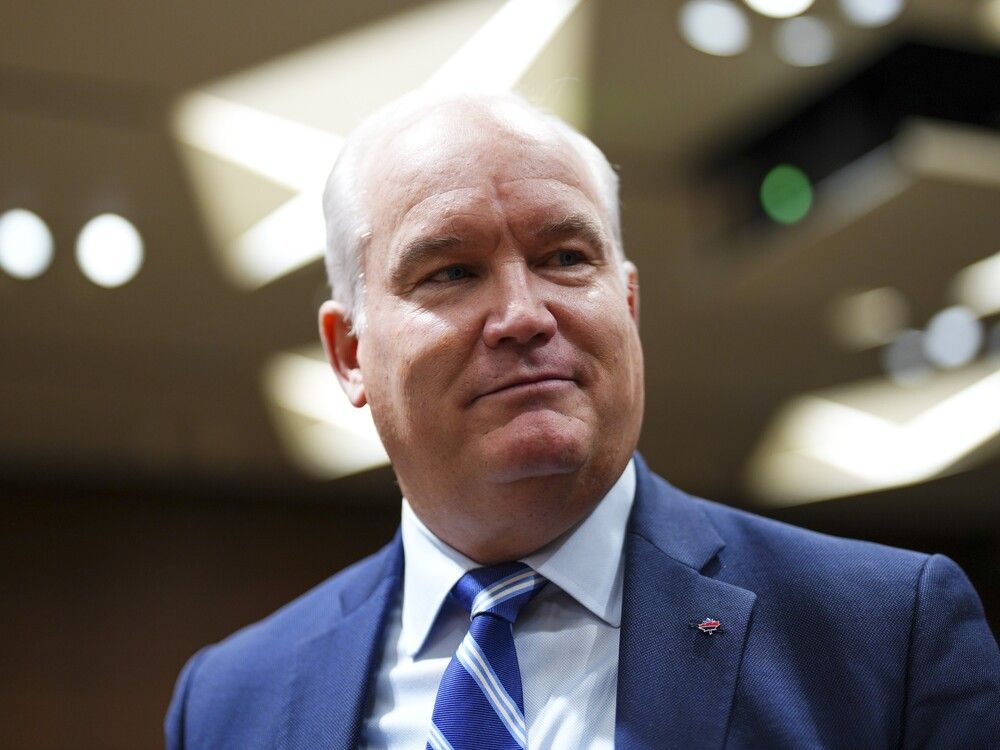
Former Conservative Party leader Erin O'Toole appears as a witness at a standing committee on procedure and house affairs on Parliament Hill in Ottawa on Thursday, Oct. 26, 2023.

OTTAWA — More than 250 prominent Canadians have signed a letter calling on Prime Minister Mark Carney to dial up the pressure against Iran.

The letter,

sent by pro-Israel group

Allies for a Strong Canada, urges Carney to take decisive action to counter Iran’s “malign influence” on the Middle East and broader global landscape.

“In light of Iran’s persistent aggression, including its support for terrorist organizations and its attempts to undermine stability in the Middle East, we urge Canada to take a leadership role against it in the international community,” reads the letter.

The letter calls for Carney to tighten sanctions on Iran’s regime, root out Iranian agents operating on Canadian soil and bar fleeing Iranian officials from taking refuge inside the country.

Signatories include former foreign affairs minister John Baird, Retired General Rick Hillier and ex-Conservative leaders Rona Ambrose and Erin O’Toole. It also includes former B.C. premier Gordon Campbell, former Alberta premier Jason Kenney and former Saskatchewan premier Brad Wall.

Michael Westcott, the executive director of Allies for a Strong Canada, told National Post that the fight against Iran belongs to Canada as much as anyone else.

“Whether it was the recent threats against (ex-justice minister) Irwin Cotler, or the

shooting down of Flight PS752

that left 55 Canadians dead, Iran is bad for Canada and bad for the world,” said Westcott.

Signatory Kaveh Shahrooz, a lawyer and senior fellow at the Macdonald-Laurier Institute, said that Carney must acknowledge the existential threat Iran presents to ally Israel.

“It is important that Canada’s government begin from the premise that Israel, like every other state, should have the right to firmly defend itself against continuous and credible threats to its very existence.”

Carney called for diplomatic solution on Sunday after news broke that the U.S. had executed strikes on three Iranian nuclear sites in support of Israel.

“While U.S. military action taken last night was designed to alleviate (a nuclear) threat, the situation in the Middle East remains highly volatile. Stability in the region is a priority,”

wrote Carney in a statement

.

National Post

Our website is the place for the latest breaking news, exclusive scoops, longreads and provocative commentary. Please bookmark nationalpost.com and sign up for our daily newsletter, Posted, here.


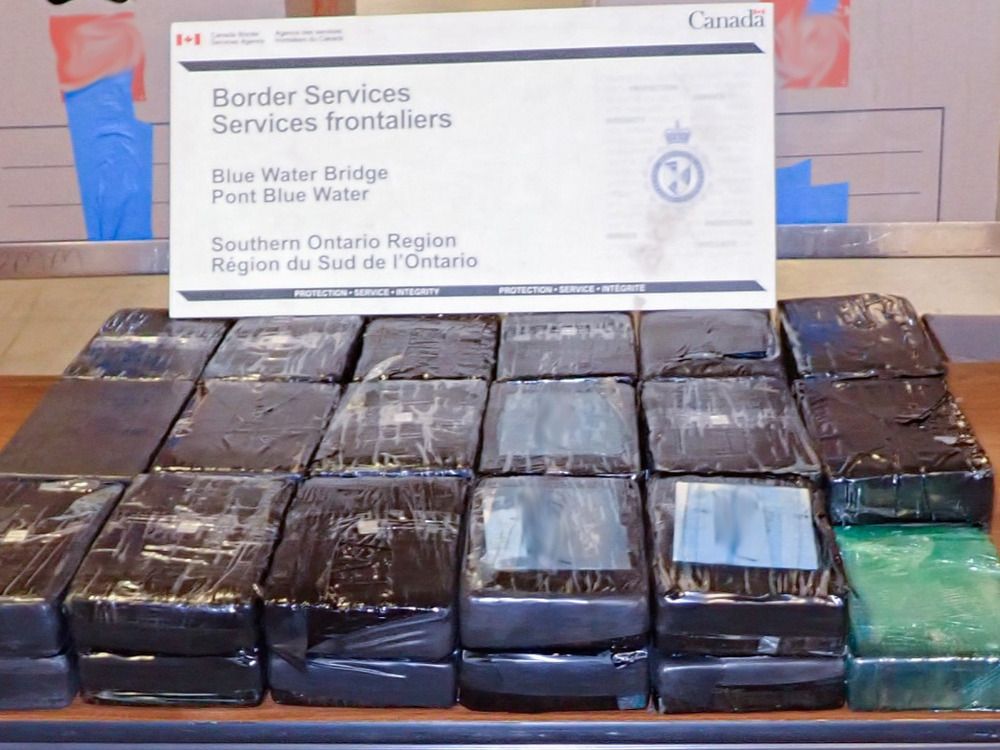
Suspected cocaine seized at the Blue Water Bridge on June 12, 2025.

The Canada Border Services Agency (CBSA) announced Thursday that it had made “a significant seizure” of cocaine at the Blue Water Bridge port of entry in Point Edward, Ont.

In a press release

, the agency said that on June 12, a commercial truck arrived from the United States at the Blue Water Bridge port of entry and was referred for a secondary examination. The Blue Water Bridge connects Point Edward, Ont., with Port Huron, Mich., and lies just north of Sarnia, at the southern tip of Lake Huron.

During the secondary inspection of the trailer, border services officers, with the assistance of a detector dog, discovered 161 bricks of suspected cocaine in six boxes. The total weight of the suspected narcotics was 187 kg, giving it an estimated street value of $23.3 million.

The CBSA then arrested Karamveer Singh, 27, of Brampton, Ont., and transferred him and the suspected narcotics to the custody of the RCMP. Singh has been charged with importation of cocaine, and possession of cocaine for the purpose of trafficking under the Controlled Drugs and Substances Act. The investigation is ongoing.

“The CBSA takes its border protection responsibilities very seriously and our officers work diligently with the RCMP to prevent smuggling across our borders,” said An Nguyen, director of St. Clair district operations for the CBSA. “This is the fourth time a significant amount of cocaine coming from the United States was seized at the Blue Water Bridge this year.”

The CBSA notes that, to date this year, its officers have seized a total of 978 kg of cocaine at Southern Ontario ports of entry.

Our website is the place for the latest breaking news, exclusive scoops, longreads and provocative commentary. Please bookmark nationalpost.com and sign up for our newsletters here.


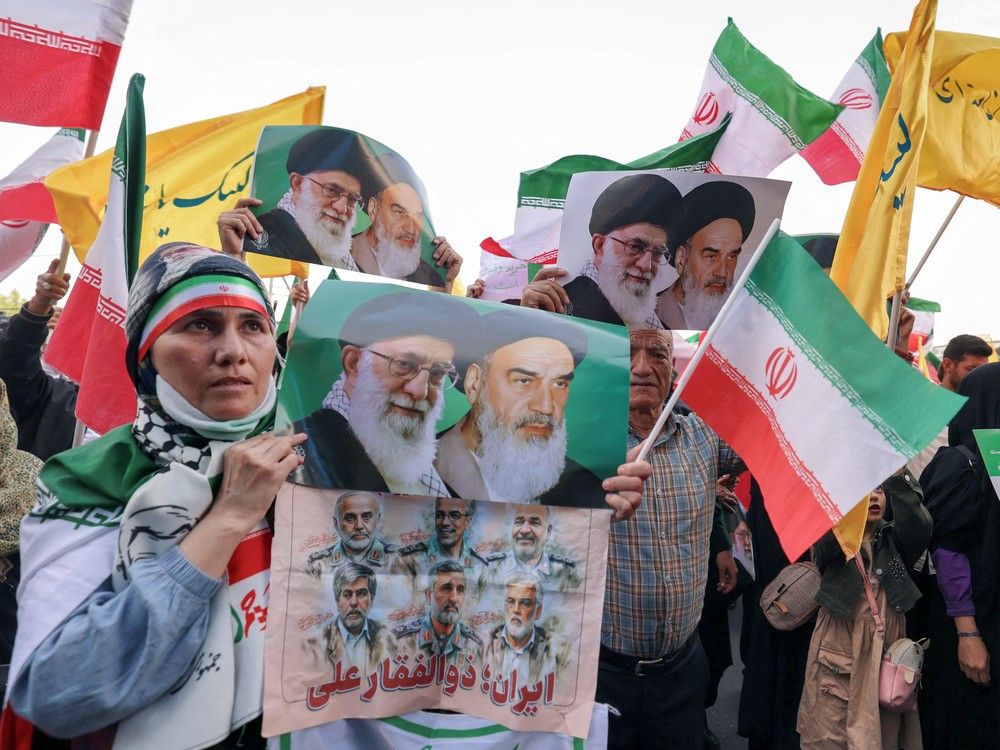
An Iranian woman in Tehran holds a poster with portraits of Iranian supreme leader Ayatollah Ali Khamenei (L) and late supreme leader Ayatollah Ruhollah Khomeini.  Canada's youngest adults are more likely to think it wouldn’t be good for Iran's regime to collapse and be replaced, according to a new poll conducted for the Association for Canadian Studies.

As tensions returned to a simmer between Israel and Iran amidst a ceasefire agreement, a new poll conducted before

the shaky armistice

found that far more Canadians are distrustful of Iran than those who have faith in the Islamic Republic.

But data from a Leger Marketing poll for the Association for Canadian Studies poll showed that younger generations are more apt to trust Iran and think it wouldn’t be good for the regime of Supreme Leader Ayatollah Ali Khamenei to collapse and be replaced by new leadership.

The polling also attempted to gauge whether respondents “think that Iran wants the destruction of the State of Israel,” with 71 per cent believing that to be the goal, and even 59 per cent of the 18-24 cohort.

Jack Jedwab, the Association’s president and CEO, said that despite the younger generations’ different perceptions of the conflict, it points to Canadian public opinion being closely aligned with that of the U.S. and NATO.

“We’re hearing from the prime minister (Mark Carney) in terms of how he positions himself, which is closer to the view of the U.S., I would suggest,” Jedwab told National Post.

“That’s not speaking to what actions the U.S. has taken in the past four or five days. I’m just talking strictly in terms of the perception of Iran and Iran’s position in these global conflicts.”

Carney, who’d previously

reaffirmed that Canada respected Israel’s right to defend itself against Iran as hostilities began in mid-June

, said after U.S. airstrikes on three Iranian nuclear sites over the weekend that Canada also stands against Iran developing a nuclear weapon and

called for a diplomatic resolution to the unrest in the broader Middle East.

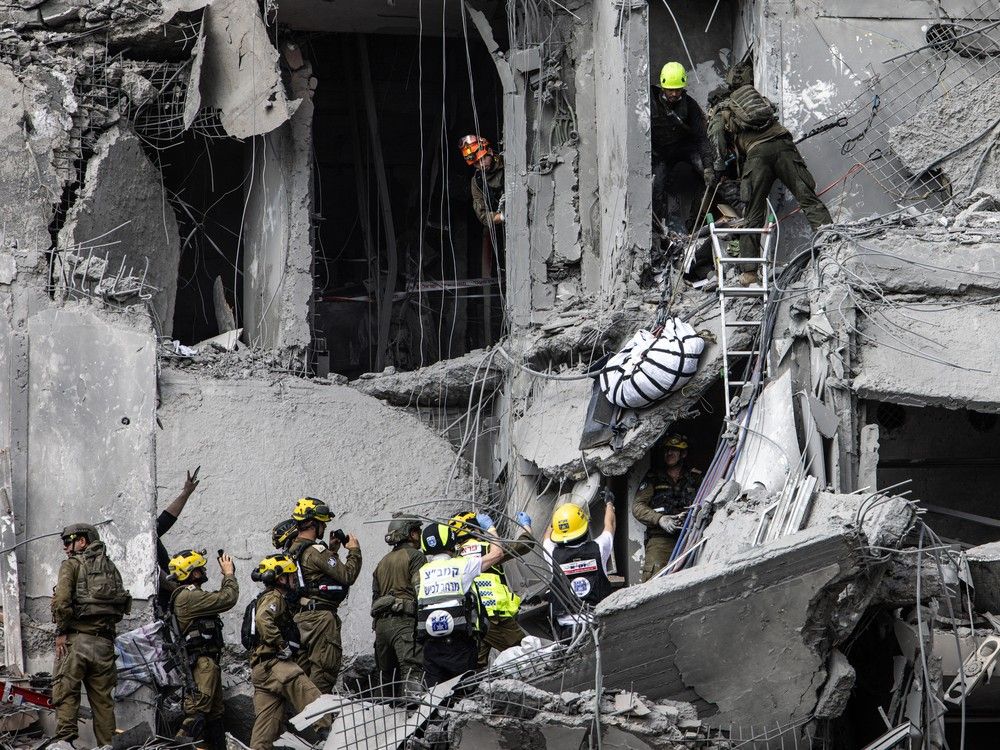
 Israeli emergency services and security officers evacuate a body from the rubble of a building hit by an Iranian missile in Beersheba in southern Israel on June 24, 2025.

Overall, ACS found that only 12 per cent of all respondents see Iran as trustworthy, compared to 52 per cent who felt it wasn’t. Trust was highest among the 18-24 group (34 per cent) and decreasingly lower across each age group, culminating with a mere 4 per cent of those over 65.

“There seems to be some very important differences in the world vision or the way in which the younger cohorts have a different view of the nature of these conflicts and how they position the protagonist,” said Jedwab, noting that data extrapolated from the employment status showed students (27 per cent) were also more apt to trust in Iran than any other age group.

“They seem to have a much softer view on Iran’s intentions and the intentions of the Iranian regime.”

He reasons that it relates to how and from where that group is receiving the news that informs their opinions.

“All the alternative narrative, not the majority narrative, seems to be really sort of more attractive to people in that youngest cohort and to students,” he added.

The youngest cohort also appears to be the most conflicted, too, with an equal 34 per cent believing Iran is untrustworthy, and 32 per cent who were unsure or chose not to answer, aligning with the national average of those who responded the same (36 per cent).

“They’re very split on the issue,” Jedwab surmised.

The generational opinion gap was evident, too, when respondents were asked if a change of government would be a good thing for Iran; only 34 per cent of those identified as students agreed, compared to more than 50 per cent in all other employment status — 71 per cent among the self-employed and retirees.

The 18- to 24-year-olds didn’t stray far from their elders in the view that Iran’s goal is to destroy Israel, however, with 59 per cent in agreement.

The poll also found that those who trust Iran are less likely (60 per cent) to concur with the regime’s collapse and replacement, and almost evenly split (49 per cent to 51 per cent) on whether Iran wants to destroy Israel. Those without trust in Iran were more confident of both sentiments (75 per cent and 83 per cent).

The poll was conducted June 20-22 and canvassed 1,580 adults. While a non-probability sample panel survey such as this doesn’t have a margin of error, a similar probability sample of that many respondents would have a margin of error of plus/minus 2.5 per cent, 19 times out of 20

Our website is the place for the latest breaking news, exclusive scoops, longreads and provocative commentary. Please bookmark nationalpost.com and sign up for our daily newsletter, Posted, here.