LP_468x60
on-the-record-468x60-white

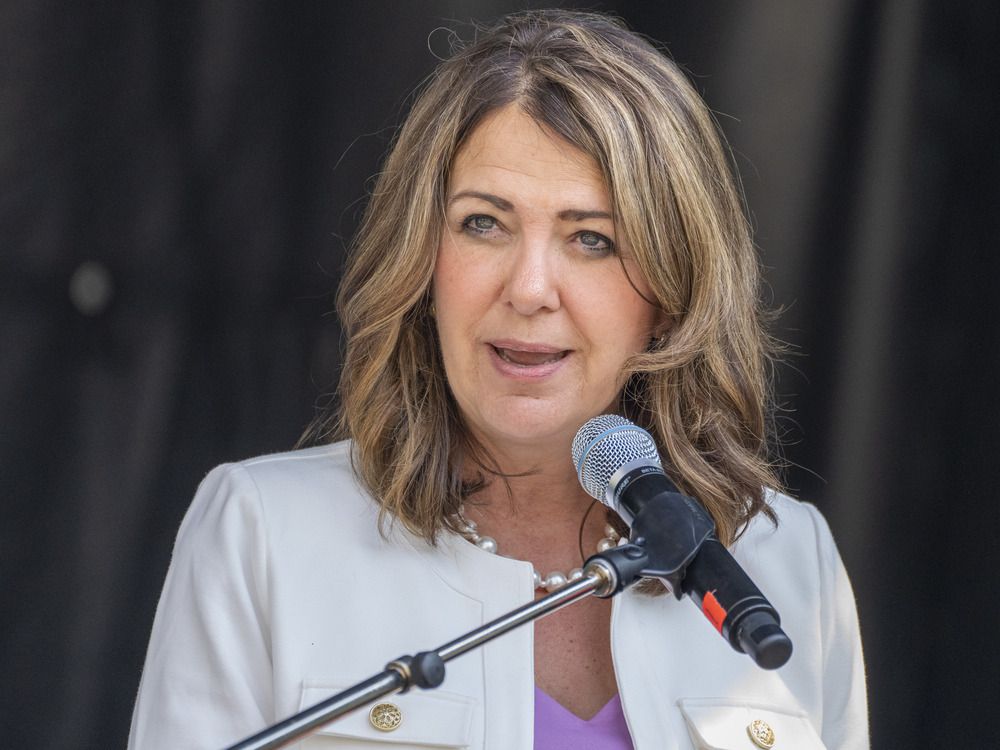
Alberta Premier Danielle Smith speaks during a press conference after the first ministers' meeting at TCU Place.

OTTAWA — “Grand bargain” was the phrase of the day on Parliament Hill after Prime Minister Mark Carney and his provincial counterparts found common ground on oil and gas development.

“If (the Conservatives) were listening to yesterday, there is a grand bargain,” Energy Minister Tim Hodgson boasted to the Opposition benches.

“There is a bargain that the premier of Alberta has signed onto.”

Alberta Premier Danielle Smith left Monday’s first ministers’ meeting with a new deal exchanging oil sands access to coastal waters for massive investments in decarbonization technologies, but experts warn this could be a costly pipe dream. 

“I’m worried we’re seeing (the first ministers) fall into a trap of wanting to have their cake and eat it too,” said Tim McMillan, a partner at Garrison Strategy and the former head of the Canadian Association of Petroleum Producers.

Smith said Monday evening 

that she was encouraged

by the inclusion of language endorsing the movement of “decarbonized Canadian oil and gas by pipelines”

in the meeting communiqué

.

“Let’s call it the grand bargain,” Smith told reporters in Saskatoon, referring to the idea of twinning new pipeline proposals with large-scale decarbonization projects.

Carney said Monday that

he’d consider fast-tracking

a new oil pipeline to the West Coast if it shipped “decarbonized barrels” to new markets.

“There’s real potential there (and), if further developed, the federal government will look to advance it,” said Carney.

But McMillan says the devil could be in the details.

“I don’t know exactly what they’re talking about with decarbonization, but… it may be linked to carbon capture, which does not increase our exports (or) investability,” said McMillan.

“If (carbon capture) becomes a long-term requirement for new projects, it will likely have a negative effect on future investments in Canada’s upstream oil and gas sector.”

The

Calgary-based Pathways Alliance

, a group of six major oil sands producers, has put forward a $16.5-billion decarbonization network that would reroute carbon emissions from nearly two dozen facilities to an underground hub near Cold Lake, Alta.

The project has been at a

standstill for years over government funding

.

Smith said Monday that the financial windfall of a new West Coast bitumen pipeline serving markets in Asia could help make the economics of the Pathways project work.

“If we had a million barrel a day pipeline going to the northwest (British Columbia) coast, that would generate about $20 billion a year in revenues… that seems like a pretty good value proposition if both of those projects can proceed at once,” said Smith.

Carney and Hodgson have

both paid lip service

to the Pathways project in recent weeks, but the venture still faces an uphill battle.

A recent independent analysis found the project was

likely to lose money

due to the limited recyclability of captured carbon.

“Even under optimal conditions, the Pathways project may struggle to break even, and real-world operations are rarely optimal,” read the study, prepared by the Institute for Energy Economics and Financial Analysis.

“The Canadian federal government and the province of Alberta may be pressured to make up the likely shortfall,” it continued.

“An unprofitable carbon capture project will struggle to bring lasting positive economic benefits to host communities and become dependent on external financial subsidies to maintain operations.”

McMillan also noted that Canada’s two biggest competitors in the heavy oil industry, Mexico and Venezuela, are unlikely to follow suit with large-scale carbon capture projects of their own, giving each an edge over Canada on a per-barrel basis.

Pathways’ President Kendall Dilling said Tuesday he was excited by the developments over the past 24 hours.

“Pathways Alliance is encouraged by the work our federal and provincial governments have been advancing, most recently at the First Ministers’ meeting,” wrote Dilling in an email to the National Post.

“We’re ready to work together for Canada’s economic and energy future and provide input on how Canada can remove barriers and develop policies to grow Canada’s oil sands and build infrastructure that brings our oil to diverse markets. At the same time securing the future of Canada’s oil sands by making it competitive in global markets.”

National Post

rmohamed@postmedia.com

Get more deep-dive National Post political coverage and analysis in your inbox with the Political Hack newsletter, where Ottawa bureau chief Stuart Thomson and political analyst Tasha Kheiriddin get at what’s really going on behind the scenes on Parliament Hill every Wednesday and Friday, exclusively for subscribers. Sign up here.

Our website is the place for the latest breaking news, exclusive scoops, longreads and provocative commentary. Please bookmark nationalpost.com and sign up for our daily newsletter, Posted, here.


An Irish fighter draped himself in the Palestinian flag after defeating his Israeli opponent in Rome last weekend.

Irish mixed martial artist Paddy McCorry’s victory over Israel’s Shuki Farage on Saturday may not have been personal, but it was certainly political.

After securing a unanimous decision at Cage Warriors 189 in Rome, McCorry draped himself in a Palestinian flag and said “Free Palestine” before screaming and flexing in celebration.

“Street justice,” followed by an Irish and Palestinian flag, he posted to social media after, along with a clip showing him appearing to yell into Farage’s face as he pummeled the Israeli with the bout’s finishing blows.

In the video, several people in the crowd can be heard chanting “Free, free Palestine.”

According to Cage Warriors, the 27-year-old from West Belfast in Northern Ireland, a more experienced fighter heavily favoured by pundits and bettors,

was dominant “from bell to bell.”

It improved his pro record to 6-1, all since 2021.

For Farage, it was his fifth professional bout since 2017, but his first since a 2022 win over Turkey’s Bugra Alparslan, a more experienced fighter.

His only other win occurred in 2017 when he got Russian Sabit Nasive to tap out. His pro record is now 2-2.


Training out of the Michaelson Brothers gym in Ramla, the six-foot-four Farage is known as “Long Reach” due to his long legs and arms. His background is not MMA, but kickboxing.

“Going to eat some Irish beef !!” his coach, Daniel Michaelson,

posted in Hebrew on Facebook ahead of the bout.

In a podcast interview prior to the event, McCorry

told host Ireland-based SevereMMA

host Paul Hughes that he’d seen Farage boasting about an upset win on an

Instagram account now set to private.

“Just show up and then we’ll see what happens,” McCorry said.

Our website is the place for the latest breaking news, exclusive scoops, longreads and provocative commentary. Please bookmark nationalpost.com and sign up for our daily newsletter, Posted, here.


Public Safety Minister Gary Anandasangaree.

OTTAWA — The Liberal government tabled a significant border security bill on Tuesday that includes sweeping new powers to intercept or search communications including mail, a tightening of the asylum claim process and increased intelligence collection and sharing across the federal government.

The 139-page Bill C-2, tabled Tuesday morning, proposes vast changes to Canadian border security, data collection and sharing by federal authorities, anti-money laundering rules, the asylum claim system and the Canadian Coast Guard (CCG).

The government said the bill had three main themes: securing the border, fighting organized crime and fentanyl and boosting the fight against financial crimes.

Throughout all those themes are improved powers for law enforcement and intelligence services like CSIS to access information, including some without a warrant approved by a court, or even search Canadians’ mail as part of a criminal investigation.

It would also increase the Canada Border Services Agency’s (CBSA) ability to search containers exiting the country by obligating transporters and warehouse operators to provide site access to border agents for export inspections.

Public Safety Minister Gary Anandasangaree told reporters on Tuesday that the new data collection and sharing powers in the bill also come with the necessary safeguards.

“In order for me to bring forward legislation, it needed to have the safeguards in place. It needed to be in line with the values of the Canadian Charter of Rights and Freedoms, and I fundamentally believe that that we have struck the balance that, while expanding powers in certain instances, does have the safeguards and the protections in place to protect individual freedoms or rights,” the minister said.

With regards to border security, a frequent gripe against Canada by U.S. President Donald Trump, the bill proposes to tighten rules around asylum claims, allow the RCMP to share information about registered sex offenders with domestic international partners and gives the CCG a new protective security role.

For example, the bill would allow the government to deem inadmissible wide swaths of asylum claimants. Among them, asylum claim received over 365 days after an applicant arrived in Canada (retroactively to June 24, 2020).

That measure, if passed, would likely impact tens of thousands of asylum claims received from international students after the Liberals drastically cut down on foreign study permits last year.

The bill would also close a loophole in the Safe Third Country Agreement with the U.S. by blocking asylum claims made 14 days after an applicant crossed into Canada from the U.S. clandestinely by land.

The bill also proposes to give the Canadian Coast Guard a new security mandate and the ability to share information with the military and intelligence agencies.

If the legislation passes, the Coast Guard would be given power to start conducting “security patrols” to monitor suspicious vessels near the border or in the Arctic and share information gathered with security organizations. As a civilian agency, it is currently not allowed to share the data with the military or intelligence agencies.

The Liberals are also proposing to increase civil and criminal penalties for failing to comply with Canadian anti-money laundering and terrorism funding laws while boosting compliance and surveillance obligations.

The bill would also set new limits on cash transactions above $10,000 in order to curb money laundering.

The bill would also implement a new Act forcing almost any organization that offers nearly any form of “electronic services” to organize users’ data to ensure that it can be requested and accessed by law enforcement or intelligence agencies if necessary and approved.

In other words, an organization that uses any form of electronic services geared towards people in Canada or that operates in the country will have to implement tools to ensure data relating to those services and the users can be extracted and provided to authorities when mandated.

The bill reprised some of the legislative measures promised by Justin Trudeau’s government back in December but that weren’t tabled at the time because the former prime minister prorogued Parliament in early January.

National Post

Get more deep-dive National Post political coverage and analysis in your inbox with the Political Hack newsletter, where Ottawa bureau chief Stuart Thomson and political analyst Tasha Kheiriddin get at what’s really going on behind the scenes on Parliament Hill every Wednesday and Friday, exclusively for subscribers. Sign up here.

Our website is the place for the latest breaking news, exclusive scoops, longreads and provocative commentary. Please bookmark nationalpost.com and sign up for our daily newsletter, Posted, here.


A traveller passes Air Canada planes at Pearson International Airport in Toronto, Ont.

There were fewer travellers flying from Canada to the United States this April compared to last year, while most of the major Canadian airports exceeded their pre-COVID numbers.

A new

report by Statistics Canada

released on Monday revealed more about the recent habits of those flying in and out of Canadian airports in April. It appears that the tension between Canada and the U.S. — amid an

ongoing trade war,
new travel policies

and repeated

calls for Canada to become the 51st state

— has had a lasting effect.

In April, two million passengers decided to travel by air within Canada. That number refers to Canadians and non-Canadian residents who passed through pre-board security screening at airport checkpoints. That was a nearly 7.5 per cent increase since last April. It even surpassed the amount of people who travelled domestically in April 2019, before the COVID pandemic.

Rather than flying to the U.S., 1.4 million passengers sought out international trips this April. That was an increase of seven per cent since the same time last year — and a 19 per cent increase since before the pandemic.

When it came to taking a trip to the United States,

travel south of the Canadian border continued on a downward trend

.

There were 1.1 million passengers who opted to fly to the U.S. in April. That was nearly 6 per cent less than the amount of travellers last year and “the third consecutive month of year-over-year decreases,” according to Statistics Canada. It was also a 12.5 per cent decrease since April 2019.

Travel to and from the U.S. is mostly concentrated at Canada’s four largest airports in Toronto, Montreal, Vancouver and Calgary. When combined, they represent more than 90 per cent of traffic across the border, per Statistics Canada.

In April, for a third straight month, those airports “recorded year-over-year decreases in screened passenger counts for flights to the United States.” At Toronto’s Lester B. Pearson International airport, there was a drop of 5.3 per cent of such travellers and at Montreal’s Pierre Elliott Trudeau International airport, a drop of 10.1 per cent.

At Vancouver’s international airport, that number fell by 7.6 per cent, and in Calgary, by 1.6 per cent.

However, there was still a surge of passengers travelling through eight of the largest airports in Canada this April. A total of 4.5 million of them went to airports in Toronto, Montreal, Vancouver, Calgary, Halifax, Ottawa, Winnipeg and Edmonton. That number was nearly four per cent higher than last year and nearly two per cent higher than in April 2019.

Six of the eight major airports surpassed their April 2019 volumes of screened passenger traffic in April 2025. Only the Edmonton and Ottawa airports recorded a lower volume.

Statistics Canada pointed out that Easter, which is a busy travel time, was in April in both 2025 and 2019, whereas last year it was in March.

Our website is the place for the latest breaking news, exclusive scoops, longreads and provocative commentary. Please bookmark nationalpost.com and sign up for our daily newsletter, Posted, here.


Leader of the Conservative Party in the House of Commons Andrew Scheer rises during Question Period, Wednesday, May 28, 2025 in Ottawa.

OTTAWA — The Liberals downplayed a vote on the throne speech they narrowly lost Monday evening to all the opposition parties which urges the government to present an economic update or a budget before the House of Commons rises for the summer on June 20.

The sub-amendment, brought forward by Conservative interim leader Andrew Scheer, called for a “firm commitment” to present a fiscal overview of the country’s finances this spring “that incorporates measures aimed at unleashing Canada’s economic potential.”

It was adopted Monday by 166 votes — comprised of the Conservatives, the Bloc Québécois, the NDP and Green Party’s Elizabeth May — against 164 Liberal votes.

It is, however, a non-binding vote, meaning that the government is under no obligation to present a spring economic update or a budget. But the vote in this new minority Parliament showed how opposition parties can aspire to go up against the government and its razor-thin margin in the House.

Mark Gerretsen, the chief government whip who is responsible for ensuring that Liberal MPs attend and vote in the way the party desires, insisted nothing went wrong.

“We knew the outcome of what that vote was going to be,” he told reporters on Tuesday.

Gerretsen said Liberals have 169 MPs, one of whom is the House Speaker, and four MPs did not vote because of “paired abstentions.” Those happen when parties agree to have a member sit out a vote because someone from another party is not able to attend.

“Every single person that was supposed to vote yesterday voted,” he said.

Justice Minister Sean Fraser admitted the government is in “new territory” with its minority mandate and parties can sway things on any given vote with very thin margins.

“I try not to bake feelings into these things. They’re math challenges, not problems with feelings. But we have to make sure that we do the work necessary to try to collaborate with parties across the aisle in order to implement the mandate that Canadians have given us.”

Finance Minister François-Philippe Champagne said last month

there would be no federal budget in the spring

, but a fall economic statement. Shortly after, Prime Minister Mark Carney said his government would present a budget during the fall session instead.

“We will have a much more comprehensive, effective, ambitious, prudent budget in the fall,” he said during a media availability in Rome, where he was to commemorate Pope Leo XIV’s inaugural mass. “You do these things right and that’s what we’re going to do.”

Carney added “there’s not much value in trying to rush through a budget in a very narrow window” given that the spring session was set to last four weeks. He also noted the trade war and defence commitments are bound to change the government’s numbers.

The decision to not table a spring budget has sparked criticism amongst opposition parties, who said they are left in the dark on the country’s current fiscal situation.

The government tabled a fall economic update last December that showed finances were in a worse state than expected, but the exercise was overshadowed by

Chrystia Freeland’s sudden and dramatic resignation

as finance minister hours before it was tabled.

Government House leader Steven MacKinnon noted that Monday’s vote to attempt to force the government to table a spring economic update or a budget is non-binding and said he suspects MPs are “going to see a lot more” of those resolutions.

MacKinnon said the real test for the government would come during the vote for the actual throne speech — which is a confidence vote — expected to happen Wednesday evening.

National Post,

with a file from the Canadian Press

calevesque@postmedia.com

Get more deep-dive National Post political coverage and analysis in your inbox with the Political Hack newsletter, where Ottawa bureau chief Stuart Thomson and political analyst Tasha Kheiriddin get at what’s really going on behind the scenes on Parliament Hill every Wednesday and Friday, exclusively for subscribers. Sign up here.

Our website is the place for the latest breaking news, exclusive scoops, longreads and provocative commentary. Please bookmark nationalpost.com and sign up for our newsletters here.


David Serkin says he been buying Lotto 6-49 tickets since its launch in 1982.

The “astronomical” odds appear to be in favour of one Alberta man who has been playing the lottery for over 40 years. Here’s what we know about his lucky streak.

What do we know about the winner?

David Serkin is retired, a cancer survivor and resides in Lethbridge.

He says he has been buying Lotto 6-49 tickets since its launch in 1982. He won $1 million on the May 3 Lotto 6-49 Gold Ball draw. This win comes after he won $500,000 on Aug. 20. On Nov. 16, he won $1 million. In a draw 12 years ago that marked his first win, he went home with $250,000.

“I know the odds are astronomical,” he said in a news release. “I don’t think it’ll happen again, but I still like buying tickets.” According to Western Canada Lottery Corporation, the odds of winning the jackpot are estimated to be 1 in 33 million.

How has his family reacted to his win?

Not surprisingly, his family is pleasantly shocked. “I went for coffee with the boys after I checked my ticket,” he said,

CTV News

reported. “They asked to see it and said, ‘Not again?!’”

The Independent

reported that with his November winnings, he was using some of it to help out his friends.

What does he plan to do with his winnings?

Travel seems to be in the cards for the winning Alberta man. He took his wife to Hawaii with his last win. This time, he plans to travel within Canada. “Now, we’re going to Newfoundland,” he said,

CityNews

reported.

Our website is the place for the latest breaking news, exclusive scoops, longreads and provocative commentary. Please bookmark nationalpost.com and sign up for our daily newsletter, Posted, here.


Olivia Chow, Mayor of Toronto speaks onstage at the premiere of

Less than half of Toronto residents approve of Mayor Olivia Chow’s performance, according to a new poll.

The Leger survey asked Toronto residents about their mayor as part of a broader poll on Ontario politics. Respondents were almost evenly split over Chow’s handling of municipal affairs as she nears the end of her second year at the helm of Canada’s largest city. Slightly less than half (48 per cent) of people strongly or somewhat approved of her performance, while 42 per cent said they strongly or somewhat disapproved. Another 10 per cent said they were not sure.

“Torontonians are on the fence about Mayor Chow,” Leger senior vice-president Jennifer McLeod Macey told National Post in an email. “While the proportion that approve is nominally higher than those that disapprove, approval is soft. Indeed, almost twice as many strongly disapprove as strongly approve.”

The poll found that 17 per cent strongly disapprove of Chow’s performance, while only 10 per cent said they strongly approve.

Macey said that the market research company “didn’t have the opportunity to probe on the ‘Why?’” in the latest survey, but she was interested in “digging deeper into municipal issues, such as taxes, crime and safety, affordable housing, and transit which are all undoubtably having an impact on public opinion.” She found little “variance” among different demographics in terms of Chow’s approval rating, but pointed to “more uncertainty among women and young-middle-aged adults.”

Whereas just six per cent of male respondents were unsure of Chow’s job performance, 15 per cent of women were. A similar number of 18 to 34 year olds (14 per cent) and 35 to 54 year olds (15 per cent) were on the fence about Chow’s performance as mayor. Greater communication “on key issues could have a significant impact on overall approval ratings,” Macey said.

Chow

was elected

in July 2023 following the resignation of John Tory over an affair with a political staffer 38 years younger than him. She had previously run for the post in 2014, placing third behind Doug Ford, who went on to become premier of Ontario, and Tory, who became mayor.

Months after she was elected, Hamas invaded Israel on Oct. 7, 2023, and Chow has been criticized by some city councillors for failing to protect Toronto’s Jewish community. Beaches-East York Councillor Brad Bradford accused Chow of dragging her feet on municipal initiatives to protect local places of worship, notably synagogues that have been picketed by anti-Israel protesters.

“In the fifteen months since October 7, an absence of leadership has turned Toronto into a city that many don’t recognize,” Bradford wrote in National Post earlier this year. “This is not a Jewish problem — it’s a Toronto problem. This is about our values and who we want to be as a city. Unfortunately, as we enter 2025, this crisis has been met with a lack of leadership at the highest level.”

Last week, news reports suggested that Bradford is

aiming to run

in the upcoming mayoral election scheduled for late October 2026. Marco Mendicino, a former Liberal cabinet minister and Prime Minister Mark Carney’s current chief of staff, is also reportedly considering a run for mayor.

When Chow entered office, she boasted a 73 per cent approval rating, according to a poll conducted by

Liaison Strategies.

However, since then, Chow has seen her approval rating steadily decline. By May 2024, her approval rating had dropped to 52 per cent, according to another Liaison Strategies survey. It went back up to 59 per cent in July, around her one-year anniversary, but it had dropped again to 54 per cent as of November 2024.

Over the same time period, her disapproval rating has gone from 18 per cent at the time of her election, to a high of 40 per cent last May, and was sitting at 38 per cent in November.

In the May 2024 Liason Strategies survey, Chow’s support was strongest in Toronto’s downtown core and weakest in the city’s farthest reaches, such as Etobicoke. The poll also found that women in the city were slightly more likely to support Chow (58 per cent) than men (50 per cent).

Chow inherited a roughly

$1 billion budget deficit

— a holdover from a pandemic-era shortfall in transit revenue and rising shelter costs — and has struggled to trim expenses. In January, she unveiled the city’s new budget featuring a nearly

seven per cent tax hike

, estimated to cost Toronto homeowners $268 a year.

In May, Chow acknowledged the city would require assistance meeting its roughly

$40 million goal to fund

its share of the 2026 FIFA World Cup, which includes six games scheduled to take place in Toronto.

“We can’t go and find any more cash, we just don’t have it,” the mayor said during a press conference last month.

The Leger survey was conducted between May 23 and 25, with an online sample of 1,025 Ontarians, of which 296 were Toronto metropolitan residents. A margin of error cannot be associated with a non-probability sample in a panel survey for comparison purposes.


Imam Mohammad Tawhidi, widely known as the Imam of Peace, is a governing member of the Global Imams Council, which opened its Western headquarters in Toronto.

In a black outer robe trimmed with a thin golden line and a traditional white turban, Imam Mohammad Tawhidi warmly greeted and welcomed guests to a hall on the second floor of a modest two-storey building in Toronto, even personally escorting some to their seats. The occasion

,

on March 31, was an Eid reception to mark the end of Ramadan, Islam’s holiest month of fasting and prayer, and it was the first such reception of the

Global Imams Council

’s new western headquarters in Canada.

The charismatic Tawhidi serves as a governing member of the council, comprised of faith leaders and scholars of all Islamic sects. The group advocates against Islamic extremism and promotes peaceful and meaningful relations with Jewish people and the Jewish nation.

Inside, the room buzzed with diversity, as community leaders, activists and even Jewish rabbis came to hear Tawhidi’s powerful speech calling for peace and unity among all faiths. Widely known as the “Imam of Peace,” Tawhidi was born in Qom, a religious city in Iran, but his parents are from Iraq. The cleric later fled the regime of Saddam Hussein and eventually settled in Australia. Coming from a long line of Shia clerics, he proudly says, “We are Shia Orthodox — orthodox in our beliefs and conservative in our traditions.”

Educated in Islamic studies, Tawhidi is pursuing a doctorate in Islamic jurisprudence. He was ordained as an imam in Qom, Iran, in 2010, and again in Iraq in 2013.

Unlike other Muslim imams, Tawhidi has sat with Jewish rabbis in synagogues, and Christian priests in churches. He has publicly denounced groups such as Hamas and Hezbollah, calling them terrorist organizations. He says Jerusalem rightfully belongs to the Jewish people, which earned him praise from interfaith advocates around the world, and threats from extremist Muslims.

National Post sat with Tawihidi to learn more about his views. The following interview has been edited for length and clarity.

Why are you known as the Imam of Peace?

Why not? That’s my question. Why not? In fact, every imam should be an imam of peace, not just me.

An imam is someone who represents the teachings of God, the wishes of God, and everything that comes down from God should be (about) peace, and what revolves around peace and what helps us reach either inner peace or social harmony, to make our lives better, not to turn our lives into misery, right?

So, anyone who says (they) represent anything to do with religion and God should be a representative of nothing but peace and positivity. So why not?

But the reasons for the name are multiple. Initially, I was referred to as an Imam of Peace in Australia. Why? Because putting me in a box was very necessary, at least for the Western world. I didn’t fit with the fundamentalists, and I didn’t fit with the extremists, and I didn’t fit with the traditionalists, and I didn’t fit with the political Islamists. So, I found myself in my own corner with my own followers and friends, and so I adopted the name. It helped me greatly in identifying myself. It’s a question of who is this guy and what does he do?

In the Middle East, people know where you stand either by knowing your tribal positions, or they know which school of thought you associate with, or they know your teachers, so they can put you in a box. But in the West, they don’t know. They see a guy with a turban and a beard — is he good? Is he safe? What’s the deal? And someone with a message like me, who is an imam and a preacher, it’s important for me to make it easier for them to understand because I am in their society. They’re not in my society. I’m in the West. So, I’m speaking to an audience that is both Muslim and Western, and I’m speaking in their language, and they have the right to know who’s talking about their affairs and issues in society, providing advice and so on. It helps everyone that I identify myself proudly as what I stand for. In my social media profiles, I describe myself with two words: peace advocate. (Those) two words explain exactly who I am.

What is the Global Imams Council (GIC)? What are you doing with your colleagues as a governing member?

The Global Imams Council is a council of Sunni and Shia Muslim clerics, imams, jurists, some of them are diplomats, representing all Muslim schools of thought, sects and denominations with no discrimination. We are a very, very diverse council, and the only one of its kind in the world. There are Sunni councils and there are Shia councils and there are Sufi councils. We are the only imam council in the world that is international and embracing of all Muslims. This, in itself, is a huge achievement.

We represent Islam and Muslims through the organizations, schools and institutes that our imams have and run, and the pulpits they have, and through our affiliations with the seminaries and grand muftis around the world, and the grand Ayatollahs who are aligned with our view of peace.

Why did GIC move its Western headquarters to Toronto?

Firstly, as a global council, you need to maintain your global presence. And in the West, the city that has one of the largest numbers of diplomatic corps and diplomatic missions in the world is Toronto. Through Toronto, we have been successful in engaging multiple countries over the last two years, starting with Kosovo, Albania, North Macedonia, the UAE, Saudi Arabia, Georgia; and in the future, we’re talking to Azerbaijan and other countries. Also, some Muslim groups, Muslim schools of thought, and their leaders all begin from Toronto.

I am also married to a Canadian, and I have a Canadian daughter. I have been active in Toronto since 2018 and got married in Canada in 2022.

You have attracted criticism from a number of corners. For example, you said Jerusalem is a land for Jews and were labelled a pro-Israel imam. You have also been called “far right” and other things. What is your response to that?

I have not said anything. God said Jerusalem belongs to the Jews. In the Holy Qur’an, Chapter Five, Verse 20 onwards, God tells Moses to take his people into the Holy Land and to never leave. So, who are the people of Moses? The people who follow the Torah, who are Jews, the nation of Moses. That’s God’s wish.

I don’t care if they went or they didn’t go; that’s not my concern. My concern is God’s wishes. That is what God wants. This is a land title for where the Jews should exist on this Earth. I am not pro-Israel. I’m not a politician. I am pro-Qur’an. I am pro

my

Qur’an. I am pro the wishes of my God. This is a very different distinction, and I do not care a single bit about political narratives. I only care about what is in my Qur’an. That is my constitution in life.

God doesn’t care about human politics or useless arguments between humans. God cares about what he ordered us to do and if we abided by it or not. That’s what I believe. On the Day of Judgment, God is not going to ask me about any political view. He’s going to ask me how did I receive his book and what did I do with it? So, I am a defender of God’s book.

If the Jewish people were claiming Mecca is theirs, it would be a different argument. But they’re not. They’re claiming what God gave them, and the land title is in my book, so how can I refuse it? So, I did not say anything from myself. I am quoting the Qur’an, and I’m allowed to quote the Qur’an.

When it comes to “far right,” I am not far right. I did not even know what the term “far right” meant until 2015. I grew up in a Muslim society, largely speaking Arabic, and I went to a Muslim private school. I lived in the Middle East for most of my teenage years, and I studied in the Middle East. The first time I heard the term “far right” was when Donald Trump was running for office in 2015, and the headlines were saying, “far right,” “far right.”

I did not know anything about left wing and right wing in the West. To me, the West was of two categories: the Westerners who liked us and our Prophet, and the Westerners who hated us and our Prophet. That’s how we understood it, that’s how we were raised in Muslim private schools in Australia. We didn’t get into political terminologies — leftists and socialism and the right and capitalism. This is very foreign to us, but we became accustomed to these terminologies after 2015 because of the news and headlines.

So, I don’t have an ideology that is political. I have an Islamic ideology. My belief system is Islamic. It’s not political Islam. It’s purely Islamic. I cannot be right wing or left wing, because I put my religion first. I have a quote about this. I say, “Listen, I’m not left wing or right wing. I am human wing.”

And if you really come down to my views on things, you will find that I have a lot in common with people who are in the centre. I believe in family values. I also believe in lower taxes. I’m an immigrant, right? So, I cannot be anti-immigration. The real issue is who I am now, the person I am. I have to be accessible, and I have to engage people of all backgrounds, because my message is universal.

As an imam, you’re visiting synagogues, churches, you’re meeting with rabbis. Isn’t that quite rare among Muslims?

Do you vote green? Red? Blue? I don’t ask. I go and I sit with the Jews, and I sit with the Christians, and we don’t even speak politics. We only speak about peace and interfaith and what is common between us. We don’t engage in cheap talk. Political talk is cheap talk. It changes, and we cannot measure our friendships based on political positions, right? But there are some exceptions. For example, we must all agree that Hamas is a political entity and should be destroyed. Hezbollah is a political party, and the militia to the political party must be destroyed.

These are views on political organizations that we care about. We care about where people stand when it comes to these Islamist Muslim Brotherhood extremist organizations, right? I’m not interested in arguing about things that change. No, I’m only interested in discussing what concerns the principles that cannot be violated.

Health care and taxes and wage gaps — these things will always be in the political sphere, discussed and argued and written about. These are harmless topics. But there are principles one should never violate. Hamas is a terrorist organization. The

Islamic Revolutionary Guard Corps

is a terrorist organization. Hezbollah is a terrorist organization, and this is what I ensure is common between us and whoever we sit with. Otherwise, we don’t sit with them. We don’t sit with anyone who disagrees that Hamas is a terrorist organization. This is as political as we go. We don’t have any other politics or political views.

Thanks for inviting me to the opening of GIC. I listened to your speech about fighting extremism. How closely are you working with communities here?

Firstly, what we are doing is we are representing Muslims in a professional way that has never been done before. We are doing so through Parliamentarians, through the media, through provincial governments, through meetings with the federal government, with the police. And we’re also representing the Muslim diaspora in Canada while having our activities in the Middle East. So, we explain to Muslim leaders in the Middle East — jurists and grand muftis — the situations and challenges and needs of the Muslim community in the West.

Secondly, we are making sure — and this is very important — that the extremists are not the only voices representing the Muslim community, because in a democracy you cannot silence people. They will always have the right to freedom of speech and belief and expression, but the extremist should never be the only voice that represents Islam and the Muslim community.

Thirdly, we are actually working on projects that are needed in the Muslim community. We are working on an education curriculum that revolves around a culture of peace that is in line with the Abraham Accords (agreements between Israel and several Arab nations to foster mutual understanding and co-operation) and the teachings that make the Abraham Accords a real, lived reality in Canada.

The Abraham Accords

mirror the values of Canada. What are Canadian values? Harmony, peace, coexistence, bridge-building, interfaith, multiculturalism, diversity, acceptance of one another. All these values are literally what formed the Abraham Accords. So, it’s very important to make that link with the Muslim world that is shifting and changing toward peace and harmony. The GIC in Canada is translating that into a Canadian context for the Muslim community and the broader, tolerant Canadian majority.


Canadian Association of Professional Employees president Nathan Prier said, the conflict in Gaza

A complaint filed against the Canadian Association of Professional Employees union president Nathan Prier on Monday argues he used social media to “harass, slander, and defame Jewish CAPE members,” according to a document obtained by National Post.

The complaint filed with the union by member Jackie Luffman says that Prier made a “sockpuppet account” on Reddit, which publicly presents as a third-party account but is actually manipulated by the user to rally support for their own posts.

In April, Prier shared an article on the “CanadaPublicServants” community in which he was quoted speaking about the need for unions to divest from Tesla. Reddit moderators identified Prier — a federal economist with Innovation, Science and Economic Development Canada — after they were alerted to suspicious behaviour in the forum, pinning a note to the post explaining that his fake account was “deleted after Mr. Prier was challenged on his deception.”

Prier confirmed to National Post the anonymous account was his.

Luffman’s complaint details dozens of controversial statements Prier is said to have made about Jews and Israel on the anonymous account. According to the complaint, most of the comments were posted on CAPE’s unofficial Reddit page — “USS_CAPE” — home to nearly 80,000 users, during back-and-forth debates on the channel with other union members in late 2024. The complaint says many of his posts are speckled with references to “Zios,” a phrase used by anti-Zionists to describe Zionists.

“Your points are all correct but stop wasting energy explaining this to zios,” Prier reassures one user in a debate about the conflict between Israel and Hamas in November 2024, “they stand proudly with a rape and torture state, and despite their fake tears about their bastardized version of racism and discrimination, they’re not worth the effort.”

“Zios trying to weaponize DEI language to shill for a rape and torture state is very funny btw,” he wrote a few days later. The following day, he responded to one pro-Israel user: “I’ll say Jim Crow Jewish supremacists from now on, which more accurately describes you.”

On the anonymous account, Prier shares his views that CAPE should play a defining role in global affairs. During a discussion, he writes, “It’s time for the international community to civilize Israel and unions can play a role like they did in ending South African apartheid or in forcing Truth and Reconciliation for the Canadian genocide.”

“Oh and people don’t find your racial supremacy cute or inspiring, you Jim Crow hacks,” he responds to one user a minute later.

Prier argues against the International Holocaust Remembrance Alliance (IHRA) working definition of antisemitism. The non-legally binding definition deems comparing Jews or Israel to the Nazis and classic tropes of Jewish control of finance as antisemitic.

“Gaza is like the Warsaw Ghetto (there I’ve violated IHRA),” he writes, taking aim at the definition adopted by dozens of countries, the federal government and several provinces.

Asked for comment, Prier wrote a short statement to the Post acknowledging the now-deleted account was operated by him.

“What’s happening in Israel and Palestine is a deeply emotional issue for many people, including me,” Prier wrote, adding he’s “always been clear that I believe in justice for Palestinians and fighting antisemitism. I support a peaceful resolution to the war in Gaza.”

“My comments on Reddit were posted to a personal account and reflect my personal beliefs. I was not speaking as the President of the Canadian Association of Professional Employees.”

 Prier says he believes “in justice for Palestinians and fighting antisemitism.”

Laura Gauthier, the senior communications adviser of CAPE, said the union would not comment on internal matters involving members or staff.

“All complaints are handled in accordance with applicable laws and internal policies, which are designed to ensure confidentiality and fairness,” she said in a note to the Post.

Luffman’s complaint argues that Prier’s conduct violated CAPE’s Code of Ethics for Elected or Appointed Officers, specifically bylaws pertaining to harassment and slander. She is calling for Prier’s resignation, because his “statements exemplify a distorted and racist view of Jews and the national movement with which the vast majority of them in Canada identify.”

She denounced Prier’s language as “horribly vile,” writing he “denies legitimacy to the Jewish people, uses derogatory language to depict Jews as supremacists, echoes tropes of Jewish control or dominance, makes comparisons of Jews confined in the Warsaw Ghetto to Israeli policy, and crosses the line from critique to vilification.”

The Centre for Israel and Jewish Affairs (CIJA) echoed Luffman’s call, telling the Post the organization lacked confidence in Prier’s leadership to represent CAPE’s diverse constituency fairly.

“The use of antisemitic tropes and hostile language by Nathan Prier raises serious questions about fitness to represent a diverse union membership and alignment with the Public Service Code of Values and Ethics,” CIJA general counsel Richard Marceau wrote the Post.

“The fact that he is using a hidden identity speaks to (a) lack of transparency at a minimum, but also to a completely unacceptable level of dishonesty for someone in such an important position. In brief, if accountability has any meaning, Nathan Prier should resign from his position.”

Luffman remains hopeful her complaint will trigger an external investigation, but sees Prier’s behaviour as part of a troubling pattern within CAPE, the country’s third-largest federal public service union representing over 20,000 members. In November 2023, Prier’s predecessor, Camille Awada,

resigned after anti-Israel social media posts

he allegedly made years earlier began circulating among union members.

 Camille Awada.

“The European Zionists are the true Aryan race. They look down at the world as if we are cattle. Israel is the illegitimate Zionist terrorist apartheid state that is the root of all evil!” Awada reportedly wrote on Facebook in January 2019. A few days earlier, he reportedly referred to Israel as that “illegitimate Zionist lunatic terrorist apartheid state.”

Luffman received confirmation that her complaint was registered on Wednesday, but said in a brief written comment she did not wish to weigh in on the story as the investigation unfolds.

“I have faith in the process and look forward to receiving the report from the third-party investigator,” she maintained.

Our website is the place for the latest breaking news, exclusive scoops, longreads and provocative commentary. Please bookmark nationalpost.com and sign up for our daily newsletter, Posted, here.


As he promotes his burgeoning musical career, 17-year-old Xavier Trudeau, left, sets the record straight.

Before launching his music career earlier this year, Xav Trudeau, the oldest son of former prime minister Justin Trudeau, flew mostly under the public’s radar.

But with three tracks already released and piling up plays — his debut,

Til the Nights Done

, just eclipsed 100,000 on Spotify and 170,000 on YouTube — Xav is starting to come to their attention.

The feedback is not always positive, however.

“When I started releasing music… I get so much hate on social media just because of who my dad is,” the 17-year-old R&B singer-rapper admitted during a broad interview on Toronto-based entertainment podcast

The Brandon Gonez Show.

“If you don’t like the music, just keep scrolling. You can comment if you want, it’s only going to help my algorithm.”

Having grown from a little boy to a young man during his father’s three terms in office, Xav said he’s well acquainted with the negativity that has followed his family, but he’s developed the ability to block it all out.

He also tried to set the record straight on future political ambitions.

“I’ve seen like what my dad has had to do and what he’s had to sacrifice, and it’s not really worth it for me,” he said, broaching the subject himself. “He’s done well, it’s just it’s not my thing.”

Gonez pointed out that a young Trudeau once said something similar when asked if he would follow in the footsteps of his father, former prime minister Pierre Trudeau.

In a 1995 interview with CTV News, a 23-year-old Trudeau said it would “never” happen. He was elected as a member of parliament for Quebec 13 years later.

 Justin Trudeau holds his two children, Xavier and Ella-Grace, as they wave to the crowd as Sophie Grégoire Trudeau looks on in Ottawa, April 14, 2013.

Xav is set to graduate from high school this year and told Gonez he plans to attend McGill University in Montreal in the fall.

The school is one of Justin Trudeau’s alma maters, and the city is home to the federal riding of Papineau, which he held for almost 18 years. It’s also the hometown of Sophie Grégoire Trudeau, Xav’s mother, and his late prime ministerial grandfather.

“Montreal is like home to me,” he said.

Xav said he hopes to release a full album before classes start in the fall.


Our website is the place for the latest breaking news, exclusive scoops, longreads and provocative commentary. Please bookmark nationalpost.com and sign up for our daily newsletter, Posted, here.