
LP_468x60
on-the-record-468x60-white

U.S. President Donald Trump wants the NFL's  Washington Commanders to start using its former name, the Redskins, and hinted at interfering with a deal for the team's new stadium.

Drop Commanders and “immediately” revert the name of Washington’s NFL team to Redskins or face holdups in a bid to build a new stadium in D.C., U.S. President Donald Trump threatened the team’s ownership on Sunday.

In the same Truth Social post, he also urged the owners of MLB’s Cleveland Guardians to restore the club’s name of more than 100 years, the Indians, saying he’s heard “a big clamouring” for both name changes.

Both clubs have used their current monikers since their respective 2022 seasons, having elected to abandon terms and branding that were offensive to Native American people. Redskin, in particular, is considered “an insulting and contemptuous term for an American Indian,” as defined by the

Merriam-Webster Dictionary.

‘Times are different now’

On Sunday morning, Trump

first said

that the “Washington ‘Whatever’s’” and Cleveland should act swiftly and return to their former branding because the country’s “great Indian people, in massive numbers, want this to happen.”

“Their heritage and prestige is systematically being taken away from them. Times are different now than they were three or four years ago. We are a Country of passion and common sense,” he wrote, adding, “Owners, get it done!”

In the post, Trump incorrectly referred to Cleveland as home to one of the six original baseball teams. While Cleveland did have a team in the early days of the National League, before the MLB was formed in 1902, it came after

the original eight-team circuit debuted in 1876.

When Cleveland joined the American League in 1900, they were known as the Lakeshores, before becoming the Naps in 1902, in honour of player-manager Napoleon “Nap” Lajoie. After his departure in 1914, club owner Charles Somers asked local sports scribes to help him rename the team, and they chose Indians.

Trump muses, council debates

After his earlier thought had “totally blown up, but only in a very positive way,” Trump later hinted that he may insert himself into the ongoing process for the club to secure a new stadium at the site of RFK Stadium, its former home of three-plus decades.

“I may put a restriction on them that if they don’t change the name back to the original ‘Washington Redskins,’ and get rid of the ridiculous moniker, ‘Washington Commanders,’ I won’t make a deal for them to build a Stadium in Washington,” he posted.

“The Team would be much more valuable, and the Deal would be more exciting for everyone.”

Trump also made the name change suggestion while speaking to reporters earlier this month, according to

CNN

, saying it doesn’t have the “same ring” to him.

It’s not immediately clear how much executive authority Trump could exert over “the deal.”

The land in question was transferred from the National Park Service to the District of Columbia by way of the

Robert F. Kennedy Memorial Stadium Campus Revitalization Act

, which passed in December and was signed into law by former president Joe Biden two weeks before Trump’s inauguration.

It lets D.C. — which has a mayor and council running the day-to-day, but whose money is controlled by Congress — redevelop the land for a stadium and a host of other purposes, including housing, public facilities and green space.

In late April, the franchise and D.C. came to terms on a deal to build a new stadium as part of a US$4 billion project funded mostly by the team ($2.7 billion), with the district adding at least $1.1 billion by 2032, per the

Associated Press

.

“The ball is the council’s court to approve the agreement,” Mayor Muriel Bowser

said when questioned about the project during a media availability last week

.

“The Commanders are anxious. The council has to make moves, that’s what has to happen.”

Public testimony hearings

for the redevelopment plan begin next week.

The name of the game

Trump ended his follow-up post by again suggesting Cleveland start using its old name, suggesting it would help the federal political career of former Ohio state senator Matt Dolan, whom Trump labelled as the Guardians’ owner.

Dolan, a non-Trump-backing Republican who ran and lost two bids for the U.S. Senate, is part of the Dolan family that is the team’s primary owner, but he hasn’t been directly involved in operations since before entering state politics in 2016.

“Matt Dolan, who is very political, has lost three Elections in a row because of that ridiculous name change. What he doesn’t understand is that if he changed the name back to the Cleveland Indians, he might actually win an Election,” Trump wrote.

“Indians are being treated very unfairly. Make Indians Great Again (MIGA)!”
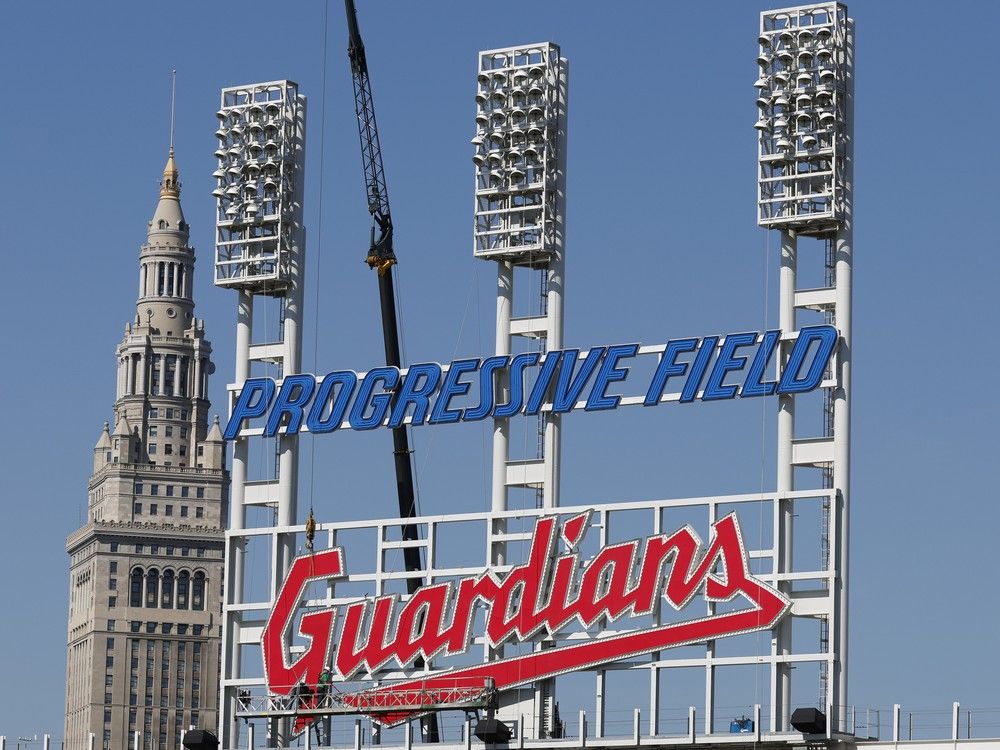
 MLB’s team in Cleveland has been the Guardians since 2022.

Guardians’ president of baseball operations, Chris Antonetti, indicated before a game on Sunday afternoon that the organization has no plans to revisit the name change.

“We understand there are different perspectives on the decision we made a few years ago, but obviously it’s a decision we made. We’ve got the opportunity to build a brand as the Guardians over the last four years and are excited about the future that’s in front of us,” he said, per

AP

.

As reported by the

Washington Post

, Commanders owner Josh Harris said much the same this February when asked about switching back.

“It’s now being embraced by our team, by our culture, by our coaching staff,” Harris said.

“We’re going with that. Now, in this building, the name Commanders means something.”

National Post has contacted the Commanders, Bowser’s office and the Guardians for comment.

Our website is the place for the latest breaking news, exclusive scoops, longreads and provocative commentary. Please bookmark nationalpost.com and sign up for our daily newsletter, Posted, here.


Former CBC host Travis Dhanraj in St. John's in June 2023.

A leaked audio recording of an internal CBC disciplinary meeting for a national news anchor reveals the public broadcaster’s tension over its policies on journalistic standards and freedom clashing with protecting its corporate image.

Travis Dhanraj, once the host of a CBC television news show called Canada Tonight with

Travis Dhanraj, resigned earlier this month

with fiery letters accusing the CBC of “tokenism masquerading as diversity, problematic political coverage protocols, and the erosion of editorial independence.”

His letters, one to CBC leadership and another to CBC colleagues, were made public and created controversy, including over perceived political imbalance in news coverage at the publicly funded broadcaster. Last week, Conservative Members of Parliament called for a public hearing into Dhanraj’s “damning allegations” on workplace culture and biased reporting.

CBC has denied Dhanraj’s criticisms made in his letters.

More than a year before his still reverberating resignation, however, a disciplinary meeting for Dhanraj was convened by CBC shortly after he made a social media post on April 19, 2024. His post on X said: “At a time when the public broadcaster is under increasing scrutiny and when transparency is needed.” CBC’s president Catherine Tait had been asked to appear on his show. “We wanted to discuss new budget funding, what it means for jobs & the corporation’s strategic priorities ahead. Our request was declined. This is unfortunate.”


The disciplinary meeting preceded his removal from on-air duties for the CBC News Network show that bore his name.

Dhanraj declined to comment on the recording or the meeting, referring questions to his lawyer, Kathryn Marshall. Marshall confirmed the recording National Post has is an authentic portion of a longer disciplinary meeting between Dhanraj and CBC officials.

CBC did not dispute the disciplinary meeting or recording.

The CBC manager speaking in the recording is identified as Andree Lau, senior director of digital publishing and streaming. Lau’s LinkedIn page describes her job as overseeing the strategic and editorial direction of CBC News Network as well as other CBC news properties.

In the recording she appears to equate a CBC journalist reporting something critical about the CBC with a potential breach of journalistic conflict of interest ethics, on the grounds that a CBC journalist has a personal stake in the broadcaster’s success.

The recording excerpt begins with Dhanraj explaining the circumstances of his post about Tait.

“The new budget funding was publicly put out in the budget on Tuesday. It was widely reported on, by not only CBC but other broadcasters. There is nothing in the tweet that is insider information,” Dhanraj says.

Lau replies: “With exception of a unionized employee criticizing their employer; that is an employee who has a personal stake in the matter whose job is part of it…. The issue is, you know, does this post meet the standards of integrity, does it meet the conflict of interest under code of conduct.”

Dhanraj says: “I firmly stand by the fact that it does.”

Asks Lau: “Do you understand the concern with this post as it relates to the principle of integrity?”

Dhanraj: “No, I really don’t. I don’t, and again, Andree, I find it problematic that we are in a meeting where we are discussing something that is in the interests of the corporation. So, I, I’m not seeing the separation right now between the journalism and the interest of the corporation. I see how it would be in the interest of the corporation for this tweet not to be out, but I don’t see how, journalistically, it’s not sound…”

An unidentified union representative then asks for context on how the appearance request to Tait came about. “I didn’t watch the show that night,” he says.

“We had an editorial discussion,” Dhanraj says, “as to whether or not now was the correct time, since there was a development, a significant development with the release of the federal budget and the new money, to put a request in for Catherine Tait. We had been discussing putting a request in for some time and we thought there was a news hook to it because of the new development….”

Lau: “… What is your understanding of the protocol and considerations when CBC journalists are covering the CBC?”

“It, it’s the J.S.P. statement again,” Dhanraj says, likely referencing CBC’s Journalistic Standards and Practices.

“Clear editorial separation,” Lau says.

Dhanraj: “So those who have the interest of the corporation should not be influencing reporters.”

Lau: “Yes.”

Dhanraj: “And if that is happening, well, that kind of goes against some core fundamentals of the public broadcaster.”

Lau then says there are other aspects of the JSP involved. In a sentence in which some words are unclear on the recording, she says “the principle of integrity and the perception of who has a stake in the matter,” finishing with “perceived impartiality because, as I mentioned, you are an employee, and you are criticizing your employer.”

The Post does not have a recording of the entire meeting.

Chuck Thompson, CBC’s head of public affairs, said the meeting was about more than just Dhanraj’s social media post, for which Dhanraj was “never formally disciplined for.”

“The discussions in April with Mr. Dhanraj were about a range of issues outside the tweet; there was a particular emphasis on CBC News policies about conflicts of interest, violations of journalistic standards and protocols on how we report on ourselves.

“Mr. Dhanraj violated these policies and was asked about them by his manager with his union representative present. He also secretly recorded the meeting after agreeing not to,” Thompson said.

Lau could not be reached for comment prior to publication. An email sent to her on Friday was returned with an automated out of office message; a detailed message to her cell phone was not responded to. A CBC official had said they would alert Lau to the Post’s request.

Marshall, Dhanraj’s lawyer, said what is heard in the recording is “disturbing.”

“It shows that Travis was intimidated for simply doing his job as a journalist. He was hauled into a meeting with human resources, his boss, and the union. The purpose of the meeting, I think, was to intimidate him, scare him and pressure him, making it clear to him that he’s not to do that, that he is not to post anything or say anything as a journalist that could be embarrassing to the public broadcaster,” Marshall said.

“This is deeply concerning. I think it demonstrates that CBC, in that moment, was far more interested in preserving its own reputation than allowing their journalists to do their jobs.”

“It shows that the CBC corporation has a disturbing level of control over their journalists and is involved in the types of stories that the journalists are covering or not covering. I think that speaks to significant concerns of bias and a lack of objectivity within the corporation.”

Thompson said late Friday that Dhanraj is still a CBC employee although currently on leave.

Marshall said CBC has

still not accepted Dhanraj’s resignation

despite him voicing his clear intent and, in fact, are still paying him.

“I want to be very clear: The CBC doesn’t get to hold him hostage. This is a free country. He’s allowed to resign.”

Marshall said Dhanraj is pressing a human rights lawsuit against CBC over his departure.

• Email:

ahumphreys@postmedia.com

| X:

AD_Humphreys

Our website is the place for the latest breaking news, exclusive scoops, longreads and provocative commentary. Please bookmark nationalpost.com and sign up for our daily newsletter, Posted, here.

A customer looks for produce at a grocery store in Ottawa, on Wednesday, April 2, 2025.

What happened to those “short-term” price increases from the pandemic?
 

From 2021 to 2023, Canadians were told that prices jumped largely because of supply-chain bottlenecks, government spending on income supports and other pandemic-related issues.
 

If so, shouldn’t those temporary increases disappeared once the pandemic subsided and those glitches were repaired?
 

While inflation may have since been tamed, Statistics Canada’s monthly inflation figures show that the pandemic-era price hikes survived.

Are consumers getting ripped off by not seeing prices slide back again?

Under typical circumstances, we would have seen some inflation, likely within the Bank of Canada’s “normal” band of between one and three per cent a year, even without the pandemic. Instead, the Consumer Price Index saw the annual rate jolt to 3.4 per cent in 2021, soar to 6.8 per cent in 2022, and load another nearly four per cent onto prices in 2023.  That additional inflation that was supposed to be because of the impacts of COVID-19.
 

Yet, more than five years after the deadly virus started to spread, and two years after the pandemic was declared over, we seem to still be paying for those price hikes. To find out why, National Post asked economists to shed some light on what happened to that “temporary” inflation and why we’re still paying for it.

Some blame corporate greed. Others, a lack of competition in some markets. Or are there other economic trends at work that suggest that consumers aren’t actually being ripped off at all?
 

What happened to consumer prices during the pandemic?

According to Statistics Canada’s Consumer Price Index (CPI), prices rose 11.4 per cent between January 2020 and December 2022.
 

But that wasn’t an immediate response to the pandemic. Inflation didn’t spike for more than a year after the start of the pandemic. In fact, prices were rising at relatively normal and modest rates until May 2021, about 16 months after the first case of COVID-19 was reported in Canada, and didn’t peak until June 2022, at 8.1 per cent, the highest rate in almost four decades.
 

(The pandemic started in China in December 2019 and a pandemic was declared in Canada on March 11, 2020.)
 

Gasoline was among the products hit hardest by inflation, with a price increase of more than 50 per cent over that two-year period. Food and transportation jumped between 15 and 20 per cent, while appliances and rent each increased by between 10 and 15 per cent.
 

What caused inflation during the pandemic?

Prices at any time are, in general terms, a function of supply and demand. In short, the pandemic caused both simultaneous supply shocks and increased consumer demand.

Barring innovation that leads to productivity improvements and lower costs, that formula will almost always mean price hikes.
 

On the supply side, some products were being produced less or not at all due to factories being closed or experiencing reduced hours, particularly in Asia. There were also shortages of some raw materials, such as lumber and metals, which also contributed to inflation.
 

And costs for many suppliers went up because transportation became more expensive due to shipping delays, congestion at many ports and the rising cost of fuel, which affects the prices of most products.
 

There were also supply problems that had little or nothing to do with the pandemic.
 

Russia invaded Ukraine in early 2022, reducing the global supply of energy products, fertilizer and some grains.
 

Some important agricultural areas also suffered from poor weather. In 2021, Western Canadian farmers were hit with the worst drought in 19 years, leading to wheat stocks to drop 38.7 per cent compared to the previous year. By April 2022, food manufacturers were paying more than double for wheat than they had been paying just two years earlier.
 

And as usual, those costs were borne by consumers. According to
Statistics Canada
, consumers had to spend considerably more on bread (+12.2 per cent), pasta (+19.6 per cent) and cereals (+13.9 per cent) than they had a year earlier.
 

On the demand side, consumers’ lives had changed because many started working from home, going out less and not travelling. That meant they were unintentionally saving money. Lower interest rates and billions of dollars in government support programs also put more money into consumers’ pockets.
 

Some employees, meanwhile, were getting fatter paycheques because there was greater demand for their services. Health care workers were pulling overtime shifts, for example. Also, as people adjusted to staying at home and renovated or bought new houses, construction workers were in high demand. 

As consumers responded to the shapes of their new lives there was increased demand for real estate, furniture, exercise equipment and home entertainment gadgets .
 

Demand, and the upward pressure on inflation, was also fuelled by government spending.
 

A new report from the C.D. Howe Institute concluded that the Trudeau government’s spending splurges played a major role in fuelling inflation during the pandemic. The report pointed the finger at Ottawa’s unfunded spending spree — more than the Bank of Canada’s monetary policies — that acted as “helicopter drops” of money for the private sector.  
 

In 2020, about
20.7 million Canadians out of an adult population of 30.3 million received income from one of the federal pandemic-related programs, according to a 2022 report. During that year alone, the programs are estimated to have cost $270 billion — about 12.5 per cent of Canada’s gross domestic product (GDP) — and cumulatively have cost about $360 billion to date.
 

While the programs broadly succeeded in providing relief to individuals and businesses and creating a cushion for the economy during a crisis, the C.D. Howe Institute noted that injecting that much extra money into an economy while unemployment is low results in inflation.

David Andolfatto, c
hair of the department of economics at the University of Miami and an international fellow at the C.D. Howe Institute, said inflation should be expected when governments add that much extra demand to the economy. “Of course prices went up,” he said. “There’s no such thing as a free lunch. Somebody will have to pay.”
 

And not only do consumers pay higher prices but they must then pay again with the higher interest rates the central bank then implemented to try bringing those prices back down.
In 2020, interest rates were down to 0.25 per cent as the Bank of Canada aimed to cushion the blow from the pandemic; by 2023, the rate had risen 20-fold, to five per cent.

Jean-Francois Perrault, chief economist at the Bank of Nova Scotia, estimated in a November 2023 report that government spending and pandemic-era transfers to Canadians were responsible for about 42 per cent (200 of the 475 basis points) of the increase in the Bank of Canada’s prime interest rate during that period. About one-third of those interest rate hikes can be traced back to provincial governments, he calculated.
 

“Our results suggest that fiscal policy at all levels of government has been badly miscalibrated,” the report concluded.
 

 How much have prices gone up since the pandemic?

Since the start of 2023, inflation has remained at less than four per cent, just over the Bank of Canada’s preferred band of between one and three per cent, but a big decrease from the peak of pandemic-era inflation.  
 

And, at least for now, it’s largely under control. Statistics Canada reported last week
that
Canada’s inflation rate
 accelerated to 1.9 per cent in June, up from 1.7 per cent the previous month.
 

Why have some prices kept rising since the pandemic?

When the pandemic subsided, it removed a number of shocks and disruptions to markets. But not all of them.
 

The Russian invasion of Ukraine, for example, still hasn’t been resolved. Many of the people who started working from home during the pandemic still do so, either part-time or full-time, which puts a little more money in most of their pockets. The glut of baby boomers is also at the stage of life where many are retiring, having saved up their money, and now want to spend it.
 

Katherine Judge, senior economist at CIBC Capital Markets said consumer markets are also still getting a boost from pent-up demand and extra savings that consumers accumulated during the pandemic.
 

Wages, meanwhile, have actually been growing faster than inflation since mid-2024, so household purchasing power has also increased.
 

In recent months, the tariff wars launched by U.S. President Donald Trump have started to put upward pressure on inflation in both components and finished goods and will continue to do so unless they are resolved.
 

Economists say that p
rices don’t normally drop — or even approach inflation of less than one per cent — unless demand falls because the economy is in a recession or governments adopt severe cost-cutting measures.
 

Neither has happened since the pandemic. The federal government kept running large deficits in spending. And while it has spoken recently about cutting costs in the bureaucracy, it also plans to boost outlays on defence and infrastructure projects.
 

As poor weather played a role in fuelling inflation during the pandemic, it’s still a major factor.
 

A new study
by a team of international scientists led by Maximillian Kotz, a postdoctoral fellow at the 
Barcelona Supercomputing Center,
found that foods affected by heat, drought, floods and other climatic extremes contributed directly to higher consumer prices.
 

This summer, for example, farmers in southwestern Saskatchewan have been hit by wildfires, heat waves and drought, driving up prices in the wheat market. But weather isn’t just affecting the Canadian Prairies.
 

Severe weather events are also causing higher prices for Japanese rice and Spanish olive oil. In a phenomenon dubbed “heatflation,” the report also documents that South Korean cabbage prices
rose 70 per cent
last year after a period of hot weather and drought, and that seafood prices increased because rising water temperatures has meant fishermen have had smaller catches.

Will prices even come down again from the pandemic inflation?

Is there a chance that some of the pandemic spike in prices could still be eliminated if the world enjoys a period of relative peace, with no disruptive shocks?

Andolfatto
,
at the University of Miami, said prices could in theory still come down in some markets, but that would be a function of changes in supply and demand at that time, not anything to do with what occurred during the pandemic.
 

But that’s unlikely to happen in Canada in the near term, Andolfatto said,  because governments haven’t taken steps to reduce the extra demand in the economy.


But are corporations keeping prices artificially high?

Many economists say they don’t believe that consumers, in broad terms, are being cheated. There may be some Canadian markets, such as banking, airlines or telecommunications services, where there are worries over a lack of competition. But in the markets that people usually point to when they think about inflation, groceries in particular, competition is robust. And the prices are, as is usually the case, largely a function of supply and demand.
 

“I’m not going to blame corporate greed for this phenomenon,” said
Andolfatto
. “Corporate greed was there before.”
 

National Post

stuck@postmedia.com

Our website is the place for the latest breaking news, exclusive scoops, longreads and provocative commentary. Please bookmark nationalpost.com and sign up for our politics newsletter, First Reading, here.


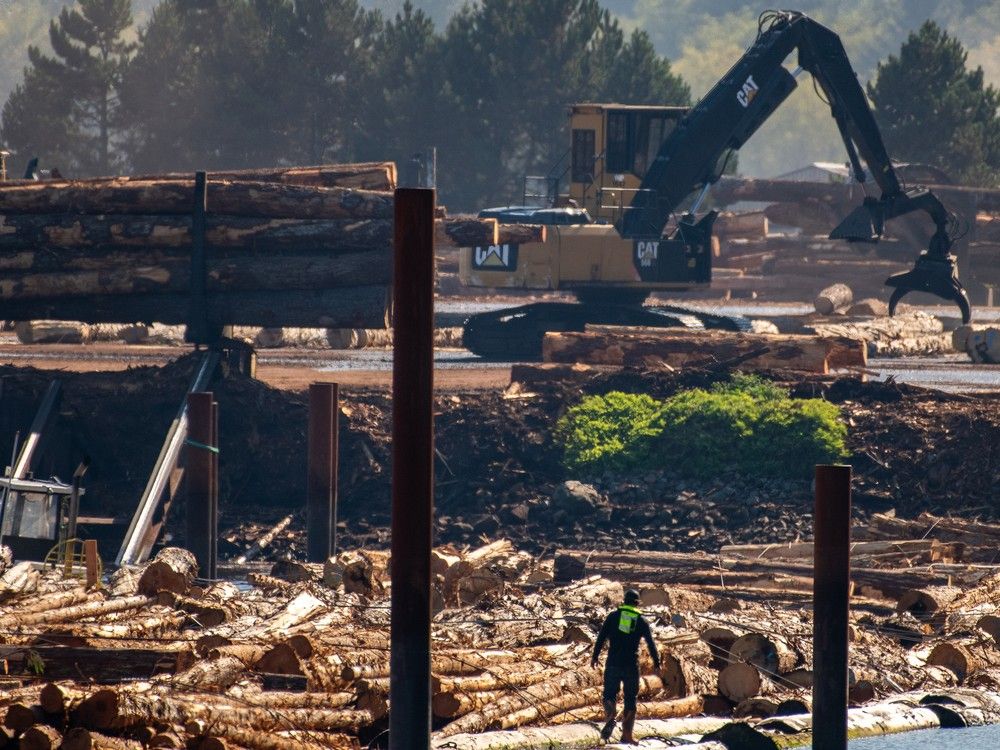
A worker cuts lumber at a saw mill near Sooke, B.C.. The softwood lumber industry has seen a unique pattern emerge, where Canadian firms own a large chunk of U.S. production capacity — something President Donald Trump says he wants — and still face aggressive trade measures.

WASHINGTON, D.C. — The Canada-U.S. softwood lumber trade relationship has dealt with ups and downs, disputes and resolutions, for decades. Anxiety for Canadian exporters is reaching a fever pitch again as the U.S. threatens to more than double softwood lumber duties and add even steeper tariffs under a national security investigation. 

Canadian foresters, mills, and governments that enjoy taxes, economic spinoffs and stumpage fees from Crown land will feel the pain if they lose too much access to the massive U.S. market. But larger producers have been preparing for just this kind of contingency and have cleverly hedged their bets, building capacity in the U.S., where they can sell as much as they want to Americans, tariff-free.

Canadian firms will soon receive word from the U.S. Commerce Department’s Sixth Administrative Review (AR6) of U.S. countervailing and anti-dumping duties on Canadian softwood lumber exports, with the rate expected to jump from around 14 per cent to roughly 34 per cent. For Canfor, the Vancouver-based lumber giant selected as a mandatory respondent in the AR6 review, it will be even worse. Its duties are calculated based on its own shipments and prices, not an industry average, like it is for other companies. 

“Canfor’s rate will be 45 per cent, plus or minus a per cent,” said Andrew Miller, chairman of Oregon-based Stimson Lumber and chair of the U.S. Lumber Coalition. “So they’ll get a kick in the teeth from the next round of duties.”

Then there’s the threat of tariffs from President Donald Trump’s ongoing national security investigation of Canadian lumber imports under Section 232 of the Trade Expansion Act, which he ordered in March and is due late this year. Currently, lumber shipments are exempted from Trump’s baseline tariffs, because they’re covered by the U.S.-Mexico-Canada trade deal (USMCA), but that could soon change based on the findings of the 232 probe. 

National Post breaks down the position of the two countries, what the impacts could be, and how Canadian producers are trying to mitigate the potential damage of punitive trade barriers.

 A worker walks along floating logs in the Western Forest Products Kelsey Bay Dryland Sort near Sayward, B.C.

What American producers want

The U.S. Lumber Coalition is playing for keeps. It backs higher anti-dumping duties and tariffs for what it sees as a subsidized domestic industry. It claims Canadian producers don’t pay market rates for stumpage because their forests are publicly owned and provincial governments set the stumpage rates, while U.S. producers face higher market rates. But it doesn’t stop there: the U.S. coalition also wants to see Canada’s U.S. market share significantly chopped.

Miller isn’t shy about the goals: “A countrywide quota with no exemptions and no carveouts, and a single-digit market share” for Canadian lumber. 

Today, Canada has a 25 per cent market share, with exports of 12 billion feet of softwood lumber to the U.S. each year, according to the coalition. Softwood lumber accounts for about 7.5 per cent of Canadian exports; in 2023, the U.S. was the destination for 68 per cent of those forestry products. The whole industry is worth about $33.4 billion in sales annually and employs more than 200,000 workers across Canada, according to a report this year from RBC.

If Trump stacked a 20 per cent tariff on top of the existing duties, driving down some of Canada’s approximately 12 billion board feet of annual softwood exports to the U.S., Miller believes the U.S. industry could almost immediately replace at least two billion feet worth through quick operational changes. Incremental mill upgrades over three years could then add another three to four billion feet of production, he said. 

“I really believe that within three years we would have replaced, through U.S. production of lumber, about half of what Canada currently exports to the U.S.,” he said, nodding to Trump’s comments earlier this year about the U.S. not needing any Canadian lumber.

The coalition is pushing for a tariff rate from the Section 232 investigation that starts at 15 to 20 per cent and goes higher from there. That, Miller explained, will incentivize U.S. sawmill owners struggling with thin margins to hire more people and invest in upgrades, bolstering U.S. production. 

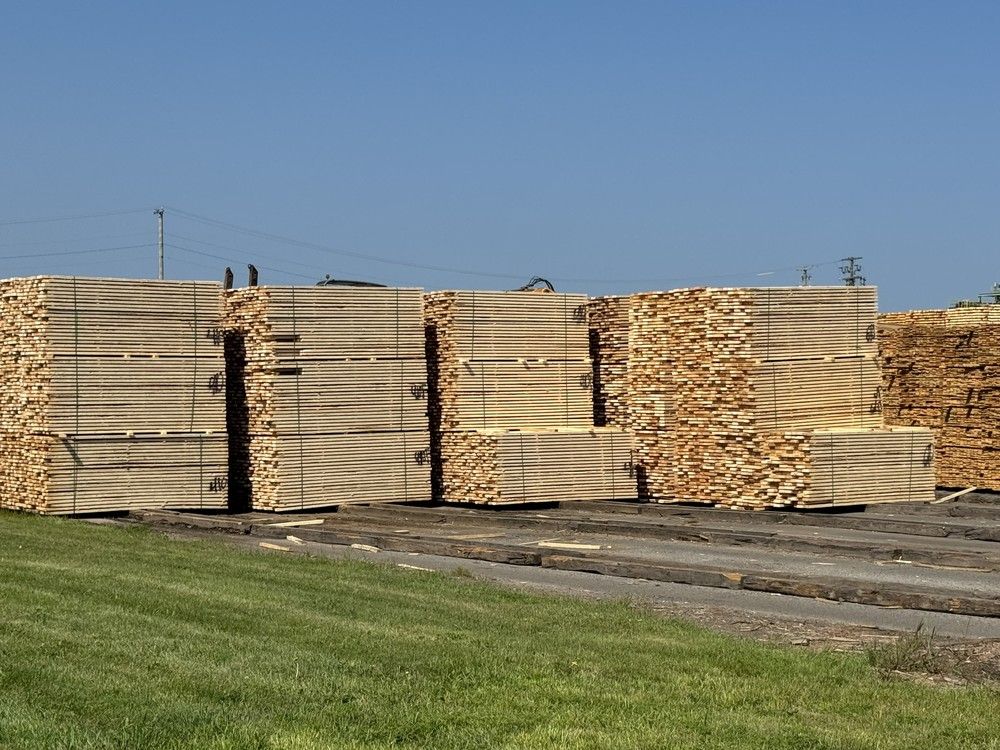
 Stacks of softwood lumber waiting to be shipped.

What Canada’s preparing for

This week, provincial leaders offered ways to settle the dispute. B.C. Premier David Eby said Canada is willing to consider a quota on exports to the U.S. for the first time, and
New Brunswick Premier Susan Holt also said quotas are on the table as an option for trade negotiations.

Miller, head of the American coalition, was far from impressed by Eby’s comments. A quota might stabilize the market and secure jobs for Canadian workers, he said, but “at whose expense?” His answer: “U.S. mill workers.”

“(Eby) is not serious about a settlement that is satisfactory to the coalition. He is floating a political trial balloon designed to derail the implementation of the AR6,” he said.

Kurt Niquidet, president of the BC Lumber Trade Council, refused to comment on what his organization prefers by way of a solution. He said options included quotas, tariffs, or a hybrid approach. But he was clear that the industry wants Ottawa to resolve things with the U.S. quickly.

“We
think that the federal government should be making this issue a priority and looking for a negotiated settlement,” he said.

Why the U.S. is divided

Niquidet argues that the U.S. already has “housing affordability issues” and taxing or restricting Canadian lumber could only make things worse.

“If the trade measures are too punitive, it just serves to drive up the prices and the costs of lumber in the U.S.,” he said. 

That’s why the National Association of Home Builders (NAHB), the trade association based in Washington, has been leading the charge to fight the duties and potential tariffs. It has repeatedly warned the White House that tariffs would only “(slow) down the domestic residential construction industry” at a time when Trump has vowed to address the country’s “severe housing shortage and affordability crisis.”

In recent years, tariffs have increased the average home price by nearly US$11,000 because of recent tariffs, according to the April 2025 NAHB/Wells Fargo Housing Market Index, when the average home sticker price is just north of US$400,000. There are also about 3.5 million Americans who work in the residential housing sector, and millions more working in commercial and industrial construction.

The NAHB has actively shared its concerns as part of the Section 232 investigation process and expressed concern that the U.S. lumber supply cannot meet the needed demand on its own anytime soon.

Niquidet agrees. He said claims by the U.S. industry and the president that American producers can make up for lost Canadian supply are “just not true.” 

How to play both sides

The twist in all this is that a growing number of producers in the U.S. are actually Canadian-owned.

Vancouver-based West Fraser started buying and investing in U.S. sawmills back in the early 2000s to diversify its assets and shore up supplies threatened in Canada by mountain pine beetles and wildfires. Others — including Canfor, Resolute and Interfor (whose U.S. operations are bigger than its Canadian ones) — 
followed suit in part to avoid trade barriers, the trend only accelerating in Trump’s first term, when he imposed 20 per cent tariffs on Canadian softwood exports.

Today, estimates are that Canadian lumber firms control as much 40 per cent of softwood lumber production capacity in the American South. In most cases, they’ve kept local families and employees in place, seamlessly taking over and often modernizing while keeping afloat many sawmills that might’ve otherwise gone under.

When asked about the paradox of Canadian firms buying up U.S. sawmills, Miller doesn’t have any concerns. “A dollar invested in a U.S. sawmill is a dollar invested in a U.S. sawmill employing U.S. citizens operating that sawmill, cutting trees and shipping them,” he said. “We don’t care who operates them. You know, it’s a free market.” 

(However, Miller said if foreign owners ever wanted to join the U.S. Lumber Coalition, which advocates against imports, it wouldn’t allow them to.)

The U.S. president has also repeatedly told foreign manufacturers that if they want to escape punitive trade measures, they should invest on U.S. soil and help ramp up domestic American production. 

“(Trump would) take that as a big victory,” Miller said of the lumber takeovers by Canadians. “That’s what he wants,”

National Post

tmoran@postmedia.com

Our website is the place for the latest breaking news, exclusive scoops, longreads and provocative commentary. Please bookmark nationalpost.com and sign up for our daily newsletter, Posted, here.

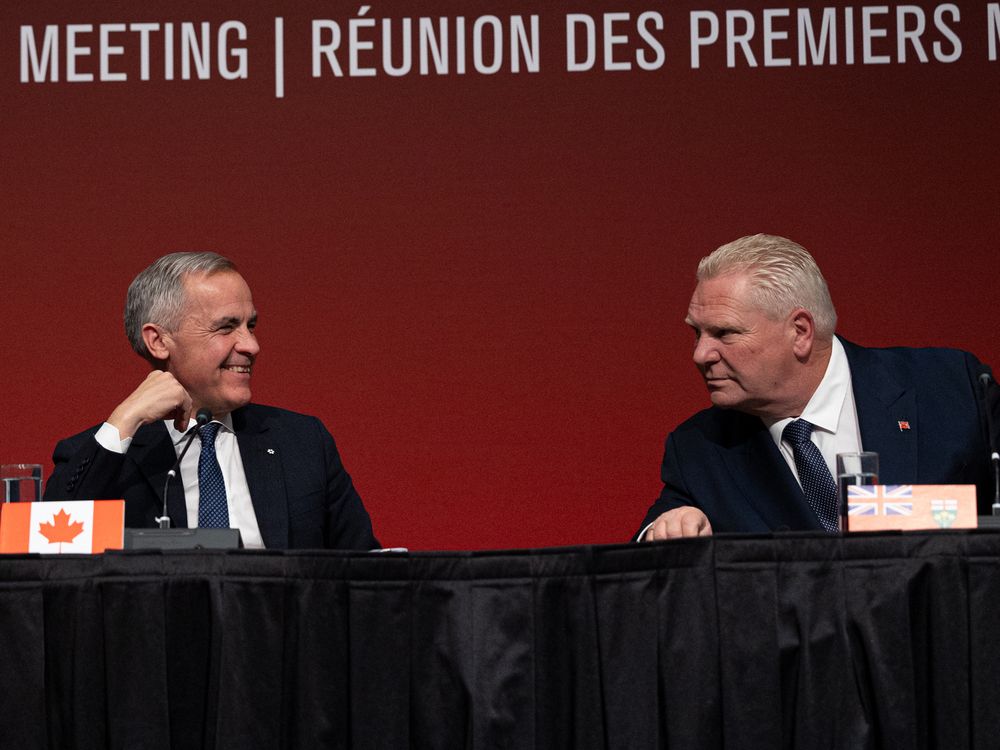
Prime Minister Mark Carney and Ontario Premier Doug Ford speak during a press conference after the first ministers’ meeting at TCU Place in Saskatoon on June 2, 2025.

Ontario Premier Doug Ford is hosting Canada’s premiers in Muskoka starting Monday at a Council of the Federation summer gathering. Premiers of the 13 provinces and territories can look forward to enjoying Alberta-bred and Ontario-fed beef on the grill at the Ford family cottage. They will have a special guest: Prime Minister Mark Carney.

“For the first time ever that I can remember,” Ford says, “the prime minister is invited. That would have never happened with Trudeau, but it’s happening under Mark Carney. And he’s going to be welcomed with open arms.”

Rather than the premiers getting together “to bitch and complain about the federal government,” Ford chuckles, “we get to present it right to him (Carney) as he’s sitting around the dinner table and we’re talking to him.”

“The access is phenomenal,” Ford says of his own relationship with the PM, “I’ll message him, he gets right back to me. It’s all about communication and relationship-building.

“And, he’s a very, very great business person,” Ontario’s premier enthuses, listing off Carney’s credentials (without a mention of potential conflicts of interest).

“He gets it,” Ford says. “He’s going to go in there and he’s going to clean house in Ottawa, which is well overdue.”

 Doug Ford and Mark Carney meet for breakfast, March 12, 2025.

Figuring out how Team Canada will respond to U.S. President Donald Trump’s declaration of a blanket 35 per cent tariff on goods imported from Canada as of Aug. 1 — on top of previously implemented tariffs on auto parts, steel, aluminum and copper — will no doubt be the premiers’ top priority in cottage country next week.

“Elbows up or elbows down? What’s the strategy, now?” I ask Ford in a recent call.

“We have to negotiate through strength,” Ford responds, “and we really have to flex our muscles and make sure President Trump hears us.”

“Because in closed-door meetings and in our phone calls with governors — and they pull a lot of weight, I heard that from (U.S. Commerce Secretary Howard) Lutnick — Republicans don’t want this,” Ford reports

“Democrats obviously don’t want this, and Republicans don’t want it. But they’re terrified to say anything publicly,” he says. Only a few U.S. senators have spoken up, Ford adds, “and God bless them.”

Carney is advancing several strategies — promoting free trade within Canada; negotiating a security and trade pact with America, in good faith; and at the same time, forging strategic partnerships with the EU to beef up security and defence alliances and boost trade and economic security. This week, Carney announced measures to protect the nation’s steel industry, including guarding against foreign steel entering Canada to bypass Trump’s tariffs.

Breaking down trade barriers between provinces is a strategy Ontario has embraced; the province has signed memorandums of understanding with all provinces except Quebec, B.C. and Newfoundland.

And Ford sees other cards to be played, other ways to pressure the Trump administration for a fair trade deal.

“I’ve been very transparent with Secretary Lutnick, we’re going to start on-shoring everything,” Ford says. “We’re going to on-shore the steel beams, the I-beams. We have more cranes in the sky in Toronto and the GTA than their top 10 cities combined.”

“We’re going to on-shore the aluminum cans, the beer cans … to make sure we don’t have to see a tariff of 25 per cent on the aluminum going down (to the U.S.), they convert it, print it, and send it back up (to Canada) with another 25 per cent; that’s 50 per cent.”

Ford’s government is giving incentives to companies — to turn aluminum into cans, produce steel I-beams, and manufacture steel rails used in transit projects. This strategy tracks with Carney’s recent commitment to rely more on Canadian steel for Canadian projects.

“Canada buys more off the U.S. than China, than Japan, than Korea, U.K. and France combined,” Ford elaborates. “We’re their largest customer, and yes, they’re our largest customer. But Ontario alone employs nine million Americans who wake up every morning to build a widget or provide a service to Ontario alone.”

“(Americans) are going to feel the pressure,” Ford says. “They’re going to feel the pressure when Americans start losing their jobs because we’re going to start on-shoring everything, and once that happens, I told Lutnick, it’s hard to turn that tap off.”

And, Ford continues, Canada can leverage its supplies of critical resources. American governors, both Republicans and Democrats, tell Ford the same thing: “There are two things they’re interested in: our nuclear energy and our critical minerals.”

Repeating his well-worn adage — “Canada is not the threat; China is the real threat” — Ford explains how China’s lock on 90 per cent of the world’s critical minerals makes Ontario’s resources in the Ring of Fire all the more essential to Americans.

“And we don’t believe in rip and ship,” Ford assures me, “we’re going to make sure that we mine it with Ontario workers, we’re going to refine it here in Ontario with Ontario workers, and then we’ll have the option of shipping it around the world.” Ford’s also pitching a deep sea port to facilitate exports, in a couple of locations — one in Ontario, in Hudson’s Bay, and one in Manitoba.

“It will wake up President Trump real quick,” Ford quips, “if we start shipping it to our other allies around the world and not to him.”

Ford is the premier of Ontario — it’s his job to look out for that province’s interests — but there’s no question he’s fully steeped in Team Canada spirits. “We all have something that we’re bringing to the table,” he assures me, repeatedly.

“The U.S. needs our high-grade nickel,” Ford asserts, “to be used in the military, in aerospace, in manufacturing. It’s no different from the aluminum, from Quebec, being shipped down there, or the potash or uranium from Saskatchewan, and obviously, the 4.3 million barrels of oil we ship down to the U.S. But we’re going to diversify that and not rely on the U.S. Yes, we have one pipeline going west, but we need another one going west, east, north and south.”

 Alberta Premier Danielle Smith and Ontario Premier Doug Ford cook pancakes at the annual Premier’s Stampede Breakfast at McDougall Centre in Calgary on July 7, 2025.

Ford is also effusive about the need to get rid of the tanker ban on the West Coast and revamp the impact assessment act. “Those days are done. They’re gone,” he says. “We have to start moving forward and create the conditions for the rest of the world to look at investing in not just Ontario but other jurisdictions across Canada, from coast to coast to coast.”

I moved from Ontario to Alberta in the early 1980s — a time when Alberta premier Peter Lougheed was struggling with prime minister Pierre Elliott Trudeau’s National Energy Program — and can still recall the bitter disappointment of Ontario premier Bill Davis’s unwillingness to support Alberta’s interests.

I admit to being impressed by Ford’s visit to the recently concluded Calgary Stampede, and not just by his commitment to flip pancakes alongside Smith, whose griddle experience is legendary. Ontario’s premier also inked two MOUs with Alberta, to advance freer trade between the provinces and publicly endorse mutually beneficial national-interest projects, including an oil pipeline from Alberta to Ontario (fabricated with Ontario steel).

Although Ford’s not sure if Carney will be specific about the nation-building projects selected to move forward, in the upcoming discussions around the table in Muskoka, he’s optimistic provincial leaders — and their constituents — recognize this unique opportunity to move forward on national infrastructure projects.

“We’re moving forward and we’re going to see another $200 billion going into our economy, increase our GDP anywhere upwards to six per cent,” Ford says.

He expects his fellow premiers will have to hop on this train. “The residents of each province are going to demand that they get on that train as we’re moving forward,” he says, “because they want to prosper as well.”

National Post

Our website is the place for the latest breaking news, exclusive scoops, longreads and provocative commentary. Please bookmark nationalpost.com and sign up for our daily newsletter, Posted, here.


A TSA employee advises travellers that liquids are not allowed through the gate at at the Los Angeles International Airport on Oct. 10, 2012.

The days of cramming travel-sized shampoo bottles into plastic bags could soon be over. U.S. Homeland Security Secretary Kristi Noem hinted that the longstanding liquid restrictions for carry-on luggage could be lifted.

During a conference hosted by The Hill in Washington, Noem said on July 16 that she was “questioning everything TSA (Transportation Security Administration) does” and hinted at potential revisions to the rules governing liquids in carry-on bags.

“The liquids, I’m questioning. So that may be the next big announcement, is what size your liquids need to be,” Noem said at the conference.

Her comments come about a week after she announced that passengers are no longer required to remove their shoes during regular TSA security checks, a change that went into effect immediately.

Here’s what you need to know about Noem’s comments about liquid restrictions in carry-on luggage and why the rule was implemented in the first place.

When did airlines start restricting liquids in carry-ons?

In 2006, authorities foiled a plan to use liquid explosives smuggled aboard carry-on luggage to blow up planes.

After the incident, the TSA banned all liquids in carry-on luggage. However, this ban was lifted after six weeks as it strained airline baggage systems, as more people were checking bags.

The FBI, along with other laboratories, found that a tiny amount of substances, those being small enough to fit into a quart-sized bag, could not blow up a plane. After that, the 3.4-ounce limit — or 3-1-1 rule — came into effect.

The rule stated that each container of liquid, gel or aerosol — whether it’s water, shampoo or hairspray — must be 3.4 ounces (100 ml) or less, all containers must fit into one quart-sized (one-litre) clear zip-top bag, and only one bag is allowed per passenger. Since then, TSA checkpoints have borne the familiar rituals of chugging water and tossing oversized containers, and fights over what’s considered a liquid or not.

After the restrictions were introduced in the U.S., other countries quickly followed suit with similar rules.

What does this mean for U.S. travellers?

For now, it is unclear how or when any changes to the liquid restrictions might take effect. Noem has not provided details on what a new policy could look like, whether that means lifting the size limit entirely, or just expanding it. Until then, passengers should expect to keep following the existing 3-1-1 rule.

Why is the U.S. considering changing this policy?

The TSA has been exploring changes to its liquid rules for years, but with recent advancements in technology, it seems more possible than ever.

Advanced computed tomography (CT) scanners are now being installed at security checkpoints across U.S. airports. These scanners generate detailed 3D images of the contents of carry-on bags and can automatically detect potential security threats, making it possible to carry bigger sized liquids through security.

Currently, U.S. travellers will still need to abide by existing TSA liquid restrictions, but with these advancements in technology, and the U.S. willing to change their approach, travellers may soon find themselves packing a little more freely.

“Hopefully, the future of an airport, where I’m looking to go is that you walk in the door with your carry-on suitcase, you walk through a scanner and go right to your plane,” Noem said at the conference. “It takes you one minute.”

What could this mean for Canada?

If the U.S. moves ahead with easing or eliminating its liquid restrictions, Canada may not be far behind. While Canadian travellers have not been required to remove their shoes for domestic or non-U.S. flights, those flying to the United States through pre-clearance areas have followed TSA protocols, including removing their shoes. Earlier this month, however, Canada aligned with the U.S. and dropped that requirement.

This quick alignment suggests Canadian authorities could follow suit if the U.S. were to ease up on liquid restrictions. So far, there has been no official word from Canadian authorities on whether such changes are being considered.

What are other countries doing?

In the United Kingdom, several regional airports, including London City and Edinburgh, have begun lifting liquid restrictions, thanks to the rollout of advanced CT scanners. The new technology allows passengers to keep liquids and electronics in their bags during screening and permits containers of up to two litres.

Similar changes are underway elsewhere.

At Qatar’s Hamad International Airport, select security lanes now let travellers leave liquids and laptops in their bags. This has also been made possible by upgraded CT scanning systems. In South Korea, major airports, such as Incheon and Jeju, are piloting the same technology on domestic routes, with plans to expand it more broadly in the future.

Our website is the place for the latest breaking news, exclusive scoops, longreads and provocative commentary. Please bookmark nationalpost.com and sign up for our daily newsletter, Posted, here.

After footage of a couple hiding from the camera at a Coldplay concert was posted online, amateur sleuths identified the couple as Andy Byron, CEO of software company Astronomer, and Kristin Cabot, the company's head of HR.

Social media has been abuzz since Wednesday night with images and speculation about two co-workers who were caught on Coldplay’s “kiss cam” during a concert by the group. Another woman at the concert recorded the event and uploaded it to her TikTok account, where it has since racked up more than 58 million views.

From X, the platform once known as Twitter, to media outlets and even a city sanitation department, companies have been weighing in on their own. Some of their jabs made more sense than others. Here’s what we know about the Coldplay couple controversy.

What happened at the Coldplay concert?

It started simply enough. At a Coldplay concert in Boston on Wednesday night, vocalist Chris Martin

told the audience

that he wanted to say hello to some of the fans.

“The way we’re going to do that is, using our cameras, you can look at the screens and we can see who’s out there and say hello,” he said. “Let’s go looking please.”

The cameras quickly found a couple wrapped in an embrace while enjoying the show — but rather than say hello, she turned away to hide her face while he ducked out of view, both of them appearing shocked.

“Either they’re having an affair or they’re just very shy,” Martin says, before the camera focuses on someone else.

In a later video

, he says, “I hope we didn’t do something bad.”

Who are the Coldplay couple?

The footage was soon

uploaded to social media

, and not long after, amateur sleuths identified the couple as Andy Byron, CEO of software company Astronomer, and Kristin Cabot, the company’s head of HR. She’s divorced. He’s married, but not to her.

Who filmed the video?

The video was recorded by Coldplay fan Grace Springer and

uploaded it to her TikTok account

. She said she didn’t expect to spark a scandal, but she stands by posting the video.

“I had no idea who the couple was. Just thought I caught an interesting reaction to the kiss cam and decided to post it. A part of me feels bad for turning these people’s lives upside down, but, play stupid games … win stupid prizes,”

she told the U.S. Sun.

“I hope their partners can heal from this and get a second chance at the happiness they deserve with their

future

 still in front of them.”

Has Astronomer responded?

On Friday, the company

released a statement

noting that its board had started a formal investigation into the matter.

Astronomer is committed to the values and culture that have guided us since our founding. Our leaders are expected to set the standard in both conduct and accountability,” the company said.


“The Board of Directors has initiated a formal investigation into this matter and we will have additional details to share very shortly,” it added.
“Alyssa Stoddard was not at the event and no other employees were in the video. Andy Byron has not put out any statement, reports saying otherwise are all incorrect.”

Late Friday Astronomer made another statement: “Cofounder and Chief Product Officer Pete DeJoy is currently serving as interim CEO given Andy Byron has been placed on leave.
We will share more details as appropriate in the coming days.”

Why did the first statement mention Alyssa Stoddard?

Internet sleuths had claimed that the embarrassed woman who was standing beside Byron and Cabot as they hid from the cameras was Alyssa Stoddard, an Astronomer employee who works for Cabot. The company has made it clear that the woman is not Stoddard.

“Alyssa was not there. This is a rumour started on Twitter. There may be some similarities in the countenance of the person, but it’s not (Stoddard),” a rep at a public relations firm hired on behalf of Astronomer

told Page Six

on Friday. “So (the rumour) is totally false based on misinformation.”

Why did Astronomer mention a statement from Byron?

A purported statement from Byron was posted to X on Thursday but it has since been identified as fake.

“I want to acknowledge the moment that’s been circulating online, and the disappointment it’s caused,” said the fake statement, which included apologies to Byron’s wife, family and Astronomer employees.

“What was supposed to be a night of music and joy turned into a deeply personal mistake playing out on a very public stage,” it said before adding that it was “troubling” that “what should have been a private moment became public without my consent.” The fake statement ends with Coldplay lyrics: “Lights will guide you home, and ignite your bones, and I will try to fix you.”

Before Astronomer put out a statement,

AFP had confirmed it was fake

, but not before it had been shared across social media and in multiple news articles.

“It did originate from a troll account and is indeed fake,” Mark Wheeler, Astronomer’s senior vice president of marketing, told AFP in an email on Friday, referring to the X account

@PeterEnisCBS, which appears to have first 
posted an image of the fake statement
on Thursday. AFP could find no record of a Peter Enis working for CBS, and the X account has since been suspended.

Former Astronomer CEO Ry Walker also called the message “super fake” in an X post.

How have other companies responded?

X delivered a simple line of text: “date idea: take your grok companion to coldplay.”

Tampa International Airport also decided to join in with: “Get your girl a plane ticket to see Coldplay or her boss will.”

And the movie studio Neon chose to post about its new body-horror movie Together with an image of the two canoodlers and the line: “The perfect date night movie.”

Not all the memes were so straightforward. Netflix obliquely posted an image from its documentary series Quarterback of Kirk Cousins of the Atlanta Falcons saying “I like Coldplay,” and that “one of the best concerts I’ve ever been to was Coldplay.”

By far the most unusual take on the situation was from

New York City Sanitation

, which defines itself as the “world’s largest municipal sanitation force” and notes that it collects 24 million pounds of trash and recycling every day.

It tends to send out messages about proper use of garbage bins and holiday well wishes, but on Thursday chose to tell its 98,000 followers: “Cameras are EVERYWHERE! Don’t get caught doing something you *maybe* shouldn’t be doing. Thinking about doing something naughty, like dumping trash in the City? We’ve got video cameras all over. We WILL catch you — and you will pay the price!”

Below those words was a montage of five images: a sign warning about illegal dumping, three photos that showed what looked like people doing just that — and Byron and Cabot at the Coldplay concert. Some people can’t keep their minds out of the gutter.

Love concerts, but can’t make it to the venue? Stream live shows and events from your couch with VEEPS, a music-first streaming service now operating in Canada. Click here for an introductory offer of 30% off. Explore upcoming concerts and the extensive archive of past performances.

Our website is the place for the latest breaking news, exclusive scoops, longreads and provocative commentary. Please bookmark nationalpost.com and sign up for our newsletters here.


Premier Danielle Smith tours Jasper, Alta., on Friday, July 26, 2024. Wildfires encroaching into the townsite of Jasper forced an evacuation of the national park.

OTTAWA — The top administrator in Jasper, Alta., downplayed claims Friday that a report his town commissioned into last summer’s devastating wildfire was about blaming the province for making things worse, after the premier called on the town to apologize.

Jasper Chief Administrative Officer Bill Given told the National Post

that the initial media coverage

of the report hasn’t given the full picture of its contents, although he said he stands by the report.

“As with any comprehensive report, looking at any one part of it in isolation can easily lead to a mischaracterization of the overall content,” said Given in an interview. “I would encourage everyone to take a look at the report in its entirety, so they have a clear understanding of what its intended scope is (and) what was out of scope.”

Given also stressed that there were “a lot of strengths” in the wildfire response, including contributions from the province.

Several news outlets on Thursday, the day the report was released, highlighted some elements of the report that said the Alberta government had complicated firefighting efforts when it added itself to a previously established command structure set up between the town and Parks Canada.

Smith called both the report and its coverage in the media “disheartening” on Friday, saying the province was unfairly characterized as a clumsy interloper in wildfire relief efforts.

“The report and the media response not only appears politically motivated, it is also misguided, given its selective framing and failure to acknowledge the tireless work of provincial emergency personnel and leadership,” wrote Smith in a statement co-signed by three of her cabinet ministers.

She also said that the report glossed over the federal government’s complicity in the fire, specifically its failure to clear out

highly flammable dead trees

and other combustible debris from the area over the years.

Smith said

at an unrelated announcement

about Alberta’s Heritage Fund that she hoped the town would apologize for the report’s contents.

The 57-page report doesn’t expressly attribute blame to the province but suggests at multiple points that provincial officials delayed firefighting efforts at the height of the blaze.

“Provincial involvement added complexity to the response, as the Province of Alberta, though not jurisdictionally responsible to lead the incident, regularly requested information and sought to exercise decision-making authority,” reads one line.

The report also says that the province’s involvement created “political challenges that disrupted the focus of Incident Commanders, leading to time spent managing inquiries and issues instead of directing the wildfire response and reentry.”

Jasper is a specialized municipality within Jasper National Park, a sprawling protected area administered by Parks Canada.

A Unified Command comprising Parks Canada and the municipality led efforts to fight back the wildfire, although the fire ultimately destroyed one-third of the townsite and thousands of hectares of surrounding forest.

A spokesperson with the town of Jasper said the community hasn’t forgotten the province’s contribution.

“We deeply appreciate the role Alberta Wildfire, (the Alberta Emergency Management Agency) and other provincial teams played during the response, and we’re grateful for the Government of Alberta’s continued support throughout the recovery process,” wrote the spokesperson in an email.

The spokesperson declined to respond directly to the premier’s comments and would not say whether an apology was forthcoming.

Federal Emergency Management Minister Eleanor Olszewski said Friday that she was reviewing the report and would have more to say in the coming days.

Olszewski also said that she didn’t “think it would be helpful” for her to discuss Smith’s comments.

She added that she will be in Jasper next week to mark the one-year anniversary of the blaze.

National Post

rmohamed@postmedia.com

Our website is the place for the latest breaking news, exclusive scoops, longreads and provocative commentary. Please bookmark nationalpost.com and sign up for our daily newsletter, Posted, here.


The U.S. Capitol is seen past American flags on the National Mall, June 6, 2025.

Included in the Trump administration’s

One Big Beautiful Bill Act

, which was recently enacted, is a provision about some travellers having to pay $250, a so-called “visa integrity fee,” to enter the country.

The act includes a plan to secure the U.S. border and gives Homeland Security the resources it needs,

per the White House

. It promises to provide more funding for ICE agents, for detention centres, as well as funds for completing the U.S.’s border wall.

The visa integrity fee is meant to go toward supporting “enforcement and administrative efforts related to U.S. visa policy and border security,”

USA Today reported

.

Another travel policy that was previously announced by the Trump administration, the alien registration requirement for foreigners, was

later updated to exempt most Canadians

from being fingerprinted. Currently, in most cases, Canadians do not require visitor, business, transit or other visas to enter the United States from Canada,

according to the Canadian federal government

.

Here’s what to know so far.

Who must pay the visa integrity fee?

The visa integrity fee applies to “any alien issued a nonimmigrant visa at the time of such issuance,” according to the act.

It must be paid in addition to any other fee authorized by law. The fee is currently set at $250, although it can be increased, and will be adjusted for inflation.

“Attaching an additional $250 fee has the very real potential to significantly reduce the number of people that can afford to do that,” managing director of programs and strategy at the American Immigration Council Jorge Loweree told USA Today.

“There are hundreds of thousands of people who receive visas and permission from the Department of State to come to the U.S. every single month temporarily.”

Do Canadians have to pay this fee?

In most cases, no. Canadian citizens can usually stay in the U.S. for 6 months without a visa, but there are some exceptions, which are listed on the

U.S. Department of State website

.

However, permanent residents of Canada do require a nonimmigrant visa and will have to pay the fee.

Can the visa integrity fee be waived?

No. According to the bill, it will not be waived or reduced.

However, the secretary of Homeland Security can provide a reimbursement if the person has complied with all of the conditions of the nonimmigrant visa. This means the person has not tried to extend the period of admission and has left the United States no later than five days after the visa’s expiry.

A person can also be reimbursed if they were granted an extension of nonimmigrant status or if their status changed to “a lawful permanent resident.”

“The intent behind this refund provision is to incentivize compliance with U.S. immigration laws by treating the $250 as a refundable security deposit — essentially rewarding those who follow the rules,” lawyer

Steven Brown wrote online

. Brown is a partner at U.S. immigration law firm Reddy Neumann Brown PC based in Houston.

When will the visa integrity fee go into effect?

Although the act has been signed into law, it is not immediately clear when the fee will be implemented.

In his blog post, Brown wrote there was no effective date.

How will this affect travel to the United States?

As well as the visa integrity fee, there were also other fees included in the act.

U.S. Travel Association President and CEO Geoff Freeman

issued a statement to Congress

, calling the fees “foolish.”

“Raising fees on lawful international visitors amounts to a self-imposed tariff on one of our nation’s largest exports: international travel spending,” said Freeman.

“These fees are not reinvested in improving the travel experience and do nothing but discourage visitation at a time when foreign travellers are already concerned about the welcome experience and high prices.”

Forbes reported that U.S. tourism officials “argue that anything that makes it more difficult or expensive to visit the United States can be a deterrent to large numbers of visitors.”

Tensions between the U.S. and Canada are already high

amid an ongoing trade war and rhetoric about Canada becoming the 51st state.

Our website is the place for the latest breaking news, exclusive scoops, longreads and provocative commentary. Please bookmark nationalpost.com and sign up for our daily newsletter, Posted, here.


Pierre Moreau, Quebec Liberal Party candidate in the riding of Châteauguay in the 2018 Quebec general election..

OTTAWA — Prime Minister Mark Carney has picked a veteran Quebec politician who joined the Senate less than a year ago to become his representative in the upper chamber.

Pierre Moreau, who held a variety of cabinet roles in Quebec’s Liberal governments for 15 years, was appointed to the Senate in September 2024. He will be replacing former senator Marc Gold as the government’s representative. Gold bid farewell to the Senate in June at the mandatory retirement age of 75.

“Senator Moreau’s expertise and experience will advance the government’s legislative agenda to bring down costs, keep communities safe, and build one strong Canadian economy,” said a press release issued Friday morning by Carney’s office.

Carney thanked Gold for his “many years of service” standing for the government in the Senate, which Gold has been doing since 2020, and wished him well on his retirement.

The government representative in the Senate is usually the main point of contact between the government and the upper chamber. His main role is to bring forward the government’s legislation in the Senate and shepherd its passage through the chamber.

The representative can also attend cabinet meetings and is responsible for answering questions on behalf of the government in the Senate,

according to the Senate’s website.

Even though Moreau is new to the Senate, his experience in legal and political circles spans over four decades. He worked as a lawyer in Montreal before he was first elected in 2003 as a member of the Quebec legislature under then premier Jean Charest.

Moreau was defeated in the 2007 provincial election, but was re-elected in 2008, 2012 and 2014. During those years, he served as minister of intergovernmental affairs, transport, education, energy and natural resources and as president of the province’s Treasury Board.

After Charest resigned in 2012, Moreau was a candidate in the Liberal Party of Quebec’s leadership race to succeed him in 2013. Moreau ended up in second place, after Philippe Couillard.

Couillard would go on to serve only one term as Liberal premier, from 2014 to 2018. His government was defeated over spending cuts that ultimately balanced the province’s books, but paved the way for CAQ Leader François Legault’s first majority mandate in 2018.

Moreau lost his seat that year and returned to practice law, while occasionally appearing as a political commentator on Radio-Canada’s television and radio programs.

Moreau was appointed to the Senate by Prime Minister Justin Trudeau in September 2024 and represents the Laurentian region, north of Montreal. He will turn 68 in December, which means he is more than seven years away from the Senate’s mandatory retirement age.

In his maiden speech in the Senate, on June 10, Moreau thanked Gold, his predecessor, for his help and advice in the early stages of his time in the Senate.

“Parliamentarism implies that we can sometimes oppose the ideas of others, even vehemently. However, such opposition must never come at the cost of respect for those who express them,” Moreau said.

“I will therefore draw on your teachings and, like you, I will always keep my door open to talk and discuss with my colleagues,” he added.

Last year, Moreau tabled

Bill S-219 in hopes of establishing a “judicial independence day”

in Canada each year on January 11. He said current events around the world make it necessary, more than ever, to reinforce the independence of the judiciary in Canada.

“In Canada, it is easy to take for granted that these cardinal rules are part of the founding principles of any democratic society. However, as we know, all democracies are fragile, and Canada is no exception,” he said.

Moreau also claimed in his speech that there are Canadian politicians “who have suddenly and inexplicably thought it wise to criticize the courts and judges and publicly challenge their decisions.”

“The direct consequence of these criticisms and attacks is to erode public confidence in the administration of justice and undermine the authority of the courts,” he said.

Moreau was a member of the Progressive Senate Group caucus until his nomination as the government representative.

National Post

calevesque@postmedia.com

Our website is the place for the latest breaking news, exclusive scoops, longreads and provocative commentary. Please bookmark nationalpost.com and sign up for our politics newsletter, First Reading, here.