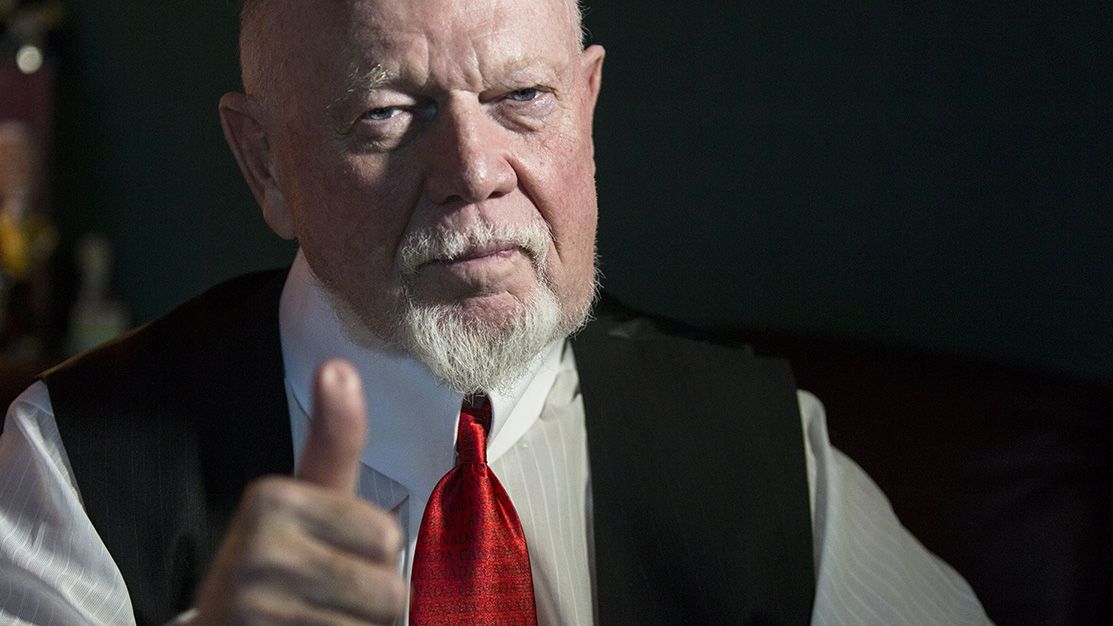
On a July morning, Dan and Theresa Mosier put on their sunglasses and park as usual in their chairs on the porch, waving at passersby driving into the village of Marysville, Ont., or neighbours on foot, waiting for grandkids to drop in. This is their retirement idyll.
Dan had been the proprietor of the Oco gas station next to their house for 35 years, but he boarded it up three years ago. In bygone days, it’d be open for business, cars pulling up to the pumps, tourists unfamiliar with Wolfe Island walking into the shop to ask for directions.
“They’d wanna know how to get to the ferry to Cape Vincent and they wouldn’t even notice the guy reading the newspaper in the back, till he peeked over the top of page and they’d say, ‘Jeezus H. Christ, it’s Don Cherry, from Coach’s Corner,’” Dan Mosier says, affecting sputtering, stuttering amazement that he had seen hundreds of times. “’What’s he doin’ here?’ And I’d tell them, ‘Grapes, he’s always here.’”
Fall, winter and spring for 37 years, Cherry sat in front of the cameras in the Hockey Night in Canada studio. Summer, though, brought his retreat to Wolfe Island and even on a sunny day, he’d make himself at home in the back of the shop by the cash register, shooting the breeze with Mosier.
Out-of-towners would see the old Lincoln Continental sitting out front and imagine the station owner was a vintage-car collector, but locals knew that meant Cherry had come into the village from his cottage to see his buddy — not that they’d crash the get-together.
“They’d know he was here, but people on the island were always good about giving Don his space,” Theresa says.
“He came here every summer to get away from the crowds, not to find another one,” says Dan, who, in cadence and volume, sounds eerily like Cherry. “You can see Kingston from here, but we’re not the city. He grew up in Kingston, spent a lot of time there, but when he got Coach’s Corner and all that other stuff, it wasn’t like he’d get the sort of quiet even in his hometown that he’d get on Wolfe Island.”
It took a village to guard Cherry’s privacy. “I had people and reporters asking me for his number,” Dan says. “No way I’d give it up. They’d get it from someone else and it would get back to Grapes and he’d say, ‘You stoned them … knew I could trust you.’”
Cherry sold his cottage back in 2019, and Mosier reckons he last spoke to him on the phone two years ago. Some Wolfe Islanders are willing to share stories, but others aren’t interested in talking to a nosy outsider. The Mosiers clearly enjoy reliving the old days, although even Dan holds some stuff back. “Don told me some stuff in confidence and they’re gonna stay that way, but there’s stuff people should know about him,” he says.
* * *
What people want to know about Don Cherry
these days is whether they’ll hear from him again. The question hung out when he signed off on his Grapevine podcast in June — his son Tim had told listeners this was “the last episode” and those familiar with Grapes’s voice and delivery thought he sounded wracked with emotion, his trademark, “Toodle-e-doo,” something more than wistful. He seemed to be struggling to get through the chat with Tim, who has produced the podcast since Hockey Night in Canada and Rogers Communications Inc. dropped Coach’s Corner in 2019. He had held down his TV gig into his mid-80s, always able to dial it up on cue, but this had been an annus horribilis: His daughter Cindy died in the summer of 2024 at the age of 67, and his younger brother Dick died in March.
The Toronto Sun’s Joe Warmington has been the unofficial Grapes whisperer since he was a reporter with the Kingston Whig-Standard 20 years ago. Through Warmington, Tim Cherry put out the message that the sign-off marked only the end of the season. “Seems the reports of Don Cherry’s retirement have been greatly exaggerated,”
Warmington wrote.
Among those who suspected Cherry wouldn’t be back was Ron MacLean, his sidekick on Coach’s Corner for 33 years. Other than those who share Cherry’s DNA or his second wife, Luba, no one could claim to know him better than the one he often referred to as Dummy. Listening to the Grapevine podcast after Cindy’s death, MacLean picked up a heartbreak that would make it unbearable to go on.
“That time Don and Tim and Cindy would have together each Sunday recording the podcast was magical,” MacLean said. “This season of the podcast would have been a constant reminder of the loss of Cindy. He’s definitely in a weakened state physically, (but) whether it’s the end, that’s for Don to say.”
MacLean did say that
Cherry’s hospitalization with pneumonia
at the end of the 2019 playoffs made him recognize that his run with Coach’s Corner was no longer sustainable. “That experience had him ask himself, ‘Why is this grind suddenly so damn hard?’,” MacLean said. “Don said, ‘I haven’t lost a step mentally and I’m in fairly good shape, but I’m now leery of putting myself through it again.’”
In comments made to Warmington following the recently published interview with MacLean, he “was very disappointed with Ron” and that MacLean was no longer welcome in his home. MacLean issued an apology to Cherry and regrets for being so forthcoming about his friend’s health, but he didn’t walk back the facts he volunteered.
* * *
Six years after his departure from Hockey Night in Canada
, it’s worth remembering the heights of Don Cherry’s celebrity, renown and respect. In 2004, the CBC embarked on an ambitious project: a vote to select the Greatest Canadians in the nation’s history. Few knocked the top slots: No. 1 was Tommy Douglas, though some might have made the case for Terry Fox who was runner-up or Sir Frederick Banting not far behind. Critics would have to come out against universal health care, the Marathon of Hope and insulin.
Don Cherry landed at No. 7 on the list. It lit up arguments — too low, said his fans; an abomination, said his critics. The merits of the poll were debatable, but it captured the influence of Cherry, then 70 years old and into his third decade as Hockey Night in Canada’s first-intermission spot.
Hard to project where Cherry would land on that list today — in 2004, he benefited from recency bias, but fading memories alone wouldn’t account for a fall down the list. Reputations made over decades can crash in a flash after the shouting. Look no further than Cherry’s fellow Kingstonian one slot behind him on the CBC list, Sir John A. Macdonald, whose legacy achievements were reappraised and judged unconscionable, his name stricken, his sculpted likenesses removed, 130 years after his death. Cherry’s carving of new Canadians not wearing poppies on Remembrance Day wound up being a firing offence in 2019, but other rants as inflammatory and offensive in the ’80s and ’90s were punished by wrist slaps, if at all. None of it figures to age well.
Cherry’s history is most likely to stay fixed longest in his hometown of Kingston and particularly on Wolfe Island, where he retreated from the spotlight every summer at the height of his fame.
* * *
When the legend becomes fact, print the legend
: This line from The Man who Shot Liberty Valance comes to mind with the Don Cherry biopic,
Keep Your Head Up, Kid!
, which in 2011 earned an erstwhile unknown former junior-hockey player named Jared Keeso a Gemini for a convincing version of Grapes in his minor-league struggles and ascendance as a coach. Tim Cherry, Don’s son, wrote and produced the film and emphasized the elements of his father’s legend that appeal to his legion of fans. With the Keep Your Head Up, Kid! screenplay, the worshipful son printed his father’s legend.
In the scene encapsulating Cherry’s boyhood, a grade-school teacher scolds Donald S. Cherry, and the kid seethes at his desk, setting up a lifetime of bucking authority. There’s no knowing how formative such challenges in the classroom were in his development, but it sets the movie’s narrative arc for the bad-boy television persona —
we want this as our truth.
This legend-buffing scene selection stands in stark contrast to a photo that landed in the pages of the Whig-Standard on Nov. 9, 1946, when Cherry would have been 12 years old and he’s listed as Don Cherry of 518 Albert Street.
The caption reads: “Rideau school youths take their sports seriously, as this picture above proves. The group, members of hockey and baseball teams, meet daily before school and during recess to discuss with Nelson Silver, caretaker, the various aspects of athletic competitions which have taken place the day before. Members of this ‘Hot Stove League’ are voted in and no more than a dozen ever meet at the same time.”
Here he doesn’t look like a kid who bucks authority — he’s an earnest boy craving to learn from those who know the games he wants to play better than him, including Mr. Silver, the necktie-wearing janitor.
“My father told me there were always old-timers around town who played at a high level,” says Doug Gilmour, whose father Don, a corrections officer, played hockey and baseball with Don Cherry growing up in Kingston. “The coaching they got was as good as the coaching in the pros and even better, and they couldn’t get enough. And everyone looked up to the best players in town.”
Way back in the day, the best on the diamond and gridiron had been Cherry’s father, Delmar. According to the century-old stories in the Whig-Standard archives, Del Cherry did everything but hit the cover off the ball and had a chance to play for Syracuse in the International League, a step away from the majors, but he chose to stick around Kingston to play for hometown teams. On the football field, the Hamilton Tigers tried to get him to play pro ball, their manager comparing the 6-foot-2, 230-pound powerhouse to Lionel Conacher as an athlete, but he again took a pass.
Long after his playing days, Del Cherry was a fixture in the Kingston sports community, a coach, a goal judge at the arena, and his lore lived on when his sons started playing, first Don and then Dick — the two boys lived and played in a considerable shadow.
Del didn’t figure in the screen telling of Don’s life, and in the abridgement, neither did his mother, Maude, who worked as a tailor at the Royal Military College and later as a receptionist at the James Reid Funeral Home. Early on in his broadcast career, Cherry would mention Maude on Coach’s Corner and rail about the city of Kingston not repairing the sidewalk in front of her house. By all accounts, Maude was particular about manners and etiquette and held considerable sway. Says Dan Mosier: “I think that it was our generation and Grapes’ mom, but for all the way he was on Coach’s Corner, he’d never swear in mixed company, and he was real polite, like he was afraid of making a bad impression.”
Again, print the legend.
* * *
Keep Your Head Up, Kid! did capture the journeyman’s desperation
in the early ’70s when he struggled to make a living away from the arena, when he hung up the blades after the 1969-70 season. His father always had a square job that he couldn’t be coaxed to drop no matter who made promises of sports glory. Don’s brother Dick had a degree and went to teacher’s college, so he had something he loved as much as hockey to fall back on. “I was going from construction site to construction site begging for jobs,” Don Cherry said in 2010 when he was promoting the movie. “I had no money. That was my lowest point.”
Even less promising were his prospects when he tried a comeback as a player in his 30s, only to wind up as a Black Ace with the
Amerks
. The Rochester Americans, AHL affiliate of the expansion Vancouver Canucks, was losing too many games and too much money for the parent club’s comfort. When the Canucks fired the coach midseason, they installed Cherry as his successor, even though his bench experience was limited to volunteering with a Rochester high-school team. Vancouver management wound up selling the franchise to a local businessman and dropping their affiliation that summer, leaving the owner and the coach with no source of players, little more to work with than the team name.
Going into the ’72-’73 season, Cherry was the farthest thing from braggadocious. He had to put together a roster comprised of everyone else’s sorry leftovers, a disaster scenario. As he told the Rochester Democrat and Chronicle: “There are days when I was so tied up with this job I’ve forgotten to eat. I’ll go home at night and realize I didn’t have a bite of food all day.”
Rod Graham knew none of this intrigue. Back in the summer of ’72, Graham was a journeyman minor-leaguer back in Kingston after a stint with a team in Austria. Out of the blue, he got invitation to the California Golden Seals (an NHL team that played in Oakland until 1976) — he figured the Seals holding their camp in his hometown was a way to cut costs.
“I skated with them in the first practice at the Memorial Centre and that night I got a call from Don Cherry who was coaching in Rochester,” Graham says. “He tells me, ‘You can’t be skating with Oakland ‘cause I’ve got your name on my list. If you’re skating for anybody, it’s me.’”
Unbeknownst to him, Dick Cherry had called his brother and recommended adding Graham to the Americans’ protected list. “Dick told Don I was pretty ‘handy,’” he says, the gentle euphemism preferred by tough guys.
Cherry was scrambling to find players to fill out the roster, so he put out a call for tough guys — if they couldn’t score, they could at least go to war. Graham decided to go along for the ride — at age 25, he had given up any boyhood dreams of the NHL, content to play the game for fun and draw a minor-league paycheque. He had no idea that the 38-year-old Cherry would become his improbable ticket to The Show.
Graham was one of 10 players to come out of training camp and into the Americans’ lineup on opening night without a game of AHL experience. To set the dynamic, Cherry had one pro journeyman, a pivotal get: Battleship J. Bob Kelly, one of the most ferocious brawlers of the era. With Kelly as the action hero out in front of them, Graham and other rookies no less handy followed his lead. They couldn’t beat the more talented NHL affiliates with skill, but they managed to put the fear of God in them.
Cherry’s scheme was born of necessity, but he soon proved a master motivator. “Don got the most out of everybody,” Graham says. “He knew how to talk to the players — knew what each one of us needed, and that’s not treating everyone just the same. He was smart socially. We’d run through walls for him.”
He explained his method in his first full season. From the Rochester daily in October 1972: “The old way of coaching was to treat everybody the same, but that doesn’t work because everybody is different, I played better when I was screamed at because I played better angry. (Veteran minor-leaguer) Darryl Sly played worse when someone screamed at him. Pushing hurt him. Pushing helped me.”
Cherry’s approach sounds only reasonable now, but this was radical in the era of the bad-cop coach. Being real life and not a movie, the Americans’ run wasn’t quite storybook stuff — there was no championship, but they won more than they lost and turned a profit. “They were drawing 2,000 a game before, but Grapes’ team was getting crowds of 5,000,” Graham said.
Battleship Kelly wound up getting signed by the St. Louis Blues after that season, so for his second season as Rochester coach, Cherry picked up another player unwanted by everyone else, John Wesink. If Kelly was a fierce but honourable soldier, then Wesink’s cold-bloodedness and unpredictability made him the nearest thing to a terrorist, a man without boundaries.
This time the Americans made the playoffs, but they lacked the talent to get out of the first round. To Graham’s mind, his coach had found his niche. “I figured he had a job for life in the minors, but I didn’t see him going to the NHL,” he says. “I didn’t see myself going either.”
It turned out Bruins GM
Harry Sinden
knew Cherry well. Two days after coaching the Bruins to the 1970 Stanley Cup, Sinden had walked away from the organization in a dispute with ownership and took a job as director of sales with a modular-home company in Rochester. When he signed with the Bruins as their managing director in the fall of ’72, Sinden told the Rochester daily: “I know Don Cherry and his family and they’re the best. Anything I can do for him, I’ll do it.”
In the summer of ’74, Sinden hired Cherry to coach the Bruins, a proven contender featuring Bobby Orr, the greatest talent the game had ever seen, Phil Esposito, the game’s most prolific scorer, and other future Hall of Fame players.
Cherry could have stayed the course in Boston, but instead decided to dance with the ones who brung him, calling up Wesink for a long stretch and Graham, who’d last only 14 games, charter members of what Cherry would tag “
Lunchpail A.C.”
Graham’s moment of glory was a story retold over the years and offered a glimpse into the antic times and Cherry’s embrace of the playing everyman, players like himself.
“We were winning 7-0 in Minnesota and we had a powerplay,” Graham says. “Johnny Bucyk said, ‘Grapes, put Rod out there. He might even score one.’ When I hop over the boards, I stepped on Grapes’ foot. He had brand new Florshiem shoes and I sliced the one wide open with my skate blade. Then five seconds in I get the puck and it’s in the back of the net. It was like Christmas and New Year’s rolled into one.”
It turned out to be April Fool’s as well.
“So after the game, we go back to the hotel and there’s a get-together when the big guys say something. Espo gets up there, and says, ‘We were gonna give Rod the puck he scored on, but Grapes, we figured you really deserve something for putting Rod out there on the powerplay …”
And keeping Hall of Famers on the bench to give a journeyman, one Cherry could identify with, a chance at a moment of glory he never enjoyed in his single NHL game. The subtext understood by the Bruins, who knew what was coming and kept straight faces.
“‘… So we figure you deserve a piece of it,’ and Espo has a puck with a Stars logo on it sawn in half. Grapes said, ‘Sawing a guy’s first goal in half, how the hell can you do that to a guy!’ And then they let him in on the gag — they just did it with an extra puck they brought back from the rink. I had my puck.”
* * *
Graham would head back to the minors
for the rest of that season and three more, dividing time between Rochester and Springfield, before heading back to Kingston for good in 1978 and taking a job with the city. He fell out of touch for a time with Cherry and didn’t know that in the summer of ’79, after the Bruins dropped him, he was visiting Wolfe Island with a friend from Rochester, Doogan Collins, who owned a cottage there.
“Back in the ’70s and ’80s it was a farm community,” says Steve Fargo, who until this spring owned the general store in the village of Marysville, just down the main drag from the Mosiers’ place. “Not really second homes or vacation places. Kind of a self-sufficient place.”
According to
a story by former Whig reporter Pat Kennedy
in 2019, Cherry asked Collins about a vacant lot near his cottage on Oak Point Road. “Dad walked the property,” Cherry’s son Tim said. “He said, ‘This would be a great place to build a cottage.’ Collins told him to forget it, that he’d been trying to buy the lot for years and the guy wouldn’t sell. Dad had Collins set up a meeting with the guy anyway, and when the two men met, they came to an agreement right then and there.”
Cherry would later talk about his love of fishing on the waterfront after school. He would have seen Wolfe Island across the water, would have seen the ferry going back and forth, but the Oak Point Road property seemed more an impulse buy than any sort of boyhood dream come true.
“Grapes never told me exactly why he bought the place, but it might be just that his buddy told him he couldn’t,” Dan Mosier says.
Though Wolfe Island would eventually maintain Cherry’s privacy in the decades to follow, that wouldn’t have been a factor in the summer of ’79 — he wasn’t yet a celebrity, just an out-of-work coach who figured he caught a break when he landed a job with the Colorado Rockies later that off-season, what would be his last pro bench job, one that would last but one season.
The successes in broadcasting were in the future, which wasn’t distant but at the time unimaginable. Before Cherry was tried out as a guest commentator in the 1980 playoffs, Hockey Night in Canada had been a conservative bit of sports broadcasting — the nearest thing to a dose of character had been Howie Meeker, mixing intelligent analysis with a “golly” here and “gee willikers” there.
Cherry was an instant sensation, and if he sounded like a speaker at a rubber-chicken sports banquet spinning yarns or a standup comic cracking wise, he might have sounded like someone else to those who came up in Kingston like him. When he’d start with a bit of instruction for “you kids out there,” it would have evoked those sessions in the Rideau Street furnace rooms, the passing on to a younger generation sage advice from those who had played.
* * *
Kirk Muller hosted his family’s “Summer Christmas”
family reunion at his place on Loughborough Lake near Kingston this month, 15 vehicles parked on his property, others spilling out onto the road. Muller, an assistant coach with the Capitals the past two seasons, timed the event around his trip to Washington for the team’s development camp. There, he’d be working with 18- and 19-year-olds, who remind him of his days as a heralded teenage prospect.
As a kid, Muller was a Bruins fan and his vivid memories of the black and gold go back to Cherry’s time behind the bench in Boston. “The Bruins were Kingston’s home team, with Grapes and Wayne Cashman and Rick Smith,” Muller says.
Muller was 13 when he watched
Game 7 of the 1979 Stanley Cup semifinal
, the Bruins up 3-1 in the third — two goals and an assist by Cashman — and then 4-3 with less than three minutes left. For Muller, and a legion of Boston fans, it looked like Cherry and Co. were finally going to get past the dynastic Canadiens. No one suspected this would be the last truly meaningful game that Cherry would ever coach. But then came the famous too-many-men penalty and Guy Lafleur flying down right wing and letting loose a slapshot that beat Gilles Gilbert, who fell like he was mortally wounded. Montreal would go on to score in overtime, and the Bruins’ run ended — so, too, did Cherry’s when he was dropped by the Bruins management soon after in a salary dispute.
“I met him as a 16-year-old playing junior (with the Kingston Canadians) at a charity event,” says Muller. By then, Cherry had been hired and fired by the Colorado Rockies and was trying out as a commentator on Hockey Night in Canada. “I was just a kid and he was known as a coach, not a TV star.”
Two years later, after New Jersey drafted Muller No. 2 behind Mario Lemieux, he landed on Hockey Night in Canada beside Cherry, whose first-intermission segment was a sensation. “That’s how fast things happen sometimes,” Muller says. “Coach’s Corner and Grapes were a real thing. It sounds crazy, but it meant something for me to have that towel — the producers gave you a Hockey Night towel when you came on. I held onto the towel like it was the puck from my first goal.”
Another measure of the speed of the game around the game: Still a teen, Muller was invited to appear on Grapevine, Cherry’s syndicated talk show. “My sisters put me in purple and green pants, fancy shoes, just like a clown outfit — they told me that if you’re going on his show, you had to dress up like Don did.”
His awkwardness on camera was outstripped by Cherry’s torment in the wake of Muller’s career highlight: the Canadiens’ Stanley Cup victory in 1993. “After the game, there were riots in the streets outside the Forum, so they wouldn’t let any of the hockey people out and that included the Hockey Night people,” Muller says. “We were trapped. So, Don is there, but so are all these Canadiens’ greats — Rocket Richard, the Pocket Rocket, even Beliveau and Lafleur — and everyone had beers out, celebrating in the same building where Boston lost that Game 7. I can’t imagine what was going through Don’s mind.”
The scene could easily have passed for a haunting and, to Muller’s credit, he broke away from his partying teammates and sat with Cherry at one point. “I told him, ‘Grapes, I don’t like this.’” Muller says. “He just shook his head and said, ‘It’s all right. Go enjoy it with the guys.’”
* * *
Many players won over Cherry
over the course of his run at Hockey Night in Canada, but none would be nearer and dearer to him than
Doug Gilmour.
Some presume that Cherry tied his star to Gilmour because he was the headliner with the Leafs, the franchise in the nation’s largest TV market. Fact is, Gilmour’s favoured place long predated his arrival in Toronto.
“Grapes knew my parents better than me,” Gilmour says. “He played ball with my dad and coached my brother Dave in Rochester.”
Or at least tried to coach Dave, 13 years Doug’s senior, gifted but hopelessly mercurial. Dave famously tested the patience of many coaches, who gave up on him in time if he didn’t give up on them first. Rochester wasn’t Dave’s last chance but it looked like his best one, Cherry being the lifetime buddy of the enigma’s father.
“Don always says Dave was more talented, but he couldn’t take criticism,” Gilmour says. “If a coach told him something, Dave would say ‘screw you.’ Grapes would have been perfect for Dave, but even he couldn’t get through to him.”
As much as Dave made the least of every opportunity, Doug emptied his chamber and took real inspiration from Cherry’s thumbs-up. “The first time I was on Hockey Night I was with St. Louis in Minnesota in the playoffs,” he says. “Before the game, Grapes came up to me and said, ‘Do something because your parents are watching you on TV.’ He went out of his way to track me down. I got a goal and three assists, so from then on, I had to get the handshake before the game.”
Those in Kingston’s hockey circles know about Doug’s superstitions — if he ever scored Leafs tickets for friends and happened to get a goal or two that night, they knew he didn’t like to mess with a streak and would hit him up again, like freeloading rabbits’ feet. No superstition weighed on Gilmour’s mind like a pre-game handshake from Cherry, all dating back to that first game with the Blues.
“He gave me energy,” Gilmour says. “I remember trying to find him before Game 6 of the (‘89 Calgary vs Montreal) final at the Forum — I had to get him to shake my hand. We’re one win away from the Cup and I’ve got to get the handshake.”
Gilmour wandered around the building, tracked down Cherry for the ritual press of the flesh, and then went out and played the game of his career: his powerplay goal in the third period turned out to be the game-winner and an empty-netter in the last minute clinched the Cup.
While the hugs and kisses Cherry gave No. 93 in the post-games became staples of Leafs broadcasts, what stands out in memory for Gilmour was an exchange dating back to his final days with Calgary after a Hockey Night in Canada broadcast of a Flames victory over the Canadiens on New Year’s Eve. An occasion to celebrate was complicated by Gilmour’s foreknowledge that he was going to be traded.
“The interview was hard, because I know it’s the last time I’m going to be with Calgary. When we were talking after the game (on air), the excitement should have been better. He got it right way. As soon as we’re off, Grapes says, ‘Something’s up. What’s wrong.’ I’m just playing dumb, and he keeps on pressing me. ‘What’s wrong?’ I just tell him that I can’t say.”
Cherry didn’t ask Gilmour directly if he was going to be traded, but it might have been only that he didn’t want to put his friend’s son in a tough spot.
“That was him reading me,” Gilmour says. “I couldn’t let (my teammates) in on it, because someone else could be involved. Nobody knew, but Don could tell. He knew about people. The success he had on Hockey Night or anything else, it was because he had a real good sense of who someone was right off the hop.”
* * *
Cherry’s been gone from Wolfe Island since 2019
, but the only physical evidence of his time there are two cartoon likenesses staring out from the main window of the General Wolfe Tavern on Marysville’s main drag. What passes for his legacy is the Wolfe Island Community Centre’s outdoor rink, built in 2009 by the Marysville baseball field in view of the church he attended on every summer Sunday.
“Grapes wanted people here to have a rink of their own,” Dan Mosier says. “He put his money where his mouth was — $100,000 for it. He did it quietly, but when he got behind it, it got momentum. He’d be out there when they’d be working on it, posing for pictures, signing things. Nothing made him happier.”
Mosier will still bend all available ears about the rightness of naming the rink after his buddy, but Cherry balked at the idea when it was floated in the run-up.
A couple of years later, the Royal Military College approached Cherry about conferring up on him an honorary degree at the graduation ceremonies. For all his on-air tributes he had paid to the Canadian military and the military connections of his forebears in Kingston, it seemed a natural.
RMC officials had to expect a bump of interest from its invitation, but after the announcement, a French teacher at the school, Catherine Lord, expressed her objections. Citing the “many occasions (Cherry) publicly expressed his contempt for many groups of the Canadian population,” including French Canadians, gay, lesbian, bisexual and trans people, Ford suggested that the RMC honoring him would send the wrong message about the school’s values. (Ford did not reply to requests for an interview.)
Cherry didn’t need to return Lord’s fire from his soapbox on Coach’s Corner. Others lined up to defend him, including opinion writers with Postmedia. No matter,
Cherry decided to not participate
in the graduation ceremony.
It was a tempest at the time, but Catherine Lord might have been the canary in the coal mine. Don Cherry in his 70s had a lot of history, but it was catching up with him. He might have anticipated there’d be blowback even on Wolfe Island if his name were attached to his beloved ice rink project
Margaret Webb, an author who plays in women’s and old-timers games at the rink, is among those who’d oppose any move to name the rink after Cherry. Echoing Lord, Webb argues that honoring Cherry would send the wrong message to young people who’d skate at the rink. To her mind, hanging a plaque that listed those who helped out, his name among them, would be enough: “Island volunteers contributed weeks of labour and continue to do so. What’s his contribution? A few weeks of his salary. Others contributed a few weeks of theirs. Everyone in the community contributed what they could.”
* * *
Ron MacLean, Cherry’s longtime broadcast partner on Coach’s Corner
, had spent a lot of time in their off-season at the Oak Point Road cottage.
“He would just get really upset at the ferry operator signalling to move his car,” MacLean said. “Just telling him that irked him. He hated being told what to do. That was so deep in his DNA — when the ferry operator would wave and tell him, ‘Move forward,’ he felt like getting out of his car and lashing out at him. If anyone touched his Lincoln, God help them.”
After a season of absorbing shots from the star of the show, MacLean could take a delight in Cherry getting so bent out of shape about what hardly qualifies as a nuisance.
I had seen their friendship up close near the end of their run on Hockey Night in Canada. As a reporter for Sportsnet, I drew the assignment of covering the 2018 Cup Final between Vegas and Washington and for travel purposes I fell in with the HNIC crew. In two weeks on the road, I watched the pair in action, their penultimate rodeo, as it would turn out, and saw how dependent Cherry, then 84, had become on MacLean — neighbouring seats on flights, neighbouring rooms at the hotel, travelling to and from the rink and, of course, the prep and setup for those minutes in the first intermission. MacLean was always there to help out — the on-air aggro was theatre and they were as tight as teammates could be, which was rarer in the business than you imagine. I had travelled with other broadcast teams and, as a rule, a triumvirate flagged three different taxis.
I couldn’t help but respect MacLean for his kindness with Cherry, and couldn’t help but feel sorry for Cherry when practical stuff became a challenge because of his age. The setup in Washington wasn’t ideal for Hockey Night — the crew had to work out of a space in the concourse with hundreds of rubberneckers swarming, giving the moment an oppressive goldfish-bowl vibe. The anxious look on Cherry’s face when he was following MacLean through the crowd had me wondering why he had signed on for another season or if this might be his last.
In Las Vegas, I asked MacLean about putting together a piece about their working relationship, something that could run when Cherry retired, which I thought was imminent — I suggested I’d ghostwrite it for him. MacLean suggested I reach out in August, but we never connected. I assumed I had misread his interest in doing a piece.
When I spoke to MacLean recently, he was an open book about having been “a support” to Cherry. “I’d see Don in his room with 50 or 100 sheets of paper — he’d written out what he was going to say so many times,” MacLean said. “He put a lot of pressure on himself. He was the cock of the walk (on air), but he was very vulnerable. Eventually, we spent so much time together (the support) became second nature.”
MacLean knew better than anyone how much the job meant to Cherry and also how much his cottage on Wolfe Island meant to him. If he didn’t want a guy in a reflective orange vest telling him to keep pulling up on the ferry, he wouldn’t countenance any suggestion that it was time to give up Coach’s Corner or Oak Point Road.
Cherry would tell the Mosiers and other Wolfe islanders, including Pat Kennedy, the former Whig reporter, the decision to sell his place on Wolfe Island spun out of his wife Luba having a scare on the highway driving from Toronto. He also mentioned to them that his late wife, Rose, had scares on the 401. Doubtless that could have been a factor. There were other scares in recent years, though.
One at the cottage could have easily been a tragedy. Early one spring, Cherry walked down to his dock and noticed that his paddleboat had become untied and was drifting out into the lake. He took off in pursuit in his canoe, but he ended up tipping over and couldn’t pull himself out of the frigid waters. When his wife screamed for help from the shore, a neighbour down the road, Al Doyle, raced into action.
“Don was lucky I was there,” Doyle says. “I was the only one nearby who had a boat in the water, and it was real cold. He was thankful, but when he got into the boat, he looked at Luba on the dock and said to me, ‘Oh, boy, I’m going to get it.’”
Presumably he did, because immediately thereafter, Cherry gave the paddleboat to the Mosiers’ granddaughter Emma as a gift.
Maybe the paddleboat incident only cramped Cherry’s style for a time, but a health scare during the 2019 playoffs might have been the deciding factor, MacLean reckons.
MacLean’s account of Cherry’s health crisis in June 2019 was first documented by Postmedia last week. Cherry was straining to breathe when their flight from St Louis touched down in Boston. MacLean and others with Hockey Night got Cherry to a fitness centre to get him into a sauna to clear his lungs. “Don was shaking, out of control on the flight,” MacLean says. “I immediately phoned Bobby Orr and I said ‘Bobby, I need your help here. Either get Don into one of the hospitals here or have a team doctor come see him at the hotel.” Bobby (who was in Florida) said, ‘I’ll make sure a team doctor comes to see him in the morning. Don’t let anybody know.’ That’s how (Cherry and Orr) operated — no vulnerability, no weakness.”
Cherry made it through the Game 7 broadcast in Boston, but he begged off going for post-game beers, what MacLean describes as their “ritual” at the end of the season. In his room, he got a call on his phone from Gary Bettman, the NHL commissioner. As MacLean recounted it: “(Bettman) says, ‘How’s Don?’ I say, ‘He’s good. Why?” (Bettman) says, ‘He’s in hospital.’ That was kind of a shocker.”
When this story was first reported, Cherry expressed outrage at MacLean in the Toronto Sun and denied going to hospital after the flight to Boston touched down — which wasn’t MacLean’s account, but Cherry’s scattershot pushback was a piece with that no-vulnerability, no-weakness attitude. MacLean later expressed regret about discussing Cherry’s health.
Five months after the scare in Boston, just days after Sportsnet fired him, the sale of Cherry’s cottage closed. To those on Wolfe Island, he told the story of Luba’s being scared on the highway as an explanation for saying goodbye to the lifestyle he loved. He didn’t mention the pneumonia in Boston.
No weakness, no vulnerability.
* * *
Dan Mosier switched off the lights at his Oco gas station
for good when he turned 72, feeling physically beat up. “What with the taxes and the bank charges on credit cards, I’d be making a penny a litre,” he says.
If a visitor drops in and Mosier has the inclination, he’ll pick up his cane and open up the garage office, now a storage space, that was once Don Cherry’s safe space.
Prominently hung at the entrance is a photo of Mosier’s daughter. “She was born with a hole in her heart,” he says. “Doctors told us to get ready, ‘cause they said she’d only live two, three years. She made it into her 30s. They have things now, plastic valves. So unlucky, but she was a blessing, having her as long as we did. Losing a child is just so hard.”
Mosier opens a drawer and pulls out a bunch of cards his buddy had printed up, Cherry in a ballcap, holding his bull terrier, Blue. “This one is pre-signed in case there was someone I’d want to give it to when he wasn’t around,” he says. “When he was around, he’d get the guy’s name on it and make it personal.”
So it was that Dan Mosier would make not even 50 cents on a fill-up and a customer would walk away with a souvenir autograph that fans would pay good money for at a Comic-Con.
“Grapes would park himself in a chair behind the counter and read the paper,” he says. “We’d talk about hockey and stuff he’d been through. He’d sit right there with the photos of Bobby Orr. He’d be in a T-shirt with the sleeves cut off and beat-up old sweats and running shoes.”
“Wolfe Island high fashion,” Theresa says.
Or what amounted to camo for someone who wound up becoming one of the greatest Canadians in history in public opinion for a time, and a performer whose seven minutes under the studio lights weekly were worth seven figures
“Grapes just liked to blend in,” Dan says. “People on the island would see this big Lincoln that he bought from Harold Ballard parked out front, but they just let him be. In the city they’d be knocking on his door and pulling up in front of his house pumping the horn or poking their noses over the fence.”
Six years after Cherry closed the sale on his cottage, there’s a new ferry, a bigger one. “We haven’t changed but I imagine the island has some,” Mosier says. “We might take the ferry once every 10 days, to see a doctor or something.”
The Mosiers want to believe the highway scares were the catalyst for Cherry’s selling of his cottage, but also acknowledge there might have been the unstated concession to age. There’d be no calling the doctor in the event of illness or injury — there isn’t one practising on the island anymore, hasn’t been for a few years. That spill where he almost drowned with Al Doyle pulling him out of the water — in a situation like that, it might be more than two hours before paramedics could arrive at the scene.
Mosier laughs when he’s shown that archival image of his old friend as a schoolboy at the Rideau Street school and asks if he can get a copy of the image. In many ways, the Oco station office was a passable stand-in for the furnace room — the coach’s favoured corner.
“Things in here are the same,” Mosier says, wiping dust off a photo of Cherry hanging behind the cash. “If Grapes gets back here, he’ll find this place’s just the way he left it.”
Gare Joyce is a multimedia journalist for the Kingston Whig-Standard and the author of 10 non-fiction books about sports.