LP_468x60
on-the-record-468x60-white

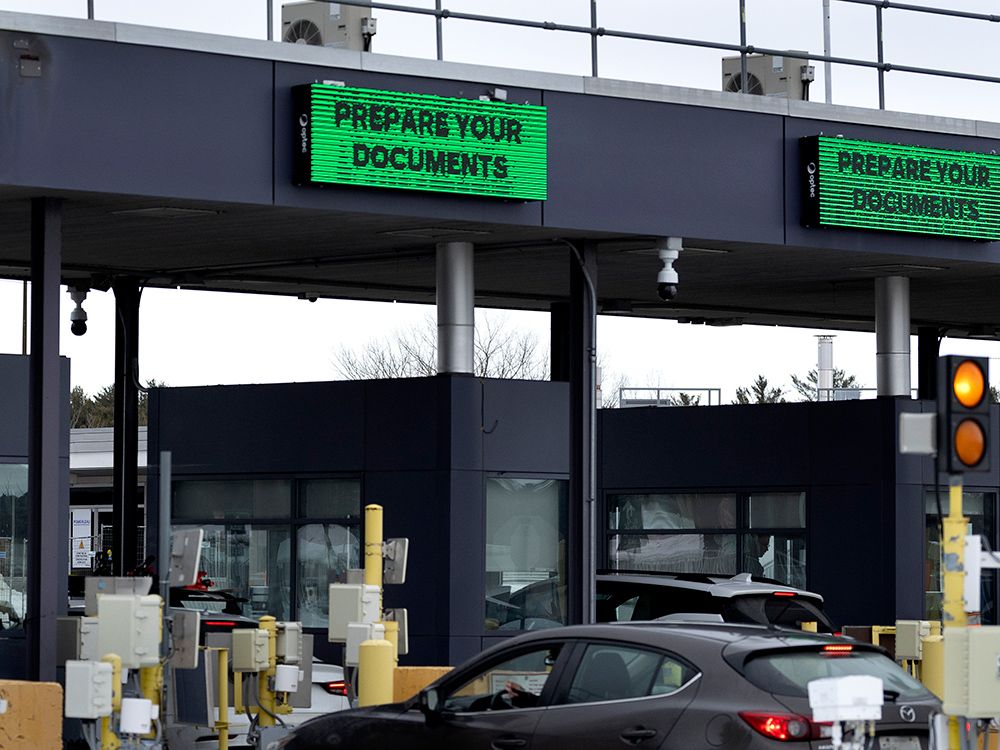
A 39-year-old Canadian man trying to enter the U.S. in a stolen Porsche SUV (pictured above) was detained and sent back to Canada last week.

A Canadian citizen trying to enter the U.S. last week was turned over to the RCMP and the Canadian border agency after it was discovered he was driving a stolen vehicle.

On Wednesday, June 11, the 39-year-old was making his way into the U.S. via the Port of Champlain border crossing in upstate New York and south of Montreal, according to

U.S. Customs and Border Protection.

During primary inspection, he told CBP officers he was bound for Plattsburgh, N.Y., about 30 minutes south, but “inconsistencies in the driver’s story” led to a more thorough inspection and screening of him and the 2023 Porsche Cayenne he was driving.

In an email, New York State CBP public affairs officer Mike Niezgoda told National Post that agency privacy laws prevent him from discussing particulars, including the “inconsistencies” that led to the accused’s secondary inspection.

“CBP officers are highly skilled at discovering inconsistencies in travellers’ statements, a skill taught at the Federal Law Enforcement Training Center,” he wrote. “When this occurs, CBP officers may proceed in requiring a secondary inspection/examination of a traveller.”

U.S. man drives into Canada by mistake, gets busted with 78 pounds of pot on the way back

CBP officers soon discovered the luxury SUV,

which costs CAD$82,000 for the base trim or $194,800 for the fully-loaded hybrid model

, had been reported stolen at an undisclosed location in Canada earlier that day.

CBP contacted the RCMP to confirm the man’s identity and that the vehicle had been stolen, “a charge that is equivalent to a felony in the United States.”

Under the

Criminal Code of Canada

, possession of stolen property over $5,000 is an indictable offence and may result in jail time if found guilty.

After being processed, CBP handed the man and the Porsche over to the RCMP and the Canada Border Services Agency.

National Post has contacted both Canadian agencies for more information.

Niezgoda said anyone seeking to enter the U.S. needs to “overcome ALL grounds for inadmissibility,” of which there are more than 60 “

divided into several major categories, including health-related, prior criminal convictions, security reasons, public charge, labor certification, illegal entrants and immigration violations, documentation requirements, and miscellaneous grounds.”

Our website is the place for the latest breaking news, exclusive scoops, longreads and provocative commentary. Please bookmark nationalpost.com and sign up for our daily newsletter, Posted, here.


As pot becomes more potent and more convenient to purchase, emergency doctors are reporting more cases of cannabis hyperemesis syndrome.

Emergency departments are seeing a spike in visits owing to a once unusual, highly unpleasant and, in rare cases, potentially life-threatening side effect of chronic cannabis use: severe bouts of vomiting lasting hours, even days.

As pot becomes more potent and more convenient to purchase, emergency doctors are reporting more cases of cannabis hyperemesis syndrome, or CHS, a gastrointestinal condition that can affect people who use cannabis frequently (several times a week, if not daily) over months or years.

In addition to “cyclical” vomiting, other signs include morning nausea, intense abdominal pain and “relief through compulsive hot showers or baths,” Western University researchers

recently wrote.

It’s increasingly affecting teens and young adults, they report. “Yet few people — including many clinicians — know it exists.”

Emergency department visits for CHS increased 13-fold in Ontario after the legalization of recreational cannabis in 2018,

one study found

. While weed’s legalization wasn’t associated with a sudden or gradual change in cases, pot’s commercialization — unlimited number of stores, more products — overlapping with the COVID-19 pandemic, was associated with an immediate bump in rates.

The potency of THC, or tetrahydrocannabinol, the main psychoactive compound in cannabis, is also off the charts, said Western’s Jamie Seabrook, rising from about three per cent in dried cannabis in the 1980s to, according to Health Canada, 15 per cent in 2023. Some strains have as high as 30 per cent THC.

“When I talk to youth, they can easily access strains that are upwards of 25 per cent. And that’s huge,” said Seabrook, a professor in the department of epidemiology and biostatistics, the department of pediatrics and the Brescia School of Food and Nutritional Sciences. The human brain continues to develop up to around age 25, he said. THC exposure over this period has been linked with problems with attention, memory and learning, as well as increased risks of paranoia, psychosis and, more recently, schizophrenia.

Here’s what to know about CHS.

What is cannabinoid hyperemesis syndrome?

CHS was first documented in

2004

by researchers reporting on 10 people from South Australia in whom chronic cannabis use “predated the onset of the cyclical vomiting illness.”

Nine of the 10 “displayed an abnormal washing behaviour during episodes of active illness.”

Reported cases of CHS have since been popping up around the world.

The Ontario study documented 12,866 emergency department visits by 8,140 individuals between January 2014 and June 2021, or pre- and post-legalization. About 35 per cent were aged 19 to 24. Nearly 10 per cent of visits led to hospital admissions. Monthly rates of CHS emergency visits increased from 0.26 per 100,000 population in January 2014, to 3.43 visits per 100,000 population in 2021.

What causes cannabinoid hyperemesis syndrome?

It’s not clear what causes CHS. Cannabinoids bind to cannabinoid receptors in the brain and gastrointestinal tract. One theory is that it may be due to overstimulation of the receptors leading to “issues with your body’s natural control of nausea and vomiting,” according to the Cleveland Clinic.

Paradoxically, low doses of cannabis can help with nausea. “But that’s low doses, and infrequently,” Seabrook said.

“Chronic use substantially increases the risk of nausea.”

What are the symptoms of cannabinoid hyperemesis syndrome?

Telltale symptoms of CHS are severe and persistent vomiting. “Scromiting” is a term that’s been used, a merger of “vomiting” and “screaming,” the Cleveland Clinic reports. “You may have intense pain, which causes you to scream while you vomit.”

Vomiting can lead to dehydration and electrolyte imbalances. Youth can mistakenly think using more pot will help with the nausea and pain, “but it’s actually exacerbating it, because they don’t even realize that they have anything called cannabis hyperemesis syndrome,” Seabrook said.

The big challenge is food and nutrition. “They’re not able to take down food without purging.” Some are mistakenly diagnosed with bulimia nervosa, an eating disorder, “simply because whoever gave that diagnosis wasn’t aware of the extent of cannabis use,” Seabrook said.

With an eating disorder, there’s a body image concern, and people are inducing purging. “Whereas with CHS, they’re not doing it on purpose. It’s the cannabis that’s causing it,” he said.

Others might get worked up for a food intolerance, suggesting “they remove this food, or that.” They might have a CT scan or an MRI, using up “a lot of health-care dollars when these simple basic questions initially could have eliminated a whole bunch of other potential diagnoses,” Seabrook said.

People can get temporary relief from hot baths and showers, but it’s a temporary fix. “When they get out, the symptoms reappear,” Seabrook said.

If left untreated, severe vomiting and dehydration can lead to acute kidney injury. In very rare cases, “it can lead to death, if you are that severely dehydrated and you’re not getting your electrolytes up,” Seabrook said.

Who is at risk?

Most people who develop CHS have used cannabis for several years, Seabrook said. There’s no evidence that, say, a teen who uses high-potency pot one day will immediately get CHS. “It’s long term, and frequency of use,” Seabrook said.

It’s also not clear why not everyone who uses cannabis chronically and frequently develops CHS, though a genetic vulnerability might play a role.

But Canada has one of the highest rates of youth cannabis use in the world, Seabrook said. “The most recent data we have from Canada — and this is kind of alarming — is that about one in five, or 20 per cent of 16- to 19-year-olds have used cannabis in the past month and close to nine per cent daily, or almost every single day,” Seabrook said.

“Potency is a huge factor. But there is also now growing social acceptance (of cannabis) and a lot of youth think there is very little harm associated with its use.”

How does CHS progress?

The first phase is called the prodromal phase, Seabrook said. “Basically, they don’t have classic symptoms at this point, but they’re starting to experience morning nausea; they feel sick to their stomach.”

In phase two — the hyperemetic stage — the severe vomiting kicks in. “It moves beyond just feeling nauseous.” Vomiting and intense pain can last one to two days, or more. Other symptoms include hot flashes, weight loss, high blood pressure, sweating and trembling.

“It’s at this stage two where they start to have baths and showers and they feel like, ‘Whoa, if I crank up this heat, it helps a bit,’” Seabrook said.

The third phase is recovery. Symptoms disappear within days or weeks of stopping cannabis use. “It’s almost 100 per cent. They completely resolve if someone quits cannabis altogether,” Seabrook said.

“But quitting isn’t easy. We always talk about things like addiction: Is cannabis an addiction? If they’re using it every day, maybe it’s more addictive than we originally thought.”

Many youth struggling with mental health turn to cannabis as a coping strategy without recognizing it increases the risk of anxiety and depression.

Some youth may need support stopping. “If you have somebody saying, ‘Look, the only way to stop this is to quit altogether’ that’s very difficult,” Seabrook said.

“A harm reduction approach would involve the use of adolescent medicine or a rehabilitation specialist that can say, ‘I’m going to meet you right where you are at. Let’s see if we can go down to this much use.’ Slowly but surely weaning them off the extent to which they’re using.”

“Lower dose potency is another really good option and slowly trying to reduce the amount and frequency that one uses.”

What else is needed?

More research is needed, including randomized trials to explore different treatment options, greater awareness among healthcare providers — emergency doctors, gastroenterologists and others — and more education in schools and through public health campaigns, Seabrook said.

National Post

Our website is the place for the latest breaking news, exclusive scoops, longreads and provocative commentary. Please bookmark nationalpost.com and sign up for our newsletters here.



Missiles fired from Iran are seen in the night sky over Jerusalem on June 14, 2025.

It’s not just the so-called Iron Dome that’s protecting Israel from hundreds of Iranian missiles.

The term Iron Dome has become “a stand-in for Israeli missile defence more broadly; so, it’s kind of like how we use Kleenex to describe every type of facial tissue,” said Wes Rumbaugh, a fellow in the Missile Defense Project at the Center for Strategic and International Studies in Washington, D.C.

Defence systems known as David’s Sling and The Arrow are also both helping Israel to intercept and destroy long-range missiles fired from Iran. But even Israel’s vaunted missile defence system can’t stop everything.

The Iranian missile attacks began June 13 after Israel launched what it called a pre-emptive strike to prevent Iran from developing nuclear weapons. Operation Rising Lion targeted Iranian nuclear sites and military installations, killing hundreds, including several of the country’s top military leaders.

“Iran retaliated by firing waves of ballistic missiles at Israel, where explosions flared in the skies over Jerusalem and Tel Aviv and shook the buildings below,” the Associated Press reported Saturday.

The Jerusalem Post reported Monday that the Israeli Defence Force “provided its first statistics of the war on its shoot down success against Iran’s ballistic missiles, setting it at 80-90 per cent, with only about 5-10 per cent of ballistic missiles hitting actual residential areas.”

Per the Post, “eight more Israeli civilians were killed in Iran’s Sunday-Monday middle-of-the-night attacks, bringing the total number of deaths to 24, with one more missing person expected to be declared dead in the coming hours.”

Here’s what we know about Israel’s missile defence systems, including how they work and why some missiles are still getting through.

How does Israel defend against missiles?

Israel fields three tiers of missile defence systems, Rumbaugh said. “At the lowest tier is Iron Dome, which has gotten more popularity just because it gets used a lot more often against rocket and maybe lower-tier cruise missile attacks. Every time that Hamas shoots rockets at Israel, that’s where Iron Dome comes in.”

Recent exchanges with Iran “are more illustrative of some of the higher tier systems — that’s The Arrow missile defence system or the David’s Sling missile defence system,” he said.

“Those systems intercept longer range missiles coming from Iranian territory. The Arrow system intercepts them” outside of the earth’s atmosphere, Rumbaugh said.

How do these missile defence systems work?

“When it comes to missile defence systems, all of them work in a similar way,” Rumbaugh said.

They all have radar systems that detect the incoming threat, some sort of control system that manages data coming in from all the various sensors “that allows them to form a track and then translate that information to a watcher system that then engages the threat,” he said.

“In all of these cases, the engagement system is a surface-to-air missile that goes up and intercepts the threat through kinetic energy.”

How much does this cost?

It reportedly costs about $50,000 to fire one interceptor from the Iron Dome system, and each missile fired from the other two would likely cost more than that, Rumbaugh said.

Rumbaugh noted that the U.S. contributes about $500 million a year toward Israel’s missile defence.

“Right now, I think you’re getting a lot of engagements for, most likely, The Arrow system,” he said, noting Germany is acquiring the Israeli-developed system for its own protection.

“We’re seeing long-range missiles fired from Iranian territory to Israel, and so to engage those at the higher speeds, you want to engage them a little bit farther away.”

The further a missile travels, the faster it will be moving “because it goes up to a higher apogee and then is coming down at a quicker rate, and so you need an interceptor that is just a little bit more capable. The Iron Dome is designed to be able to intercept smaller rocket systems like the Katyusha rockets that Hamas fields.”

 An Arrow-3 hypersonic anti-ballistic missile is launched at an undisclosed location in Alaska in 2019.The Arrow 3 system — designed to shoot down ballistic missiles above the Earth’s atmosphere — was jointly developed and produced by Israel and the United States.

How effective are these systems?

While the Iron Dome isn’t much use against long-range missiles, it would be capable of defending against Iranian drone attacks, Rumbaugh pointed out.

“It is far too soon to have a conclusive assessment of effectiveness of the systems,” he said.

“We saw multiple examples of reasonable effectiveness of Israeli missile defence systems against Iranian attack last year. The question going forward … will be just when do the inventories start to deplete of interceptor missiles? There’s not an infinite supply of these capabilities.”

There are also reports, he said, of the U.S. Navy intercepting Iranian missiles with their Standard Missile 3, a ship-based surface-to-air missile.

It’s difficult to determine “from grainy Twitter videos” what Iranian missiles are getting through to Israel, he said.

“There’s no such thing as a perfect air and missile defence system,” Rumbaugh said.

“It’s not going to stop every single missile…. Because it’s just a very technical, challenging mission set, it’s going to be a challenge to have a perfect defence. And as inventories sort of deplete, Israel is going to have to get more choosy and will have to make more difficult decisions about its interceptor usage and it’s going to have to prioritize certain target sets or certain areas for defence over others.”

Some Israeli citizens might be surprised to see missiles making it through the country’s defences, Rumbaugh said. “But I think the Israeli military probably knew and would have … factored into its decision to launch these strikes that at least some are going to get through. Even when Iron Dome is defending against rocket attacks, some of those rockets get through and, to some degree, that’s occasionally a decision of the system.”

If the Iron Dome detects a missile or a rocket “isn’t going toward a highly populated area, they’ll preserve interceptors by not engaging that particular missile,” Rumbaugh said.

The Israeli defence establishment is obliged to let the public know about casualties and what they can expect in terms of missile attacks, he said.

“The Israeli public does not want to live near their bomb shelters for an indefinite period of time,” Rumbaugh said.

How long can Israel keep this up?

Rumbaugh couldn’t say when Israel will run out of interceptors.

“Those sorts of inventory numbers are pretty tightly held secrets for a reason. You don’t want to say how many missiles it takes to exhaust your inventory” because that would help Iran plan its attacks, Rumbaugh said.

Though he noted Israel has “managed to make the defensive task more tractable with some of their efforts to destroy Iranian missile production bases as well as destroying Iranian missiles and launchers through some of their air strikes.”

But it’s “difficult to get them all,” he said.

“Both the United States and Israel have tried to eliminate the Houthis’ abilities to launch missiles in the Red Sea over the last couple of years with limited success.”

This is likely “the most sustained and long-term defence” Israel has mounted against ballistic missiles, Rumbaugh said.

“They’ve dealt with periods where there has been lots of rocket fire from Hamas and other groups in the area,” including Hezbollah, he said.

Those might have involved deploying more interceptors, Rumbaugh said. “But the technical sophistication of the long-range missiles that Iran is firing, combined with the period over which Israel is having to defend (itself) over multiple days,” means this has been one of the “longer range air and missile defence engagements that Israel has seen.”

What are Israel and Iran targeting?

Israeli air bases are likely on Iran’s top list of targets, he said.

“They probably need to disrupt Israeli air operations as much as possible, considering that those are what are delivering the majority of the weapons on Iranian territory right now that are destroying some of the nuclear infrastructure and are being used to carry out the attacks on Iranian military leadership,” Rumbaugh said.

“But then as the (supply of) Iranian missiles gets lower and lower, do you start to shift your focus toward civilian areas to sort of start inflicting punishment on civilian areas in an attempt to create pressure on the Israeli government to stop becomes one of the considerations that Iran’s leadership has to make.”

Israel hasn’t been able to hit some Iranian nuclear facilities “because they’re buried deep in the mountains and they would need certain munitions types that they don’t have and that the United States fields in terms of the massive ordnance penetrator type weapons,” known as Bunker Busters, Rumbaugh said.

“But is the goal to entirely roll back Iran’s civilian nuclear industry? Or is Israel’s goal to weaken (and) reduce the capacity of Iran’s missile capabilities?”

He questions whether regime change in Iran is the goal of Israeli air strikes. “I’m not seeing Israel being able to mobilize the sort of ground forces they would need to impose regime change militarily, so will air strikes be sufficient is sort of an unclear picture for me.”

Israel has said this could be a “multi-week” set of operations, according to Rumbaugh. “So, we might just be at the start of this.”


Minister of Transport and Internal Trade Chrystia Freeland arrives for the First Ministers' Meeting at TCU Place.

OTTAWA — Conservatives will be supporting the Liberal government’s internal trade and major projects bill that is expected to be passed before Canada Day, revealed Leo Housakos, the leader of the Opposition in the Senate.

Housakos confirmed the news as he was questioning Minister of Transport and Internal Trade Chrystia Freeland during a pre-study of the bill on Monday afternoon.

“Obviously, the Conservative opposition in the House (of Commons) supports this bill, as the opposition does in this chamber,” he said, before criticizing current Liberals who were in his party’s view a “little bit overzealous” under Justin Trudeau’s government in putting in place “impediments and red tape” for projects in the energy sector.

Freeland thanked Housakos for “recognizing and highlighting that Conservatives are supporting this legislation” and went on to say how proud she was as finance minister to have completed the expansion of the Trans Mountain pipeline which she said will

add $1.25 billion to government coffers this year alone.

Bill C-5 would give the federal government sweeping powers for five years to quickly approve natural resource and infrastructure projects once cabinet deems them to be in the national interest, as well as break down internal trade barriers and make it easier for workers to work in other provinces.

Conservatives had so far hinted that they were in favour of the bill, which aligns with many of their election commitments, but had not confirmed that they would be voting for it.

“Of course, we Conservatives hope the government can show Canadians that big, audacious, nation-building projects can get approved and built in competitive timelines by the private sector, not by taxpayers,” said Conservative MP Shannon Stubbs, who is the party’s energy and natural resources critic, in a speech in the House last week.

Stubbs said she expects Liberals to “fix” C-5 and “make it transparent, clear and certain.” Amendments include adding a clear definition of what is in the “national interest,” a concrete two-year timeline between the final decision by cabinet on a project and its completion and ensuring project deliverables are achieved on time and on budget.

Liberal MP Judy Sgro defended her government’s decision to fast-track the legislation, saying that “it’s an opportunity for Canada to really become the economic engine that we know it can be in consultation with all of the various groups that matter to us.”

“The Conservatives are working with us,” she added.

On Monday, Conservatives voted with the governing Liberals to speed up debate on C-5 — despite intense criticism from the Bloc Québécois, the NDP and Green Party Leader Elizabeth May — and are expected to support the bill at second reading later this evening.

May said she has never seen a process to push through legislation so quickly and urged Prime Minister Mark Carney to let the bill be studied thoroughly during the summer.

“The idea that this bill will be done and dusted by Friday must be resisted,” she said during a press conference on Monday with Indigenous chiefs and environmental lawyers.

“What is the rush to pass bad legislation that will lead to court challenges?”

NDP MP Leah Gazan said her party cannot support C-5 in its current form. While she said the first part of the bill on lifting internal trade should be reviewed, the fast-tracking of major projects section deserves more scrutiny.

“The second part is riddled with lack of oversight, constitutional violations against Indigenous peoples, violations against the health and safety of workers. We are saying a clear ‘no,’ while the Liberals and Conservatives are saying a clear ‘yes’ to corporations.”

So far, at least one Liberal MP has publicly raised some concerns about the bill and another one said he has heard concerns from his constituents.

B.C. MP Patrick Weiler said while C-5’s extraordinary powers are justified to deal with the trade war, those powers will be in effect for five years and said parliamentarians need to consider how this legislation “could be used in bad faith by a future government.”

Marcus Powlowski, an MP from Northern Ontario, said he has also heard some concerns from his constituents that C-5 will be used to push through projects without sufficient environmental controls and oversight, and input from Indigenous communities.

Powlowski said he supports the fast-tracking of the bill. “I think a lot of people kind of see malice in it, but I don’t see malice in it,” he said.

The bill is expected to be studied at the House of Commons transport committee on Tuesday and Wednesday. Bloc MP and committee member Xavier Barsalou-Duval, in an attempt to hear from more witnesses, has tabled an amendment for the committee to sit from 10 a.m. until midnight on Tuesday and to hear from Carney and various ministers.

“It appears to me, and it remains to be seen, that Mr. Carney’s new majority coalition is Liberal-Conservative, delivering Pierre Poilievre policies with a more friendly face,” said May.

With files from Stephanie Taylor.

National Post

calevesque@postmedia.com

Get more deep-dive National Post political coverage and analysis in your inbox with the Political Hack newsletter, where Ottawa bureau chief Stuart Thomson and political analyst Tasha Kheiriddin get at what’s really going on behind the scenes on Parliament Hill every Wednesday and Friday, exclusively for subscribers. Sign up here.

Our website is the place for the latest breaking news, exclusive scoops, longreads and provocative commentary. Please bookmark nationalpost.com and sign up for our daily newsletter, Posted, here.


Peel Regional Police Chief Nishan Duraiappah speaks about Project Outsource, an investigation that targeted the tow truck industry in Brampton and Mississauga, Monday June 16, 2025. In total 18 people were arrested with 97 charges.

Another police probe in southern Ontario connected a violent crime wave to the tow truck industry, this time a large criminal network accused of extortion, fraud, shootings and arson.

Peel Regional Police said more than $4.2 million in assets were seized and 18 people were arrested, including two men alleged to be the bosses behind a network involved in two streams of criminality: one dedicated to extortion and violence, and the other to systematic fraud through staged car collisions rooted in the towing industry.

Of the 18 charged, almost half were already on a form of judicial release for previous charges at the time of their arrest.

Since their most recent arrest, three of the 18 were quickly released with an order to attend court at a later date. Of the 15 who were held in police custody pending a court appearance, seven have had that hearing, where all but one was released on bail. The remainder await a court hearing.

In 2023 a wave of violent extortions — demands for large sums of money accompanied by threats of violence — targeted members of the South Asian business community in Peel, west and northwest of Toronto encompassing the cities of Mississauga and Brampton.

“These threats escalated into a variety of different offences including drive-by shootings, arson, a variety of acts of violence that spread fear and insecurity, not just into our local community but it gripped international news,” said Peel’s Chief of Police Nishan Duraiappah.

 Police in Peel Region released phots of the alleged leaders and underlings of a violent crime network behind extortions targeting the South Asian community and frauds linked to the tow truck industry.

Patrick Brown, mayor of Brampton, said the extortions and violence terrified his community.

“Everyone was scared. They heard about these incidents and there was a real concern that we were only hearing the tip of the iceberg, that there’s more and more of these very dangerous extortions happening.”

The police response led to a task force formed last summer that led to a large probe named Project Outsource.

The investigation pointed to two Brampton men who are now under arrested. Investigators allege Inderjit Dhami, 38, and Paritosh Chopra, 32, were at the top of the criminal organization’s hierarchy.

“They are charged with instructing the commission of an offense for a criminal organization,” said Peel’s Deputy Chief Nick Milinovich. “What that means is they were in charge of this organization and providing direction to others that were a part of it,” he alleged. “This was a crime group who attempted to extort hundreds of thousands of dollars from our community with threats and also engaged in tow industry related violence and crimes like fraud.”

A police parking lot packed with items seized during the investigation, raids and arrests — 18 tow trucks, six guns, a crossbow, 586 rounds of ammunition, cash, a stun gun, baseball bats and a ballistic vest with a “POLICE” logo on it — suggested the violence or potential violence involved.

“We have substantial evidence linking the group to dozens of staged accidents and potentially costing insurance companies between $80,000 and $100,000 for each staged accident. In total those fraudulent claims exceed a million dollars for this particular investigationm” Milinovich said.

“To our community members, if you receive a demand for money under violence do not pay. Call the police immediately. We are committed to protecting your identity and your safety,” he said.

 Some of the weapons seized during Project Outsource on display.

Acting Detective Sergeant Brian Lorette, the primary investigator in Project Outsource, said the 18 tow trucks seized, valued at $2.8 million, were found to be associated with two towing companies, operating under the names Certified Roadside and Humble Roadside.

Four personal vehicles, valued at $840,000, were seized and five stolen vehicles recovered.

Lorette said the investigation is still ongoing, and he anticipates further arrests and charges. The guns are being examined both to trace their source and also for potential use in other crimes. One gun has already been linked to a shooting. A ballistic vest bearing a police logo was seized from one of the accused, he said. Police are investigating its authenticity and whether it came from a police service.

All but one of the accused is a male living in Brampton. One woman was arrested, who lived in King City, north of Toronto. Like their victims, almost all of those arrested are from the South Asian community.

The announcement was used by federal and provincial politicians to promote their crime reduction policies and promises.

Ruby Sahota, federal secretary of state of combating crime in Prime Minister Mark Carney’s new cabinet, was bullish on the Liberal’s crackdown.

“This is not just an investigation, it’s a turning point,” she said, calling the Peel announcement “a warning to organized crime that we will not stop here. Our new government is going to provide law enforcement with even more tools to take down organized crime.

“When law enforcement does great work like they have today through Project Outsource, we need to make sure that it’s met with a bail and sentencing system that fits the nature of these crimes.”

 Investigators allege Paritosh Chopra, 32, and Inderjit Dhami, 38, were at the top of the criminal organization’s hierarchy.

Silvia Gualtieri, Ontario’s parliamentary assistant to the solicitor general, said public safety is an Ontario government priority.

“There has never been a government more focused on public safety than the one under the leadership of Premier Ford. Thanks to his leadership, Ontarians can wake up, go to work, and return home knowing their safety is a top priority every single day.”

A violent turf war over tow trucking business and ancillary spin offs, such as auto repairs, insurance payments, and medical and therapy bills, has been hitting the Greater Toronto Area with shootings and arsons for several years.

Earlier this month, Toronto police announced that a shocking mass shooting inside a Toronto pub in March was linked to an ongoing tow truck turf war that included other shootings and a robbery. Toronto police charged 11 people in their probe.

• Email: ahumphreys@postmedia.com | Twitter:

Our website is the place for the latest breaking news, exclusive scoops, longreads and provocative commentary. Please bookmark nationalpost.com and sign up for our newsletters here.


Leaders, including Russian President Vladimir Putin, fourth from left, stand for a group shot at the G8 venue in Enniskillen, Northern Ireland, on June 18, 2013.

BANFF — When world leaders gathered for the 70th anniversary of the D-Day landings, it was an awkward situation: Just months before, Vladimir Putin’s Russia had invaded Ukraine, annexing Crimea.

That invasion precipitated a diplomatic and military crisis that, more than 10 years later, is still unfolding. And in one of the earliest signs of the international community’s resistance to Russian belligerence, the leaders of the world’s advanced economies ejected Russia from the G8, in March of that year.

“Personally, and I only speak for Canada here, I don’t see any way of a return of Mr. Putin to the (G8) table unless Russia fundamentally changes course,” said then prime minister Stephen Harper at the time.

In fact, Putin had been slated to host world leaders in Sochi, Russia, in 2014, but the now seven-member summit regrouped and reorganized the event for Brussels, in Belgium. Since then, Russia has dramatically escalated its war on Ukraine, launching a full-scale invasion in February 2023.

John Kirton, the director of the G7 research group, said that in 2014 the sidelining of Russia was a “very big deal.”

“Russia, which had been a democratizing country — which is why it had become basically a full member of the G8 — was clearly turning back and in a very big, bold way, and even beyond that, that was a violation of the core membership criteria for being a G7 member, you have to be a democracy,” said Kirton.

Yet, on Monday morning, U.S. President Donald Trump, who’s widely perceived as friendly with the Russian strongman, lamented the ejection of Russia from what was then the G8 in remarks before reporters after meeting with Canadian Prime Minister Mark Carney.

“The G7 used to be the G8. Barack Obama and a person named Trudeau didn’t want to have Russia in, and I would say that that was a mistake, because I think you wouldn’t have a war right now if you had Russia in, and you wouldn’t have a war right now if Trump were president four years ago,” Trump said. “It was a mistake in that you spend so much time talking about Russia, and he’s no longer at the table, so it makes life more complicated, but you wouldn’t have had the war.”

The story of Russia leaving the G8 is more complicated than that, however. For starters, Justin Trudeau wasn’t prime minister in March 2014 — Harper was. And Harper was a bullish defender of Ukrainian sovereignty, becoming the first G7 leader to visit the embattled European nation

following Russia’s invasion

and famously telling Putin at a Group of 20 meeting in November 2014 that he should “get out of Ukraine.”

It was also not just Obama and the Canadian prime minister that condemned Russia’s invasion of Ukraine.

The Hague Declaration

, signed by the leaders of Canada, France, Germany, Italy, Japan, the United Kingdom, the United States, the president of the European Council and the president of the European Commission, jointly condemned “Russia’s illegal attempt to annex Crimea in contravention of international law and specific international obligations,” and announced the member nations of the G8 would not participate in the Sochi summit, effectively bringing that organization to an end.

Even as far back as 1997, when Russia officially joined the G8, not all members were enthusiastic about the country joining, Kirton said, being distrustful of Putin and his policy goals.

On Monday, Trump said that Putin, who was then — as now — president of Russia, was incensed by the ejection.

“He’s not a happy person about it. I can tell you that he basically doesn’t even speak to the people that threw him out, and I agree with him,” said Trump.

But, back in 2014, Russian Foreign Minister Sergey Lavrov said being kicked out hardly mattered.

“The G8 is an informal club, there is no formal membership in that club, so nobody can be expelled from that club by definition,” Lavrov said. “If our Western partners believe that this format has no more future, well so be it. We are not clinging to that format and we will not see it as a tragedy if it does not convene.”

Harper, at the time, responded: “I am not surprised at the kind of cavalier reaction of Putin and then to strut and shrug off any reaction. That is how he handles these things.”

Get more deep-dive National Post political coverage and analysis in your inbox with the Political Hack newsletter, where Ottawa bureau chief Stuart Thomson and political analyst Tasha Kheiriddin get at what’s really going on behind the scenes on Parliament Hill every Wednesday and Friday, exclusively for subscribers. Sign up here.

Our website is the place for the latest breaking news, exclusive scoops, longreads and provocative commentary. Please bookmark nationalpost.com and sign up for our newsletters here.

French President Emmanuel Macron speaks during a news conference in Nuuk, Greenland, Sunday, June 15, 2025.

French president Emmanuel Macron has come out strongly against U.S. President Donald Trump’s musings about annexing Greenland, making his comments during a stop in Denmark’s island territory ahead of the G7 meeting.

Macron paid a visit to Greenland on Sunday, on his way to the G7 conference in Kananaskis, Alta. He became the first foreign leader to visit the region since Trump’s recent talk of annexation, and was openly critical of those plans.

Reuters reports that

, when asked on his arrival about Trump’s ambitions, Macron said: “I don’t think that’s what allies do … it’s important that Denmark and the Europeans commit themselves to this territory, which has very high strategic stakes and whose territorial integrity must be respected.”

In a speech

that was received by cheers and applause from locals, Macron said: “Everybody thinks in France, in the European Union, that Greenland is not to be sold, not to be taken.” He added: “The situation in Greenland is clearly a wake-up call for all the Europeans. And let me tell you very directly that you are not alone.”

Referring to Greenland as a part of Europe, he said: “We know our common flag and we know our long-standing choices, and this is why it’s very important for French people and all the European people to convey very clearly this message of solidarity and the fact that we stand with you, now, for today, and for tomorrow.”

A source at the Élysée Palace told Reuters that Macron’s trip had a “dimension of European solidarity and one of strengthening sovereignty and territorial integrity,” without directly mentioning the Trump administration’s threats to purchase Greenland, or take it by force.

Additionally, the source said the French president’s six-hour visit would focus on Arctic security, climate change and Greenland’s economic development, and would include a tour of a glacier, a hydroelectric power station and a Danish warship moored near the territory’s capital, Nuuk.

 French President Emmanuel Macron, right, Danish Prime Minister Mette Frederiksen, left, and Greenlandic leader Jens-Frederik Nielsen at a glacier in Greenland, Sunday, June 15, 2025.

Trump’s comments about wanting to buy Greenland or just take it over go back to his first term as president, when he briefly considered

the purchase option

.

But since his re-election, he has been more bellicose in his musings. This month, U.S. Defence Secretary Pete Hegseth

seemed to acknowledge

that the Pentagon had contingency plans to take Greenland and also Panama by force if necessary, telling a congressional hearing: “Our job … is to have plans for any contingency.”

That said, U.S. designs on the world’s largest island can be traced back over more than a century. U.S. senator William Henry Seward, who oversaw the purchase of Alaska in the 1860s, had a similar plan to buy Greenland from Denmark,

going so far as to write

that its incorporation into America would “flank British America for thousands of miles … and greatly increase her inducements, peacefully and cheerfully, to become a part of the American Union.”

In other words, Canada might have become the 52nd state, after Greenland.

Instead, there is pushback on all fronts today. Florian Vidal of the Paris-based think tank Ifri

told the Guardian

newspaper that Macron’s comments, especially as the head of a nuclear-armed nation, will carry great weight in the world.

“The Trump administration’s more aggressive posture makes the French vision of Europe, one that is more autonomous, appear more reasonable for Denmark,” he said. “From a Nordic point of view, France is a military power that counts.”

Our website is the place for the latest breaking news, exclusive scoops, longreads and provocative commentary. Please bookmark nationalpost.com and sign up for our daily newsletter, Posted, here.


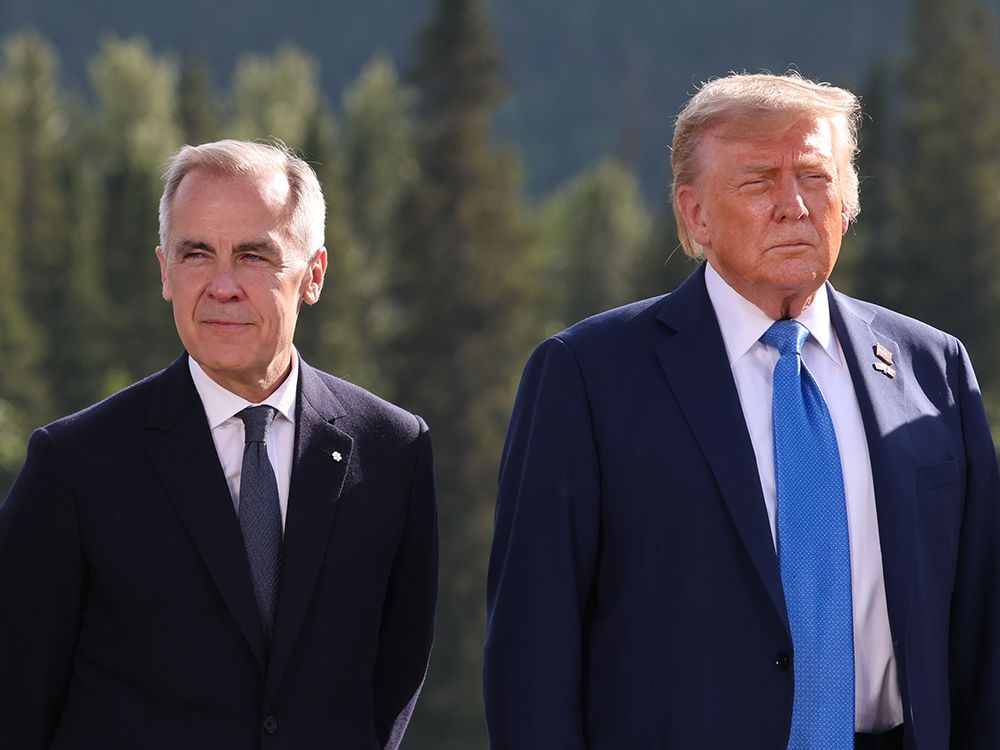
Canadian Prime Minister Mark Carney (L) greets US President Donald Trump during an arrival ceremony at the Group of Seven (G7) Summit at the Pomeroy Kananaskis Mountain Lodge in Kananaskis, Alberta, Canada on June 16, 2025.

KANANASKIS — As U.S. President Donald Trump stepped onto a podium for a photo with Prime Minister Mark Carney and his wife Diana, he wore two lapel pins on the left side of his suit.

The first, a small pin of the American flag. And underneath, paired Canadian and American flags.

Earlier in the day, when Trump and Carney met and took questions from reporters, Trump affected an upbeat mood, praising the relationship that he had built with Carney.

But given the oft-strained relationship between Canada and the United States, and in particular between Trump and former prime minister Justin Trudeau, the lapel pin is perhaps indicative of a warming relationship between the two countries.

In fact, it’s perhaps the first time Trump has worn such an adornment. In contrast, when Israeli Prime Minister Benjamin Netanyahu visited the United States in April, photos from the Oval Office show Trump in his trademark blue suit, with an American flag lapel pin — but no Israeli flag. Ditto for the May meeting between Carney and Trump. No Canadian flag in sight.

Trump caused a major diplomatic rift between the two allies when, late last year, he began musing publicly about Canada becoming the 51st state. On Christmas Day, in 2024, Trump mocked Trudeau, referring to him as governor. He also suggested that retired NHL star Wayne Gretzky could be the governor of Canada. He referred to the 49th parallel border as “artificial,” and suggested that Canada would have lower taxation and a stronger military if it became part of the United States.

The comments sparked nationalist outrage in Canada, and was likely partially responsible for the Liberals’ resurgence in the polls and eventual victory in the late April federal election in Canada. In his election night victory speech, Carney said the world had changed.

“Our old relationship with the United States, a relationship based on steadily increasing integration, is over,” he said.

At least part of what’s on the agenda for the G7 Summit this week is discussions of trade deals between Canada and the United States, after Trump slapped tariffs on Canadian goods, and Canada reciprocated, sparking the North American front in what has become a larger, global trade war.

Get more deep-dive National Post political coverage and analysis in your inbox with the Political Hack newsletter, where Ottawa bureau chief Stuart Thomson and political analyst Tasha Kheiriddin get at what’s really going on behind the scenes on Parliament Hill every Wednesday and Friday, exclusively for subscribers. Sign up here.

Our website is the place for the latest breaking news, exclusive scoops, longreads and provocative commentary. Please bookmark nationalpost.com and sign up for our daily newsletter, Posted, here.


Israeli firefighters, not those shown, rescued a Canadian embassy worker from a building hit during the Iranian missile barrage on Tel Aviv over the weekend.

A Canadian embassy worker in Tel Aviv needed to be rescued from a building hit by an Iranian missile over the weekend, according to Foreign Affairs Minister Anita Anand.

In a post to X on Saturday evening, Anand offered thanks to the “brave firefighters” who helped a woman escape one of the many structures severely damaged in the Iranian missile bombardment in recent days.

“She was eventually rescued, along with other occupants of the building, and is safe and sound,” Anand reported.

Anand also confirmed a discussion with Gideon Sa’ar, Israel’s minister of foreign affairs, in which she pledged that “Canada firmly supports Israel’s right to defend itself in the face of Iranian attacks.”

In a

separate post

, Foreign Policy Canada, an arm of Global Affairs Canada, said Anand had also liaised with counterparts in Europe, Jordan, the Kingdom of Saudi Arabia and Oman on Middle East peace talks over the weekend.

National Post has contacted both Global Affairs and the Canadian Embassy in Tel Aviv for more information on the staffer and her rescue.

The incident comes as long-simmering tensions between the rival Middle East nations have boiled over into spiralling violence following Israel’s

Operation Rising Lion

— a series of surprise airstrikes on more than 100 strategic targets, including Iranian uranium enrichment sites, to keep Iran from building nuclear weapons. The attacks resulted in the deaths of high-ranking military leaders and scientists.

Iran responded with Operation True Promise III, launching several hundred ballistic missiles and drones in two waves Friday and Saturday, striking locations in Tel Aviv, nearby Bat Yam, Haifa, and other places.

 The Israeli Iron Dome air defence system fires to intercept missiles over Tel Aviv, Israel, Friday, June 13, 2025.

The nations exchanged missile attacks again on Sunday and into Monday.

As of Monday morning, Israel says 24 people have been killed and more than 500 injured,

per the Associated Press

. Iran, meanwhile, says its death toll is at least 224, per AP.

“Canada condemns Iran’s attack on Israel and urges restraint on both sides. Further actions can cause devastating consequences for the broader region,” a Saturday morning X thread from Foreign Policy Canada begins.

It goes on to suggest that “U.S.-Iran negotiations” are the way to resolve regional and global concerns with Iran’s nuclear program, noting the theocratic republic should not have nuclear weapons.

“Iran’s continued efforts to pursue nuclear weapons, support for terrorists, and direct attacks on civilian centres embody Iran’s persistent threat to regional stability and to Israel, which has the right to defend itself. ”

Ottawa is also urging Canadians to

“avoid all travel”

to Israel due to the new conflict with Iran and the existing war with Hamas in Gaza. A similar warning is in place for

Iran

.

Our website is the place for the latest breaking news, exclusive scoops, longreads and provocative commentary. Please bookmark nationalpost.com and sign up for our daily newsletter, Posted, here.


United States President Donald Trump arrives in Calgary for the G7 2025 Summit in Kananaskis on Sunday, June 15, 2025.

OTTAWA — It may not be his favourite team but Prime Minister Mark Carney is now the proud owner of a Washington Capitals jersey emblazoned with his name and the number 24 thanks to U.S. President Donald Trump.

Trump gifted Carney, a die-hard Edmonton Oilers fan, the framed and mounted jersey after the leaders sat down for their first in-person meeting in the Oval Office last month, according to a public registry of disclosures.

That meeting laid the groundwork for what Canadian political and business leaders hope leads to a reprieve from Trump’s global tariffs on autos, steel and aluminum. It is a deal the two leaders have yet to lock in as they meet again, this time in Alberta, as Canada plays host to the G7 leaders’ summit.

Gift-giving between leaders is a diplomatic custom during official visits. Another round is unfolding this week as Carney welcomes leaders from across Europe and other parts of the world for the G7 gathering.

For his part, the last time Carney and the rest of the Canadian delegation saw Trump, they left behind a photograph of a famous football game played between Canadian and American soldiers several months before D-Day in 1944, snapped by a Canadian military photographer.

It was an image meant to signal the coming together over sports, and amid global uncertainty, the latter of which Carney is trying to bridge with a volatile Trump administration.

Canada also gifted Trump a hat and golf gear from the Kananaskis Country Golf Course, given that Kananaskis is where he and other G7 leaders are meeting.

It appears Trump stuck with the sports theme for his last gift to Carney, too.

The Washington Capitals are not only Trump’s hometown team, but also where Russian-born NHL star Alexander Ovechkin plays. Trump mentioned Ovechkin by name during his Oval Office meeting with Carney last month, which began with a wide-ranging question-and-answer session with the U.S. president, while Carney and other Canadian ministers watched on.

And while the president may not have gotten the team quite right for Carney, who cheers for the Edmonton Oilers, he nailed his number, given that Carney serves as Canada’s 24th prime minister.

Most Canadians will likely be relieved that the president chose that digit over the number 51, given how often Trump has repeated his desire for Canada to become the U.S.’s “51st state.”

staylor@postmedia.com

National Post

Get more deep-dive National Post political coverage and analysis in your inbox with the Political Hack newsletter, where Ottawa bureau chief Stuart Thomson and political analyst Tasha Kheiriddin get at what’s really going on behind the scenes on Parliament Hill every Wednesday and Friday, exclusively for subscribers. Sign up here.

Our website is the place for the latest breaking news, exclusive scoops, longreads and provocative commentary. Please bookmark nationalpost.com and sign up for our politics newsletter, First Reading, here.