LP_468x60
on-the-record-468x60-white

A screenshot from an Instagram video by Toronto comedian Nour Hadidi in which she complains that Egyptian authorities have detained her and other activists in an enclosure

First Reading is a Canadian politics newsletter curated by the National Post’s own Tristin Hopper. To get an early version sent directly to your inbox, sign up here.

TOP STORY

A who’s who of vocal Canadian anti-Israel activists are now begging Ottawa for help after their planned solidarity march through Egypt was interdicted by local authorities.

Over the weekend, reports emerged that the Global March to Gaza — a foreign-organized demonstration setting out from Cairo — had been swiftly met with arrests, detentions and passport confiscations by Egyptian security officials.

This included an estimated 40 Canadians.

Among them was Toronto-based comedian Nour Hadidi. In

a Friday Instagram video

, Hadidi said “we were stopped at a checkpoint, they took our passports, they have detained us.” She added, “they have put us in a barrier like animals.”

Hadidi then followed up with an appeal for supporters to petition Canada’s Egyptian embassy for help. “As a Canadian citizen, I am reminding you of your duty to act when Candian (sic) are in danger in Egypt,” read the suggested text.

The official Instagram account for Canadian participants in the Global March for Gaza complained of “harrowing” treatment for its members.

The account quoted an unnamed “member of the Canadian delegation” who alleged that participants were forced onto waiting vans after refusing to board them voluntarily. “They eventually dragged us up violently into vans. They treated my black Muslim sisters horribly especially,”

it read

.

The account is in line with other activists reporting rough treatment from Egyptian authorities.

In one

widely circulated video

, German organizer Melanie Schweizer described activists being allegedly “pushed” and “dragged” onto deportation buses. “They have beaten people; I have seen one woman that was beaten in her face in front of me,” shealleged.

Egypt also detained Yipeng Ge, an Ottawa physician prominent in the anti-Israel community who as recently as January was describing Canada on social media as a white supremacist “settler colonial state” that

needed to be destroyed.

In a Friday post to his X account, Ge said he and other activists had been detained at a checkpoint between Cairo and Ismailia, a city on the western bank of the Suez Canal. “Some have been waiting for hours. Some people have been told to get their passports back, they have to get on a bus to the airport to be deported,”

wrote Ge

.

On Monday, Ge posted letters of support from two NDP MPS, Leah Gazan and Alexandre Boulerice. In an appeal to Egypt’s ambassador to Canada, Ahmed Hafaz, Gazan not only asked for the Canadian activists to be released, but to be allowed to

continue their march through the Sinai peninsula

right up to the Egyptian border with Gaza.

The Global March to Gaza was intended in part as a critique of Egyptian government policy. Egypt maintains a heavily fortified border with Gaza, and activists were open about their intention to pressure Egypt into opening it. On the Global March to Gaza’s official website,

it warns

that if Egypt were to foil the march, it “would create unprecedented pressure and severely damage the country’s image.”

Egypt’s foreign ministry, by contrast, issued a statement in advance of the march warning that Egypt retained “the right to take all necessary measures to preserve its national security, including the regulation of the entry and movement of individuals within its territory, especially in sensitive border areas.”

Thus far, the Canadian government has seemed content to allow Egypt to carry out the deportations without interruption. As of Sunday, activists had already begun arriving back in Canada following their detention in Egypt.

This

included University of New Brunswick professor

 Jeff Houlahan, who last summer was issued a notice of trespass by the University of New Brunswick in relation to his  participation in a “Free Gaza” encampment on

university property

.    Houlahan says that the university eventually withdrew the notice of trespass after his union filed a grievance.

“Several people had their phones taken then returned,” said Houlahan. “We suspected they have installed new SIM cards with spyware.”

Prior to the march, Global Affairs Canada issued a travel advisory specifically telling Canadians to avoid the area being targeted by activists.

“Avoid all travel to northern Sinai due to terrorist activity and ongoing military operations by the Egyptian Armed Forces,”

it reads

. In a statement to CBC, Global Affairs reiterated that “

Canadians who choose to travel to the region do so at their own risk.”

Canadian participation in the march was coordinated in part by Tatiana Harker, a member of the anti-Israel group Palestine Vivra Montreal. On Friday, Harker told CBC “our government is completely ignoring us” and that detained activists were being left in the heat for “two to three hours.”

On Sunday, Palestine Vivra Montreal was urging supporters to

contact their MPs

to press for the release of any Global March for Gaza participants being “repressed” by Egypt.

The message was a sharp contrast from earlier this year, when Palestine Vivra Montreal had endorsed a campaign to harass Canadian MPs at their constituency offices. In March, Palestine Vivra’s official Instagram account

promoted the

“Chase your MPs campaign” with the slogan, “If we don’t get no justice, they don’t get no peace.”

Palestinian Youth Movement, one of Canada’s most active organizers of anti-Israel blockades and protests, was also urging supporters to petition the Canadian government for help.

In a Sunday “

emergency call to action

,” they provided contact information for Canada’s Egyptian embassy and for Foreign Affairs Minister Anita Anand.

That would be the same Anand who only a few weeks ago had her offices targeted by Palestinian Youth Movement picketers

accusing her

of complicity in genocide.

In April, PYM protestors also attempted to

forcibly obstruct a fundraiser

featuring Anand, declaring “they do not get to fundraise to run their campaigns in peace during this election period.”


IN OTHER NEWS

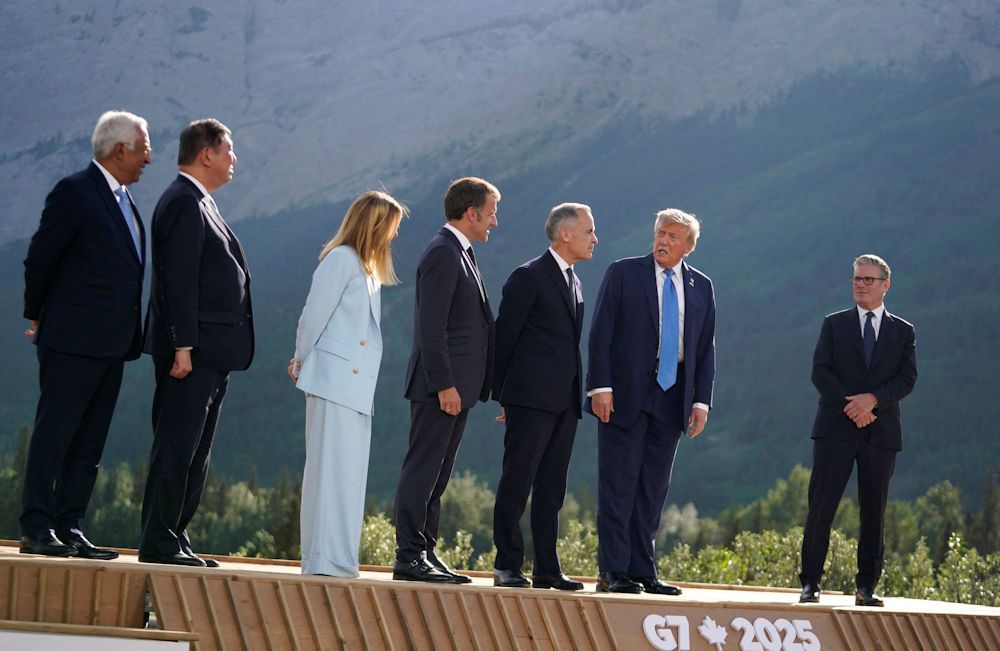
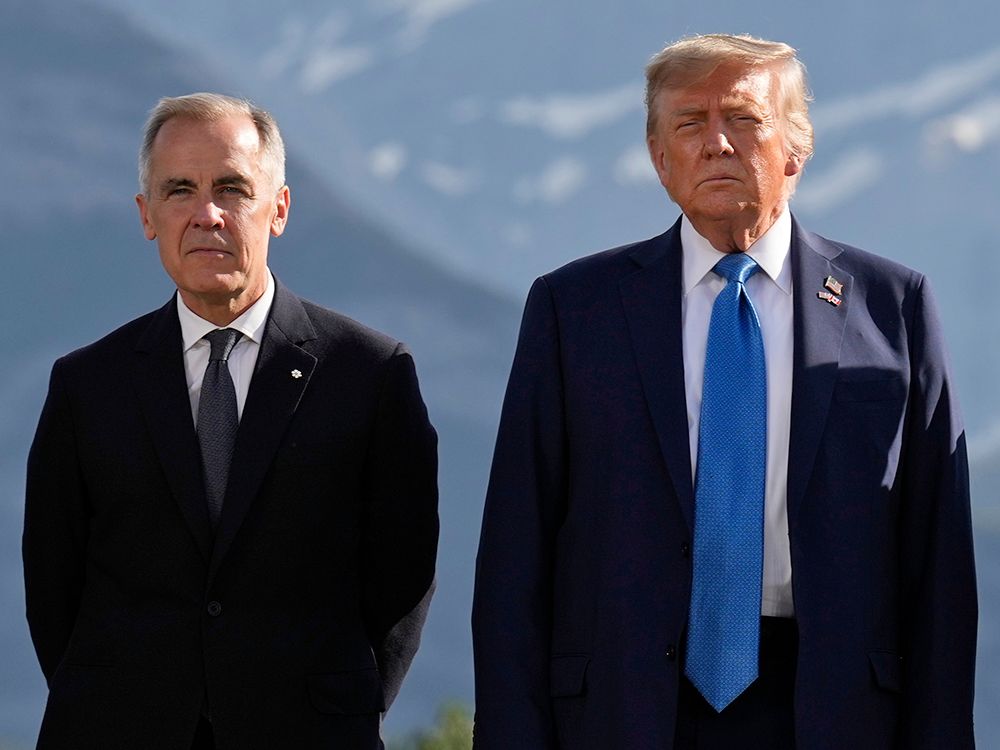
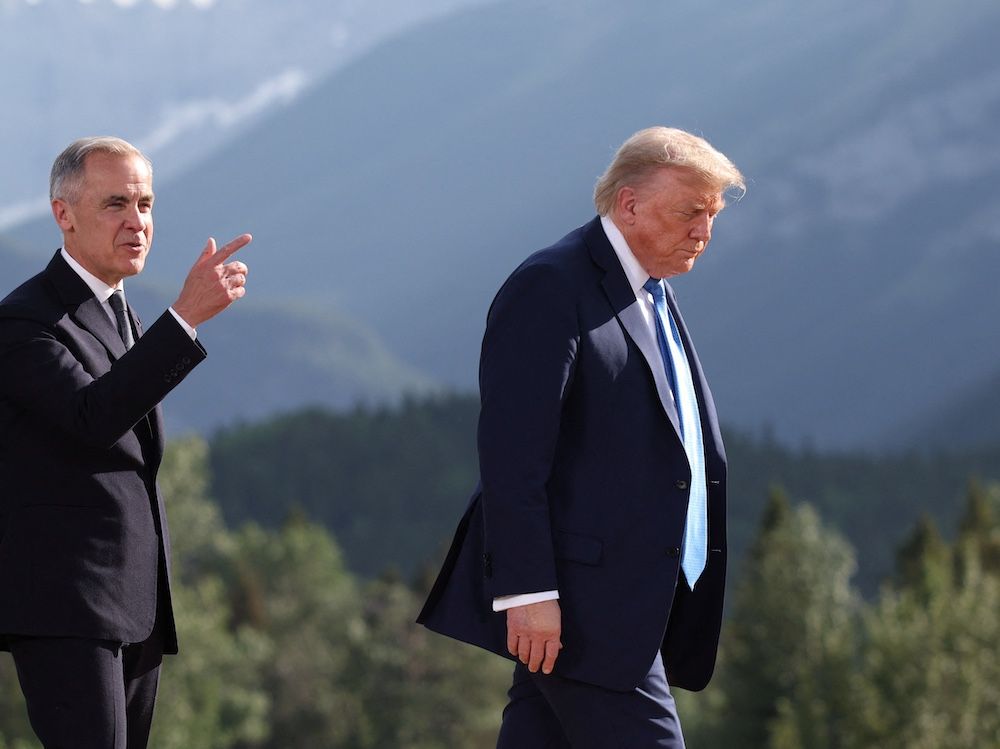
 A somewhat unexpected development in U.S.-Canada relations is that Prime Minister Mark Carney and U.S. President Donald Trump actually seem to get along quite well. It was Trump’s birthday on Saturday, and in front of G7 summit news cameras Carney both wished Trump a happy birthday and thanked him for his “personal leadership.” According to National Post columnist Anthony Koch, the bonhomie between the two is because Carney never believed his anti-Trump rhetoric and voters never particularly cared anyway.

At the core of Canada-India tensions is the belief by New Delhi that Canada is a haven for violent Khalistani extremists, a fear that stretches all the way back to the 1980s, when B.C.-based Khalistani terrorists perpetrated the Air India bombing. This perception probably wasn’t helped by the fact that

Indian Prime Minister Narendra Modi was scheduled to touch down in Alberta for the G7 soon after Calgary was hit by Khalistani rallies featuring violent imagery.

On Monday, a rally in Downtown Calgary featured Khalistan flags and

placards with Modi’s head framed in the crosshairs of a gun

. Independent journalist Mocha Bezirgan

interviewed the leader of

a convoy of vehicles flying Khalistani flags, who spoke of the convoy’s goals to “kill Modi politics” and “ambush Modi.”

An unidentified private pilot may have narrowly cheated death

after

he flew too close

to the G7 summit and was targeted by “final warning” flares fired from RCAF CF-18s … the last step before being shot down.

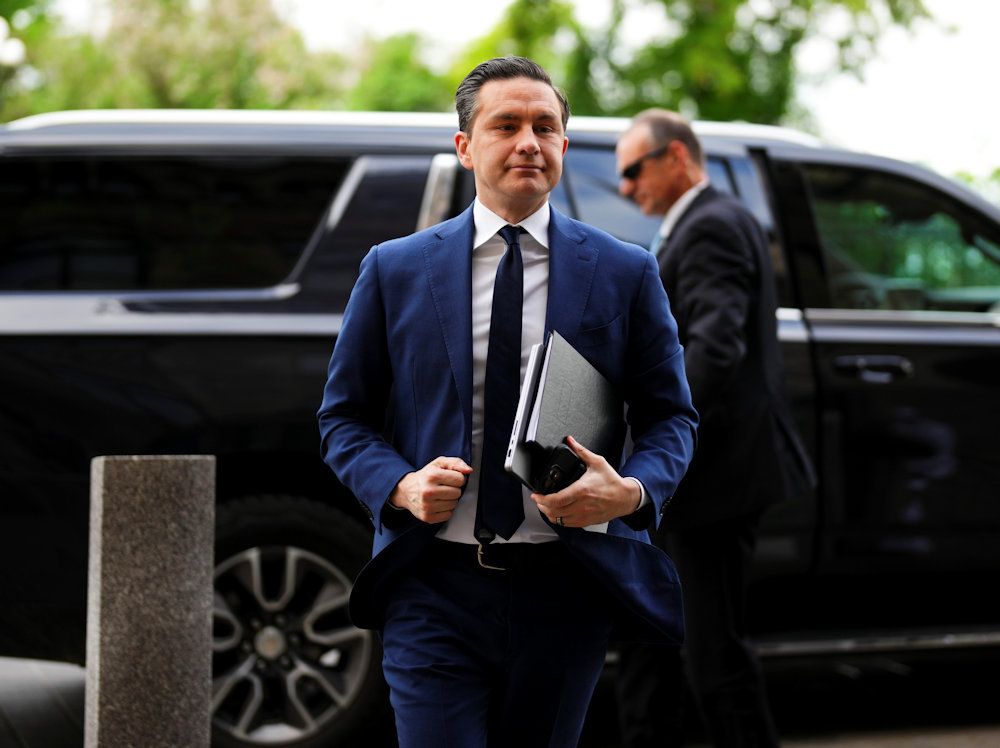
 Conservative Leader Pierre Poilievre had obviously hoped to be prime minister right now, rather than an opposition leader without a seat in the House of Commons. But he did just start releasing longform video interviews. The first edition, which dropped Saturday, features Billy Morin, the former chief of the Enoch Cree Nation just elected as a Conservative MP.

Get all of these insights and more into your inbox by signing up for the First Reading newsletter.

Clarification:
This article was revised to clarify that University of New Brunswick professor, Jeff Houlahan, did not ignore an eviction order issued by a court.


Bill C-5 is a Trojan horse. A fourteen-foot-tall wooden Trojan horse was placed outside the gates of Parliament Hill on Monday as part of a demonstration on Oct. 17, 2011.

Mark Carney’s election platform did not include giving himself the power to suspend the entirety of federal law and, by extension, democracy. But that’s what he aims to do with

Bill C-5

, which he hopes to ram through by

Canada Day

.

Conservatives, astonishingly,

haven’t ruled out

helping the prime minister on this front, which is a royal shame since they’re our last line of defence.

Introduced to the House of Commons on June 6, the bill would create a Building Canada Act to fast-track any project the feds consider to be in the national interest. The act would do this by allowing the Liberal government to completely bypass parliamentary scrutiny.

The act would give cabinet the power to

add any project

it likes to a list of “national interest projects” by issuing an order-in-council. Cabinet would also have the power to

make a list

of federal laws that can be suspended at any time, with the stroke of a pen, with respect to any designated national interest project.

To exempt any designated projects from any number of suspendable laws, the feds would simply need to

write a regulation

specifying which laws no longer apply to which projects, and it would be so.

For example, the Building Canada Act would allow Carney and his team to designate all work by his forthcoming home-construction agency as a national interest project, and shield all of its business from conflict-of-interest laws, from transparency rules set out in the Access to Information Act, from the scope of the auditor general, from federal taxes via the Income Tax Act, and from police via the Criminal Code.

The same legal exemptions could be given to a favoured engineering firm, telecom company, construction giant, consulting behemoth, etc., as long as cabinet finds a national interest angle in the work. Foreign entities could even be excused from following the Investment Canada Act, which exists to protect economic and national security.

The Building Canada Act would also allow cabinet to exempt preferred companies from environmental legislation, such as the Impact Assessment Act, the Species At Risk Act, the Canada National Parks Act and the federal carbon tax.

So, if Carney wanted to give a foreign electric vehicle manufacturer a leg up, or allow a solar plant to be built on federal parkland, or free an Indigenous-owned pipeline from the mound of rules that apply to their non-Indigenous competitors, he could do just that. The same could be done for any industry, really: if reconciliation is always in the public interest, why not free Indigenous fishing corporations from the constraints of the Fisheries Act?

Making matters more concerning are Carney’s own potential private-sector interests: he is the former chair and environmental, social, governance (ESG) lead of Brookfield Asset Management. Carney’s publicly traded assets

have been

put into a blind trust, but we’re still waiting on financial disclosures through the ethics commissioner. All considered, he could stand to benefit from the suspension of law in the area of modular housing and green energy, for example, given Brookfield’s holdings.

Aside from the corruption risk, the Building Canada Act could ultimately create the expectation that the feds should selectively suspend clunky laws to get anything of worth built, incentivizing lobbying campaigns and distracting from the actual job of government. If some Canadian laws are so hostile to development that they warrant total suspension, as the Liberals seem to admit by tabling Bill C-5, they should spend their time fixing them. Fast-tracking exceptions aren’t out of the question, either: if Parliament wants to give cabinet the ability to suspend certain pre-determined clauses in certain cases, it can go right ahead.

Indeed, the left decried Conservative Leader Pierre Poilievre’s plan to repeal the burdensome Impact Assessment Act, which hasn’t approved a single project in its six years of existence, and requires proponents to file everything from sociology dissertations to greenhouse gas projections in their applications. But Poilievre’s intent was to replace it with something else — and he certainly didn’t set out to suspend the whole roster of environmental laws, as seems to be Carney’s approach.

Proponents of the scheme will likely defend it by pointing to the fact that Bill C-5, as it’s currently written, proposes a list of only 13 suspendable laws. These include the Impact Assessment Act (and its predecessor, which still applies to a number of projects underway in Canada), the Fisheries Act, the Indian Act, the National Capital Act, the Migratory Birds Convention Act, a part of the Canada Transportation Act, the Species at Risk Act, and a handful of federal laws that govern Canadian bodies of water.

It’s a fraction of the hundreds of federal laws that are on the books — but that’s just for now. The moment the Building Canada Act becomes law, that list can be expanded at cabinet’s pleasure. In that way, Bill C-5 is a Trojan horse.

The Liberals are now moving the bill along at a pace so fast that it escapes the rule of law. The House of Commons transport committee is scheduled to handle the bill this week, with only one day of witness hearings

planned

before MPs hit their deadline to propose amendments. It will simply be impossible to give this wide-ranging bill the full consideration it deserves, as a proposal to allow cabinet to pause any law at any time should take months, not hours.

Bloc Québécois Leader Yves-François Blanchet got it right last week

when

he denounced the bill and promised to fight the Liberals’ attempt to speed it through the House of Commons without any meaningful debate.

The Conservatives are

still on the fence

, but they shouldn’t be. Supporting Bill C-5 in its current form means unleashing the Liberals from the oversight of Parliament, which would be a catastrophic dereliction of duty for the Opposition.

National Post


Israeli air defence systems are activated to intercept Iranian missiles over the Israeli city of Tel Aviv amid a fresh barrage of Iranian rockets on June 16, 2025. (Photo by Menahem Kahana / AFP)

A direct military confrontation between Israel and Iran has been decades in the making, but some in the media are naively trying to make the case that the Islamic Republic didn’t pose much of a threat to the Jewish state.

In Canada’s less interesting national newspaper, the Globe and Mail, columnist

Doug Saunders claimed

that the 2015 Iranian nuclear agreement was “a success,” even though it enriched the country’s theocratic regime with funds it used to conduct a global campaign of terror, while doing little to retard Iran’s nuclear progress.

In truth, Iran’s quest to develop nuclear technology, and its genocidal intents, have been well known for decades. At his state of the union address in January 2002, shortly after 9/11, then-U.S. president George W. Bush identified Iran as a member of the “

axis of evil

,” alongside Iraq and North Korea. Unfortunately, Bush attacked the wrong Persian Gulf country starting with the letters IRA, which took out Iran’s greatest regional foe and allowed it to develop its nuclear program unabated.

In 2012, Israeli Prime Minister Benjamin Netanyahu stood in front of the United Nations General Assembly and

warned the world

that Iran was reaching the point of no return. Yet no world leader has had the fortitude to do anything about it — until now.

While it’s true that Iran had yet to take the final step of putting together a working bomb, at least as far as we know, the country has for years been enriching uranium past the point that is needed for civilian purposes. An International Atomic Energy Agency (IAEA)

report

released late last month found that the country had stockpiled enough highly enriched uranium to produce nine nuclear warheads.

Although Saunders acknowledged that the IAEA’s board of governors

censured Iran

last week for failing to comply with its obligations under the Nuclear Non-Proliferation Treaty — including refusing to answer questions about uranium particles found at undeclared sites — he wrote this off as “a familiar tactic practised by Tehran during negotiations over the last 20 years: increasing tension over its nuclear program in order to create a sense of urgency.”

The Globe’s senior international correspondent, Mark MacKinnon, also

brushed off fears

that Iran was racing towards a bomb, claiming that there is “no evidence suggesting Iran was on the verge of developing a nuclear weapon — let alone threatening anyone with it — next week, next month or next year.”

Those claims have been disputed by Israeli intelligence officials, who, according to an

Army Radio report

on Sunday, said that Israel had received information showing that Iranian scientists had been conducting secret nuclear weapons experiments since the end of 2023 and that they were mere weeks away from developing a functional bomb.

We may never know the truth, but claiming, as Saunders did, that there is “no looming nuclear-weapons threat from Iran” is disingenuous, at best. Playing games with nuclear inspectors and threatening to ramp up nuclear activities following the IAEA’s damning resolution may be par for the course for the mullahs in Tehran, but the cost of not taking them and their word is far too high for the Jewish state.

During the Cold War, the principle of mutual assured destruction ensured the Americans and Soviets never unleashed their nuclear arsenals, but this only worked because both governments were rational actors that did not want to bring about Armageddon. The same cannot be said for the Islamists in Tehran, who are far more concerned with collecting their 72 virgins in the afterlife than protecting life here on earth.

For decades, Iranian leaders have been making explicit threats against the Jewish state. Twenty years ago, then-Iranian president Mahmoud Ahmadinejad gave a talk at the “World Without Zionism” conference, in which he

called for Israel

to be “wiped off the map.”

In 2018, Iranian Supreme Leader Ayatollah Ali Khamenei

called Israel

a “cancerous tumour” that must be “removed and eradicated.” A couple years later, his website featured an image calling for a “

final solution

” in Palestine. And in 2019, the deputy head of the Islamic Revolutionary Guard Corps said the Islamic Republic

intends to

“erase Israel from the global political map.”

It’s easy for us, in a safe country like Canada, to watch from afar and criticize the Israeli government’s policies; to claim, as the Globe’s journalists seem apt to do, that Netanyahu is “addicted to war” and that his decision to go to war was pure “political opportunism.”

But Netanyahu did not start this war. Israel was the victim of a brutal terrorist attack on Oct. 7, 2023, when thousands of Iranian-backed Hamas terrorists stormed southern Israel, brutally raping and slaughtering 1,200 people, mostly innocent civilians, and took over 250 hostages.

Israel was then attacked by Hezbollah and the Houthis, which are also Iranian proxies. And last year, Tehran turned the long-simmering cold war between the two countries into a hot one when it launched

a direct assault

against Israel for the first time in history.

It’s important to remember that

Israel

is a small country — less than half the size of

Nova Scotia

— and it’s surrounded by mortal enemies. According to the

Nukemap

website, a 150 kiloton nuke, the size of the one tested by North Korea in 2017, would take out Tel Aviv and some of its suburbs, killing an estimated 214,000 people and wounding around 278,000; a 100 megaton bomb, the world’s largest, dropped on Tel Aviv would destroy all of central Israel and kill millions.

In the current conflict, Israeli

officials estimate

that five to 10 per cent of the missiles fired by Iran have penetrated Israel’s air defences. As tragic as it is to see whole apartment buildings destroyed, the effects of even one nuclear warhead detonating within Israeli territory would be catastrophic (and would surely invite a second strike that would bring about even more death and destruction).

In the end, the calculation for Netanyahu was simple. He has the solemn duty of protecting the world’s only Jewish state, home to around two-thirds of the global Jewish population, from experiencing a repeat of the Holocaust. And he is faced with a regime in Tehran that has explicitly stated that it wants to annihilate Israel and has been developing weapons capable of realizing that goal.

It’s fair to question Netanyahu’s timing and his strategy, but anyone who didn’t see this coming, or thinks that, barring regime change, this standoff wasn’t eventually going to lead to war, hasn’t been paying attention.

National Post

jkline@postmedia.com

Twitter.com/accessd


The U.S. Supreme Court has sided with a heterosexual woman employed by the Ohio Department of Youth Services who applied to enter management but had her application turned down when the department instead hired a lesbian. She was subsequently demoted and replaced with a gay man.

The United States Supreme Court is seen to be sharply divided between conservative and liberal jurists so it is noteworthy when it speaks with one voice. In Ames v. Ohio, liberal Justice Ketanji Brown Jackson wrote a unanimous decision that is viewed by some as resetting the diversity, equity and inclusion debate.

Marlean Ames is a heterosexual woman employed by the Ohio Department of Youth Services, initially as a secretary, subsequently promoted to program administrator and applying in 2019 to enter management. Her application was unsuccessful when the department instead hired a lesbian and demoted Ames from her administrative position — restoring her to a secretarial post — and replacing her with a gay man. Alleging discrimination because she is straight, she sued under Title VII of the 1964 Civil Rights Act, unsuccessfully at trial and in the circuit appeals court, but successfully on appeal to the Supreme Court. Justice Jackson observed, with emphasis, that the Act makes it unlawful “to fail or refuse to hire or to discharge ANY INDIVIDUAL, or otherwise to discriminate against ANY INDIVIDUAL with respect to his compensation, terms, conditions, or privileges of employment, because of such individual’s race, colour, religion, sex, or national origin.” That Ames was a member of a non-gay majority did not affect the result; “the law’s focus on individuals rather than groups (is) anything but academic.”

The case was remitted to the lower courts for correction, but it is Justice Jackson’s emphasis on individuals that is important here. It is individuals who have equality before the law and it is individuals who must be protected from discrimination based on race, colour, religion, sex or national origin. This does not preclude considerations of race, colour, or other traits, when addressing comparative advantage or disadvantage; it insists only that the focus must be on individuals when making these comparisons.

Taken along with the 2023 U.S. Supreme Court decision ruling affirmative action unconstitutional, it is clear that the United States and Canada part ways on issues of equality, discrimination and affirmative action. Their laws on these subjects are similar: the U.S. Civil Rights Act and Fourteenth Amendment, and Canada’s Charter Section 15(1) and its equivalent in provincial human rights codes, guarantee equality before the law and protection from discrimination based on immutable conditions. But here the similarities end. The unconstitutionality of affirmative action and the emphasis on individual rights in the U.S. stand in marked contrast with the extensive practice of affirmative action and emphasis on group rights in Canada.

The American experience has lessons for Canadians; we, too, need to reset the DEI debate. Although some group rights are recognized in our Constitution (e.g. Indigenous peoples and minority languages), they do not mandate special treatment apart from their specific texts. The issues here are broader and more fundamental: do we see affirmative action, sanctioned by Section 15(2) of the Charter, as an exception to a general rule prohibiting discrimination, or does its extensive practice in our public institutions suggest that the exception is becoming the rule? Should we re-emphasize

individual

rights as a unanimous Supreme Court did in Ames v. Ohio? Is DEI a benign practice or an ideological cover for discriminatory practices? If we do not face these questions, test them in our courts, and develop a social consensus around them, differences among Canadians that we have seen to date will pale beside those to come.

National Post

Peter MacKinnon has served as the president of three Canadian universities and is a senior fellow of the Macdonald-Laurier Institute and the Aristotle Foundation.


A Royal Canadian Air Force member from HMCS Montreal's Helicopter Air Detachment marshals a CH-148 Cyclone helicopter during operations in the Mediterranean Sea as part of the NATO battle group Operation Reassurance, on March 1, 2022.

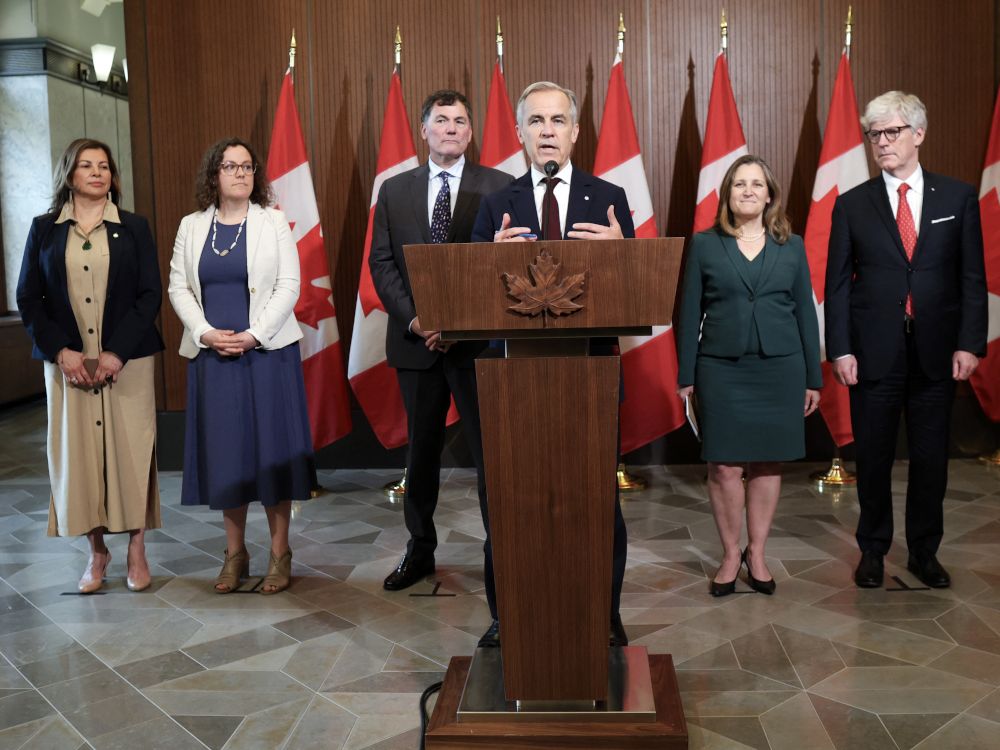
Prime Minister Mark Carney’s surprise pledge to meet NATO’s defence spending target is long overdue, but without real reform, leadership and a shift away from bureaucracy and social experimentation, it risks falling short of what the moment demands.

Canada committed in 2014 to spend two per cent of its gross national product on defence — a NATO target meant to ensure collective security and more equitable burden-sharing. We never made it past 1.37 per cent, drawing criticism from allies and, in my view, breaching our obligation. Now, the prime minister says we’ll hit the target by the end of fiscal year 2025-26. That’s welcome news, but it comes with serious challenges.

Reaching the two per cent was always possible. It just required political courage. The announced $9 billion in new defence spending shows intent, and Carney’s remarks about protecting Canadians are encouraging. But the reality is our military readiness is at a breaking point. With global instability rising — including conflicts in Ukraine and the Middle East— Canada’s ability to defend its territory or contribute meaningfully to NATO is under scrutiny. Less than half of our army vehicles, ships and aircraft are currently operational.

I’m told the Treasury Board has already approved the new funds, making this more than just political spin. Much of the money appears to be going where it’s most needed. Pay and benefit increases for serving members should help with retention, and bonuses for re-enlistment are reportedly being considered. Recruiting and civilian staffing will also get a boost, though I question adding more to an already bloated public service. Reserves and cadet programs weren’t mentioned but they also need attention.

Equipment upgrades are just as urgent. A new procurement agency is planned, overseen by a secretary of state — hopefully with members in uniform involved. In the meantime, accelerating existing projects is a good way to ensure the money flows quickly. Restocking ammunition is a priority. Buying Canadian and diversifying suppliers makes sense. The Business Council of Canada has signalled its support for a national defence industrial strategy. That’s encouraging, but none of it will matter without follow-through.

Infrastructure is also in dire shape. Bases, housing, training facilities and armouries are in disrepair. Rebuilding these will not only help operations but also improve recruitment and retention. So will improved training, including more sea days, flying hours and field operations.

All of this looks promising on paper, but if the Department of National Defence can’t spend funds effectively, it won’t matter. Around $1 billion a year typically lapses due to missing project staff and excessive bureaucracy. As one colleague warned, “implementation (of the program) … must occur as a whole-of-government activity, with trust-based partnerships across industry and academe, or else it will fail.”

The defence budget also remains discretionary. Unlike health transfers or old age security, which are legally entrenched, defence funding can be cut at will. That creates instability for military suppliers and risks turning long-term procurement into a political football. The new funds must be protected from short-term fiscal pressure and partisan meddling.

One more concern: culture. If Canada is serious about rebuilding its military, we must move past performative diversity policies and return to a warrior ethos. That means recruiting the best men and women based on merit, instilling discipline and honour, and giving them the tools to fight and, if necessary, make the ultimate sacrifice. The military must reflect Canadian values, but it is not a place for social experimentation or reduced standards.

Finally, the announcement came without a federal budget or fiscal roadmap. Canada’s deficit continues to grow. Taxpayers deserve transparency. What trade-offs will be required to fund this? If this plan is just a last-minute attempt to appease U.S. President Donald Trump ahead of the G7 or our NATO allies at next week’s summit, it won’t stand the test of time.

Canada has the resources, talent and standing to be a serious middle power. But only action — not announcements — will prove whether we truly intend to be one.

National Post

Michel Maisonneuve is a retired lieutenant-general who served 45 years in uniform. He is a senior fellow at the Frontier Centre for Public Policy and author of In Defence of Canada: Reflections of a Patriot (2024).


Buzz Hargrove in May 2008. NATIONAL POST  STAFF PHOTO   /   PETER REDMAN  /  National

When

Buzz Hargrove

spoke, you listened. He was an electric public speaker that drove his message through compassion and wisdom. He could carry the room with his knowledge.

He would never ask you to do anything he wasn’t prepared to do himself. He led more plant occupations and corporate dust-ups than anyone in the country. He knew how to win and gave us all the confidence to fight against great odds. “You can’t win if you are not prepared to fight,” he would often say.

I was fortunate to have a front row seat as one of Buzz’s assistant’s in the final years of his presidency of the Canadian Auto Workers. I was able to watch the master in action. He was brilliant in battle but compassionate and articulate in life.

He understood that the most important role of the union was how we impacted the lives of the rank and file through collective bargaining. With that in mind, Buzz was the best. He knew better than anyone that our collective solidarity fused together as one, created unlimited strength. When facing the pillars of the corporate community, he was like a pit bull terrier with an abscessed tooth. Brains and brawn that drove success regardless of the situation.

He really was a legend respected by all whose lives he touched.

Buzz above all was a rank and file leader. He came from the shop floor and was proud of it. His working class roots are what defined him. He would often say that you can’t build a union surrounded by lawyers and academics. They had a role but they just couldn’t lead it. He believed that the rank and file’s heart and soul was the foundation on which to build.

Meeting and marrying Denise Small made Buzz the happiest man alive. He loved her for all her strength and support.

We will miss you Buzz. You were one of a kind.

Rest in peace.

Jerry Dias is a former national president of Unifor.


U.S. President Donald Trump meets with Prime Minister Mark Carney at the G7 Summit in Kananaskis, Alta., on Monday, June 16, 2025.

The G7 meeting in Kananaskis, Alta. hadn’t even kicked off in earnest when Mark Carney began to wear the look of a man who had lost control of events that were starting to control him.

The

prime minister’s meeting with Donald Trump in front of the cameras Monday morning

started well enough, with him flattering the president by saying that the G7 is “nothing without U.S. leadership.”

Trump responded by commenting that he has developed a “very good relationship” with the Canadian prime minister, whom he called “Mark.”

But Trump can’t pass a fire without putting an iron in it. Without prompting, he mused on how the G7 used to be the G8, before former president Barack Obama and “a person named Trudeau” kicked Russia out.

In fact, Russia was suspended after its invasion of Crimea in 2014, a year before Trudeau became prime minister, but the president does not let the facts interfere with his preconceptions.

“I would say that was a mistake. You wouldn’t have had a war if Russia was in, or if Trump was president,” Trump said.

Carney would have been well advised to use his prerogative to get Trump the hell out of the room before the president started taking questions. But, too late, Trump was quickly in his preferred environment as the centre of attention.

U.S. officials suggested ahead of the G7 gathering that Trump

wants to show progress on trade deals

. He was asked what is holding up a deal with Canada and responded that a deal is “achievable” but that he has a “tariff concept,” while Carney has a “much more complex idea.”

“I’m sure we can work something out,” he said.

He sidestepped questions about the U.S. getting involved in the conflict between Israel and Iran, but he was happy to make the case for Vladimir Putin and Russia, again and again and again.

By this stage, Carney was sweating spinal fluid and gesturing to his team to cut the press conference short.

But Trump was asked about his request in a late-night social media post Sunday for Immigration and Custom Enforcement to

target America’s big cities

, and by this time the president was like a sausage, fizzing and popping in its own grease.

“I want them to focus on the cities, because that’s where the people are. I look at New York. I look at Chicago. I mean you got a really bad governor in Chicago and a bad mayor … That city has been overrun by criminals. Look at L.A., those people weren’t from L.A. They weren’t from California.

“Biden allowed 21 million people to come into our country. Of that, vast numbers were murderers, killers, people from gangs, people from jails. They empty their jails out into the U.S. Most of those people are in the cities, all blue cities. All Democrat-run cities and they think they’re going to use them to vote. It’s not going to happen.”

Trump’s Sunday night

Truth Social post went further

, saying “illegal aliens” are being used to “cheat in elections.” He said Democrats are “sick of mind” and people who “hate our country” — this just a day after two state Democrats in Minnesota were targeted by an assassin, and

lawmaker Melissa Hortman and her husband Mark were killed

.

With the implicit threat hanging in the air that Trump is going to use federal law enforcement to target Democrats, Carney was caught in a cruel dilemma: nothing he could say would do much good and anything he said could do a great deal of harm to Canada’s national interest.

With the prospect that the next question could be on the president’s bête noire — trade imbalances with the U.S. and his views on Canada’s sovereignty — the prime minister politely urged an end to the proceedings.

“If you don’t mind…,” he said.

The media minded a great deal, sniffing headlines like bird dogs detecting a partridge. They continued to shout out questions, but the prime minister’s team were uncharacteristically insistent on shutting things down.

It was an ominous start to the proceedings.

The G7 process is based on consensus. The agenda was focused on finding common ground on things like drug trafficking and energy security.

But it was a reminder that no democratic leader can find communion with this president. Trump’s base, his sympathies and his prejudices are too narrow for anyone who has a different outlook, and wants to maintain their or their nation’s self-respect.

National Post

jivison@criffel.ca

Get more deep-dive National Post political coverage and analysis in your inbox with the Political Hack newsletter, where Ottawa bureau chief Stuart Thomson and political analyst Tasha Kheiriddin get at what’s really going on behind the scenes on Parliament Hill every Wednesday and Friday, exclusively for subscribers. Sign up here.


U.S. President Donald Trump (R) walks away from Canadian Prime Minister Mark Carney at the official welcome ceremony during the G7 Leaders' Summit on June 16, 2025 in Kananaskis, Alberta. (Photo by Chip Somodevilla/Getty Images)

The last federal election was not an honest conversation about Canada’s place in the world. It was a performance — slick, poll-tested, and ultimately hollow. Mark Carney presented himself as a principled adversary to Donald Trump, a steward of Canadian sovereignty who would stand up to a dangerous and unpredictable United States. And now, just months into his premiership, he insists “the G7 is nothing without U.S. leadership,” his government has resisted retaliating against American tariffs, and has even expressed desire to join Trump’s Golden Dome missile defence program.

Let’s dispense with the polite fiction: Carney never meant what he said. The campaign rhetoric wasn’t just exaggerated, it was fabricated. There was no principled foreign policy vision, no doctrine of Canadian independence. It was anti-American cosplay, staged for a segment of the electorate that wanted to feel morally superior to our southern neighbours without having to actually think seriously about Canada’s strategic position in the world.

And here’s the truly galling part: voters didn’t mind. Not really. Carney’s flip-flop hasn’t cost him much because many of the people who cheered his fiery condemnations of Trump didn’t actually care if he followed through. For a certain kind of upper-middle-class Canadian Liberal, politics isn’t about outcomes, it’s about vibes. It’s about feeling right, looking progressive, and imagining yourself on the right side of history while outsourcing all your material security to American economic and military power.

These are the same voters who nodded along when Carney spoke about “de-risking” our relationship with the United States, who applauded when he warned of creeping authoritarianism from Washington. And now they nod along just as enthusiastically when he floats ideas for joint continental defence initiatives, shared strategic supply chains, and deeper financial integration. They are not engaged citizens. They are consumers of political affect — buying whatever narrative makes them feel smart and virtuous in the moment.

But the consequences of this self-indulgent politics are real. By campaigning on a lie, Carney squandered the opportunity for a serious, grown-up conversation about our geopolitical future. Should Canada pursue closer integration with the United States? Perhaps. Should we coordinate more closely on military defence in the Arctic? Maybe. But those decisions should be debated openly and honestly, not buried under layers of electoral theatre and bait-and-switch messaging.

Instead, we got a campaign that pretended Canada could forge a proud, independent foreign policy by sneering at a country we rely on for our trade, our defence, and much of our cultural gravity. And now we’re being quietly ushered into a new phase of integration, not with clarity or consent, but with a shrug and a press release.

Carney is at fault for misrepresenting himself. But we should also hold accountable the class of voters, pundits, and strategists who enabled it — who preferred the aesthetics of defiance to the responsibilities of leadership, and who now applaud the very subservience they claimed to abhor.

If there is a lesson in all this, it is not that politicians lie. That much is eternal. The lesson is that in modern Canadian politics, the truth isn’t just optional, it’s often irrelevant. Carney’s entire foreign policy posture during the campaign was a mirage, and the people who bought it seem perfectly content with the bait-and-switch, so long as it flatters their self-image.

The next election will come. And it, too, will be full of noble-sounding promises and performative outrage. But voters would do well to ask themselves: do I want to be told the truth? Or am I just here to be comforted by the sound of my own values echoing back at me? Because when the consequences finally come knocking, it won’t be enough to blame the man who sold the lie. We’ll have to reckon with the country that wanted to believe it.

Anthony Koch is the managing principal at AK Strategies, a bilingual public affairs firm specializing in political communications, public affairs and campaign strategy. He previously served as national campaign spokesperson and director of communications to Pierre Poilievre.


A couple take pictures of a wildfire as its spreads in Squamish, B.C., on June 10.

For the past decade, the Liberals have made climate change their top priority. This commitment has come at the cost of not only watching as other countries pursued economic opportunities that we passed up, it has also sparked a national unity crisis, as Alberta’s anger has risen in response to Ottawa’s unwillingness to approve new energy projects.

So Canadians might be surprised to hear that despite all the talk about climate change and this country’s commitment to reducing carbon emissions, over the past few years, a huge new source of emissions has emerged — one that the Canadian government does not want to talk about.

That alone tells you that the source of the emissions is not the oil and gas industry. Rather, the source of these new emissions is this country’s massive wildfire problem, which started making headlines in 2023, the worst wildfire season on record, and has been bad ever since.

But what makes this issue even more concerning is that we lack the resources and strategy to fight these fires. Canada does not have a federal office that could formulate a national strategy for combating wildfires, nor do we have the personnel and equipment to combat them effectively. Rather, fighting wildfires is a provincial responsibility, one that the provinces have proven themselves incapable of doing effectively.

Given that, you might think that the federal government would be attempting to figure out ways to at least assist the provinces with a task they are clearly overwhelmed by. Sadly, you would be mistaken. Despite all that has happened over the past few years, the response of the federal government has been characterized by inaction. No major departmental changes have been made, no initiatives have been undertaken, nor have any major acquisitions been announced. And Canada still does not have a national disaster response agency.

First, though, a bit of recent history. Canada’s wildfire problem first attracted widespread attention in 2023, when massive fires broke out throughout much of the country. They burned through the summer and fall. Smoke from the fires gradually moved south, and ultimately affected not only major Canadian cities, but American ones, as well (recall the eerie photograph of Manhattan’s skyline being shrouded in a dense haze of smoke).

Air quality alerts became common, and people with asthma and other lung conditions were told to stay indoors for days at a time. For a country in which summers last only a few months, being told not to go outside adversely affected many people’s quality of life. Still, despite the warnings, the country’s emergency services were even busier than usual, as many people struggled with breathing issues.

The carbon emissions produced by the fires were stunning. A study published in the journal Nature in 2024 found that the fires released around 647 megatonnes of carbon. This number was larger than Canada’s total emissions from all other sources, and the combined number made us one of the largest emitters in the world in 2023 (a ranking the Liberals tried hard to ignore).

At the time, many noted that Canada lacked the capacity to fight the fires effectively, and thus the fires burned longer and caused more damage than they otherwise would have. In 2023, an aviation expert told CBC News that Canada had a total of about 60 “quality” water bombers (not including an additional 40 aircraft that are too small to be effective). Most of these aircraft are decades old, and they have the same maintenance challenges that any older aircraft have. As a result, many are unavailable at any given time.

In contrast, it might be instructive to look at the state of California, which has a population comparable to Canada but whose land mass is only one-20th the size (and which has similarly struggled with wildfires). The state also operates a fleet of around 60 firefighting aircraft, but many of them are newer and some, like its converted C-130 Hercules aircraft, have a far greater capacity than anything Canada operates. And in emergencies, the state can deploy modified civilian passenger jets, including McDonnell Douglas DC-10 and MD-87 aircraft, for even greater capability.

All of which brings us to this year, and the fires now burning throughout western Canada. They began in Manitoba and Saskatchewan (both of which have declared states of emergencies), but have grown to include Alberta, British Columbia and northern Ontario. Just like two years ago, tens of thousands of people have been evacuated and air quality alerts are becoming commonplace once again. And summer hasn’t even officially begun yet.

As with so many issues, Canada talks the talk on climate change, but as our lack of action on fighting wildfires demonstrates, we do not walk the walk. If this country truly took the issue of carbon reduction seriously, then the federal government would not only look at the oil and gas industry as a source of emissions, but also the country’s massive wildfire problem.

This is the third year in a row that such fires have blanketed significant parts of the country. With summers growing warmer and precipitation patterns becoming increasingly unpredictable, the federal government has so far given no indication that it sees itself as part of the solution. Rather, it seems to have thrown up its hands and settled on a strategy based on inertia and hoping the problem magically disappears.

That is obviously unacceptable. Ottawa needs to take serious and urgent action. It needs to establish a national office dedicated to fighting wildfires and purchase additional resources immediately. It needs to make wildfire containment and the efforts to combat such fires a national priority. In effect, it needs to demonstrate that Canada takes this issue seriously, and that we will not stand by and watch as huge chunks of this country literally go up in flames.

National Post

Andrew Richter is an associate professor of political science at the University of Windsor.


Jordan Peterson: “We look at Carney and we don’t pay any attention to politics ... and so we see someone who looks like a banker from the 1990s, when everything was just fine in Canada.”

I don’t know if Canadians have the interest or the patience to submit themselves yet another time to another chapter of the interminable saga of the conflict that I have been embroiled in for what seems like forever with the relatively newly renamed Ontario College of Psychologists and Behaviour Analysts. I know I’m sick and tired of the whole affair, having moved out of the country in no small part in consequence of the prejudice, ideologically-motivated shenanigans, false morality and petty power mongering of that august body.

I ran afoul of the worthies who run that incomprehensible organization for reasons that are not sufficiently clear to me and appear to be even more opaque to them. I’ll summarize the situation as best I can, nonetheless, so that we are all on the same page, insofar as that is even possible. I was charged by my professional organization, responsible for ensuring the public is properly served by psychologists, with something approximating unprofessional conduct for my behaviour on social media — particularly on X, when it was still Twitter. Here is a summary of my crimes (and I say crimes because the legal cost of breaking these rules is high, the punishment severe — loss of my professional license and the disgrace associated with that — and lawyers and the courts are almost certain to be involved).

I objected to an actress who was subjected to the entirely barbarous and unforgivable although voluntary removal of her breasts advertising that fact proudly to her multitude of fans, many of whom were exactly the kind of star-worshipping and therefore highly influenceable young women maximally susceptible to the dangerous social contagion that is camouflaged under the evil rubric of “gender affirming care.” Since I made that objection, none other than the Supreme Court of the United Kingdom has decided that there is a fundamental and inalienable difference between men and women. Furthermore, that country and many others (including the Netherlands where the horror originated) have concluded that there is little evidence that such “care” produces anything but terrible harm, and have banned such procedures for minors. In addition, incontrovertible evidence has emerged that the organizations who pushed for the widespread adoption of such appalling treatment and described it as a moral and scientific necessity were corrupt, unqualified, manipulative and even sadistic ideologues pushing a pathological falsehood.

No crime there, apparently, on my part, let’s say, with the wisdom of retrospection — although in Canada a nurse, Amy Hamm of British Columbia, recently had her life destroyed (that is, she was sanctioned by her professional college and then fired by her employer) for having the temerity to support the world’s most famous author, J.K. Rowling, in the latter’s insistence that trans activists and their idiot movement of narcissists and psychopaths pose a genuine danger to sanity, women and society.

What else was deemed evidence of my guilt? I criticized our dearly departed leader, Justin Trudeau, for his progressive idiocy, and threw in a former staff member of his and an Ottawa city councillor for good measure. They all richly deserved the criticism and much more and had worked diligently and for a long time to earn it.

I pointed out on the world’s most famous podcast that the economic models of doom that the climate apocalypse mongers have been foisting on the public and demoralizing young people for decades with were a pack of antihuman lies, founded on shaky climate “models,” which (1) do not indicate an emergency even by the admission of the modellers themselves and pointing out (2) that models are hypotheses, not data. That criticism is looking pretty good now, too, as Germany suffers tremendous economic decline in consequence of the green idiocy; as the U.K. and the U.S. have abandoned much of the Net Zero moralizing; as even Canadians, shocked by Trump, have realized that we will languish and perish without the fossil fuels the bloody deluded greens have worked so hard and so utterly counterproductively to demonize. So no crime there, either, ladies and gentlemen.

Finally, although there were perhaps a scattering of other “missteps,” I pointed out that valorizing a morbidly obese model whose health and beauty was insisted upon (or else) by the dangerous mob known as the “body positivity” movement (and on the cover of Sports Illustrated, no less) was not an idea in keeping with any sane notion of beauty, athleticism or health. In a time where a substantial proportion or even a majority of the population is suffering from severe metabolic disease, brought about by a diet far too high in sugar or the carbohydrate equivalent, that looks like a deadly accurate observation, as well, rude though it might be.

For pointing out these simple and once self-evident truths I was removed from Twitter (although reinstated by Elon Musk) and sentenced by the College in question to a course of re-education of unspecified duration and expense at the hands of a social media expert, whose expertise was far from established, who was going to teach me God only knows what. I appealed my sentence to the higher courts of Canada, on the grounds of free speech, which has terrifyingly little protection in our fine country, and lost. Those concerned about such niceties for themselves and their children are advised to take note.

It is also important that none of these complaints had anything to do with my conduct with my clients as a practicing psychologist, and none of the accusations upheld by the College were brought forward by people who had any direct or even second-party contact with me.

In the aftermath of their pyrrhic victory — the rejection of my appeal — the College then added a whole other set of demands to the original order, many of which violated their own policies, including: that I attend the retraining sessions in person, at a law office in downtown Toronto, instead of participating virtually (a ruling designed for maximum inconvenience and hypocrisy, given that the authorities in question conduct much of their own business virtually, and that they knew full well I travel continually). Furthermore, I was to agree to keep all the proceedings as well as the identity of the hypothetically expert retrainer confidential. A transcript would be produced, of the retraining sessions, and I could get a copy, but only if I agreed not to make any of it public. Finally, I was not provided with the contact information of said trainer, even though it is a condition of the College that a malefactor being disciplined has the responsibility to do exactly that. I might also point out that arranging all this took far more than the few months allotted for the exercise — again, by the College’s own policies. I presume that has something to do with the right of the accused to a timely intervention, as well as ensuring a quick response on his or her part. I was ready to go, as I indicated, and very publicly — but the College was not.

Being exactly the sort of recalcitrant offender that I am — and someone very likely to reoffend in the future, as far as the College was concerned — I rejected their machinations, on the grounds that the “confidentiality” they were insisting upon was there, to the degree that it existed at all, to protect me, and not them, and that I was willing to forego that protection entirely, convinced as I was and am of the absolute corrupt idiocy of this whole endeavour. The proof? I want it all public, so that people who are interested can decide for themselves what is going on (ideally, in the College’s estimation, behind closed doors, which is precisely the operating principle of the arbitrary authoritarian). I also rejected their conditions for the intervention, including the in-person attendance at the offices of a somehow involved third party. This tied their tails in knots for months. Why? Because they knew perfectly well that making any of this truly public would cause no end of scandal, given the essential validity of my initial comments, the impossibility of the retraining exercise, and the strange status of the expert retrainer.

In the last weeks, in any case, the College has re-established contact, after months of unnecessary delay, which occurred in violation of their own order and guidelines. They have made me an entirely new offer, all the while insisting that this was their intent all along, which it most clearly was not.

All they really want, it turns out, is one two-hour session, which will not involve any “social media” training. This will be conducted by a man — one Harry Cayton — a citizen of the U.K., who is neither social media expert, according to the College and is definitely not a psychologist. So who and what is he? His field of expertise, such as it is, remains opaque and mysterious, and his suitability to be involved in such an affair, entirely unspecified, although his website portrays him as

“an internationally recognized advisor on professional regulation and governance.”

If that is the case, and he has true expertise, why not make the discussion public? If I am the intransigent fool, and he is the wizard to set things right, why not bless everyone interested with his wisdom, and allow them to participate in the restructuring of my psyche and eventual enlightening? Why the concern with confidentiality?

The brief and apparently harmless and oh-so-reasonable meeting now insisted upon ever-so-benevolently by the College can also now apparently be undertaken remotely, even though that was initially out of the question. Furthermore, the target in question — me — is only to be “coached,” no doubt ever so gently, and will be encouraged to “review, reflect on, and ameliorate his professionalism in public statements.”

That’s an exact quote, and it reflects ever so ironically and comically the blatant stupidity and carelessness in concept, word and deed at work here. It is not my “professionalism,” boys and girls, but my apparent lack thereof, that is to be ameliorated. That’s a crucial distinction, and the error is telling, in my estimation. Words matter, which is why I choose mine carefully, and am willing to make them public. Not only did the College get the intent wrong, in their last written missive, but they literally reversed it. A trained psychologist of a certain psychoanalytic bent might regard that not as a mere mistake, but as precisely the kind of Freudian slip that reveals the deeper truth, as such slips are wont to do.

It is in fact (and so perversely) precisely my professionalism, manifest in my willingness — nay, duty — to say what I thought that the College indeed wishes most devoutly to “ameliorate” by this re-education, which is now described so softly as “coaching.” After all, we’re all friends here, right, working together for the same aim.

I think not, and up yours.

What is really going on here, and why should Canadians care? I am essentially being offered a very particular form of bribe by my professional betters: “Dr. Peterson, we have backed down on every demand, excepting two, which no reasonable person would deny us. You will now therefore be subject only to a minimal intervention and, if you agree to make the proceedings confidential, all this maddening trouble will just go away.”

The troubled, weak and even damaged and sick part of me is inclined to throw in the towel. This has been a horrible experience: a decade long, stunningly, even internationally, public, fractious beyond compare, very difficult for my family, and exceedingly expensive — almost three quarters of a million dollars to date. I could be free, with a stroke of my pen and a few admittedly painful hours. Is that not what a reasonable person would do? The College is certainly endeavouring to provide a deal, much different than their original demands, designed to make any continued refusal reflect badly on me, particularly among those already inclined to be skeptical of my claims to moral virtue.

But I know in the depths of my soul — and I take such things with dead seriousness — that it is a grievous error to kowtow to petty tyrants, no matter how well cloaked in moralism and well-meaning. In fact, I believe that it is imperative above all else, perhaps, not to falsify thought and words, even by omission. It is this that I have learned in consequence of my decades of studying just how the forces of oppression and malevolence prevail. God granted Abraham even the redemption of Sodom and Gomorrah if 10 men good and true could be found in the environs of those doomed cities. We are all called upon to be one of those 10.

In consequence, I had my lawyers (with their blessing, note) inform my professional body in writing that their request for confidentiality is unacceptable. I will record whatever proceedings are mandated, all bureaucratic protestations to the contrary, just as I have continually claimed and insisted. Then, the public — the very people hypothetically being protected by the College — can decide for itself, if it cares, who has something to reveal and who has something to hide.

Why, though, should anyone care?

Because these proceedings are arbitrary, unjust, incompetent and insane; because if these camouflaged self-righteous confused bureaucrats can corner and silence me, given all my resources and reach, they can silence anyone — and that is exactly and precisely the point. If I capitulate, and allow all or even any of this to take place in secrecy, all those who occupy positions of authority merely to enjoy the arbitrary power will be emboldened. That will not be good for Canada, as a country — the Canada where my son and his family still live, and where I plan still to spend much time — or for its far-too-asleep and complacent citizens.

And it is precisely the fact that I was unwilling to be silenced to begin with that was my true crime, all protestations by the midget authoritarians to the contrary. Nothing has changed, despite the niceness of the most recent offer.

Do your worst, you contemptible bastards — but don’t be thinking that you will have the advantage of invisibility. It is corruption, not peace, order and good government, that thrives in the darkness.

We’ll see who blinks.

National Post