
LP_468x60
on-the-record-468x60-white

Freedom Convoy leader Tamara Lich outside an Ottawa courthouse in April. She faces up to seven years in prison and co-organizer Chris Barber faces up to eight for their roles in the protest.

On Monday, Conservative Leader Pierre Poilievre and deputy leader Melissa Lantsman

publicly deplored the seven-year sentence

that might be facing Tamara Lich and Chris Barber on Wednesday. They were key organizers and spokespeople for the 2022 Freedom Convoy that eventually parked itself in downtown Ottawa and didn’t leave for three weeks.

They won’t necessarily get that sentence. That’s the Crown’s strikingly harsh request. But the Conservatives probably had to say something, to placate the base — even if they regret how strongly they supported the convoy at first, which I suspect they do.

I’m not sure they had to go quite as scorched earth as they did, however.

“While rampant violent offenders are released hours after their most recent charges and antisemitic rioters vandalize businesses, terrorize daycares and block traffic without consequences, the Crown wants seven years prison time for the charge of mischief for Lich and Barber,”

Poilievre said in an online statement

.

Lantsman took it a step further,

alleging the requested sentence amounted to an act of “political vengeance.”

Such allegations — that the Crown is essentially following orders from Ottawa — are always going to get up Laurentian noses and generate negative press. Negative press isn’t a bad thing for Poilievre among his base, but they certainly took a risk here. The occupation was unpopular among Conservatives and Liberals alike.

Poilievre has a point, however, and the conclusion Lantsman draws is one of few coherent explanations on offer.

In isolation, seven years for what Lich and Barber did would probably strike most Canadians as excessive. (Among all the criticisms of Poilievre’s and Lantsman’s statements that I have read, I have not seen anyone actually defend the Crown’s sentencing request.)

In comparison to what we read in the news week in and week out, it’s downright incomprehensible.

Funnily enough, just last week, another notable convicted criminal recently got a sentence of seven years.

His name is Jamal Joshua Malik Wheeler

, whose criminal record in July 2023 included three attacks on total strangers on Edmonton’s public transit system. He mugged one transit rider using an axe, which got him a 14-month sentence. He punched another, sending him onto the LRT tracks. He sprayed three others with bear spray.

He was out on bail, conditions of which included staying away from public-transit property, when he fatally stabbed 52-year-old father of six Rukinisha Nkundabatware, a total stranger. Originally charged with second-degree murder, Wheeler was allowed to plead guilty to manslaughter. And yes, his sentence was seven years — the ridiculously low end of the Crown’s ask.

And then on Monday, the Crown, defence and judge in a Quebec courtroom coughed up an absolute hall-of-fame sentence. In October 2014, Oumaima Chouay admits, she decamped for Turkey and then Syria, and signed up with the nice folks at ISIL. She married a fellow traveller, had two kids, and in 2017 was captured and imprisoned by Syrian Democratic Forces.

Canada brought her home in 2022.

Chouay pleaded guilty

to participating in a terrorist group’s activities, which carries a sentence of up to 10 years. Her sentence, no word of a lie: One day, plus three years of probation.

“The recommended sentence here takes into consideration the early, ongoing, demonstrated and independently evaluated steps … Chouay has taken to demonstrate remorse, take responsibility, (and) commit to fundamental change and a rejection of extremist ideology,” Director of Public Prosecutions George Dolhai

said in a statement

. “This addresses the ultimate goal of protecting the community.”

Accepting that for the sake of somewhat dubious argument, there are other goals to sentencing, among them denunciation and deterrence. Indeed, one argument for throwing the book at Lich and Barber is to redress public outrage over the Ottawa occupation. I dare say there’s a fair degree of public outrage in Canada over citizens taking up arms with ISIL and repeat offenders reoffending yet again while out on bail — sometimes with lethal consequences.

Apparently that’s not worthy of redress.

One significant difference is that the Ottawa occupation was much bigger, national news than either of these cases. The hyper-concentration of Canadian media resources in Ottawa meant blanket coverage, from reporters on the street to pundits at their keyboards and in TV studios. And it united people across the political spectrum: Only a week into the occupation,

Angus Reid found 53 per cent of Conservative voters

felt the protesters should “go home now, (having) made their point.”

Objectively outrageous sentences like seven years for killing a stranger or one day for joining up with terrorists don’t get the same treatment. For reasons that escape me, few progressive Canadians seem to get publicly worked up about them. It’s not that they actively

support

such sentences. (I don’t think

anyone

supports a mere seven years for stabbing a random stranger to death.) They just seem reticent to speak their minds about it … and many also seem happy to cheer on the prospect of a seven-year sentence for mischief.

That speaks to perhaps the most depressing part of this particular battle: When it comes to protest, a distressingly large number of Canadians are raging hypocrites. They supported the convoy and the occupation, which shut down the nation’s capital for three weeks, but want anti-Israel protesters hauled off in handcuffs after 90 minutes. And the reverse is absolutely true as well: The difference between the anti-Israel protests and the convoy is that the former are good and the latter was bad.

This is not fertile ground for the total justice-system overhaul this country needs to take root.

National Post

cselley@postmedia.com


U.S. President Donald Trump walks from Marine One after arriving on the South Lawn of the White House, Tuesday, July 15, 2025, in Washington. (AP Photo/Alex Brandon, File)

The most entertaining part of the Trump-versus-Epstein conspiracy is that it’s ensnared the U.S. president in his own make-believe, never-happened, deny-it-unto-death world, and it’s hard to escape a world you invented and exist at the centre of.

Trump says he didn’t author the crude, lewd and sophomoric birthday

letter

included in a packet of similar greetings presented to sex abuser Jeffrey Epstein on his 50th birthday in 2003. He’s

suing

the Wall Street Journal for reporting the existence of the letter after he warned them not to and told them he didn’t write it.

Is he telling the truth? Does it make any difference? Over a decade as president, past president and president again, Trump has firmly established that, to him, truth doesn’t matter. He doesn’t know the truth. He doesn’t use the truth. He doesn’t accept the truth as true. He doesn’t give any indication he sees any reason he should.

It’s been an essential part of his identity since Day One. Advisor Kellyanne Conway set the bar in his first administration with her declaration that MAGA world owned its own set of “alternative” facts and would deploy them as it saw fit. Entire data banks have been established to collect and store the falsehoods he’s tossed about with unrestrained abandon. Big ones and small ones. The crowds at his first inauguration were bigger than Obama’s, who by the way was born in Kenya. He didn’t lose the 2020 election. The attack on Congress wasn’t a riot; the insurrectionists calling for his vice-president’s head did nothing wrong.

He disremembers inconvenient happenings. The 2020 U.S-Mexico-Canada trade pact was utterly unfair to Americans, though

he negotiated it himself

and he’s the greatest deal-maker in the history of the world. Jerome Powell is a terrible Federal Reserve chairman and Joe Biden should be ashamed of appointing him, except Biden didn’t appoint him —

Trump did

and there’s

video

of him declaring his pleasure in doing do.

Truth to Trump is what he wants it to be at any given moment. He named his personal internet megaphone Truth Social and invents the content as he goes along. Among the challenges Trump represents to the world is how to cooperate with a leader who rejects today what he asserted yesterday and may not abide by tomorrow. The very essence of the man is that nothing he says can be trusted.

None of this mattered much to the White House until now because MAGA world bought whatever he was selling, and a subservient Republican Congress bowed and scraped obediently to whatever was expected. But MAGA is a movement founded on conspiracy theories and it absolutely believes there’s a conspiracy going on over the Epstein files. So if Trump doesn’t comply with its demands for full details of the conspiracy, he must be part of the conspiracy.

This puts the president in the very position in which he so enjoys trapping others. He once promised to release the Epstein files. Then he said there’s nothing worth releasing. Now he says he’s

ordered the release

of the files

he said aren’t worth releasing.

Is he telling the truth, or is he part of a coverup? That’s hard to gauge, as you’d first have to establish which of his contradictory positions the question pertains to. And the one thing about a conspiracy is that denying you’re part of one only feeds suspicions that you’re lying.

So there’s no easy escape for Trump and it’s driving him batty. He dedicates entire head-spinning diatribes to the unfairness of his devoted followers wasting their time on

Epstein, Epstein and more Epstein

when they should be focusing on other issues, like whether

Coca-Cola

is switching to cane sugar like he says it is. (It probably isn’t).

It was entirely predictable that he’d launch a suit against the Journal after successfully extracting a

US$16 million payout

from CBS and parent company Paramount Global over a 60 Minutes interview with former vice-president Kamala Harris. It’s reasonable to assume Paramount caved rather than risk Trump using his position to complicate a planned merger with Skydance Media, and saw US$16 million as a small price to pay. Journal owner Rupert Murdoch’s news and entertainment empire has at least as much at stake in its U.S. operations but evidently concluded the Epstein story is just too juicy to resist, scandal having been the lifeblood of Murdoch’s fortune.

Murdoch’s Fox News, a fiercely dedicated Trump admirer, paid

US$787 million

to settle a suit for cheerleading fake claims of ballot box fraud in the 2020 election, and shuttered one of its oldest and widely-read UK publications over a

hacking scandal,

so the Australian billionaire fully understands the potential cost of titillating journalism.

But what the heck? Murdoch can afford it, and fun is fun. The Journal may well have calculated a court fight would force more explicit Epstein details into the light — as happened with Trump’s lost sex abuse battle against author E. Jean Carroll — and the chance to watch Trump squirm was well worth the price.

National Post


Alberta Premier Danielle Smith and Quebec Premier François Legault.

Seven years ago, Quebec Premier François Legault made a very unfortunate comment, calling oil from Alberta’s oil sands “dirty energy.” “I am not embarrassed to refuse dirty energy while we are offering clean energy at a competitive price,” Legault

said

, rejecting the idea of a pipeline crossing Quebec’s territory to reach the port of Saint John, New Brunswick. Albertans were incensed, and rightfully so, considering that Quebec receives billions in equalization payments thanks, in part, to Alberta’s prosperity. Consider also that Quebecers

consume millions of barrels of gas

from the oil sands each year.

Last week, at a hearing held by the Alberta Next panel, Premier Danielle Smith made a derogatory comment about Quebec that went largely unnoticed. Regarding the possibility that her province might withdraw from the national supply management regime, Smith

stated

: “Creating our own Alberta version of supply management, maybe as a pathway to a market system and … just because it would stick our finger in the eye of Quebec … might be (something) we want to do a little consultation on.”

Let’s leave aside that sticking a finger in fellow Canadians’ eyes is a very poor basis for crucial policy decisions. Her comment is of the kind that responsible politicians in Canada should not encourage, let alone make. There is enough anti-Alberta, anti-Toronto, anti-Quebec prejudice in our country; while defending their province’s interests, provincial premiers should avoid language that escalates rather than calms tensions within our federation.

I understand why many Albertans are angry with Quebec. I also understand how Quebecers came to hold negative views about the oil sands. I believe that such misunderstandings can be alleviated by dialogue. Unfortunately, few of our elected officials, federally or provincially, appear willing to engage in such open-minded discussions.

Politically, it is often easier to ride on people’s prejudices than to challenge them. This is certainly what Legault has been doing since being elected in 2018. Unfortunately, Mr. Legault has invested very little energy in improving relationships between Quebec and other provinces.

My impression is that Smith is doing exactly the same in encouraging the view that Alberta’s problems are mainly caused by a federal government controlled by Ontario and Quebec. I noticed that the Premier’s

message

on Canada Day said very little about what unites Canadians; it was all about Alberta.

It is unclear how Mr. Legault feels about Canada, so we should not expect more from him. But we know that Smith is a proud Canadian; her words and actions should reflect that. I am afraid that, for the moment, the Alberta Premier is more concerned about not losing the separatist vote than about promoting Alberta’s interests within a

united

Canada.

This is a time where Canadians need to hold hands to face the new, threatening world we live in. This can only happen if we overcome our simplistic views of Canadians from other regions, cultures, religions, age groups, etc. Diversity is Canada’s strength, we often hear. However, we need to go beyond flowery statements. Our national unity is based on respect for diversity. This requires hard work from everybody, especially our leaders.

I had the privilege of sitting in Canada’s Senate for three and a half years. There are things I did not like in the Red Chamber, which is why I resigned. What I enjoyed the most was working with thoughtful Canadians from all walks of life and regions in order to solve common problems, from pipelines to supply management, from the environment to public finance, from official languages to national unity. The vast majority of Senators I worked with were willing to listen to my concerns, and I certainly tried my best to listen, really listen, to theirs. In the end, most of the time, we found a pathway to a win-win solution.

Sitting beside me in the Senate for two years was Murray Sinclair, who sadly passed last year. Murray, as we all know, had courageously chaired the Truth and Reconciliation Commission of Canada. I learned more from Senator Sinclair during those two years, not only about Indigenous issues but about life in general, than in my 35 years in journalism. I could say the same about quite of few of my former colleagues.

Listening and keeping an open mind is the key to keeping this country together at a crucial time in our common history. Our past demonstrates that we are up to the task if we put our hearts into it. Let’s begin.

André Pratte, a former Senator, is a communications consultant and a doctoral student in history.

National Post


A woman cries as she stands among Israeli flags in Tel Aviv's Hostages Square prior to the Feb. 20, 2025 handover of the bodies of four hostages taken by Hamas fighters in the October 7 raids on Israel.

Let’s stop pretending the Middle East is complicated.

Israel wants to live. Its enemies want it gone. That’s been true since 1948, and it’s still true today. Every time Israel defends itself, people are quick to condemn. Every time it fights to exist, critics demand it explain itself. But ask yourself honestly: what would you do if your neighbours wanted to burn your house down?

From day one, Israel has been fighting for survival. The day it declared independence, five Arab armies attacked, not over borders or policy, but because they couldn’t accept a Jewish state. Israel won, barely. Then came 1967, the Six-Day War. Surrounded and threatened with annihilation, Israel struck first. It won again, then offered land for peace. The Arab world responded:”No peace, no recognition, no negotiations.”

And the latest was so brutal and savage, and yet within hours, the world turned on Israel again.

On October 7, 2023, Hamas crossed into Israel and carried out one of the worst massacres of Jews since the Holocaust. They murdered babies, burned families alive, and took hostages. It wasn’t resistance. It was hatred, deliberate and unrelenting.

And still, when Israel fights back, the world tells it to be measured, to show restraint. Try diplomacy, they say, with people who want to kill them. When Israel responded to rocket fire from Gaza in 2014, it was accused of using disproportionate force. When it targeted Hezbollah in Lebanon in 2006, it faced global protests. Even after the October 7 massacre, when it struck Hamas strongholds, world leaders rushed to demand ceasefires — not justice. Critics raise their voices quickly and loudly, condemning every Israeli response as if it’s aggression, not defence. United Nations panels, human rights groups, politicians and celebrities line up to judge Israel by a different standard. They don’t ask what any other country would do if its civilians were slaughtered. They just expect Israel to take the punches and apologize for surviving.

Why are the rules different?

Israel doesn’t just need weapons or intelligence, it needs people around the world to speak the truth out loud: Israel is doing what any nation would do under attack. And if the world won’t say it, then we must.

Because the double standard isn’t just unfair, it’s dangerous. It isolates Jews. It fuels hate. It tells a global audience that Jewish suffering is negotiable, and that Jewish self-defence is somehow unacceptable.

Jews around the world, including in Canada, are feeling the fallout. Not because they’re Israeli, but because they’re Jewish.

Hate crimes are surging across Canada. In 2023, police-reported religion-motivated hate crimes jumped 67 per cent to 1,284 incidents, with 900 targeting Jews — a 71 per cent rise year-over-year.

Since October 7, synagogues have been vandalized, including in Montreal, where one was defaced with Nazi slogans during protests. Jewish schools have received threats, one in Montreal was firebombed. People have been harassed by pro-Palestinian protesters in heavily Jewish neighbourhoods in Toronto. Jewish businesses have been boycotted, including a Jewish-owned coffee shop in Toronto. And now, it’s come to this: many Jewish families are quietly removing their mezuzahs, the small prayer scrolls traditionally placed on door frames, so their homes no longer reveal that a Jewish family lives inside.

Yet authorities fail to do very much to prevent it or to find out who’s responsible. “Let people express their views,” they say. But this isn’t about views. It’s about fear. It’s about Jews being told to hide who they are, stay quiet, and accept that, once again, they’re being blamed for a war they didn’t start.

Ask any Jew. They know the difference between protest and persecution. They know what it means to be the original targets of hate crimes. They recognize this for what it is — the same old hatred, wearing a new mask.

And here’s the twist. While all this unfolds, Israel is led by a man most Israelis don’t even want. Benjamin Netanyahu is deeply unpopular. Before October 7, he was already facing widespread protests over his attempts to weaken the judiciary, while standing trial for corruption, bribery and breach of trust. Many blame him for dividing the country, for mismanaging security, and for allowing the October 7 attack to happen in the first place. Israelis protest him in the streets. They want him gone. But right now, they have no choice. He’s the one in charge, and until the war is over, they’re relying on him to lead, protect, and win.

This isn’t about politics anymore. It’s about existence.

Israel’s strength, the kind that keeps it standing when the world turns its back, didn’t come out of nowhere. The Jewish people have had to learn to survive in every kind of darkness, to rebuild in the ashes, and to grow stronger than those who tried to destroy them. That strength isn’t aggression. It’s resilience. It’s experience. And it’s what keeps Israel alive today.

And in war, sadly, innocent victims are inevitable. No one wants that, except Israel’s enemies, some of whom are willing to sacrifice their own people.

Hamas has repeatedly shown it prioritizes its own military goals over civilian safety, often using people as shields. Israel discovered tunnels beneath hospitals and schools — including one under the European Hospital in Khan Younis, linked to the compound of senior Hamas commander Mohammed Sinwar. The group has stored weapons in civilian spaces and even positioned women and children at the front lines to deter attacks. This isn’t collateral damage, it’s deliberate: hostages being held in bustling residential areas further highlight how Hamas exploits civilians to mask its operations.

So ask yourself, once more: if your neighbours were trying to burn your house down, would you stand back and reason with them while the fire spread? Or would you do what anyone would do — protect your home, your family, your future?

Israel isn’t asking for sympathy. It’s asking for the same right every nation demands, the right to defend itself, and the right to live.

We’ve seen what happens to Jews when the world stands back. Let’s not make that mistake again.

National Post


Convoy protest leader Tamara Lich arriving at the Ottawa courthouse with her lawyer Lawrence Greenspon Thursday. Photo by TONY CALDWELL, Postmedia.

It is to be hoped that the judge in the case of Tamara Lich and Chris Barber, key organizers of the notorious Freedom Convoy, has more common sense and respect for justice than the prosecution which seems intent on nothing more than revenge and retribution.

Whatever one’s view of the Freedom Convoy and its actions during a three-week period in early 2022, a prison sentence of seven years for Lich and eight years for Barber would throw the administration of justice into disrepute.

That the Crown is asking for these sentences is shameful and ignores some of the other issues in this country that is making Canadians doubt that the legal system is fair, balanced, impartial and beyond reproach.

Most of the prosecution case has been demolished. Lich was facing six charges and Barber seven for a variety of accusations including mischief, intimidation, counselling others to break the law, obstructing police and counselling others to obstruct police.

At the end of a 45-day trial the organizers of the convoy were both found guilty of mischief and Barber was also found guilty of counselling others to disobey a judge’s order to stop honking horns.

They were found not guilty of the majority of the charges and yet the Crown demands a penalty that is entirely unjustified.

This week they will be sentenced by Ontario Court Justice Heather Perkins-McVey but at the weekend Lich

tweeted

that the Crown was asking for seven years imprisonment for her and eight for Barber.

Their fate will be decided three years and five months after they were first arrested. An old adage says justice delayed is justice denied.

But it is interesting to note that in her April 3

judgement

finding the pair guilty, the judge said she accepted that Lich and Barber came to Ottawa “with the noblest of intentions to simply protest their wish for the government and Prime Minister (at the time) Trudeau to end COVID mandate.”

Further, “The Crown agrees that the accused came to Ottawa to advance a noble cause and had the right to protest against COVID mandates, but argues they crossed the line with the means used to achieve their ends.”

The Freedom Convoy was certainly a nuisance. It caused inconvenience and hardship for citizens for some three weeks. The honking of horns was particularly annoying until stopped by a court order.

The judge said in her ruling, “Persons testified that the noise from the truck horns made it difficult for downtown residents to sleep and focus on work. Others testified that the egress from their buildings was blocked or that because of the streets being blocked that it was difficult or impossible to get to work and appointments. Generally, the central core of the city came to a standstill.

“The downtown residents who testified including persons and their families who lived in the downtown core, owners and employees of small businesses and other institutions such as churches suffered significant interferences in the use and enjoyment of their property and in their daily activities because of the protest.”

But the Freedom Convoy was not violent.

The line that Lich and Barber crossed is one written in sand, shifting, defined only after the fact by the courts and only after a contest between competing rights.

The judge said that there is a “delicate balance between law enforcement concerns for public safety and order and individual rights and freedoms on the other.”

There was “tension” between those rights, she said.

Judge Perkins-McVey quoted a judge in another case who said, “in a free and democratic society such as Canada, we welcome and encourage people to hold demonstrations if such is necessary to exercise their right of freedom of conscience, freedom of expression, freedom of peaceful assembly and their right to freedom of association as guaranteed by section two of the Canadian Charter of Rights and Freedoms.

“However, society also expects demonstrators to exercise these rights to do so without violating the rights of others to move about freely or to engage in activities which they have a perfect legal right to do so.”

Here is the nub of the case. The judge had to balance the tension between Lich’s and Barber’s perfect right to protest with the rights of people to go about enjoying their daily lives.

“At the heart of the competing interests in this case lies the question to what extent does the exercise of the right to protest protects those from criminal liability when the rights of other citizens to enjoy their property have been impacted by their actions. Even Charter-protected rights are not absolute,” said the judge.

The defence argued the pair were “engaged in and encouraged a lawful and constitutionally protected peaceful protest.”

The judge has found them guilty, but clearly from her ruling there has been, and will be going forward, much more debate and cases involving protests and citizens’ rights.

Since October 7, 2023, Toronto, Montreal, Vancouver, and other Canadian cities, have seen constant anti-Israel protests (along with demonstrations in support of the terror group Hamas) that have blocked streets, traffic, led to emergency vehicles being diverted, and caused much annoyance, nuisance, fear and alarm to citizens.

Yet they are continuing and more are planned.

Who decides that the rights of citizens have been impacted to such an extent that the protests are unlawful? The protesters won’t do it. As is the case with protests, they push boundaries until they cross lines they don’t see.

As for the citizens of Toronto, Montreal, et al, they aren’t being listened to.

Regularly blocking intersections and causing distress to citizens in downtown Toronto for 21 months doesn’t appear to be a crime. And yet honking horns and, yes, causing annoyance to the citizens of Ottawa for three weeks, is deemed worthy by the Crown of sending people to jail for seven and eight years.

Canadians will not see that as right, proper, balanced or fair.

What began in 2022 as a noble protest shouldn’t end in 2025 with a sordid persecution.

National Post


Fentanyl recently seized, displayed during a press conference at BC RCMP Divisional Headquarters in Surrey, B.C., Friday, Feb. 23, 2024.  THE CANADIAN PRESS/Tijana Martin Blackwell KG NP Fentanyl

Reviews and recommendations are unbiased and products are independently selected. Postmedia may earn an affiliate commission from purchases made through links on this page.

Between President Donald Trump claiming there’s a flood of fentanyl from Canada to the U.S., and people here insisting there’s almost none, the truth is elusive. A new American report gets to the bottom of what’s really going on, and its author, Jonathan Caulkins, talks to Brian about what he found. Specializing in crime systems, the professor from Carnegie Mellon University’s Heinz College breaks down how global supply chains run by criminal organizations moving from Mexico to China to Australia feed Canadian labs with precursor chemicals. And how much of the final made-in-Canada product actually ends up on America’s streets — including, unexpectedly, in Alaska.


A Canadian flag flies next to the American one at the Lewiston-Queenston border crossing bridge on February 04, 2025 in Niagara Falls.

First Reading is a Canadian politics newsletter curated by the National Post’s own Tristin Hopper. To get an early version sent directly to your inbox, sign up here.

TOP STORY

This month, one of the world’s most well-known Canadian residents finalized his plans to leave Canada for good.

The term “famous Canadian” almost always describes someone who no longer lives in the country of their birth. Neil Young, Justin Bieber, Malcolm Gladwell, Ryan Reynolds, Alanis Morrissette; all of them live full-time in the United States, and have done so for years.

Until recently, Jordan Peterson was an exception. He could sell out stadiums in Europe and pen best-selling books in the United States, but his home base remained Toronto, where he retained his position as a psychology professor at the University of Toronto.

But with Peterson officially putting his Toronto home up for sale as part of a permanent move to Arizona, he’s effectively severing his last physical tie to Canada in what he’s described as a “

painful parting

.”

And news of the Peterson sale happened to break in the same week that another prominent figure announced that he was reluctantly abandoning his Canadian address. In a widely circulated op-ed for the National Post, Vancouver Jewish community leader Michael Sachs said he could no longer justify raising his family in Canada when the U.S. was an option.

“I have received multiple death threats over the last few years for advocating for my community. For my family, the luxury of patience has run out and our confidence in Canada’s political leadership is gone,” he wrote.

Both Peterson and Sachs have their own political reasons for leaving, but they’re part of an accelerating trend. Canada has always struggled to stop capital and top talent from fleeing abroad, but what was once a steady trickle of people leaving may be ramping up.

In a Thursday social media post, the chief operating officer for Shopify, Kaz Nejatian, said he had multiple Jewish friends tell him their plans to leave.

“They say they no longer feel safe sending their kids to school here,” he said.

That same day, the U.S.-based National Review

profiled several Jewish Canadians

who were either mulling a move to the U.S. for safety reasons, or had already done so. They included veteran Conservative political organizer Georgann Burke, who cited noticeable increases in both antisemitic hatred and anti-American hatred. “I have received a series of really nasty emails. One was from someone who actually threatened to kill me,” she said.

Another, Toronto real estate developer Avi Glina, characterized Canada’s steep rise in Jewish hate not as something distinct from the country’s various economic ills, but a symptom of it.

“Antisemitism is a symptom of a broken economy and nation state,” he said.

As far back as 2022, U.S. data was showing a noticeable spike in Canadians moving across the border. When that year’s incoming Canadians were compared against outgoing Canadians, the U.S. Census Bureau determined that they had taken in a net 42,825 newcomers. It was the fastest growth in Canadian immigration they’d seen since 2013.

And Canada’s own figures are also tracking a spike in departures.

In the first three months of 2025, Statistics Canada counted 27,086 emigrants permanently leaving the country. That’s up from 25,394 in the first quarter of 2022.

Emigration figures include both citizens and permanent residents, so some of those departures may include recent immigrants who are ditching Canada for new horizons.

But regardless, it represents a near-unprecedented rate of established Canadians deciding they don’t want to live here anymore.

“Aside from a spike in 2017, this is the highest sustained outflow since the 1960s,”

reads an analysis of the emigration figures by Better Dwelling

.

Over the 12 months preceding the April federal election, a total of 106,900 were added to the Canadian emigration rolls. On whatever day that Peterson finally left Canada for good, he would have been among about 300 Canadians doing the same.

Canada’s chief weakness in retaining talent and money is economic.

In fields ranging from engineering to law, the average Canadian professional can not only make more money in the United States, but face dramatically lower housing prices and cost of living expenses.

The disparity has long been most obvious in the tech sector. In some years, the University of Waterloo’s software engineering department

has immediately lost up to 85 per cent of its graduates

to jobs in the United States.

As one Canadian engineering student put it

in a lengthy 2022 blog post

about the Canadian brain drain, “’Cali or bust’ and ‘US or bust’ are common terms I heard throughout my undergrad in engineering.”

The two countries used to be much more comparable for housing and wages, but the last 10 years have seen

U.S. per-capita GDP surge ahead of Canada

, while Canadian housing unaffordability

has simultaneously surged ahead of the U.S

.

And if Canada’s economy is scaring away people, it’s also scaring away money. A Thursday update by Statistics Canada confirmed that both Canadian and foreign investors have been feverishly divesting from the Canadian economy, with $83.9 billion having been divested from Canadian securities in just the last four months.

According to Statistics Canada, a lot of that divested money

was being poured into the United States instead

.

One of the most illuminating polls from Canada’s current trade war with the United States

was a January survey

finding that four in 10 Canadian young people would vote to dissolve their country if it meant that they could receive U.S. citizenship.

The question was whether respondents would vote for Canada to become a part of the United States provided the U.S. “offered all Canadians full U.S. citizenship and a full conversion of the Canadian dollar and all personal financial assets into US dollars.”

The cohort that liked the idea more than anyone else was Canadians under 34; 43 per cent said they would trade their country’s sovereignty for such a deal.

Those would be the same under-34 Canadians who have long been at the sharp end of Canada’s unaffordability crisis, as well as its declining per-capita income and

rising youth unemployment

.


IN OTHER NEWS

Supply management is one of the most intractable political issues in Canada for the precise reason that dairy farmers have successfully captured virtually the entire Canadian political establishment. Dairy Farmers of Canada is

the most powerful lobby group in the country

, with the result that even if the Canadian public isn’t entirely happy about paying elevated prices for dairy, there are few if any federal MPs who would ever say the same.

But it’s in Alberta where a potential challenge to the dairy hegemon could emerge. Alberta Premier Danielle Smith

mused at a recent town hall

that she could conceivably pull her province out of the federally mandated dairy quota system, thus blowing a hole in the national monopoly.

 Jeremiah Valentine listens as Justice John McMahon issues his sentence yesterday as defence lawyer Edward Sapiano and Crown attorney Maurice Gillezeau look on.

Get all of these insights and more into your inbox by signing up for the First Reading newsletter.


People hold Canadian flags at an immigration ceremony in Toronto.

For too long, Canadians have been misled about the benefits of largely unchecked immigration growth.

Between 2016 and 2023, an

average

of 612,000 people were admitted annually to Canada on a permanent and temporary basis. There were assurances made that it was all beneficial, while the consequences for housing, wages, or jobs were downplayed.

While in the past a well managed immigration system has been good for Canada, the most recent data reveal the supposed benefits of the Liberals’ mass immigration plans were all a sham.

The Canada Mortgage and Housing Corporation (CMHC)

announced

recently that advertised rents had fallen across major Canadian cities. The July 8 report projects that, compared to last year, the cost of renting a two-bedroom apartment declined in the first quarter of 2025 by 4.9 per cent in Vancouver, 3.7 per cent in Toronto, and 4.2 per cent in Halifax.

What is causing this relief?

According to the CMHC report, much of this decline occurred alongside the reduction in international students and non-permanent residents allowed into Canada.

This contradicts the received wisdom, past statements by lobby groups like the

Century Initiative

and others who downplayed the impact of recklessly growing the population. As late as 2023, Macleans was

publishing

articles declaring that “limiting immigration isn’t the solution” to the housing crisis. If slashing the annual intake is not a silver bullet for fixing affordability, it certainly has not worsened it.

For years, immigrationists asserted that this immigration-driven demographic expansion

was worth it

, despite the risks of a

dwindling housing supply

, a

rising cost of living

, and a

flooded job market

.

The housing crisis worsened as immigration hit modern record highs that

inflated

the population by three per cent in 2023.

According to the CMHC in 2023,

restoring affordability

will require 3.5 million new housing units to be built by 2030, on top of the 18.2 million units already expected to be built. Even with the reductions in rent this year, the affordability crisis is only slightly less unbearable.

Trudeau’s successor, Mark Carney, has promised to bring the number of new permanent residents down to

under 400,000

per year. To call this a modest improvement would be an overstatement, as even this drop far exceeds the steadier numbers of the Harper government, which

reached 300,000

at their highest point, but were typically much lower, in the 200,000 range. Furthermore, international students and TFWs will supposedly be capped at five per cent of the population, which will come out to

over four million people. 

The supposed

negligible impact

on affordability was one of many myths used by the Trudeau government and its supporters to justify its immigration policy. Another myth was that mass immigration would “raise living standards for all Canadians,” as

stated

by Century Initiative co-founder Mark Wiseman in 2016.

On July 7, the Conference Board of Canada released a report that

found

the slowing rates of immigration could help accelerate wage growth across the country, as businesses are forced to compete for labour. It has been a long time since blue-collar Canadian workers were treated as valuable.


Simply put, many business owners

hire newcomers

for low-skilled, low-wage jobs. Michael Bonner, who worked as a policy advisor in the Harper government and later as Director of Policy for the Government of Ontario, has

written that

, “wages and prices are kept artificially low, and Canadians —  usually young people — are priced out.”

The market economy is the greatest engine for creating prosperity. However, business owners break the social contract when they deliberately exploit immigration to suppress wage growth.

Right now, young Canadians are feeling the worst effects of the government’s policies. The rate of youth unemployment stood at 8.2 at per cent at the beginning of 2020, but now it has risen to an alarming 11.2 per cent nationwide for those aged 15 to 24.

University graduates, born and raised in Canada, are spending their dwindling summers desperately churning out resumes in the hopes they can secure any meaningful employment before returning to school. The fortunate among them receive a polite rejection, and many have been forced to compete with temporary workers (TFWs) for low-skilled, minimum-wage jobs.

Needless to say, Canada’s standard of living has not improved. In fact, it has

steadily fallen

since 2019.

Another myth of modern immigration policy is the

canard

that Canadians will not work the same jobs as foreign workers. This is true in some sectors, such as

manual agricultural labour

, but these are the exceptions.

Canada may have a low birth rate, but young people did not suddenly disappear between 2019 and today. When nobody else is available, native-born citizens are perfectly capable of taking these allegedly undesirable jobs.

Last year in the Globe and Mail, Christopher Worswick, an economist at Carleton University,

wrote

that the TFW program should be abolished completely. He outlined how many companies deliberately keep wages low and avoid improving working conditions, adding that, as foreign workers often cannot legally switch employers.

This system of mass, low-skilled immigration is cruel and disillusioning for all. Under the Trudeau model, per-person GDP growth

languished

below half a per cent annually. It was hardly worth the cost.

Canadians are

more cynical

about immigration than ever before in the 21st century, and rightfully so.

If Mark Carney’s Liberals are serious about rebuilding public trust, they must go further and faster to fully abandon the failed policies of the Trudeau government.

National Post


A sign pointing to a polling station in Montreal during the May 23 election.

If you think politics is bad now, just wait till an army of pimple-faced teenagers who get most of their “news” from TikTok are given a say over who’s in charge.

This week, British Prime Minister

Keir Starmer announced

that his Labour government will introduce legislation to enfranchise 16- and 17-year-olds before the next general election in the summer of 2029.

Starmer justified the move by arguing that, “It’s really important that 16- and 17-year-olds have the vote, because they are old enough to go out to work. They are old enough to pay taxes, so pay in.

“And I think if you pay in, you should have the opportunity to say what you want your money spent on, which way the government should go.”

There’s a certain logic to this argument, and I will admit to wrestling with the fact that 16-year-old me and 44-year-old me likely have very different opinions on this subject.

But the fact remains that although people as young as 16 may be able to enter the workforce and pay taxes (even if many of them don’t), there are a lot of things they’re legally prevented from doing, such as entering into contracts, getting married, buying alcohol and, in many jurisdictions, joining the military and getting a full driver’s licence.

So if you think a 16-year-old is capable of making decisions affecting the fate of the country, and perhaps even the course of world history, fine. But then why wouldn’t they be old enough to buy a bottle of Scotch, or drive without restrictions, or marry someone several years older than them?

It’s because society has set the age of 18 (or 19 in some Canadian provinces) as the cutoff point for when people become adults capable of making their own decisions in the eyes of the law.

There’s no doubt that this is an arbitrary number. Perhaps it should be 14 given that, throughout much of history, people that young were given adult responsibilities. Or maybe it should be closer to 30, around the time when the human

brain stops developing

.

Regardless, we need to come up with some number to legally differentiate the age at which parents are no longer responsible for their children and young adults are responsible for their own actions.

Yet given that England and Wales

raised the age

at which people can legally marry from 16 to 18 just two years ago, it seems odd that the country now wants to give new freedoms to people who just had other rights stripped away — not to mention the fact that the age at which people can legally run for office will remain at 18.

Only from a political perspective does this change make any sense.

YouGov

polling

in the 2024 election found that only eight per cent of 18-29-year-olds supported the Conservatives, while a plurality voted for Starmer’s Labour party. But support for the Tories increased steadily by age, peaking at 46 per cent (compared to 20 for Labour) among the over-70 crowd.

That pattern didn’t hold in the last Canadian election, when

exit polls

found that a plurality of young adults voted Conservative, while those over 55 tended to favour the Liberals. Yet historically, the left-right split based on age has generally held true in this country — and for good reason.

As the old saying goes, “If you’re not a liberal when you’re young, you have no heart; if you’re not a conservative when you’re old, you have no brain.” Youth is the perfect time to philosophize and experiment with extreme (usually socialist) political positions, because there are generally few consequences for doing so.

It is also a time when people tend to focus on themselves — before starting businesses, raising families, buying property, investing in the market and contributing to the tax base, which gives older folks a greater stake in what’s going on in the world around them.

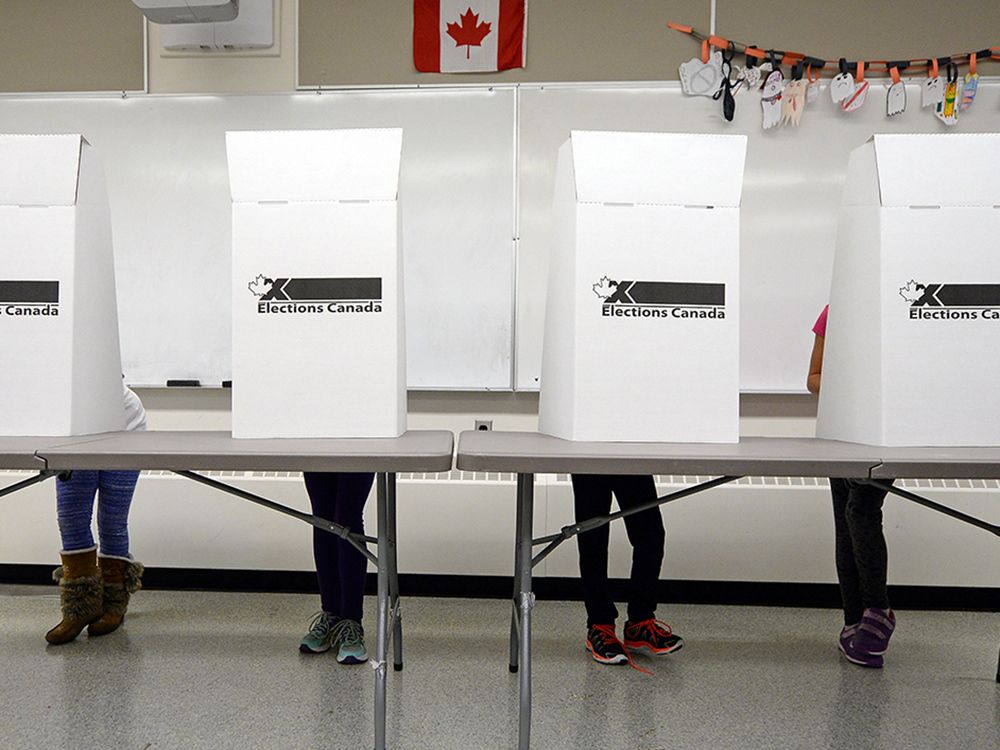
A few years ago, Elections Canada asked Canadians a

series of questions

relating to the 2019 election. For astute political observers, they shouldn’t have been hard.

They included questions such as: “Which level of government has primary responsibility for health care?”; “Which party promised to abolish the carbon tax?”; and what was Chrystia Freeland’s position over the past year.

On

average

, Canadians over 35 correctly answered five of the questions, while those between the ages of 16 and 22 could only answer two.

I don’t think there’s anything wrong with this, per se. Youth is a time for dreaming big and having fun. It shouldn’t necessarily be wasted fretting over the fate of the world and reading stuffy newspaper columns.

But do we really want more idealist, low-information voters making decisions on who is going to run our country and how governments spend our money?

And if you think political proselytizing is a problem in schools today, just wait until all those hippie teachers realize their gullible high school students could change the course of an election.

There have already been a few failed attempts to reduce the voting age in Canada, and lobbying groups intent on lowering the minimum age are celebrating Starmer’s announcement and hoping it will spur action on this side of the pond. But lawmakers should be wary about emulating Great Britain’s Great Youth Enfranchisement Experiment here at home.

National Post

jkline@postmedia.com

Twitter.com/accessd


Via Rail's

ON BOARD THE CANADIAN — One hundred and fifty years ago, on the left bank of the Kaministiquia River, four miles from Thunder Bay, the first sod was turned for the main line of the Canadian Pacific Railway. It was a June afternoon in 1875.

“We have met today for no other purpose than to inaugurate the beginning of the actual construction of the Canadian Pacific Railway,” said Judge Delevan Van Norman to the assembly of some 500 dignitaries.

In this sesquicentennial summer of patriotic holidays prompted by the American menace — or more precisely, one menacing American — when better to board The Canadian, Via Rail’s four-day trip from Vancouver to Toronto — over the Rockies, across the plains, around the Great Lakes and down the Canadian Shield?

It’s not exactly elbows-up in a sleeper berth or the dining car, but from each according to his ability, as our prime minister certainly did not say. Yet with George Grant, Pierre Berton and Richard Gwyn in my mobile library, it is a propitious time to think about the Canadian project. My copy of

Lament for a Nation

 belonged to the late Hugh Segal, so memories of eminent Canadians are company along the rails.

A century and a half of history asks if we are still capable of great projects. Prime Minister Mark Carney insists that we are, and Parliament recently passed a bill fast-tracking projects of national importance. No project was ever as important as the CPR was to the nation. It made the nation.

Judge Van Norman spoke of recent immigrants to Canada, who “seeking a new home in this new world, but still under the old flag, may with celerity, safety and certainty examine the country from Cape Breton in Nova Scotia to Vancouver’s Island in British Columbia, in the meantime passing over a space as vast as the great ocean that divides and separates the old world from the new.”

Canada was still new in 1875; less than 10 years had passed since Confederation. This Sunday (July 20) marks the anniversary of British Columbia joining the fledgling Dominion in 1871. Sir John A. Macdonald promised a national railway as a condition of joining. It was an reckless promise to make, impossible to fulfill in any timely manner. Sir John A. kept his promise.

It was a national project, not a partisan one. Scandals over CPR contracts drove Sir John A. from office in 1873, but the project was continued by his successor,

Alexander Mackenzie

, Canada’s first Liberal prime minister. How important was the CPR? Mackenzie appointed himself his own minister of public works, directing the railway project himself.

There were other considerations in the 1870s beyond linking B.C. to the eastern provinces. The Americans had concluded their Civil War in 1865, with an enormous number of men under arms. Standing armies do not always remain standing around, so there was fear that troops might be turned north to occupy the vast territory between the Great Lakes and the Pacific Ocean.

Pierre Berton

, chronicler of

The National Dream

— his 1970 book — observed that “the Canada of 1871 was a pioneer nation without an accessible frontier. The Canadian Shield was uninhabitable, the North West virtually unreachable. The real frontier was the American frontier, the real West the American West. As the decade opened, a quarter of all Canadians in North America were living south of the border.”

Some went for adventure, some for economic opportunity. Canadians who wished to go out west had to go south. The “North West” — the Hudson’s Bay territory of

Rupert’s Land

— was too forbidding.

Rupert’s Land was an immediate priority after Confederation. That same year, 1867, the Americans had bought Alaska. Would they buy Rupert’s Land — one-third of Canada by land mass — too?

Canada got Rupert’s Land, but what to do with it? Jacques Cartier famously referred to the north shore of the Gulf of St. Lawrence as the “

land God gave to Cain

.” What would he have said about the North West?

Berton opens

The National Dream

 with a sketch of the North West.

“How many white men inhabit this empty realm?” he asks. “Perhaps twenty-five hundred. Nobody knows for certain because there has never been an accurate census. The North West is a scattered archipelago of human islets, each isolated from the others by vast distances and contrasting lifestyles — Scottish farmers, Métis buffalo hunters, Yankee whiskey traders, French missionaries, British and Canadian fur merchants. In the lonely prairie between these human enclaves the nomadic and warlike Indian bands roam freely.”

Canada managed in 10 years to conquer the North West, and the Rocky Mountains! From 1875 at Kaministiquia to the last spike at Craigellachie in 1885 – the railway was completed, the country united, the dominion secured.

Are we capable of such now? Toronto’s 19-kilometre Eglinton LRT line is now 14 years into construction and not yet complete. It’s not possible in 2025 to ride the rails across Eglinton Avenue. Better then to board The Canadian, from the Pacific Ocean to Lake Ontario.

National Post