



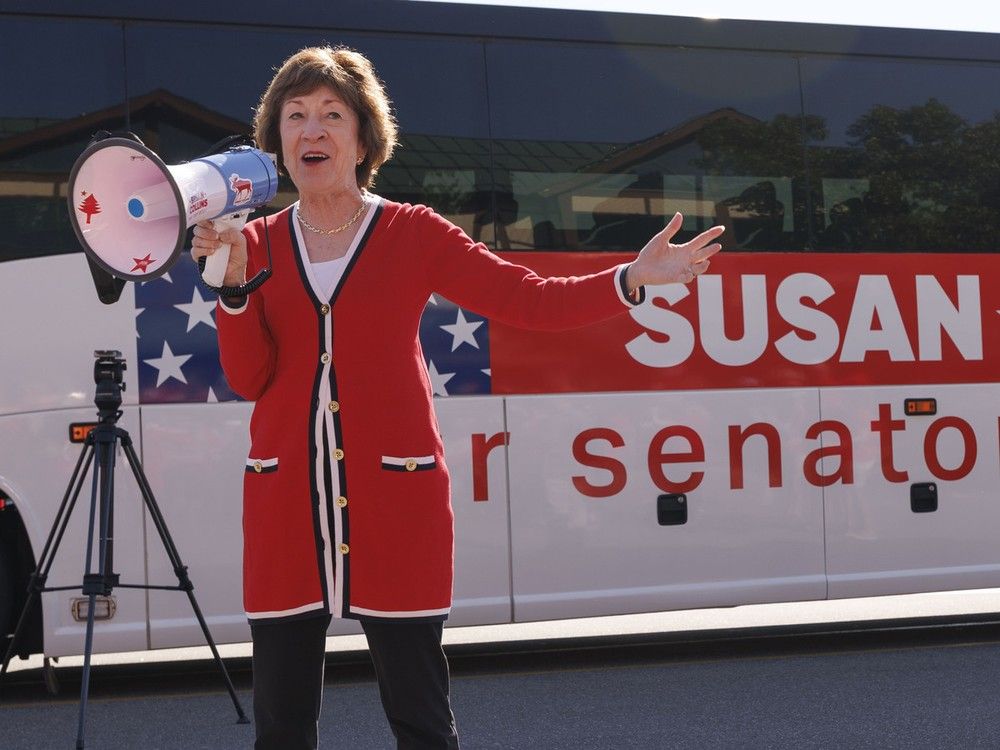
WASHINGTON, D.C. — The last time Maine voted for a Republican presidential candidate was in 1988 for George H. W. Bush, yet in every U.S. Senate race since 1996, the Pine Tree State has elected Republican Senator Susan Collins.
Even in 2020, when Democrats tied the race to a broader referendum on Donald Trump — and polls predicted she would lose to Democrat Sara Gideon — Collins prevailed. Some Mainers split their tickets, voting for both her and Joe Biden.
But now, with President Donald Trump’s approval ratings low and tensions with Canada worsening, many pollsters and analysts wonder if Collins’s political fortunes will fade this November.
“I was cautiously optimistic that Susan Collins — after Graham Platner was such a disaster — was going to pull this off in Maine, and then Trump does this,” said Andrew Hale, fellow for Advancing American Freedom, referring to the reignited tariff war with Ottawa.
Hale noted how Collins has worked to put space between herself and Trump.
“She shrewdly has distanced herself from the president and J.D. Vance, who are not popular there,” he said. “She’s articulated why (the tariffs) are wrong for Maine voters … and has actually done quite a lot when it comes to trade to oppose President Trump’s trade war.”
On August 24, Collins did not attend Vice President JD Vance’s event in Brewer, Maine, where he defended Trump’s tariff war with Canada while campaigning for Republicans. Her campaign cited a scheduling conflict, and Hale called Vance’s trip “really, really unhelpful to Susan Collins.”
The senator has written to U.S. Trade Representative Jamieson Greer and Commerce Secretary Howard Lutnick, seeking clarity on the tariffs and urging a resumption of U.S.-Canada trade talks. She has also voted in the Senate to rescind some of Trump tariffs.
But pollsters and analysts are unsure whether that will be enough to help Collins win the crossover votes she needs from some Democrats and Independents this cycle.
A July University of New Hampshire Survey Center poll found Democrat Troy Jackson leading Collins, 49 per cent to 46 per cent. A Fox News Poll conducted by Democratic pollster Beacon Research and Republican pollster Shaw & Company Research in early August found Jackson leading Collins 48 to 46 per cent.
Sabato’s Crystal Ball, a nonpartisan weekly online political newsletter, lists the race as a toss-up, while Inside Elections rates it Tilt Republican and the Cook Political Report rates it Lean Republican.
“It’s gonna be hard for her to win,” said Andrew Smith, director of the UNH Survey Center, but noted that she could still pull it off. “I don’t want to dismiss her,” he said, noting how she would need more than 60 per cent of the Independent voters and probably 10 per cent of Democratic voters to do it.
Nathan Gonzales, editor and publisher of Inside Elections, explains why it’s tough to predict the Collins race. “The senator has earned the right to be given the benefit of the doubt in her races,” he said. “In 2020, she was behind in most of the polls and won in a race that wasn’t particularly close.”
Likewise, Chris Stirewalt, senior fellow at the American Enterprise Institute, said, “I think we’re all a little snakebit by 2020 because her overperformance was so remarkable.” But he also acknowledged 2026 will be harder.
“She’s a remarkable survivor, but this is definitely her toughest test yet,” Stirewalt added.
Gonzales said Collins faces a tougher task holding onto crossover support.
“Voters are just less likely to go against the partisan lean of their state,” he said.
But Kyle Kondik, managing editor of Sabato’s Crystal Ball, still thinks non-Republican Mainers who have voted for Collins in the past may continue to do so.
“There might be just something about Maine that makes it more open to splitting its tickets,” Kondik said.
Stirewalt believes Collins’ personal popularity could produce an unusually large bloc of late deciders. “There are going to be a larger than usual portion of Maine voters who hem and haw over that race because they do like Collins, and they do trust her, and think that she is a good person.”
“It’s gonna be harder for them to flip the switch in their brains,” he added.
Democrats are framing this and other races around affordability — a major issue this midterm season for all voters — and in Maine and other border states, Trump’s tariff policies are likely to play into that.
On Tuesday, Sen. Chuck Schumer introduced a bill called the “End Trump’s Tariff Tax Act” that Democrats say would revoke the administration’s newest tariffs and refund duties already paid. The legislation faces steep odds, thanks to the Republican-controlled Congress, but it’s meant to give Democrats a way to pressure Republicans over the tariffs before the midterms.
“Tariffs are a huge part of the conversation in Maine right now,” said Stirewalt.
“This tariff war totally makes (the affordability crisis) worse,” said Hale. “It has the potential to make it so much worse.”
“It’s ruinous for people who are trying to get elected in border states,” he added.
Both Hale and Kondik argued that Trump’s Canada policy was politically damaging to Republican candidates.
“If Trump were actively trying to undermine Republicans, would he be doing anything different? I don’t know if he would be,” said Kondik.
“If he cared anything about Republican candidates trying to get elected in the midterms, he would end this,” said Hale, referring to the U.S.-Canada trade tensions.
Stirewalt said he expects Republicans to push back hard on the affordability narrative and that “the cavalry is already there and will continue to come in for Collins.”
Republicans’ strategy will focus on “making Troy Jackson an unacceptable choice,” he said.
So could a deal be forged that would help Republicans, including Collins, before the midterms ?
Most analysts say a deal would help Republicans, but it would need to be soon.
“If before the end of September the dispute with Canada was resolved, it would be in time to help Susan Collins,” Stirewalt said.
Gonzales, however, thinks it may already be too late. “A challenge is that voter sentiment is rarely sudden,” he said. So while the president may say there’s a deal, “it will likely take time to have a real-world impact for voters to change their mind on what’s happening.”
Our website is the place for the latest breaking news, exclusive scoops, longreads and provocative commentary. Please bookmark nationalpost.com and sign up for our newsletters here.