



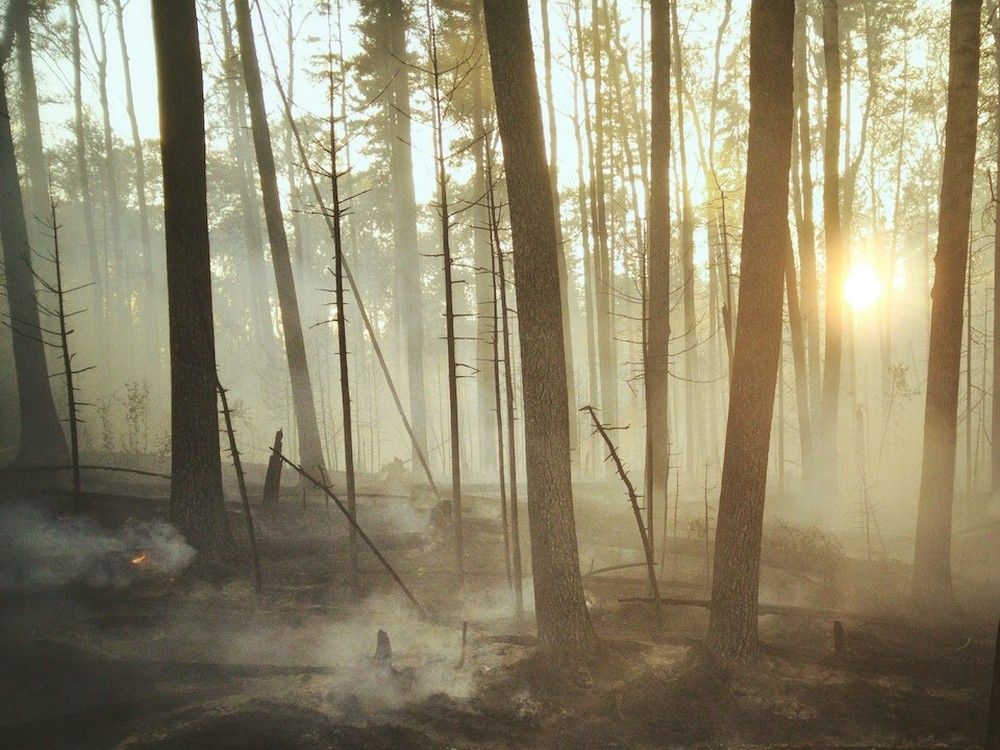
If trust falls in the forest, but there is nobody there to witness it, does anybody notice?
For a long while now, public opinion data have documented declining levels of trust in government by citizens. That is part of a pattern of eroding trust in all institutions — commercial, cultural, ecclesial.
What happens when governments lose trust in their own people? That seems to be the case in Nova Scotia, where sweeping measures aimed at preventing forest fires have essentially banned freedom of movement in the woods.
Colby Cosh had a
here with the total ban on arboreal perambulation, fretting about a metal walking pole hitting a rock, creating a spark, igniting the forest and burning down Halifax.
Extreme measures to prioritize safety have been a political and cultural norm for decades. Pandemic restrictions were the most high-profile example, but for decades now, expectant and nursing mothers, universally and scrupulously, avoid even a few molecules of the demon booze, even for years at a time, lest the mere bouquet of a Bordeaux inflict rampaging fetal alcohol syndrome upon their babies.
That’s not a law, but standard medical advice rooted in the premise that mothers cannot exercise good sense and moderation about such things. Don’t blame the doctors entirely either; the cultural enforcement of that norm is fiercely enforced.
The priority of safety over liberty has enjoyed wide popular support for some time — mandatory seat belts, helmets for hockey and cycling, permission slips to pick up children’s friends from school and burdensome measures at the airport. There is little controversy about any of that.
Maritime Canadians appear to enjoy the smack of firm government, delighting as they did with the most severe pandemic restrictions in the country. They were not wholly singular though; it is forgotten now how popular the pandemic restrictions were across the country, with only less enthusiasm in Alberta.
That the Nova Scotia fire restrictions are overkill is really the point. In times of danger, severe measures are required for untrustworthy people. Hence, lockdowns in prisons where there is trouble in the air.
The Nova Scotia government reports that nearly all wildfires are caused by human activity, accidental, not arson. A campfire not properly extinguished, a cigarette butt carelessly thrown away, the hot exhaust of an all-terrain vehicle in the tall, dry grass. It would be possible to ban those things in times of imminent danger, not merely walking in the woods. But the Nova Scotia government does not trust Nova Scotians to refrain from mischief when hiking, so therefore no hiking.
It’s been more than thirty years since Francis Fukuyama published his eponymous
, with a focus on economics. Trust was essential to lowering the transaction costs of trade, Fukuyama observed. The more steps required to verify the trustworthiness of a potential customer or supplier, the more expensive trade becomes, and the less economic activity results. High trust societies can have highly efficient wealth-creating markets. Low trust societies cannot.
At the micro level, online shopping only functions because there is a high level of trust on the part of consumers that they are not going to be swindled by whomever they just authorized to bill their credit card. At the macro level, money itself depends upon widespread trust that the national government and bank will honour the value of currency.
One reason for the rise of private cryptocurrencies was declining trust in such institutions. Of course, those holding cryptocurrencies put their trust in other agents — not always wisely.
Fukuyama’s observations — not original to him — do not only apply between private actors. Trust is essential in government-citizen interactions. In countries where there is low trust in the honesty and competence of the state, tax avoidance is much greater. Government regulation is only effective if citizens are generally willing to abide by the rules. If they feel at liberty to flout them, or to bribe the enforcing officials, a tool of governance is lost.
Law enforcement authorities are granted quite formidable powers, including arrest and incarceration. If those powers are used arbitrarily and unfairly, a criminal justice system eventually becomes an instrument of power, not justice. That claim is made by no less than the president of the United States, with Donald Trump arguing that is what was done to him.
Trusting strangers is essential for economics and for politics — really for any civilized order. It cannot, though, be generated by the market itself, which operates on self-interest, or the state itself, which operates on power. Trust must be generated in the institutions of culture — families, churches, neighbourhoods, fraternal associations.
When trust is lost, it is enormously difficult to restore. Ask any wife of an adulterous husband, any abandoned friend, or any betrayed business partner.
Nova Scotia has judged its residents — or at least a dangerous number of them — to be untrustworthy. Thus the woods will be empty. Can anyone hear the trust falling?
National Post

