



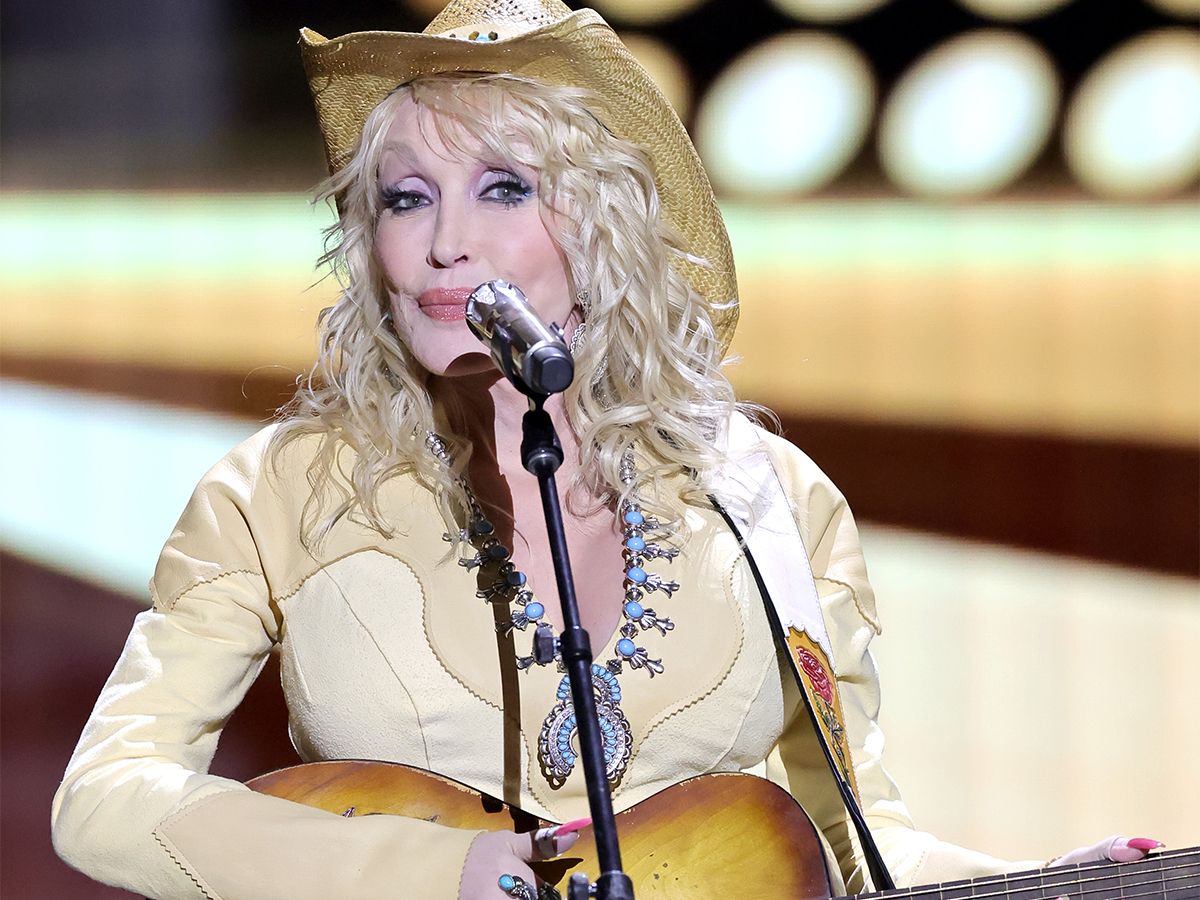
Over her long and delightful career, people stopped laughing at Dolly Parton and simply began loving her.
She had joined in the jokes from the beginning, defusing the disdain they contained for the hillbilly girl from the hovels in the hollers, who took the bus to Nashville the day after her high school graduation, her belongings packed into four shopping bags from the local Piggly Wiggly.
She wanted to be a music star and the 18-year-old who grew up in a one-room cabin with neither electricity nor running water was utterly confident that she could be. With an astonishing songwriting ability — her publishing catalogue contains thousands of songs — and a voice to match, she stepped into her high heels and marched out of grinding poverty, becoming one of the most glamorous figures in country music.
At five-foot-nothing, she created an outsized persona, the buxom blonde in big wigs and tight costumes, all glitter and rhinestones. She revelled in it even more than those who ridiculed it. She never appeared in public without being fully made up, telling all and sundry that “it takes a lot of money to make me look this cheap!”
When she arrived in Nashville in the 1960s, there were few female country music stars. They knew well that certain good ol’ boys might seek to take advantage of what they likely regarded as a dirt-poor dumb blonde, desperate to make it. The grand old dames assured Dolly that they had her back.
“It’s not my back the old fellers are interested in,” Dolly laughed back.
It turned out that Dolly could take care of herself, proving to be more savvy than the old fellers in the business of music. Famously, she declined to let Elvis Presley cover her “ I Will Always Love You” when his manager insisted on 50 per cent of future royalties. Whitney Houston would later make it one of the monster hits of all time, and Dolly made so much money that she chuckled, “I could buy Graceland!”
While recording chart-topping and award-winning songs in the 1970s, Dolly shifted from something of a caricature to become an admired character with the 1980 movie 9 to 5 , where she held her own with established actresses Lily Tomlin and Jane Fonda. The comedy told the story about working-class women who were badly treated by the old fellers. The eponymous song was a hit. Underneath the fake hair and fake nails was a woman who told true stories — her own and those of so many such women — with sincerity and sympathy. And the songs were so very good.
At the end of the 1980s, Dolly returned to the big screen in Steel Magnolias , taking her place this time alongside accomplished actresses Shirley MacLaine, Olympia Dukakis, Sally Field, Julia Roberts and Daryl Hannah. It was an endearing tale of Southern women telling stories about being Southern women, pretty as flowers and strong as steel. Dolly wrote “ Eagle When She Flies” for the film, though it was not used. She released it later herself, telling her story in song; indeed she would later call herself a “songteller.”
“She’s a woman/ she knows how to dish it out or take it all,” Dolly wrote, as much about herself as her role. “Her heart’s as soft as feathers, still she weathers stormy skies/ And she’s a sparrow when she’s broken/ But she’s an eagle when she flies.”
“Gentle as the sweet magnolia, strong as steel her faith and pride/ She hurts deep, and when she weeps, she’s just as fragile as a child … Oh, bless her, Lord.”
The screenplay for Steel Magnolias allowed Dolly’s character — Truvy Jones, the hairdresser who owned her own beauty parlour — to speak as Dolly, the storyteller.
“There is no such thing as natural beauty,” Truvy declares in her salon, where women share burdens, wisdom and gossip.
“Laughter through tears is my favourite emotion,” Truvy says, explaining many of Dolly’s greatest hits. “I really wish I had some words of wisdom but I don’t so why don’t just focus on the joy of the situation.”
Or put more directly: “I have a strict policy that no one cries alone in my presence.” When Dolly sang sad songs, it was so that others might be a little less sad.
Forty years ago, Dolly opened the Dollywood amusement park in the marvellously monikered Pigeon Forge, Tenn., in her native Sevier County and near the Great Smoky Mountains National Park. Dollywood was the flagship enterprise of the Dolly Parton business empire, making her one of her generation’s most successful women entrepreneurs.
With her profits she pioneered a different kind of philanthropy, in addition to the usual things rich people do, like donating to the children’s hospital in Knoxville, Tenn., which bears her name after an undisclosed “generational” contribution.
Ten years ago, she sent $1,000 cheques for six months to families in Sevier County who lost their homes in the Smoky Mountains wildfires in 2016.
Growing up one of 12 children to a hard-working, creative but illiterate father, Dolly started the Imagination Library 30 years ago, sending free books to families in Sevier County — one book a month from birth to six years old. The Imagination Library, now in partnerships across the U.S. and abroad, including in Canada , has sent more than 322 million books to young children. Songtellers first need to read stories before they can write their own.
When Taylor Swift was looking for a philanthropic dimension to her summer wedding last month, she gave $2 million to the Imagination Library.
At Dollywood there is a pavilion for bald eagles that cannot live in the wild due to injury or disability. At daily exhibitions, visitors can witness the beauty and majesty of birds which would otherwise be overlooked, beaten down by life, hidden away in the hollers.
Broken like sparrows, the eagles have a place at Dollywood, and in Dolly’s heart, which was the biggest thing about her.
National Post

