


More than 50 years ago it was said that only Nixon could go to China. Now everyone can go to China. A great many did this past week as the Chinese communists put on quite a diplomatic show.
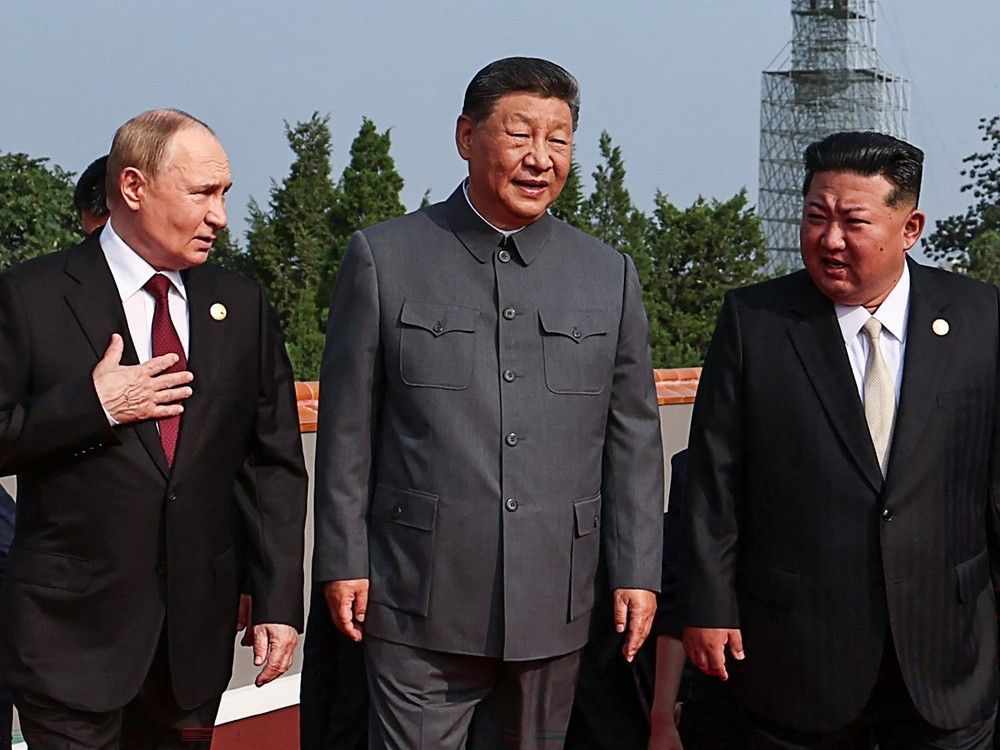
President Xi Jinping even enjoyed a bit of implicit needling of President Donald Trump. Trump had his big military parade in June by himself; Xi had his with honoured guests Vladimir Putin and Kim Jong Un, two men with whom Trump boasts he has very good relationships.
“Nixon-to-China” suggested that only a figure with hardline anti-communist credentials could make overtures to Mao. And it was accepted by the early 1970s that such overtures were necessary. The diplomatic isolation of China after the 1949 communist revolution had not led to reform in Beijing, and risked driving China into an alliance with Soviet Moscow. Somebody had to go to China to prevent that, and Richard Nixon was the man.
History turns and turns again. Wednesday’s military parade in Beijing commemorated the 80th anniversary of the defeat of Japan in World War II. While the emperor had surrendered in a radio address on Aug. 15, the actual treaty of surrender was signed aboard the USS Missouri in Tokyo Bay on Sept. 2.
Amongst the victorious allies signing were the United States, the Soviet Union and (pre-Maoist) China. Just as the Soviets took the heaviest losses in the defeat of Nazi Germany, so too did China bear the brunt of imperialist Japan’s aggression. While Canadians tend to think of World War II primarily in its European theatre, the National World War II Museum in New Orleans considers the relevant dates 1937 to 1945, i.e., beginning with the Sino-Japanese war, not the invasion of Poland in 1939.
The United States, Soviet Russia and pre-Maoist China were allies then. By the 1970s, the challenge was to prevent communist Russia and communist China forming a powerful pact against Washington. After the Cold War the supreme western challenge was to see whether Russia and China could be integrated into a liberal order of (quasi-) democracy, human rights and market-oriented trade.
Contrariwise, since 2014, and more intensely since 2022, Russia’s Putin has sought the reversal of what he regards as the “greatest geopolitical tragedy of the 20th century” — the defeat and dissolution of the Soviet Union in the Cold War.
The diplomatic question of 2025 has been what will become of Putin’s attempted reversal through his war against Ukraine.
Can President Trump stop the war in Ukraine by himself? Attempting that would require taking steps against Putin that he has been unwilling to countenance thus far, for example, seizing frozen Russian assets held abroad, and ramping up military provision for Ukraine.
Instead, as Trump more fiercely threatened consequences for Russia this summer, Putin escalated his attacks on Ukraine, including Kyiv, to no consequence whatsoever, aside from a ride in the presidential limousine in Anchorage. Instead of direct American action, Trump levied massive taxes on Americans who import goods from India, an attempt to persuade India to cease buying Russian oil.
In Shanghai, Putin took Indian Prime Minister Nahendra Modi for a ride in his limousine, perhaps to thank him for buying Russian oil, or for standing up to Trump, or just to imitate the convivial atmosphere of Alaska.
Trump calculates that punishing American importers and Indian exporters can persuade India to pay more for oil, replacing cheap Russian supplies with more expensive non-Russian sources. The broader premise is that India can do something significant to dissuade Putin from continuing his war. The still broader question is whether China and India together hold enough influence over Russia to stop the war. A related question is whether, if they could, would they?
This week’s Shanghai summit and Beijing parade indicate that the answer to the last question is no. Whatever influence Beijing and Delhi have over Moscow, they are not willing to use it to reverse Russian aggression. Quite the opposite, to the extent that the Ukraine war is against the interests of Europe and the United States, it appears that both Xi and Modi are inclined to smile upon it. Or at least to accept it as a reasonable (Ukrainian) price to pay for a world in which China, India and their allies have greater scope for action independent of, or even contrary to, the interests of the United States. Trump’s tariff war against both China and India may have confirmed them in that view.
Trump had wanted Putin to be invited to the G7 in Alberta last June. He didn’t get his way, and had to content himself with entertaining Putin solo in Alaska. Now Putin has been feted in Shanghai and Beijing in the company of India and North Korea. Summer 2025 turned out much better for him than even Trump had planned.
National Post

