



The Ontario government’s 2023 decision to use
privately owned clinics to boost cataract-surgery capacity
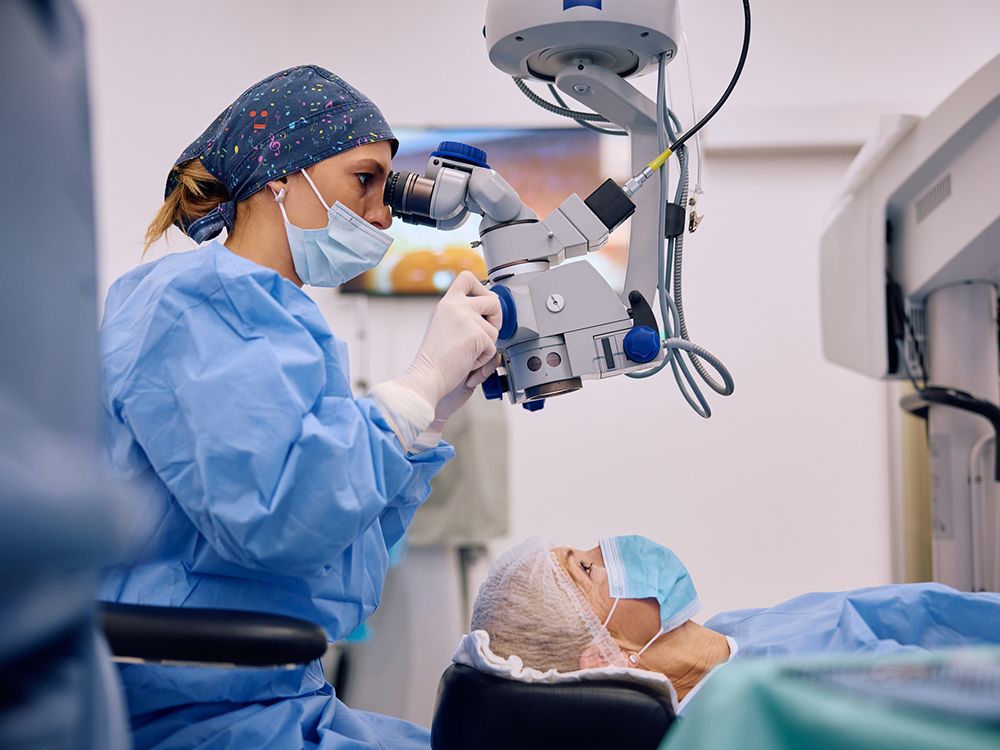
was one of the smartest health-care moves the province has made. This common eye surgery is a simple procedure that does not require a hospital setting and the clinics are faster and more efficient because they concentrate on just one thing.
The new approach allowed 32,000 extra cataract surgeries in 2023–24 the Ontario Ministry of Health reports, and the number of procedures is expected to double this year. Despite that, the Ontario Health Coalition (OHC) is doing everything it can to discredit and undermine the clinics.
The coalition bills itself as a grassroots group whose “primary goal is to protect and improve our public health care system,” but in reality it is against anything it considers privatization, and uses overblown rhetoric to make its case.
To listen to the health coalition talk, clinic-based cataract surgery in Ontario is little more than a scam designed to bilk elderly patients.
Coalition executive director
that despite cataract surgery being covered by OHIP, “elderly patients are being required to pay increasingly outrageous amounts of money for their surgeries in violation of our medicare laws that explicitly make such charges illegal.”
“Essentially it’s like there isn’t public medicare when it comes to eye surgery in Ontario. It’s gone,” she claims.
That last statement would be alarming, if it was true, but it’s not. Not even close.
Cataract surgery is the most common surgery in Canada. In Ontario in 2023–24, almost 177,000 people received the procedure that replaces an age-clouded lens with a clear artificial lens. Of those procedures, 143,800 were done in public hospitals.
Public eye-care in Ontario is not gone, it’s just basic, like most things the public Ontario Health Insurance Plan provides. The government covers the cost of the surgery, ultrasound measurement of the eye and a standard lens.
Rich Weinstein, chair of the Eye Physicians and Surgeons of Ontario (EPSO), says the standard lens is all that’s required if a patient’s only vision problem is cataracts. He says laser measurement of the eye gives a more accurate prescription for the required lens. The province doesn’t cover that and it typically costs about $300. The patient has the choice whether to get the laser measurement.
The EPSO website provides useful
information on cataract surgery and lens choices
.
Cost and complexity enter the picture when a patient wants to make the perfectly reasonable choice to correct not only for cataracts, but for other vision-blurring conditions like astigmatism. The lenses that fix these problems can cost from $800 to $2,575 per eye, depending on type.
The government does not cover those other lenses on the premise that OHIP’s responsibility is to prevent blindness, not to perfect everyone’s vision. Just as the government doesn’t cover the cost of glasses, it doesn’t cover lenses for non-cataract vision issues.
The health coalition seems offended that patients are offered these choices, but what business is it of theirs? People can spend money on enhanced lenses to fix their vision problems or they can spend money on glasses. The lens choice doesn’t involve any extra cost to the public system.
In the view of hardcore proponents of public health care, all care must be provided directly by government, not a penny can change hands directly, and everyone should receive exactly the level of care approved by government and nothing more. It’s an inflexible, out-of-date approach that denies patients the right to make choices for themselves.
The OHC would like to see eye surgeries take place only in hospitals, or at least be conducted under hospital supervision, but the health coalition’s vision of good, honest doctors working in hospitals versus greedy, dishonest doctors working in privately owned clinics doesn’t pass the reality test.
Doctors who work in clinics typically do work in hospitals, too. The more expensive lenses that fix more eye problems are available to patients getting their work done in hospitals, not just in clinics.
The OHC has rounded up 50 patients who say they were sold lenses they didn’t require, or even were charged for surgeries that OHIP covers. The coalition will lodge formal protests this week with the provincial and federal governments.
Perhaps there is substance to these complaints. If so, the health coalition should forward them to the College of Physicians and Surgeons of Ontario for investigation. Mehra says some patients feel intimidated by that process. Maybe the OHC could help them. That would be doing something useful.
What isn’t useful is attempting to undermine the cataract-surgery clinic program because the service is provided by privately owned businesses. The typical doctor’s office is privately owned, as are many of the province’s diagnostic clinics.
Unfortunately, ideology blinds some to the advantages of private-sector health care involvement, even the extremely mild version offered in Ontario.
National Post
randalldenley1@gmail.com
Get more deep-dive National Post political coverage and analysis in your inbox with the Political Hack newsletter, where Ottawa bureau chief Stuart Thomson and political analyst Tasha Kheiriddin get at what’s really going on behind the scenes on Parliament Hill every Wednesday and Friday, exclusively for subscribers. Sign up here.