



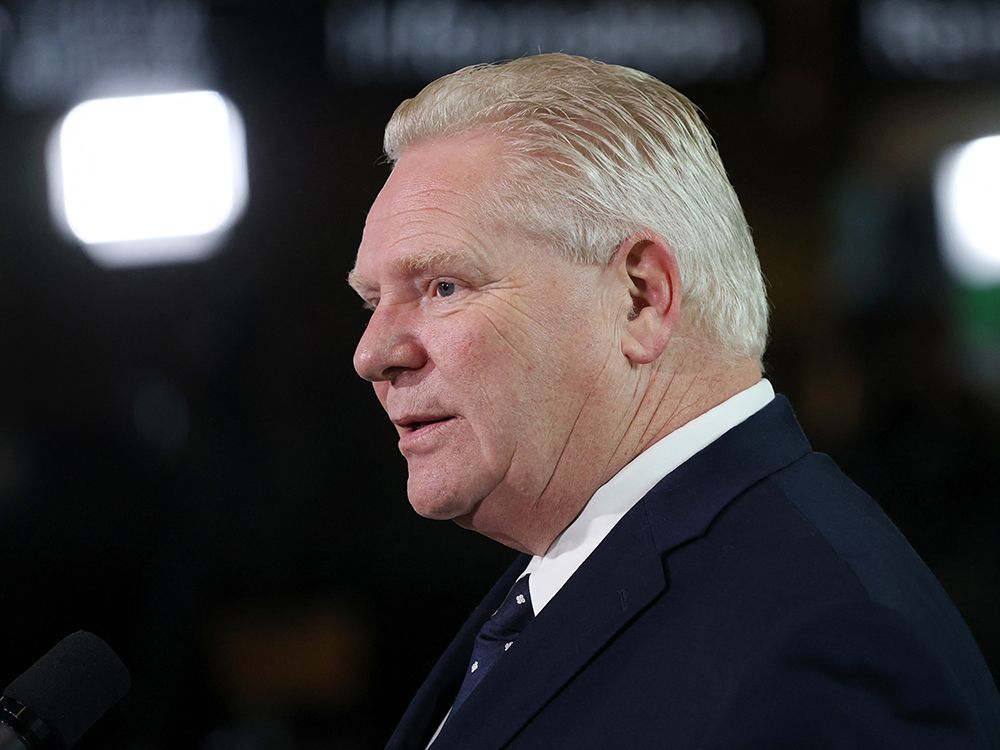
Ontario Premier
is billed as a plan to protect workers, businesses and communities from U.S. tariffs and the economic uncertainty they have caused.
Judged by that standard,
is a middling effort that offers temporary tax deferrals for businesses, retraining for those who lose their jobs, money for heavily affected communities, and contributions to multiple pots of money that are meant to stimulate the economy.
The biggest pot consists of $5 billion to protect jobs, transform businesses and develop new sectors of the economy. Of that, $1 billion is intended for immediate liquidity relief for businesses hit hard by tariffs.
It’s a scattershot effort from there, with money for everyone from grape growers to operators of short-track railroads that serve some industries. This is micro thinking, not macro.
Infrastructure spending will be accelerated this year and next, moving forward about $7.7 billion in spending as compared to what was described in last fall’s economic update. That will benefit companies and workers in the infrastructure industry, but these are not the ones most affected by tariffs.
What’s lacking is an overall, compelling plan that will reduce Ontario’s over-dependency on the American economy and boost its mediocre growth. If you want to make businesses more internationally competitive, cut corporate taxes. If you want to stimulate the economy, cut income taxes. Creating multiple little pots of money that will enable the government to “invest” in this and that encourages companies to look for handouts, not build a stronger economy.
This budget promises to “unleash” the Ontario economy, but real GDP growth is projected at only 0.8 per cent this year and one per cent next year. By comparison, the International Monetary Fund projects
of 1.4 per cent this year and 1.6 per cent next year. The OECD projects
will increase by 2.2 per cent this year and 1.6 per cent next year.
Naturally, this budget follows Ford’s longstanding approach of projecting a budget balance in a couple of years. Wednesday, the premier said, “We can always balance in a year or two.” Presumably he meant always promise to balance in a year or two.
This year’s projected deficit is $14.6 billion and next year it will be $7.8 billion before a tiny surplus occurs in 2027-28. To attain that goal, the Ford government will have to exercise a lot tighter control on program spending than it has recently. Between 2023-24 and 2024-25, base program spending increased by $14.5 billion. The new budget predicts base program spending will only increase $8.2 billion by 2027-28. That sounds like wishful thinking.
The new Ford budget is notably weak on the key issues of affordability, housing and health care.
The budget will make permanent earlier reductions in gasoline and fuel taxes that were announced as temporary in 2022 and renewed regularly since. Great stuff, but that doesn’t put any additional money in Ontarians’ pockets. Tolls will also be eliminated for the provincially owned portion of Highway 407, a modest boon to those that use it, nothing for those who don’t. But let’s not forget the $200 cheques sent out around election time. Already spent it? Too bad.
Ford’s limited affordability efforts look weak compared to the federal government’s personal income tax cut that is
expected to save two-income families $840 next year
. Ford promised a similar tax cut in 2018, but the promise remains unfulfilled.
Housing gets only the lightest attention in this budget, despite the persistent unaffordability issue in Ontario. Some money is added to existing funds that help municipalities pay for new water and sewer services, perhaps reducing development charges. The government has also earmarked $50 million over five years to expand modular housing capacity, an area already heavily targeted by the federal government.
On health care, the budget rehashes worthy plans to build more hospitals and long-term care homes and train more doctors and nurses. It also points to an already announced but rather vague plan to provide primary care for 300,000 additional people this year. The message is patients, be patient.
In all, this new budget relies far too much on reminding Ontarians what the Ford government has done and not enough on what it will do in the future. It feels like the budget of a government in mid-term, not a new government.
Of course, that’s exactly what it is. Earlier this year, Ford paused his government and insisted that he needed a new mandate to take dramatic tariff protection actions. Looking at the budget, it’s hard to see why he needed a special blessing from voters.
Ford is fond of saying it’s “not business as usual” in Ontario these days. Unfortunately in this budget, it mostly is.
Randall Denley is an Ottawa journalist. Contact him at randalldenley1@gmail.com
Get more deep-dive National Post political coverage and analysis in your inbox with the Political Hack newsletter, where Ottawa bureau chief Stuart Thomson and political analyst Tasha Kheiriddin get at what’s really going on behind the scenes on Parliament Hill every Wednesday and Friday, exclusively for subscribers. Sign up here.

