



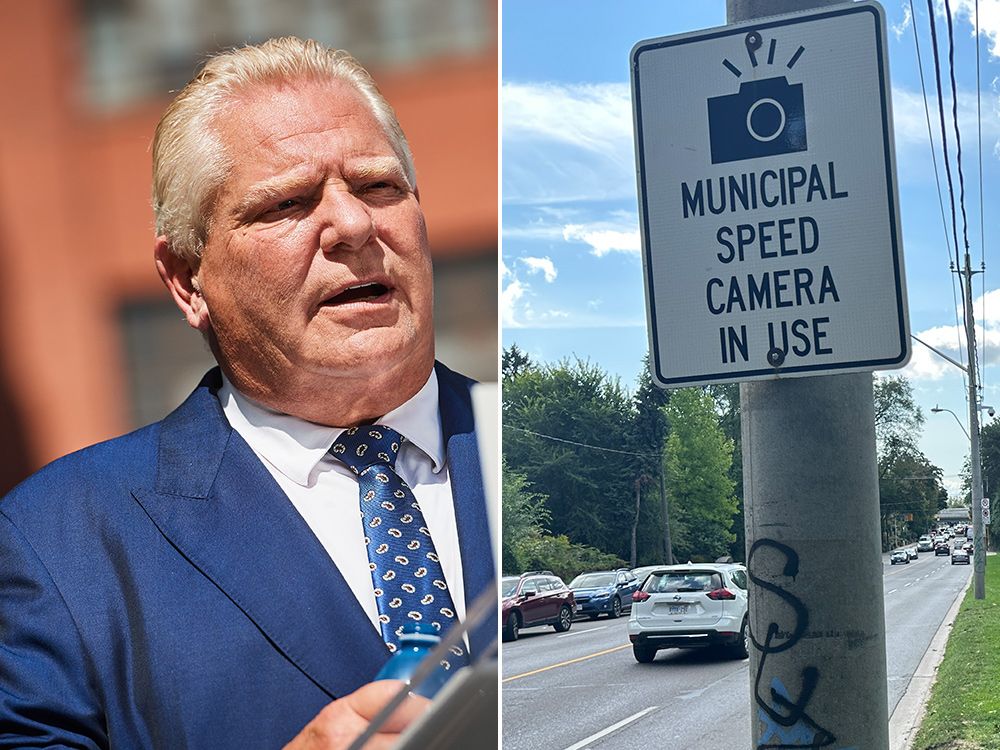
Who is Ontario Premier Doug Ford trying to appeal to with Tuesday’s
threat to eliminate municipal speed cameras
?
It can’t be those with children, who would almost certainly prefer that people drive slowly near schools and parks. And we can rule out people who think that laws should be enforced, a group that ever so recently included the premier himself.
That leaves two groups that would benefit from cancelling speed cameras: speeders and vandals who like to damage speed cameras. What a unique political coalition.
This week’s comments weren’t the first time Ford has criticized speed cameras, but his timing wasn’t great. Speed cameras are in the news because of a wave of vandalism in Toronto, where
in recent days. In all, there have been 800 incidents of speed camera vandalism in Toronto this year.
Ford’s promise to eliminate speed cameras altogether if municipalities don’t do so on their own seemed designed to appease vandals and speeders. What’s the message? Vandalize something and the premier will take up your case? It’s an odd stance from a politician who constantly talks tough on crime and laments the leniency of the courts.
To be fair, when Ford calls these speed cameras a “tax grab,” he’s not totally off the mark, although cash grab would be more accurate. The fines imposed on speeders have been a welcome source of revenue for municipalities.
Toronto took in $40.6 million in speed camera fines last year and has already racked up $45 million this year, partly because it doubled the number of cameras from 75 to 150. The money goes to general revenue but some of it is directed to road safety. The city of Ottawa collected $29 million from speeders last year. The money left after expenses goes to a road-safety reserve fund.
The sheer number of speeding tickets given out is astounding. Ottawa issued 190,000 tickets in the first half of this year. Between January and April, Toronto issued 263,054 tickets.
The city of Vaughan, on Toronto’s northern edge, installed cameras earlier this year and generated 32,000 fines in just two weeks. The response was public complaint and some vandalism. Mayor Steven Del Duca
temporarily as a result, but he didn’t cancel it as Ford claimed this week.
Those numbers would indicate a significant speeding problem. The question is what to do about it. Ford’s solution would be speed-limit signs that are bigger than the ones in community safety zones now, with the occasional presence of a police officer with a radar gun. That seems like a disproportionately small response.
The best test of the speed program is whether it reduces speeding.
According to city staff in Ottawa, it does
.
Prior to the implementation of cameras in designated safety zones, speed limit compliance was just 16 per cent. Within three months of bringing in cameras, it rose to 57 per cent. After one year, it was 69 per cent and after three years 81 per cent. High-end speeding was reduced from 14 per cent to 0.7 per cent. Some would call that success.
A
study by researchers at Toronto’s Hospital for Sick Childeren
in Toronto found similar dramatic reductions. What’s different between the two cities is public reaction. In Ottawa, most people welcome any new rule and can’t wait to follow it. In Toronto, vandals cut down the cameras. What a waste of energy. All they had to do was give the premier a call.
There isn’t much of a case to be made for cancelling the speed camera program, but that doesn’t mean it couldn’t be improved. In fact, Ford’s government
suggested just that back in May,
when it proposed a number of changes to the program, intended to give the province more control. Cancelling it altogether wasn’t part of the plan.
One issue that could be addressed is the very literal interpretation of speeding. Going even one kilometre over the posted limit counts as speeding where a camera is concerned. That seems a bit silly.
Driving 10 km/h over the limit generates a $68.25 fine. One could argue that’s a cheap wakeup call, but a warning for a first offence would be a little more reasonable. After that, if people keep speeding make them pay. It’s their choice, not a “tax grab.”
In summary, the effect of eliminating speed cameras would be less safety around schools, parks and other heavy traffic areas; more speeding; and less revenue for municipalities. On top of that, Ford is downplaying the importance of the speed limits his own government sets. In effect, he’s telling people that it’s OK to speed near schools, or at least that they shouldn’t get a ticket for it.
Ford regularly champions drivers, but sometimes those drivers need to slow down and think. In this case, so should he.
National Post
randalldenley1@gmail.com