


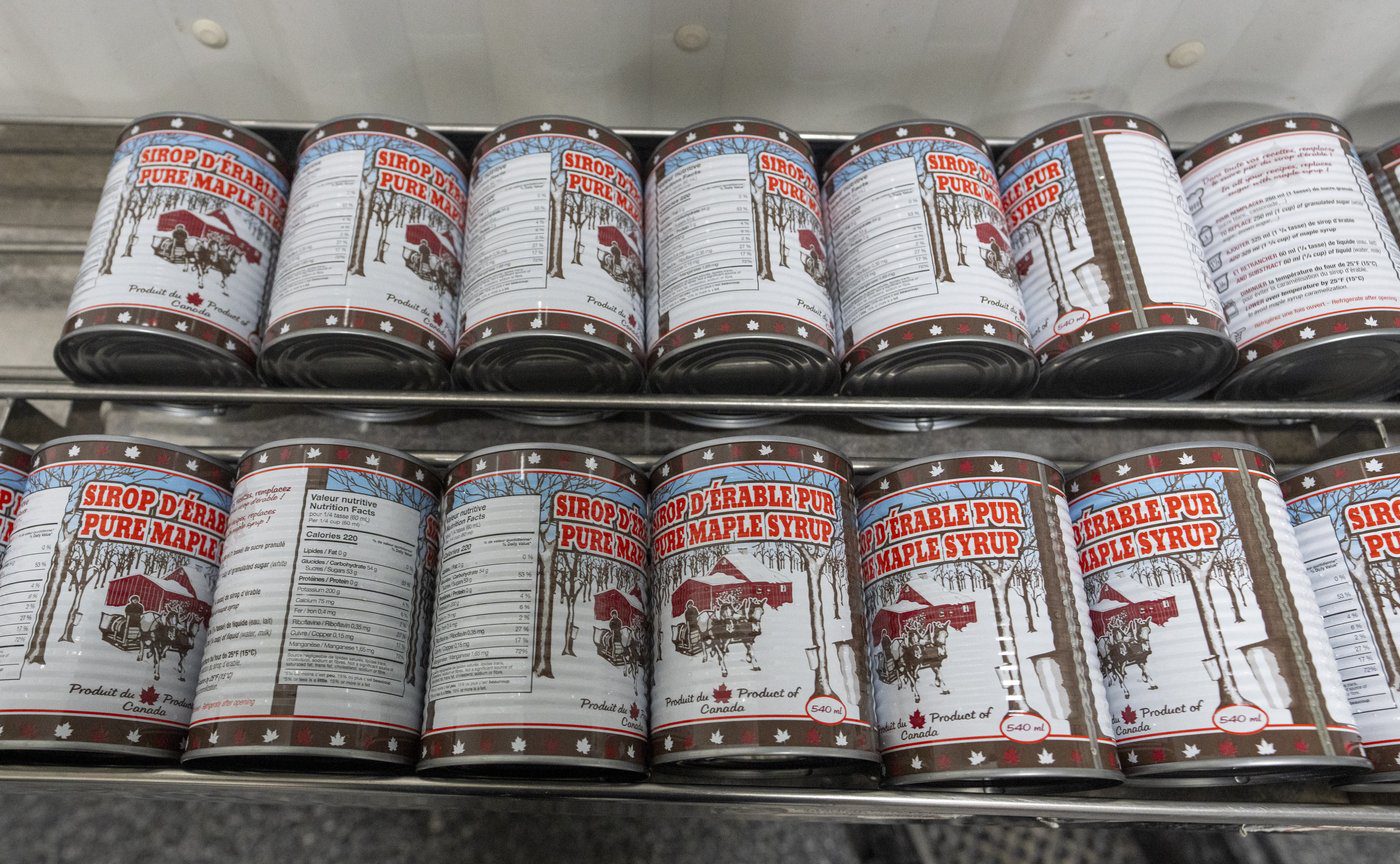
MONTRÉAL — The head of Quebec’s maple syrup producers’ association says the province’s strategic syrup reserve has run dry amid high demand for the product.
Québec Maple Syrup Producers President Luc Goulet says government support will be needed to ensure the industry doesn’t miss out on opportunities to grow the sector.
Maple syrup yields depend on weather conditions.
As a result, the producers’ association has established a strategic reserve to ensure prices and supply remain relatively stable.
Last year, U.S. commercial customers stocked up, fearing that President Donald Trump would carry out his threat to impose tariffs.
Goulet says the buffer has been exhausted as sales continue to rise.
“Our strategic reserve has been reduced to zero,” Goulet said in an interview at the release of a report on the industry’s economic benefits. That means the industry could lose customers if weather conditions are less favourable for maple sap flow, he said.
Goulet cites the stock shortages in 2007 and 2008 as an example.
“We lost some markets because the product wasn’t available,” Goulet said. “Then, consumers very quickly turn to another sweet product. And once that happens, those consumption habits are established.”
Quebec maple syrup is gaining market share abroad, according to the president of the Maple Industry Council, which represents authorized buyers.
Louis Turenne notes that exports increased by 9.34 per cent in 2024 compared to the previous year. The pace accelerated in 2025 with a 15.8 per cent increase as the threat of new tariffs loomed over the industry.
In 2026, exports rose at a slower rate — 2.48 per cent from January through August compared to the same period the previous year. “It’s always hard to beat an exceptional year,” Turenne said.
Goulet acknowledges that satisfying the demand of eager consumers is a nice problem to have. However, he believes the industry can still grow. “There is still a great deal of untapped potential in Quebec’s maple groves,” he said.
Investments from Quebec City “are too low for our liking,” says Goulet, who hopes to have the ear of the newly-elected Parti Québécois government.
“When we’re told that we have an industry that’s thriving, that we’re growing, and that we don’t need support — well, I no longer accept that line of reasoning at the government level,” he said.
For his part, Turenne believes that Quebec could encourage increased production by providing financial support to producers, and helping processors in their search for new markets abroad.
Currently, nearly 65 per cent of maple syrup exports go to the United States “We’ve made significant progress in diversifying our markets in recent years. Twenty years ago, that figure was 80 per cent,” Turenne said.
“But we need to accelerate the opening and development of European, Australian, and Asian markets to become less dependent on the U.S. market,” he said.
While the maple leaf graces the Canadian flag, the syrup industry is heavily concentrated in Quebec. More than 70 per cent of North American production is in the province, according to the industry group’s report, released Thursday.
When production, processing, and specialized equipment manufacturers are included, the maple syrup industry contributed $1.21 billion to the gross domestic product in 2025, the report said.
In total, the sector employs more than 10,000 full-time equivalent workers and generated $285 million in tax revenue, excluding municipal taxes and fees for the lease of public lands.
This figure does not include the sugar shacks that many Quebecers visit in the spring.
“Sugar shack operations are more akin to the restaurant industry,” Turenne said.
The maple syrup producers’ group used the recent election campaign to highlight the industry’s importance as an employer and economic driver, and Goulet says the candidates were often surprised by the important role it played.
In some municipalities, “if you take away maple syrup production, you might as well shut down the villages,” Goulet said.
This report by The Canadian Press was first published Oct. 19, 2026.
Stéphane Rolland, The Canadian Press