



The famous genderless washroom in the 1990s TV show Ally McBeal was a plot device meant for comedic purpose. These days it is no laughing matter. Across Canada, separate men’s and women’s restrooms are rapidly being replaced with unisex facilities.
In Kitchener, Ont., recent renovations have left the 2,000 seat
, the city’s premier music auditorium, with five multi-stall gender-neutral washrooms. These require men and women to line up together to access a series of individual stalls that each contain a toilet, paper dispenser and garbage can. Such an arrangement, which upends centuries of sex-separated bathrooms, brings with it plenty of double-takes, puzzled looks and awkward moments. (Including when I took my 89-year-old mother to the Nutcracker.) But it is by no means unique.
In Montreal, a new washroom at the Université de Montreal’s student services building features a unique circular design with study rooms and couches meant to encourage users to linger all day. It also includes 12 individually-ventilated stalls with floor-to-ceiling doors, and a common area for washing up. Numerous public schools across B.C. have similarly done away with separate boys’ and girls’ washrooms. And the same is planned for the current renovation of Centre Block on Parliament Hill in Ottawa, the seat of Canada’s democracy.
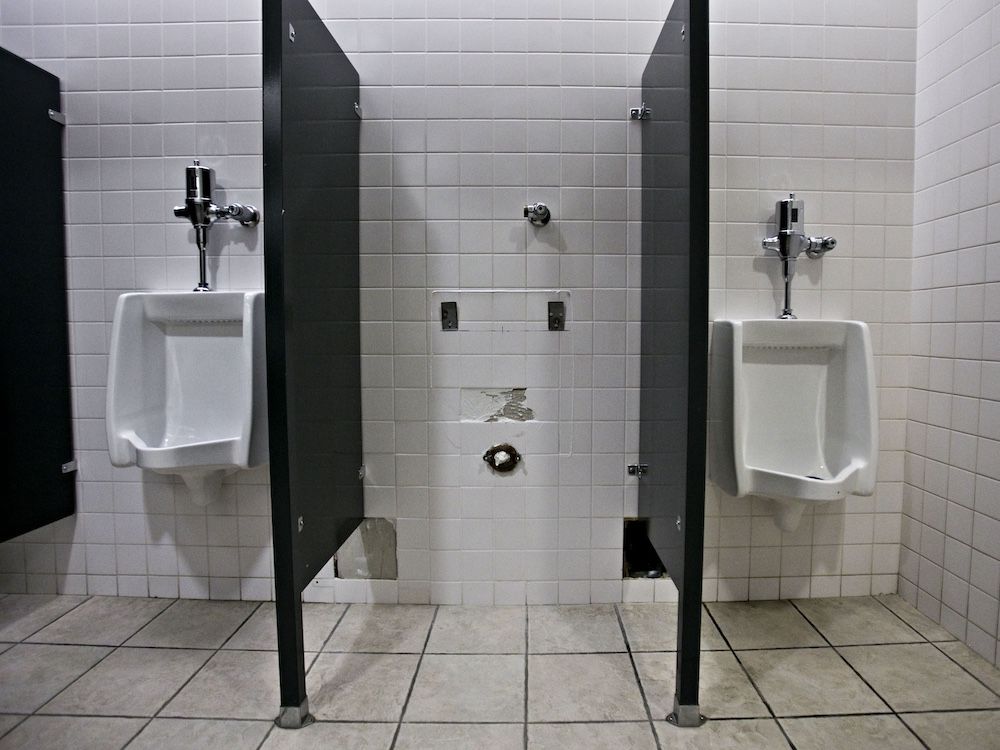
While these bathroom changes have all been presented as bold steps forward for “inclusivity,” there’s one thing genderless washrooms lack. Amid current efforts to rid restrooms of any vestige of traditional male and female differences, the urinal — a uniquely male waste management device — is at risk of disappearing forever. It’s time someone stood up for this unloved, overlooked and occasionally smelly necessity.
The current campaign against urinals finds its roots in efforts to solve the eternal dilemma of why the line at the ladies’ room is always longer. Kathryn Anthony is a professor of architecture at the University of Illinois Urbana-Champaign and a well-known advocate for “potty parity.” As Anthony explained in an interview, “Potty parity means equal speed of access to public toilets for men and women. Women simply take longer to go due to our anatomy and the need to disrobe.” To this end, she has spent decades campaigning for larger women’s washrooms to compensate for the extra time requirement.
More recently, however, the potty parity movement has made common cause with trans-gender activists who seek to eliminate any evidence of biological sex by promoting the concept of universal washrooms, which entail one bathroom line for all. And no urinals. “As we see more and more unisex restrooms,” Anthony said, “we will see fewer and fewer urinals. And not too many people are going to be sorry about that.” That remains to be seen.
While walls and fence posts have served the purpose throughout time, the modern urinal dates back to the Industrial Age, when it became necessary to find a way for working men to relieve themselves quickly on the job. And beginning in the 1830s, Paris began installing streetcorner
to improve public health by giving impatient male passersby a proper place to go. While its male-only concept may suffer for public support today, the urinal remains a marvel of utility and efficiency.
Among its foremost advantages is speed. “Urinals have always served an important purpose in allowing men to pee standing up,” said Klaus Reichardt, founder of Waterless Co. Inc., a California-based company that makes waterless urinals. “And that means we can get in and out of the restroom quicker.” While Reichardt’s system uses no water whatsoever — a major selling feature in drought-wracked California — all urinals save water, which brings up their second major benefit.
Canada’s
requires that a urinal consume no more than 1.9 litres per flush. That compares with 6 litres for toilets designated for industrial, commercial or institutional use. A standard urinal uses one-third the water to perform the same task as a toilet. Forcing men to urinate in unisex toilets thus wastes up to 4.1 litres of potable water per flush. Scaled up over hundreds of millions of flushes, this is an enormous waste. Advocates of genderless washrooms typically see themselves as equity crusaders, but they are also proponents of an environmental calamity.
Urinals are also excellent space-savers since they take up less than half the square footage of toilet stalls, leaving room for other things, such as larger women’s washrooms. And they offer the opportunity to harvest a product very high in nitrogen and phosphorus. Reinhardt eagerly supplies several studies revealing the efficacy of using his product to collect undiluted urine for fertilizer, including a January 2025 study by Spanish researchers, impishly titled “Urine Luck,” that found a cubic metre of “yellow water” can produce 2.4 tons of hydroponic tomatoes.
While urinals outperform toilets on every conceivable measure of efficiency, particularly for men, there is one category in which their disappearance will leave women noticeably worse off. Here we refer not to efficiency, but
accuracy
. Where urinals are replaced with unisex toilet stalls, men will inevitably use them to pee standing up. And because their aim is not always very good, women who enter immediately after a man has just left can face an annoyingly messy situation.
A 2015
of women by U.S. bathroom manufacturer Green Flush Restrooms reveals that “two-thirds of respondents ‘agreed’ or ‘definitely agreed’ that they prefer to use restrooms that are only used by women.” Why? Respondents expressed “the frustration of sitting down on a toilet seat that men have urinated on.” Plus, many women consider the washroom to be a female-only sanctuary where they can relax and chat with friends; having to share it with men destroys that ambiance.
The battle over urinals thus comes down to a clash between strict equity on one hand, and efficiency, cleanliness and cultural preference on the other. Tim Huh is a professor at the University of British Columbia’s Sauder School of Business whose typical research milieu concerns the optimization of business systems such as call centres. In 2019 he applied his analytic toolkit to the issue of optimizing bathroom fairness.
“Universal bathrooms are one way to equalize wait times,” he said in an interview. “There are no equity issues if everyone has to wait in the same line.” But, he added, “urinals are very efficient” and removing them imposes some very large costs on society.
His research suggests that beyond making men wait longer, a shift to genderless, urinal-less washrooms is unlikely to produce significant gains for women since they must now compete with men for the same stalls, and those men will take longer to do their business in the absence of urinals. Universal washrooms, his report concluded, “may not be a proper solution to ensure potty parity.” Instead of getting rid of gender-specific washrooms altogether, he found it makes more sense to enlarge women’s washrooms. And under no circumstances should urinals be eliminated.
Urinals save time, space and water. And while women can’t use them, their mere presence improves their lives as well. Keep in mind, without urinals, many men will out of necessity find other places to go, harkening back to the smelly and unhygienic situation that led to their invention in the first place.
Mandating universal washrooms and getting rid of urinals will leave almost everybody and everything worse off. So why are we even considering such a thing?
Peter Shawn Taylor is senior features editor at C2C Journal, were the longer, original version of this story first appeared. He lives in Waterloo, Ontario.

