


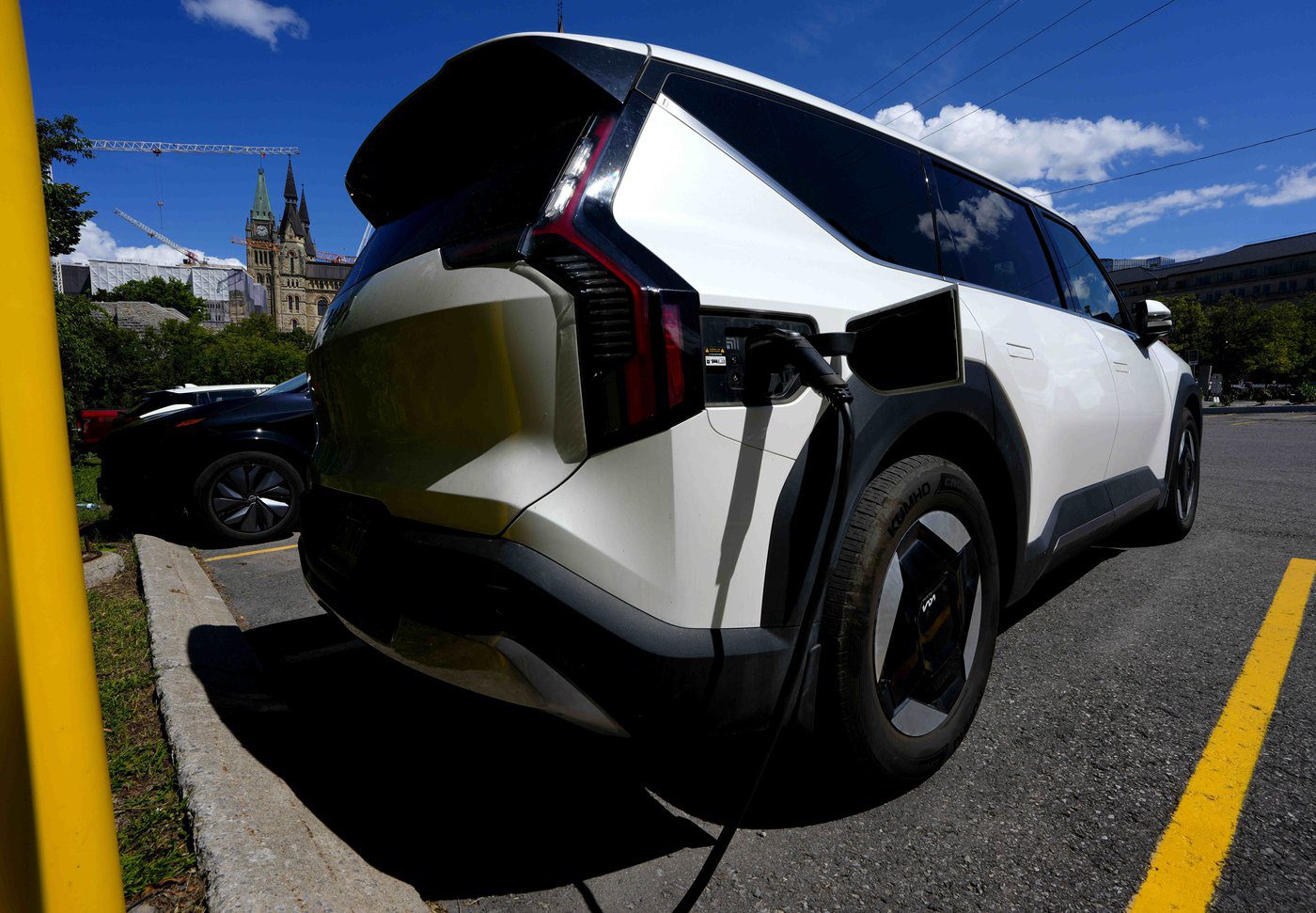
OTTAWA — Prime Minister Mark Carney has delayed tougher new emissions standards for passenger vehicles until 2029, just eight months after the government said it wanted them to take effect in 2027.
Experts say the move will buy Ottawa time to see how U.S. policy might shape up in the coming years, but critics say it’s just another rollback of an environmental policy.
Last week, Carney, alongside Ontario Premier Doug Ford, said Canada would maintain its tailpipe standards at 2026 levels through to 2029. Carney said that will give Canada’s automakers some breathing room in the face of U.S. tariffs, while helping Canada reach its emission reductions “in the long term.”
In February, when Carney launched a new auto strategy to replace the government’s scrubbed electric vehicle sales mandate, the goal was to set new standards limiting emissions from vehicle tailpipes for model years 2027 to 2032.
Officials were to finalize amendments to the regulations by the end of this year.
But Ottawa now says consultations on those new measures aren’t set to begin until early 2027, with draft regulations coming shortly afterwards.
Bloc Québécois environment critic Patrick Bonin said Ottawa is again walking back its climate commitments.
“Instead of doing the consultation, (Carney) has decided already that he’s going to freeze the emission standards until 2030. So the manufacturers won’t have any obligation to build more fuel-efficient vehicles,” Bonin said in French.
“The government is inspiring itself from what (U.S. President Donald) Trump is doing. This will delay the electrification of Canada’s transportation system and the jobs it creates, many of which are in Quebec.”
When the auto strategy was launched in February, Carney said the new tailpipe standards would be twice as strict as existing regulations and would achieve the equivalent of a 75 per cent EV adoption rate by 2035 and 90 per cent by 2040.
“That strategy talks about repealing the EV availability standard and replacing it with strong tailpipe emission regulations that would achieve similar, if not the same goals. And that was supposed to happen in tandem,” said Joanna Kyriazis, the transportation lead at Clean Energy Canada, a think tank out of Simon Fraser University.
“This is a significant delay. If the standards were supposed to be in place by model year 2027 … and now we’re talking about a delay of two or three years, that will have a significant impact. Not just on greenhouse gas emissions, but I think also in Canada’s place on when it comes to EV adoption.”
Canada typically has tried to align its tailpipe standards with the United States, given the integration of the two auto industries.
In September, the Trump administration released new fuel economy standards which relaxed regulatory requirements for automakers to control pollution from gasoline-powered cars and light trucks.
The change furthered Trump’s goal of revoking policies that encouraged or created incentives for the production of electric vehicles.
Brian Kingston, head of the Canadian Vehicle Manufacturers’ Association, said the move to delay more stringent emission standards on vehicles gives the government some breathing room to see where U.S. policy goes over the next several years.
“It was a smart move by the federal government to do this,” said Kingston, whose group represents the Canadian arms of Ford, General Motors and Stellantis.
“We know that there will be a new administration in the U.S. Impossible to know what direction they take, but I think you can reasonably assume there’s a world in which there are increased stringencies in the future in the United States.
Kingston said that, “given the fact that we are so highly integrated with the U.S., pausing now to flatline the standard” and “figure out where the Americans are going” makes sense for both Canada and the industry.
Kyriazis agreed the move to delay Canada’s new stringent tailpipe standards amounts to a “wait and see approach” but said it contradicts one of the goals of the auto strategy.
“The goals of that strategy are to reduce reliance on U.S. and on gas-powered vehicles. And it talks a lot about Canadian sovereignty when it comes to the cars that we drive and … the cars that we build,” she said.
“So I think we’re not quite seeing that same move toward greater sovereignty from the U.S. when it comes to the cars that we build and the cars that we drive.”
Kingston said the auto strategy was misguided in that respect.
“There is no world in which we have an auto industry without integration and alignment to the United States. It’s just a geographic and economic fact that we happen to sit beside the largest, most prosperous economy in the world,” Kingston said.
“The auto strategy had some language around diversifying. Not possible. This industry is founded on our access to the U.S. market. So, while we encourage the government to find ways to build less (reliance) on the U.S. economy where you can, when it comes to manufacturing and auto, it’s not possible.”
This report by The Canadian Press was first published Oct. 31, 2026.
— With files from The Associated Press
Nick Murray, The Canadian Press