



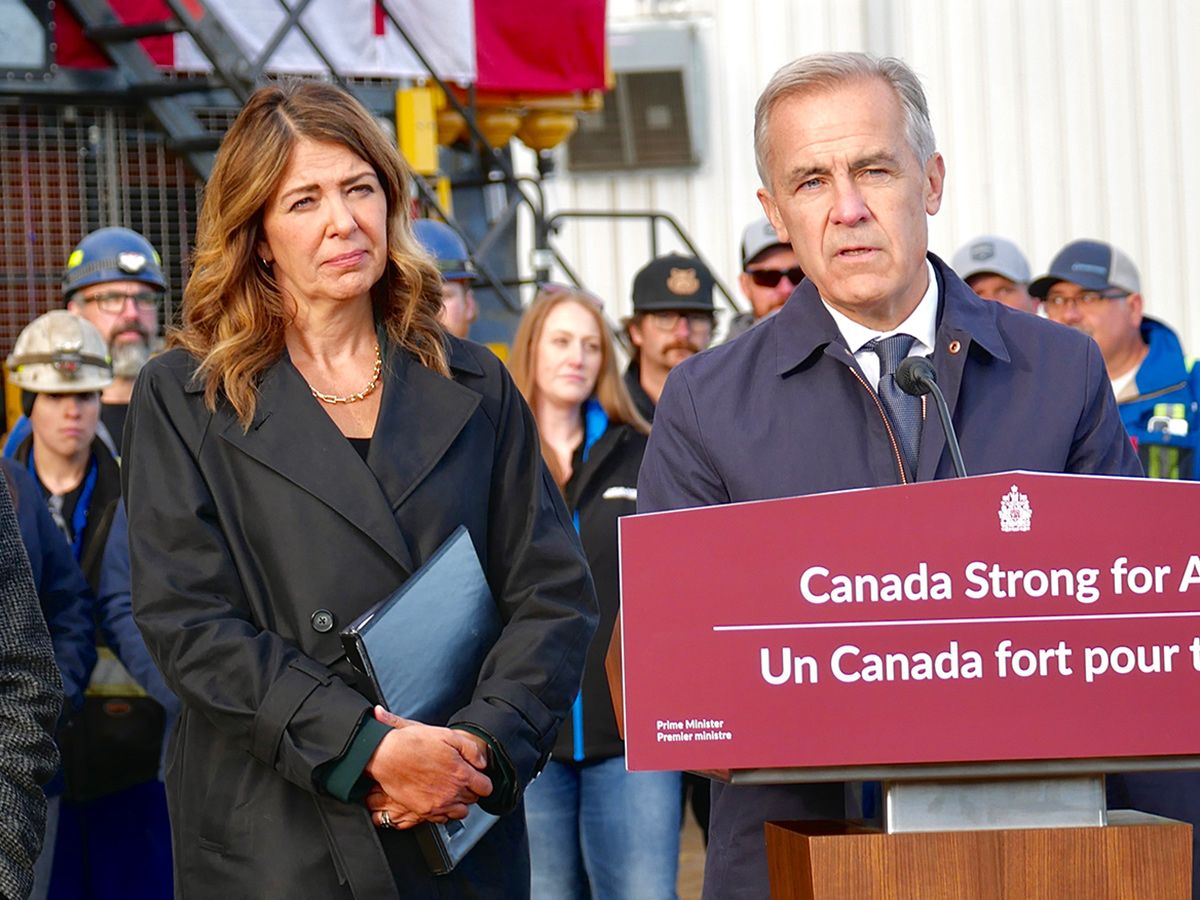
This week’s announcement by Prime Minister Mark Carney and Alberta Premier Danielle Smith that a new pipeline to the West Coast, now called Pacific Link, has been designated as a national interest project is good news for Canadians and the energy industry that powers their economy.
But any celebration must be tempered by the fact that despite clear and growing demand for Alberta oil, Canada has become such an unattractive place to invest that a pipeline can only be built with the full backing of the federal government.
True to form, Carney stood in front of a crowd of oil workers in Fort McMurray, Alta., on Thursday and said many of the right things. “Oil demand will continue to be significant for decades to come,” he admitted. “The question is: who will emerge as the world’s trusted suppliers?”
His answer: “It must be Canada” — a country he referred to as a burgeoning “global energy superpower.” But is this really how an energy superpower would act?
Thursday also marked the one-year anniversary of Smith’s announcement that she was seeking a new pipeline. That was followed by a memorandum of understanding (MOU) signed between the federal and provincial governments on Nov. 27, 2025. On March 6, they announced an “agreement-in-principle to accelerate the construction of major projects in Alberta,” including pipelines.
That was followed by an “ Implementation Agreement ” on the MOU, which provided further details about what both parties would need to do to see the project through. And on July 2, the pipeline was referred to the Major Projects Office (MPO).
That’s at least five joint announcements in less than a year on the same pipeline, and that’s before a single environmental review has been conducted. If Canadians think that’s moving relatively fast, it’s only because the bar has been set so low and they’ve been conditioned to believe that development happens at a snail’s pace.
Faced with an Iranian-blockaded Strait of Hormuz, the United Arab Emirates announced the construction of a new pipeline in May that it expects to be operational by next year — basically the amount of time it took us to decide whether a pipeline is actually something a would-be energy superpower might need.
Perhaps it’s not fair to compare Canada to a dictatorship, but even this country used to build pipelines at record speed . The U.S. issued orders for the 2,500-kilometre wartime CANOL pipeline from Alaska to the Northwest Territories on April 30, 1942. Canada approved the plans eight days later and it was built in just two years.
A mere 38 days after the Pipe Lines Act became law, the newly established regulator approved a portion of what is now Enbridge Line 1 from Edmonton to Regina. The full 1,600-kilometre line to Wisconsin was built in 150 days . And 11 months after the Trans Mountain Pipeline Company was created, the 1,150-kilometre Trans Mountain pipeline was given the go-ahead. It was completed eight months later.
Pacific Link now has a national interest designation, but as Carney said on Thursday, “Today is just the start, it’s the real start of the process.” The pipeline still has to be approved by the MPO. Environmental assessments need to be completed. More First Nations must be consulted. Conditions will have to be finalized and then met. Shovels will not be in the ground until Sept. 1, 2027 — at the earliest .
The Liberals have made some efforts to expedite the process, including Bill C-39 , which is currently being debated in the House. But as the Post’s Jamie Sarkonak argued earlier this week, the proposed legislation is mostly window dressing.
The bill is intended to streamline approvals and provide a greater degree of certainty for developers by designating one federal authority to oversee the process and ensure that numerous assessments can take place concurrently. But much of that enhanced co-ordination appears to be optional for the Canadian Energy Regulator, which is responsible for pipelines.
The bill aspires to get pipelines approved within 365 days, but gives considerable leeway to the government in how it calculates that timeline, and includes options to extend it for additional Indigenous consultations.
And herein lies the problem with getting anything done in this country: no matter what gets proposed, some provinces, Indigenous groups or special interests will inevitably try to stand in the way.
Carney attempted to present a unified front this week, when he appeared alongside First Nations leaders and oil executives and held up his friendly relationship with Smith as an example of “co-operative federalism.”
But the prime minister has so far failed to convince private investors that Canada is an any-less-risky place to do business than before. The new pipeline will be owned by the Canadian and Alberta governments, with at least a 10 per cent stake going to Indigenous communities. Pembina Pipeline and Trans Mountain Corporation have been brought on as partners, but it should escape no one’s notice that one of those is a Crown corporation .
Canada desperately needs new pipeline capacity, so we’re glad this project is one step closer to being realized, but Canadians should not fool themselves into thinking that Carney is fulfilling his promise to build “at speeds we haven’t seen generations,” or enticing investors to come back to the Alberta oilpatch.
National Post

