



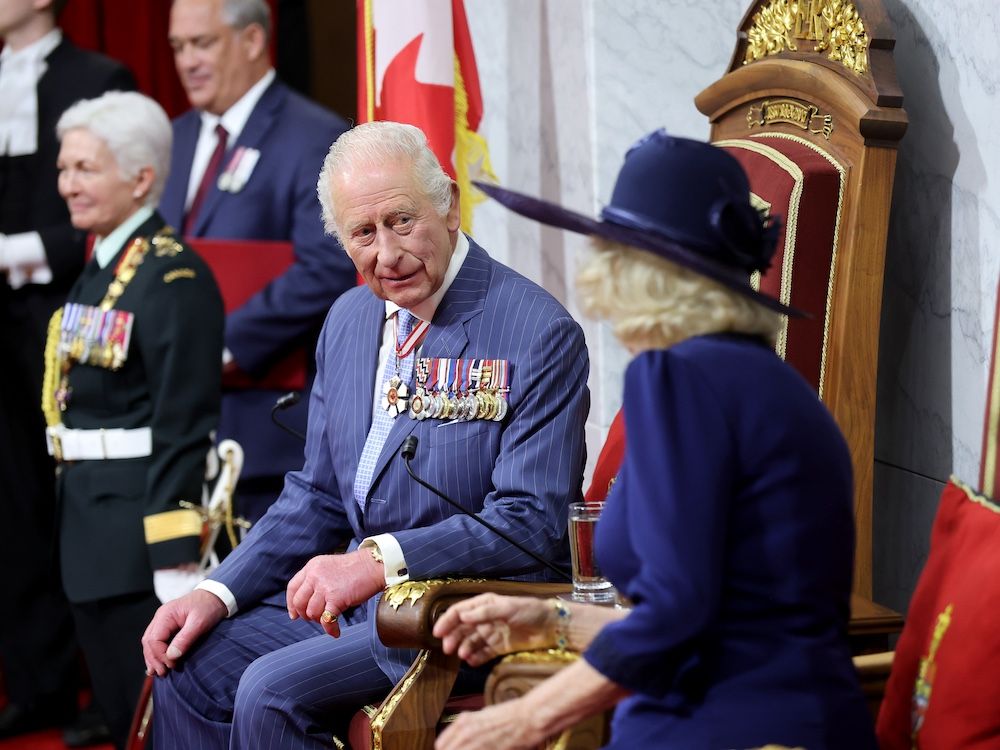
There was no greater demonstration of Canada’s unique system of government than hearing King Charles III, in all his regal dignity, discuss during the Speech from the Throne Tuesday, relatively mundane matters of government, such as dental care and the amount of GST charged on new homes.
After all the anticipation of inviting the King to Ottawa to open Parliament, it was a wholly humbling affair. It was humbling for His Majesty, as it made clear he is a servant of the people, and it was humbling for Prime Minister Mark Carney’s government, because it was a demonstration that all political power in Canada flows from the Crown. To an outsider, it might have seemed a bit silly, but the oddness of it all is entirely the point. Ancient traditions, rife with symbolism, such as the throne speech, affirm Canada’s distinct history, heritage and place in the world.
The content of the speech — little more than the Liberal platform of irresponsible spending and central planning — mattered much less than who was speaking it, and the spectacle of the King addressing Parliament was welcome indeed.
The King did much to show his respect for this country, chiefly by coming to assert Canada’s independence in the face of repeated threats to our sovereignty by American President Donald Trump.
He also showed that he is at least as familiar with this country as his beloved mother, Queen Elizabeth II. It was noted in the speech that he has visited Canada 20 times in around 50 years, compared to the late Queen’s 22 visits over 70 years.
But familiarity, even an intimate familiarity, isn’t the same thing as an enduring presence. Though the Sovereign’s role as King of Canada is distinct from his role as King of the United Kingdom, the non-resident nature of the Canadian monarchy was felt all the more when confronted with the King’s presence in Parliament. The visit emphasized much of what has been lost in Canada over the decades, as successive governments confused asserting independence from Britain, with suppressing the Crown.
There are, of course, advantages to having a King who does not live here, as we are spared much of the drama surrounding the royals, including years of drama involving Charles himself, in particular his public divorce from the late Princess Diana. The celebrity obsessions that surround the royal family are not needed or necessary to benefit from constitutional monarchy.
As for the pitfalls of a non-resident monarch, the unifying nature of the Crown as an institution above politics that people can find common cause with, is more challenging without a constant physical human presence. Difficult, but not impossible. It manifests itself in the naming of highways, the Royal museums, provincial Courts of King’s Bench, the Royal Canadian Mounted Police, and provincial flags, such as those of Alberta, Manitoba and Ontario, all of which symbolize the Crown, as distinct from the government. Victoria Day in May honours the reigning monarch at the time Canada gained independence in 1867.
But in other, more serious ways, the Crown has receded from public life. It is no longer common to hear people sing God Save the King, even as a secondary anthem. The Red Ensign, Canada’s old flag, has weirdly been dismissed by progressives as a symbol of the far right, as opposed to a proud symbol of our history. Statues of past monarchs, and of early prime ministers are toppled.
Contemporary prime ministers adopt the manner and practices of a president of a republic, as opposed to a chief advisor to the Crown. Carney’s repeated signing of fake executive orders, emulating Trump, are merely the latest example of this.
As for Governors General, who act on behalf of the Sovereign, they had tended before the 1970s to be those with experience as diplomats or in the military. In other words, the Governor General was traditionally chosen from among the ranks of people already familiar with serving the Crown, and placing such service above partisan needs.
That all changed with Pierre Trudeau, and those named to the role since have been increasingly political, while increasingly having little respect for the institution.
This week, a social media account for Governor General Mary Simon posted that conversations with the King “deepen the meaningful bond between our nations” followed by small images of the Canadian and U.K. flags. The message was that the King was representing another nation, rather than being the King of Canada. It is an unfortunately common misunderstanding among Canadians, but the one person who should not make this mistake is the Governor General, even if it was an underling who wrote the post.
This degradation of the Crown in Canada must come to end.
Perhaps it is true that if Canadians were designing a political system from scratch, it would not be based on a 1,000 year-old institution that has evolved to the point where the person with the most power constitutionally may only keep that power if he never (or rarely) uses it.
Our system of government, with a hereditary head of state that is not only above politics, but who must avoid politics, however, has proven remarkably stable, and remarkably well suited to protecting the rights and liberties of Canadians. Following the King’s visit, let us all do our part to hold on to the very institutions that define us.
National Post