


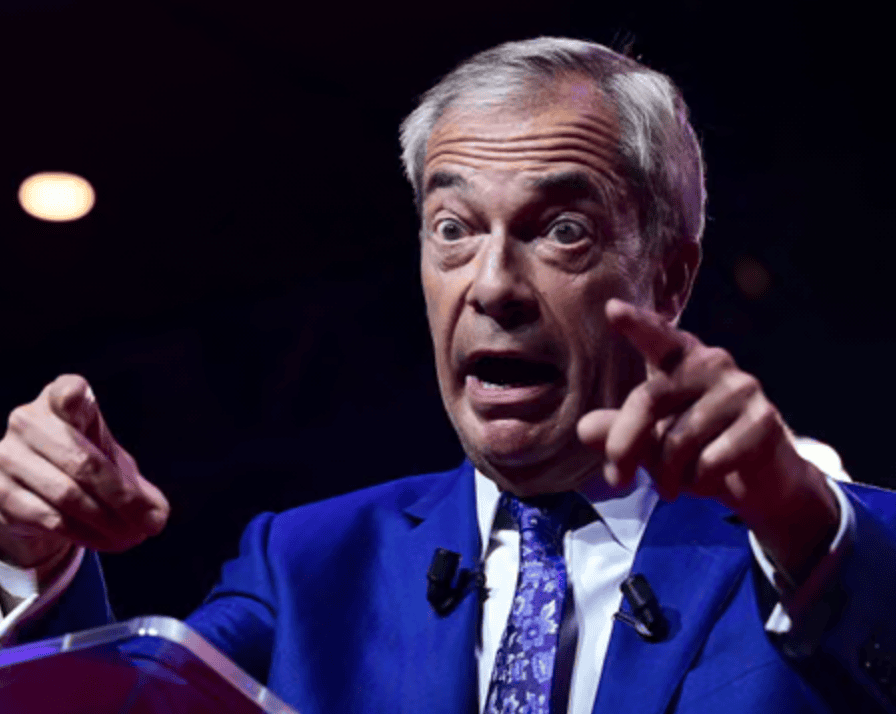

How did a by-election turn into one of the biggest political stories of 2026? That’s easy, when your main showdown is Nigel Farage vs. Count Binface.
Wait, what?
Yes, it’s true. Let’s dig into one of the most improbable political showdowns of all time.
The Aug. 13 by-election is being held in the parliamentary constituency of Clacton in Essex. The county has a population of 85,359, according to the 2011 census, and includes several seaside towns like Clacton-on-Sea, Frinton-on-Sea and Walton-on-the-Naze. The residents are overwhelmingly White (96.1 percent), and the main religion is Christianity at 50.4 percent, with 41.9 percent claiming to have no religious affiliation.
Clacton’s politics is a mix of fiscal and social conservatism. Since the constituency was established in 2010, all of its MPs have been right-of-centre. The short list includes former Conservative, UK Independence and Independent MP Douglas Carswell (2010-2017), former Conservative MP Giles Watling (2017-2024) and, most recently, Reform UK leader Nigel Farage (2024-2026).
Farage is a well-known and controversial figure in UK politics. A former Conservative Party member, he led the UK Independence Party (UKIP) from 2006 to 2009, and from 2010 to 2016. He was a Member of the European Parliament for South East England from 1999 to 2020, when the UK withdrew from the European Union. He co-founded the Brexit Party in 2019, now known as Reform UK, and led it twice: 2019-2021, and 2024 to the present.
Farage has been described as everything from a right-wing populist to a strong opponent of immigration policies. He’s perceived as being ‘far right” in some circles of interest, and “centre-right” in others. He supports the private sector, free market economy and free speech, but has also supported reindustrialization in Wales related to coal mining as well as the nationalization of UK steel companies. He’s a well-known Eurosceptic, and was one of the main voices leading the Brexit movement. He’s also been a political commentator for GB News, LBC and Fox News.
All of this has helped Farage’s public profile, but hurt his chances at greater political success. The biggest roadblock he’s faced was winning a seat in the House of Commons. He ran seven times between 1994-2015 for UKIP, coming closest to winning it in the latter election in the constituency of South Thanet. The long-awaited breakthrough occurred on his eighth attempt, winning 46.2 percent in Clacton.
The Reform UK leader would still be in the House of Commons today if it wasn’t for an investigation into his financial interests. This included an alleged payment of £5 million from businessman and cryptocurrency investor Christopher Harborne and possible gifts from financier George Cottrell. Media scrutiny led to Farage vacating his seat on July 7 and immediately announcing he would run in the by-election.
The major parties – Labour, Conservative, Green Party, Liberal Democrats and Restore Britain – opted not to run candidates against Farage. “Labour and Restore Britain called it a ‘circus,’” according to the BBC’s Ben Hatton and Craig Hoyle, while “the Conservatives called it ‘a fake by-election’ and the Lib Dems called it ‘Farage’s vanity project.’” This opened the door to fringe candidates and parties to run. A total of 15 parties and 19 Independents are on the ballot. This includes: Reclaim Party leader Laurence Fox, Social Democratic Party candidate William Clouston, Rejoin EU candidate John Stevens (a former Conservative MEP), and satirical Monster Raving Loony Party leader Howling Laud Hope and candidate Nick The Incredible Flying Brick.
The main challenger to Farage? A novelty candidate known as Count Binface.
The man wearing the bin-shaped helmet is Jonathan David Harvey. He’s worked as a scriptwriter for two comedy series (The Thick of It, Time Trumpet), a panel show (Have I Got News for You) and authored two books, including A Fan for All Seasons: A Journey Through Life. Harvey first ran in the 2017 general election as the novel candidate Lord Buckethead against then-Conservative Prime Minister Theresa May in Maidenhead. This resulted in some high-profile media attention and led Todd Durham, who created Lord Buckethead for his 1984 film Hyperspace, to reclaim his character. Harvey decided to run again as Count Binface, an “intergalactic space warrior” whose face looks surprisingly like a dustbin.
Binface is the leader of the officially recognized Count Binface Party. He’s made several attempts to win a political seat, including the 2019 and 2024 general elections and 2021 and 2024 London mayoral elections. He’s an amusing candidate with a good sense of humour and occasional tangible comment. When he ran in the June 18 Makerfield by-election won by new UK Prime Minister Andy Burnham, an impromptu interview on Sky News went viral. He was also mentioned by now-former Prime Minister Keir Starmer during PMQs and became a permanent part of Hansard.
Ipsos conducted a nationwide poll of 1,000 Britons to find out who they would prefer in the by-election. Binface led Farage by 32 to 21 percent, with an additional 13 percent undecided. This has now led some commentators to muse whether the joke candidate will shock the nation and beat the Reform UK leader.
Do I think this is going to happen? No.
Clacton is a conventional right-leaning parliamentary constituency. While some joke parties and candidates have won seats in the UK, including the Monster Raving Loony Party in local, parish and town councils, the chances of winning a House of Commons seat would be highly unlikely. Binface’s surge in popularity, which is more on a national scale than local, will likely slow down closer to election day. As for Farage, who put himself in this potentially embarrassing predicament to begin with, he’s heavily favoured to win by Polymarket – and, in my view, will succeed by a very comfortable margin.
The Farage-Binface battle in Clacton has certainly captured the imagination of many Britons from coast to coast. To imagine that it could lead to the biggest upset in UK electoral history is way beyond the pale.
Michael Taube, a long-time newspaper columnist and political commentator, was a speechwriter for former Canadian prime minister Stephen Harper.

