



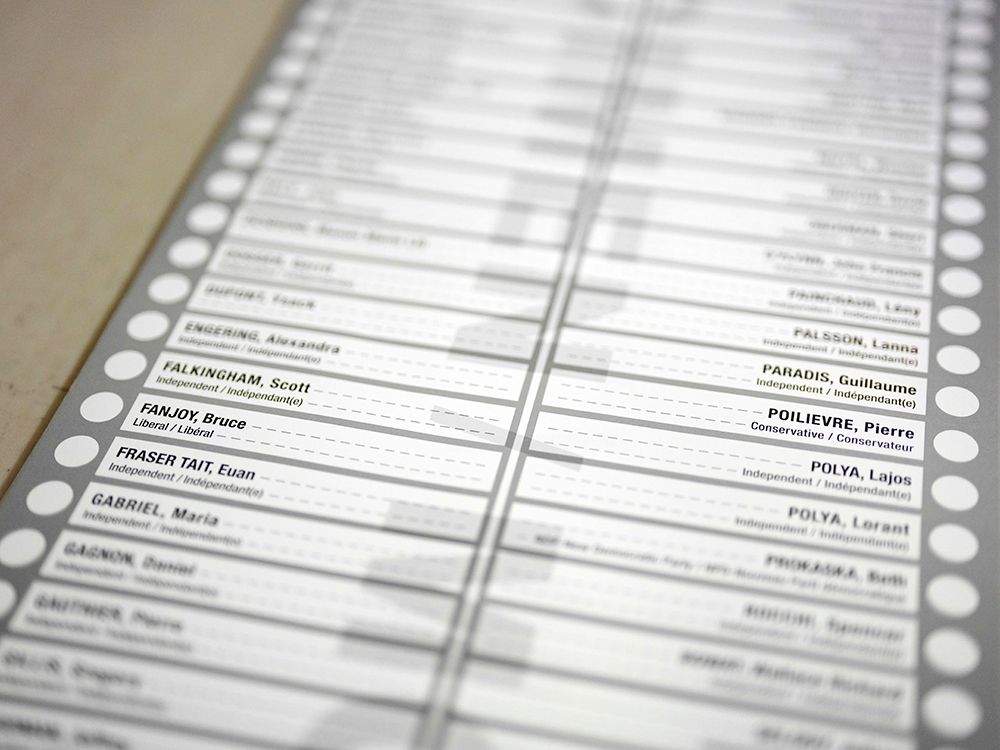
Conservative Leader Pierre Poilievre is running in a federal by-election in the Alberta riding of Battle River-Crowfoot. Advance voting
on Friday, and he should
quite comfortably on Aug. 18.
What will columnists and political commentators be keeping an eye on?
’s impact in the Battle River Crowfoot by-election, or lack thereof?
The Longest Ballot Committee has
to flood ballots in seven targeted federal ridings (and one Ontario riding) since 2019. This activist movement is
of Canada’s first-past-the-post electoral system, and has signed up candidates to defend a
: why Canada should shift to a more fair and balanced political
of proportional representation.
Has this campaign worked? They claim it has. In reality, its impact bas been negligible at best.
The Longest Ballot Committee, through its
with the now-defunct Rhinoceros Party,
to set a Guinness World Record during the 2019 election with the “longest ballot papers in history.” They targeted then-Conservative leader Andrew Scheer’s riding of Regina-Qu’Appelle. It was a failure: Scheer earned over 63 per cent of the vote, and only two of the eight candidates were aligned with them.
Other attempts to disrupt elections haven’t fared much better.
The Longest Ballot Committee had 15 of the 21 candidates running in St. Boniface-St. Vital (2021 election), 33 of 40 candidates in Mississauga-Lakeshore (2022 by-election) and 42 of 48 candidates in Winnipeg South Centre (2023 by-election), but the Liberals held all three seats. It also
two 2024 by-elections in Toronto-St. Paul’s (77 of 84 candidates) and LaSalle-Émard-Verdun (79 of 91 candidates). The voters shifted to a Conservative and Bloc Quebecois candidate, respectively, for reasons that had nothing to do with proportional representation, however.
Nevertheless, this movement has
it played a pivotal role in Poilievre losing his seat in Carleton in this year’s election. “This one-of-a-kind campaign has been a whole lot of fun and we want to thank again all of the volunteers, candidates, and supporters who made this year’s longest ballot possible,” spokesman Tomas Szuchewycz told the Canadian Press on April 30. “It’s been a success,” said one candidate, Mark Moutter, who went off on a tangent and remarked, “I’ve never seen people looking more optimistically at electoral reform, ever.”
Is this true? No.
The Longest Ballot Committee was
by 85 of the 91 candidates in Carleton, but only
a cumulative 824 votes out of 86,060 cast on April 28. That’s roughly 0.01 per cent of the total vote. As a comparison, Liberal candidate Bruce Fanjoy took 43,846 votes, or 50.95 per cent, while Poilievre earned 39,333 votes, or 45.7 per cent. The difference between them was 4.25 per cent, meaning Poilievre would have still lost even if the Longest Ballot Committee hadn’t participated.
What about electoral reform? There’s some appetite for it in Canada. A January 2025 poll conducted by EKOS Research for Fair Vote Canada
that “two-thirds of Canadians (68 per cent) support moving towards a system of proportional representation.” Then again, the large number of candidates in Carleton running on a pro-proportional representation platform were wiped out. It’s a mixed bag at best.
The Longest Ballot Committee likely had little to nothing to do with Poilievre’s loss in Carleton. (His loss was more likely a result of U.S. President Donald Trump and tariffs, as I’ve
before.)
While they’re
his Battle River-Crowfoot by-election in record numbers — 204
214 candidates — lightning won’t strike twice. It’s one of the safest Conservative ridings in Canada. Damien Kurek, the three-term Conservative MP who stepped aside so Poilievre could run,
85.5 percent, 71.3 percent and 82.84 percent of the vote in the 2019, 2021 and 2025 elections, respectively.
Elections Canada also decided to use special ballots in this byelection. Voters will
the candidate’s name in a blank space, and “as long as your intention is clear, your vote will be counted, even if you misspell” it, as some undoubtedly will.
Nevertheless, Poilievre recently called for a
to be introduced in the fall to change the election rules and prevent what he’s called the “longest ballot scam” from happening again. He suggested adjusting the number of signatures required by nominees from 100 to 0.05 per cent of a riding’s population, electors only being allowed to sign one nomination form and official agents only representing one candidate.
Is this really the answer? The Longest Ballot Committee’s strategy is annoying and wasteful in terms of time and resources, but I wouldn’t go as far to describe it either as undemocratic or something that needs to be eliminated by Elections Canada. There are small parties, one-issue candidates and joke candidates that occasionally run in elections. If we grant them that freedom, which is the hallmark of a parliamentary democracy like Canada, then the Longest Ballot Committee must be afforded that freedom, too.
It’s therefore up to political parties and politicians to come up with strategies to combat and negate this nuisance in Canadian politics. Based on the fact the Longest Ballot Committee hasn’t yet changed the course of a single riding, has vastly overinflated its importance thus far, and is a protest vote that barely amounts to a political whisper, it’ll be easy to swat them away. That’s what Poilievre should do when he returns to Ottawa in the fall.
National Post

