



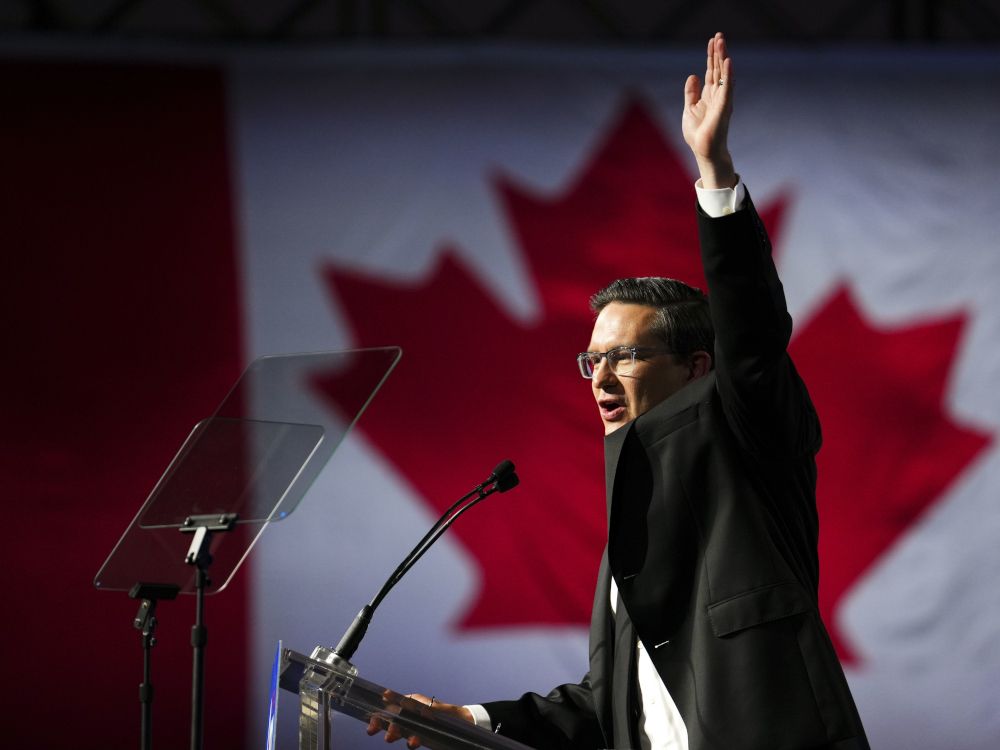
The topsy-turvy federal election is in the home stretch. Mark Carney’s Liberals are out in front, but Pierre Poilievre and the Conservatives have gradually narrowed the gap. There’s just enough time for the Tories to win, and they have just enough momentum to do it.
Let’s begin by deconstructing the election’s most frequently heard narrative: the most likely scenario on April 28 is a “Liberal majority.” Canada’s talking heads have parroted this assessment so many times, I’ve lost count. In reality, the election seems to be much closer than many pollsters, columnists and political commentators would have you believe.
Considering how volatile the Canadian electorate has been over the past two months, this year’s campaign has been defined by instability. The Conservatives
in the polls they had held for over two years.
Part of their support was always going to dissipate when former prime minister Justin Trudeau announced his long-awaited departure, but the vast majority evaporated due to U.S. President
. Canadian anger and frustration, combined with the inaccurate belief that Trump and Poilievre were two sides of the same political coin, was a lethal combination.
When Carney became Liberal leader last month, he rode this unplanned political wave with unbridled enthusiasm. The Liberals moved ahead in most polls. A March 13 Ekos poll even suggested their lead was in the double digits.
Yet Carney couldn’t sustain this unexpected shift in momentum. His political inexperience, arrogant demeanour, inflated ego and aloofness have worked to his detriment. His curt responses to reporters raised red flags.
When economist
in the Hub that the “entire fiscal trajectory of the federal government is now pointed in a potentially unsustainable direction” due to Carney’s political platform, the
in a contemptuous manner and said he was wrong.
Carney has barely proposed an original idea, having
several Conservative policies (removing the carbon tax, tough-on-crime legislation) and maintaining some Liberal policies (the no new pipelines act). He’s not much different than Trudeau, either.
That’s why some Canadians have started to sour on Carney. Polls released by Liaison Strategies, Mainstreet Research, Nanos Research and YouGov on Tuesday showed the Liberals ahead by between one and 5.6 points. Innovative Research had them
the following day (38-38 per cent).
Of additional interest,
had the Liberals ahead by three points (41-38 per cent) on April 21, while
the Liberal lead was 4.5 points (43.5-39 per cent). The former had the
by 12 points on April 6, while the
the Liberals with a 13 point lead on April 10.
Of course, the party that wins the popular vote doesn’t necessarily earn the largest number of seats. The Conservatives finished ahead of the Liberals in popular support when Andrew Scheer and Erin O’Toole led them in 2019 and 2021, respectively — and they lost both elections. So how does Poilievre avoid a similar fate?
The Conservatives need to get 40 per cent of the popular vote. They’re either pretty close or have reached this target in most polls. On Wednesday, CBC News’s
noted the gap in two battleground provinces, Ontario and British Columbia, are both in single digits and getting more competitive.
A stronger NDP and Bloc Québécois showing would be helpful as well, but isn’t entirely necessary. As
in a recent National Post column, the former doesn’t require a significant percentage of the popular vote to be competitive in ridings — and the latter’s momentum in Quebec appears to be growing.
None of this seems to suggest a Liberal majority, but rather a Liberal or Conservative minority government. I believe that’s the most likely scenario.
There’s also the possibility that the polls have been inaccurate since the beginning. “What if the Liberals never really led by like 8 to 12 points and it was just response bias?” Abacus Data CEO
on X on Monday.
Response bias refers to the possibility of inaccurate or false information provided to pollsters. This would help explain why the political needle has shifted all over the map in this election. Time will tell if there’s anything to this.
Whatever the case, Poilievre must stay focused and emphasize several key messages for the remainder of the campaign. Discussing the economy and the financial well-being of Canadians is vitally important for him. Pushing for affordable housing, reduced food costs and lower energy prices will give Canadian families hope for the future.
Consistently using the word “we” instead of “me” for Conservative messaging creates a unified approach to issues and ideas. Pushing for a renewed foreign policy agenda that removes the stench of the Trudeau years would be helpful. Talking about getting tough on crime, drugs and gangs is a must.
The recently released
— which includes a 15 per cent income tax cut, reduced taxes on new home and a $5,000 top-up for TFSA investments in Canadian companies — must be presented to more undecided voters, as well.
Could Poilievre go from winning to losing to winning the election in two months? We’ll find out shortly.
National Post

