



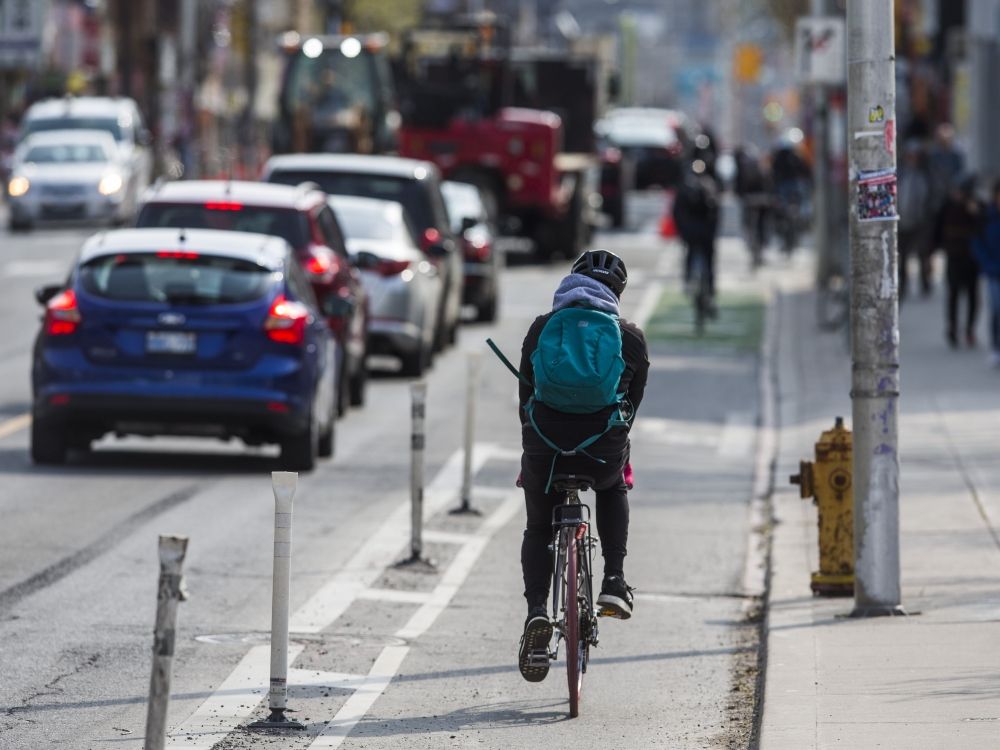
Removing bike lanes is …
unconstitutional
?
I know it sounds completely insane. Yet, that’s exactly what the Ontario Superior Court
on Wednesday with respect to Premier Doug Ford’s plan to remove bike lanes on three busy Toronto intersections — Bloor Street, Yonge Street and University Avenue — to improve the flow of traffic and reduce congestion.
The advocacy group Cycle Toronto set out last December to prevent the lanes from being removed: in a notice filed to the court, it
the Ontario government had “embarked on an ill-conceived, arbitrary and hurried legislative campaign against people who ride bikes in the City of Toronto by mandating the removal of approximately 19 kilometres of protected bike lanes.” This, it added, was done “in full awareness of, or lacking all concern about, the increased number of injuries and deaths that will result.” Hence, the cycling advocates wanted to bring an end to this “reckless legislative act.”
Ontario Superior Court Justice Paul Schabas
an
on April 22 that temporarily paused the removal of the bike lanes. This was ridiculous in itself, but even worse was his decision Wednesday to take the side of Cycle Toronto.
“The evidence shows that restoring lanes for cars will not result in less congestion, as it will induce more people to use cars and therefore any reduction in driving time will be short-lived, if at all, and will lead to more congestion,” Justice Schabas
. He also accepted the expert testimony on Cycle Toronto’s behalf that “bicycle lanes, and in particular separated or protected bicycle lanes, reduce motor vehicle traffic congestion by providing an alternative method of transportation that is safer for all users of the roads.”
Moreover, the removal of these bike lanes “will put people at increased risk of harm and death, which engages the right to life and security of the person.” Hence, the ruling
that “any steps taken to ‘reconfigure’ the target bike lanes that removes their protected character for the purpose of installing a lane for motor vehicles in order to reduce congestion, would be in breach of s. 7 of the Charter.” (This particular section of the Canadian Charter of Rights and Freedoms
that “everyone has the right to life, liberty and security of the person and the right not to be deprived thereof except in accordance with the principles of fundamental justice.”)
The Superior Court ruling is preposterous on many levels. Creating bike lanes in our cities and communities has always been an impediment to traffic. They reduce the amount of space on the roads for cars and trucks to move at proper speeds, which slows down the overall traffic flow and creates more congestion. At the same time, anyone who has ever driven a car on a busy street in a metropolitan city like Toronto knows that plenty of cyclists weave in and out of traffic. Cars and trucks are therefore forced to slow down to avoid hitting, injuring or killing cyclists who don’t seem to care where a city’s bike lanes have been painted.
While people are free to ride bikes for work, exercise and transportation, they’re not making our roads any safer and they’re consistently slowing down traffic. Any so-called “expert” who suggests otherwise likely doesn’t have much experience driving vehicles of the four-wheel variety.
The Ontario government is obviously going to appeal this ridiculous decision.
Dakota Brasier, a spokesperson for Transportation Minister Prabmeet Sarkaria,
CBC News that “we were elected by the people of Ontario with a clear mandate to restore lanes of traffic and get drivers moving by moving bike lanes off of major roads to secondary roads.” Ford was also approached by CBC News after an event in Brampton and made this succinct assessment: “I believe, and the people of Ontario believe, that they elect parties to make decisions — they don’t elect judges.”
That’s one of the key arguments for Ford and the Ontario Progressive Conservatives when they begin the process to hopefully reverse the Superior Court’s ruling.
Governments are elected by the people to serve the people. They propose ideas, like removing bike lanes, that they feel would make sense in political and economic terms. They shape many of these ideas into specific policies. If they have a sufficient number of legislative seats and votes, they’ll pass these policies into law.
That’s stating the obvious, of course. What’s also obvious is that Canada’s unelected judges don’t run our governments or make political decisions. They serve an important role in our society, but it has absolutely nothing to do with the political arena.
There needs to be a proper separation of powers between Canada’s legislative and judicial branches. This would help ensure our judges don’t overstep their boundaries and interfere in decisions that are supposed to be made by our elected officials. This bizarre Superior Court ruling that it’s somehow unconstitutional for the Ontario PC government to remove a few bike lanes in Toronto shows that some judges are more than willing to weave in and out of political lanes.
Let’s hope that sanity prevails when the Court of Appeal for Ontario gets involved.
National Post