



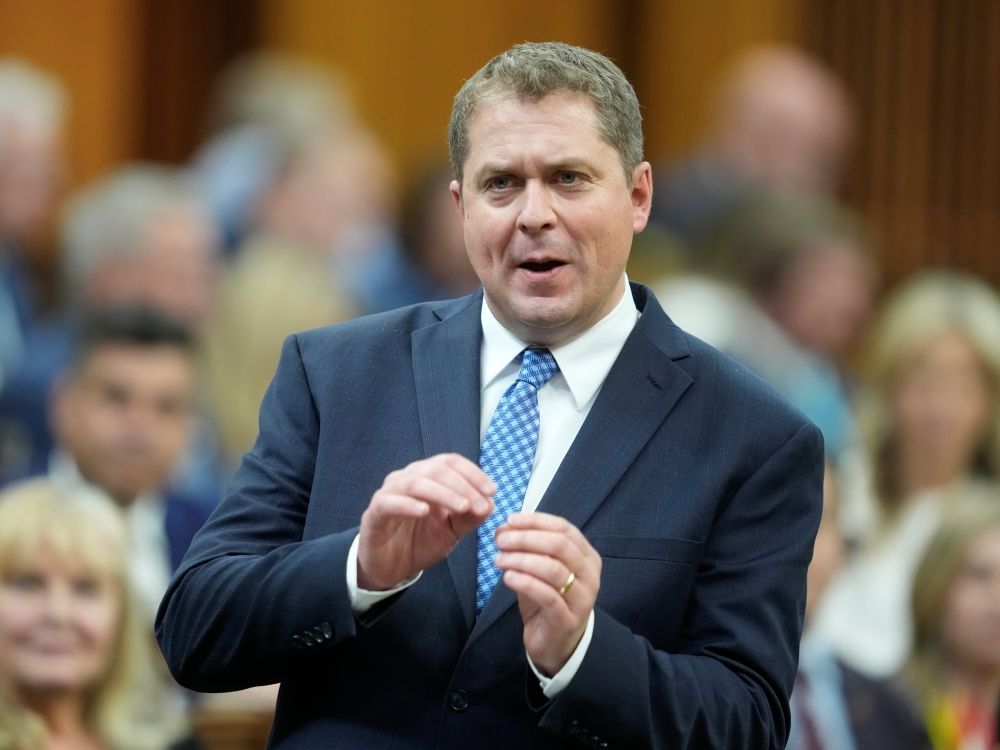
The Conservative caucus
on Wednesday that Andrew Scheer will serve as interim Opposition leader during the spring parliamentary session. It’s not only an incredible political comeback for the former party leader, but it’s also led to a hilarious amount of pearl-clutching from political critics and foes alike.
Filling the Opposition leader’s role in the House of Commons was unavoidable.
Conservative leader Pierre Poilievre led the party to a solid second-place finish and its highest share of popular support (41.3 per cent)
former prime minister Brian Mulroney in 1988. Alas, he unexpectedly lost his seat in the Ontario-based riding of Carleton to Liberal candidate Bruce Fanjoy. Conservative MP Damien Kurek has agreed to
from his extremely safe Alberta-based seat in Battle River-Crowfoot to trigger a byelection. The
that Kurek can resign is late June, meaning Poilievre won’t be able to rejoin Parliament until mid-September.
This opened the door to Scheer’s return to political leadership, albeit on a temporary basis. While Conservative colleagues and supporters congratulated him, a brigade of rabid lefties began to freak out right on cue.
Scheer was called a “clown,” “loser,” “irrelevant,” “snivelling,” “misogynistic,” “unserious” and far worse on social media. He was labelled an “American” and “goofy and immature.” One person was “creeped out” by his “perma-smile.” There was also this offensive albeit creative insult, “Andrew Scheer said he’s confused, he thought they nominated him Pope.”
Putting this left-wing disdain for Scheer aside, why are some Canadians so irritated by the prospect of his brief sojourn as Opposition leader? People get triggered by almost anything these days, so that’s part of the equation. The other component? They remember how much they opposed his fiscal and social conservative beliefs and values.
Scheer has been in politics for over two decades. He was
in 2004 as a Conservative MP for the Saskatchewan riding of Regina-Qu’Appelle. (One of the members of that particular freshman class was, as it happens,
.) He’s never been a cabinet minister, but served as Deputy Speaker of the House and became the
House Speaker in 2011 at age 32.
His defining career moment was serving as Conservative party leader from May 2017 to August 2020. Scheer was effective in this role from the get-go. He fought for lower taxes, smaller government, private enterprise and more individual rights and freedoms with enthusiasm. He was
“Stephen Harper with a smile,” which gave him the ability to be compared to the well-respected former prime minister while still ensuring that his own personality and leadership would continue to shine.
Scheer
in most polls against then-Liberal Prime Minister Justin Trudeau starting around February 2019. He took advantage of Trudeau’s declining popularity in the midst of some of his worst scandals, including three older instances of wearing blackface. When the election was called, it seemed as if he was going to win.
Things soon began to fall apart. Scheer was hurt by several controversies of his own. These included
about his previous work in the insurance industry in Saskatchewan as well as the revelation that he actually
dual Canadian and American citizenship.
Moreover, he got dragged down for his social conservative values by his critics in politics and the media. Scheer has a strong Catholic faith. He supports religious freedom, family values and the rights of the unborn. That being said, he recognized that his private views had to always remain separate from his political ambitions. He also stood for a big tent philosophy in the Conservative party and movement. Those who differed from his own position on abortion and gay marriage would continue to have their views respected and heard in every corner of this country.
This was a fair and level-headed approach to these contentious issues. Anyone who knows Scheer on a political or personal level could vouch for its authenticity.
The problem was that he consistently struggled to convey those long-held positions with the right words and tone to ease people’s concerns. This became problematic when a 2005 video was unearthed in which he spoke out against gay marriage. He
that same-sex couples “have many of the collateral features of marriage, but they do not have its inherent feature, as they cannot commit to the natural procreation of children. They cannot, therefore, be married.” Although he
his views on this subject had evolved and he would not reopen this debate in Parliament as prime minister, many doubted his words all the way to election day.
That was then, and this is now.
Scheer has worked hard to successfully rebuild his name and public image. He’s been Opposition House leader since September 2022. He’s one of the party’s main faces and voices to
important political messaging and set the tone for policy initiatives. He’s well-respected by his leader, colleagues and peers. He’s earned the right to be leader of the Opposition until Poilievre returns to Ottawa.
Will pearl-clutching Canadians think differently about Scheer’s improbable political comeback once the House reconvenes? No. The world of politics may be his oyster, but they’re not going to let go of the shell.
National Post