



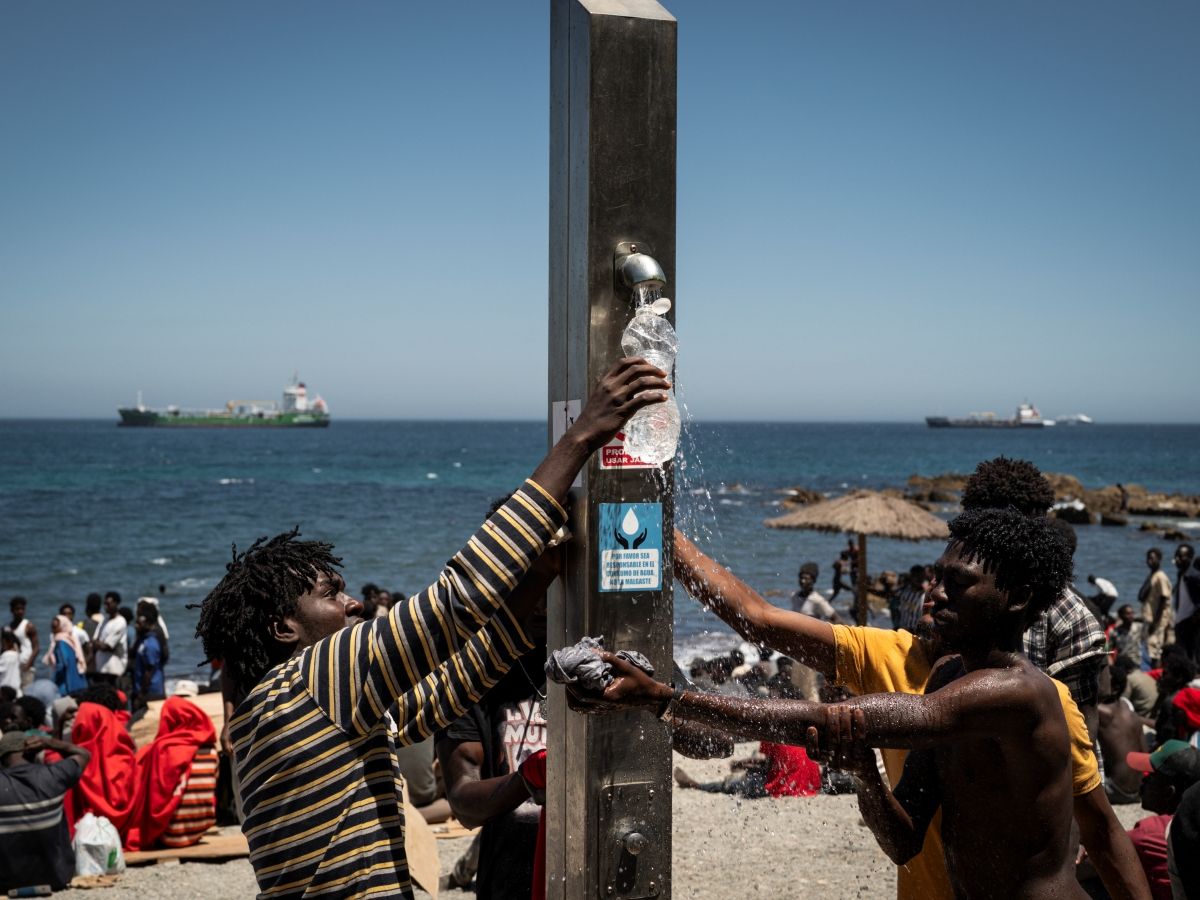
Imagine the Rogers Centre filled to capacity, then filled again by half, to conjure a mental image of the some 70,000 people last week who scrambled, mostly swimming and climbing, from Morocco into Ceuta, a Spanish territory in North Africa. It was the largest single crossing at the Spain-Morocco border on record, bearing the hallmarks of a co-ordinated movement rather than a spontaneous spasm: migrants were reportedly ushered across by Moroccan agents embedded in the crowds . Morocco contests Spain’s sovereignty over the cities of Ceuta and Melilla, even though Iberian dominion predates Moroccan independence by centuries.
If the desired result of this incursion was to humiliate Madrid, as seems likely, it has proved a spectacular success. European officials clambered over one another to condemn the socialist government of Pedro Sánchez for the breach of Spanish — and therefore, European Union — territory.
Giorgia Meloni, Italy’s prime minister, suspended her country’s agreement on free movement with Spain last week. She further called for Spain to be suspended from Schengen, Europe’s free travel zone, which the North African territories fall outside of. This week, the European commissioner for migration rebuked Spain’s recent decision to regularize half a million illegal migrants as “not a good signal” for Europe.
There is a sense in some European capitals that Spain’s lax approach to illegal migration has, by flaunting a soft underbelly to millions seeking to enter Europe, made the continent as a whole more vulnerable at a time when public anxieties around immigration are placing populist parties — long considered beyond the pale — in the ascendant.
The Spanish government claimed on Tuesday that it had returned most of the migrants who made the crossing, excepting the approximately 75 people who died in the process. The operational crisis has mostly subsided. But the symbolic damage for Spain and Europe’s border security has been considerable — such numbers overwhelming the Spanish border are likely to invite more of the same.
Most concerning from Europe’s perspective, though, is that Morocco’s claim to the cities has received tacit U.S. support. Morocco has long been willing to weaponize migration as a form of kinetic diplomacy. Last week’s crossing was a major escalation. It is unclear what prompted Rabat to ramp up the pressure; it might, however, feel emboldened after a budget report recently approved by the U.S. House of Representatives described Ceuta and Melilla as “located in Moroccan territory” and subjects of “Morocco’s longstanding claim.”
To make matters worse for Spain, Israel, a Moroccan ally, supported Moroccan irredentist claims over Western Sahara, a disputed territory in northwest Africa, in exchange for Rabat’s participation in the Abraham Accords, normalizing relations between Israel and its Arab neighbours. Israel is one of the few countries to have done so, and some Israeli officials appear willing to lend rhetorical support to Morocco’s claims over Ceuta and Melilla, too.
Danny Danon, Israel’s ambassador to the United Nations, posted on X last week: “Spain, which never misses an opportunity to lecture Israel, has declared a state of emergency in Ceuta following the crisis over its immigration policy. Maybe before it continues lecturing us, it’s time it explained to the world why it still maintains colonial enclaves in Africa.” The remarks led to speculation from Spanish opposition politicians — which remains unsubstantiated — that Israel and the U.S. had a hand in orchestrating the crisis.
Under Sánchez, Spain has become one of Europe’s most trenchant critics of Israel, so it is unsurprising Jerusalem seized on last week’s incident to return the opprobrium. Yet Israel is fast approaching pariah status in Europe, and the state swiftly distanced itself from Danon’s comments, with Dana Erlich, Israel’s ambassador to Spain, writing on X: “The comment made by Israel’s Ambassador to the UN on the issue does not represent the position of the State of Israel.”
While the U.S. and Israel have not publicly encouraged Rabat’s use of immigration as a form of blackmail, neither country has explicitly condemned Morocco’s actions. U.S. Vice-President JD Vance limited his criticism to “radical left-wing globalist policies,” an unlikely reference to Rabat’s autocratic monarchy.
The incident has highlighted a geopolitical fault line in which the interests of the U.S., Israel and Morocco appear to run against those of Europe. Europe’s response, in turn, has been to train its ire on Spain, which has become a pro-migration black sheep on a continent hardening in the other direction. In a Wednesday op-ed, Bruno Maçães, Portugal’s former secretary of state for European affairs, decried this emergent “common foreign policy” as “every man for himself.”
He might have added that Sánchez’s unilateral decision to regularize one-million migrants, as well as Angela Merkel’s move, as Germany’s former chancellor, to admit one-million asylum seekers into Europe’s free travel area in 2015 and 2016 , made such an approach all but guaranteed.
National Post

