



A chart showing the
of Turkey’s currency against Canada’s resembles a very long, slow, but relentless slide down a steep hill.
In 2015 a Canadian dollar was
about 2.3 Turkish lira. Today it takes almost 30 lira to buy a loonie.
According to currency exchange site XE.com, the dollar’s increase over that period totals more than 1200 per cent. Viewed from Ankara, of course, the opposite is true: an extended collapse comprising a
of currency crises accompanied by often-ruinous inflation and gyrating interest rates. There was a crisis in 2018, another in 2021, and a third in 2023. This year alone Canada’s dollar — relatively weak against U.S. and E.U. currencies — is up almost 18 per cent against Turkey’s lira.
A 2021 article in Britain’s Financial Times
that that year’s crisis was caused not by economic fundamentals, but “almost entirely reflect the increasingly erratic decision-making of one man and the influence he wields over the supposedly independent Turkish central bank.”
The man in question is President Recep Tayyip Erdogan, whose personal power over the country’s central bank brings nothing to mind more than U.S. President Donald Trump’s attempts to enforce his will on the U.S. Federal Reserve. Like Trump, Erdogan considers himself smarter than the professional economists, experienced technocrats or financial authorities who have the sort of background and know-how usually deemed necessary for such critical and complex positions.
The results of Erdogan’s manoeuvrings have been disastrous. Fuelled by a set of unorthodox personal economic beliefs, the Turkish leader has seen inflation
as high as 85 per cent, while interest
have risen from eight per cent a decade ago to 50 per cent in 2024. He’s hired and fired central bank governors on a whim — he’s on his fifth in six years — and set off yet another drubbing this year by
the man expected to stand against him in the next presidential election. Istanbul Mayor Ekrem Imamoglu was
of falsifying his university diploma, for which prosecutors reportedly want a penalty of eight years in jail.
Turkey is no U.S. when it comes to the economy. At about US$1 trillion it’s roughly a
the size of that of Texas, and still deemed an emerging economy by the International Monetary Fund. But its troubles underline the degree of damage that can be done by the sort of erratic, arbitrary and often unpredictable shifts that are a hallmark of Trump’s approach to government.
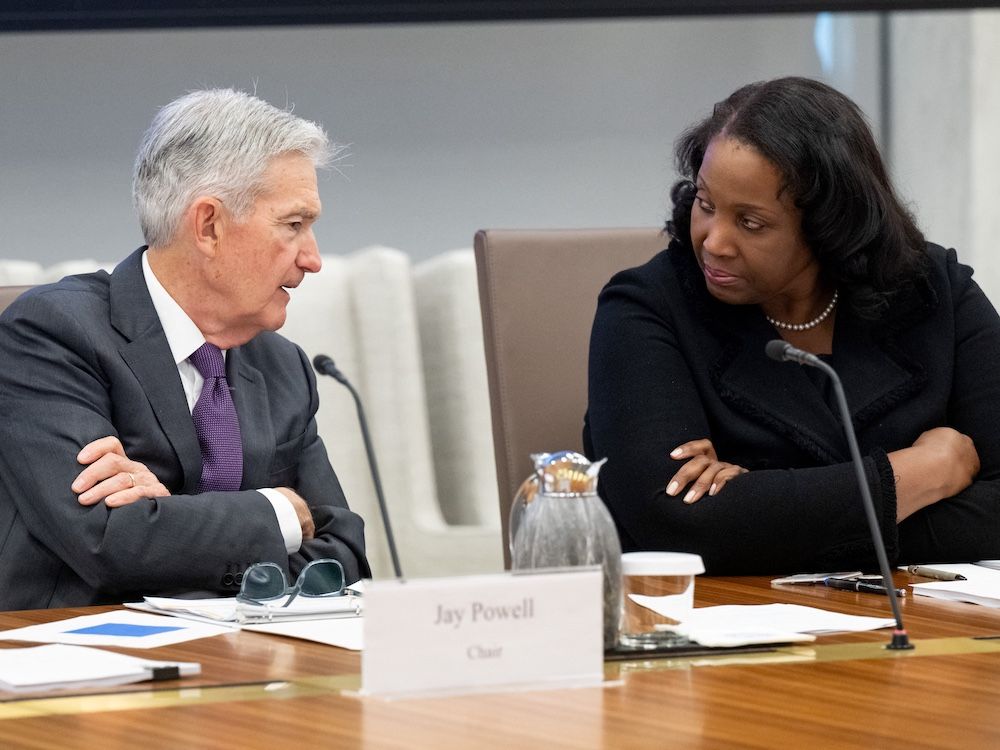
Trump has been waging a campaign to oust Federal Reserve chairman Jerome Powell, whose second four-year term doesn’t expire until next May. Last week the president
he was firing Governor Lisa Cook, the first black woman to serve on the Fed’s board, accusing her of mortgage fraud, and potentially opening the way to
a Trump-aligned replacement. Cook denies the allegations and filed a lawsuit charging that Trump’s attempt is unlawful.
Trump wants Powell to lower interest rates to reduce financial pressures on consumers and reduce the cost of financing the grossly swollen national debt, which has burgeoned from massive deficits under both the Trump and previous Biden administrations. Reports indicate Trump could also make a healthy personal profit, having
at least US$100 million of U.S. bonds to his portfolio since taking office. Bond prices go up as interest rates go down.
Trump’s belief in the energizing impact of lower rates at least accords with basic economic theory: the lower the rates the bigger the anticipated boost from increased spending and investment. The danger is that higher spending can also lead to inflation, the fear of which has kept Powell from giving in to White House pressure. Erdogan, on the other hand, believes it’s high rates, not low, that produce inflation, and stuck to his guns for years despite the financial turmoil his policies produced.
Erdogan has ruled Turkey for more than two decades, first as prime minister, then as president, and runs the kind of authoritarian
Trump openly admires. Since coming to power in 2003 he has jailed opponents, clamped down on the press and expanded his own powers, in addition to instituting mass firings and a flood of detentions following a 2016 coup attempt. Upset at what he considered the meagre digs in which he was expected to reside, he built a massive
to himself, three times the size of Versailles, with 1,000 rooms and a cost topping US$600 million.
He’s on his third presidential term under a constitution that allows for only two, amid
he aims to alter the rules again in hopes of running for a fourth.
Trump is a fan of the Turkish leader, who he credits with helping oust Syria’s Assad regime from power. He admires Erdogan’s willingness to ignore rules, skip past laws and stomp all over opponents. “He’s a tough guy and he’s very smart,” he told reporters. “I happen to like him, and he likes me.” Erdogan also enjoys congenial
with Russia’s Vladimir Putin, for whom Trump also holds a peculiar soft spot.
The whole point of independent central banks is to remove them from governments keen on manipulating figures, interfering in markets or exerting pressure for self-serving political ends. In most advanced countries, the economy is viewed as too crucial to be exposed to political game-playing. Erdogan’s record in pushing around Turkey’s bankers speaks for itself: a beaten up, threadbare currency; crushing price hikes; roller-coaster inflation and debilitating interest rates.
Don’t expect that to deter Trump, however. He has absolute confidence in his own judgement. It’s easy to think you’re right about everything when you know so little about so much.
National Post

