



On June 22, a crowd waving pro-Palestinian flags and
of the Ayatollah Khamenei at the “Hands Off Iran” rally in the middle of University Avenue in downtown Toronto
that were replacing subway trains, causing innocent people to be delayed.
Since early June, a motley crew has privatized a portion of the Ontario legislature grounds in opposition to Ontario’s new resource development law, complete with
and
.
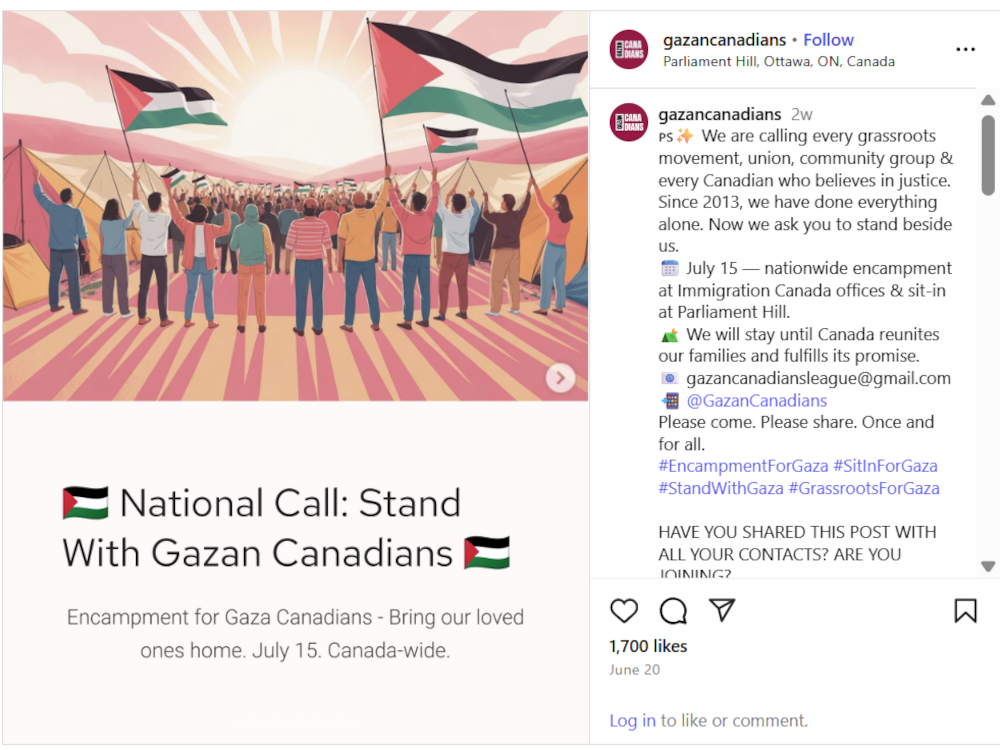
Now, social media posts are promoting an “
,” set to start on July 15, which promises nationwide encampments outside of Immigration Canada offices and a Parliament Hill sit-in until family members of Palestinians are brought to Canada.
As a civil libertarian, you might expect me to defend these protest tactics. I won’t. As John Locke
, “where there is no law, there is no freedom.” All of these acts are illegal.
Canadians, especially protesters and police, need to educate themselves on the limits of the Charter rights to freedom of expression and freedom of peaceful assembly so order can be restored and freedom can return.
Here’s some of what I think everyone needs to know about the legal limits of protest.
Freedom of peaceful assembly protects one’s right to gather peacefully with others for a common purpose, including protest. The “peaceful” qualifier means that the constitution doesn’t protect behaviour that interferes significantly with the rights of others. As the Supreme Court explained in an early Charter case, freedom is the absence of coercion or constraint. Your freedom ends where another’s begins.
In practice, this means you can march down streets chanting and holding signs, even if that briefly delays traffic, but you can’t stand in the middle of an intersection refusing to move. While a march uses the street fleetingly just like driving a vehicle, a blockade exerts force and coercion. More than a dozen court decisions confirm that, depending on the protester’s intent, blockading is either criminal mischief (interfering with property) or criminal intimidation (blocking or obstructing a highway for the purpose of compelling someone to do something or not do something that they’re entitled to do). Police have no excuse to let the blockades continue.
While freedom of expression protects your right to say extremely offensive things outside a place of worship, as long as it doesn’t rise to the level of hate speech or advocating genocide, you don’t have the right to block anyone’s path: that too is mischief or intimidation.
While you can show up at a park every day to let your views be known, you can’t build a semi-permanent tent city. Even if one were to consider that action peaceful protest, courts have confirmed that trespass laws are a reasonable limit. You can’t privatize space that belongs to all.
While the Charter protects your right to show up in public buildings for protests, it doesn’t allow you to interfere with or halt their normal operations until someone concedes to your demands.
And while you can be noisy in the streets to try to get your message across, you don’t have a right to blast speakers or truck air horns so loud that people can’t sleep or work. To quote Ottawa’s Justice Hugh McLean, who issued an injunction against the truck horns during the Freedom Convoy, “you can dissent as long as you don’t hurt people.”
The state also must also follow the rules. Cities shouldn’t require permits to hold a spontaneous protest in a public park, charge fees so high that people can’t gather, or try to regulate what people can say in public spaces, as cities like Calgary, Toronto and Vaughan, Ont., have done with their bylaws creating “bubble zones” outside places of worship, libraries and more.
Police need to respect the public’s rights too. They can’t demand protesters stop filming them unless they’re interfering with an arrest. They can’t force people to move if they’re simply trying to engage with the other side. They can’t search people’s bags without reasonable grounds.
I’m convinced that if Canadians — police and protesters especially — better understood the rules, we could restore the order and the rule of law that is a vital precondition to liberty. If we don’t, we risk people taking the law into their own hands.
Josh Dehaas is counsel with the Canadian Constitution Foundation and author of the new Guide to Protesting Safety and Legally in Canada.
National Post