



Ontario Premier Doug Ford says the federal government should consider blocking oil exports to the United States to give Canada leverage in the trade war that’s now hitting that province hard.
“Even if the federal government buys the oil and puts it into reserves, that’s what we need to do until they feel the pain,” Ford told reporters on Tuesday last week.
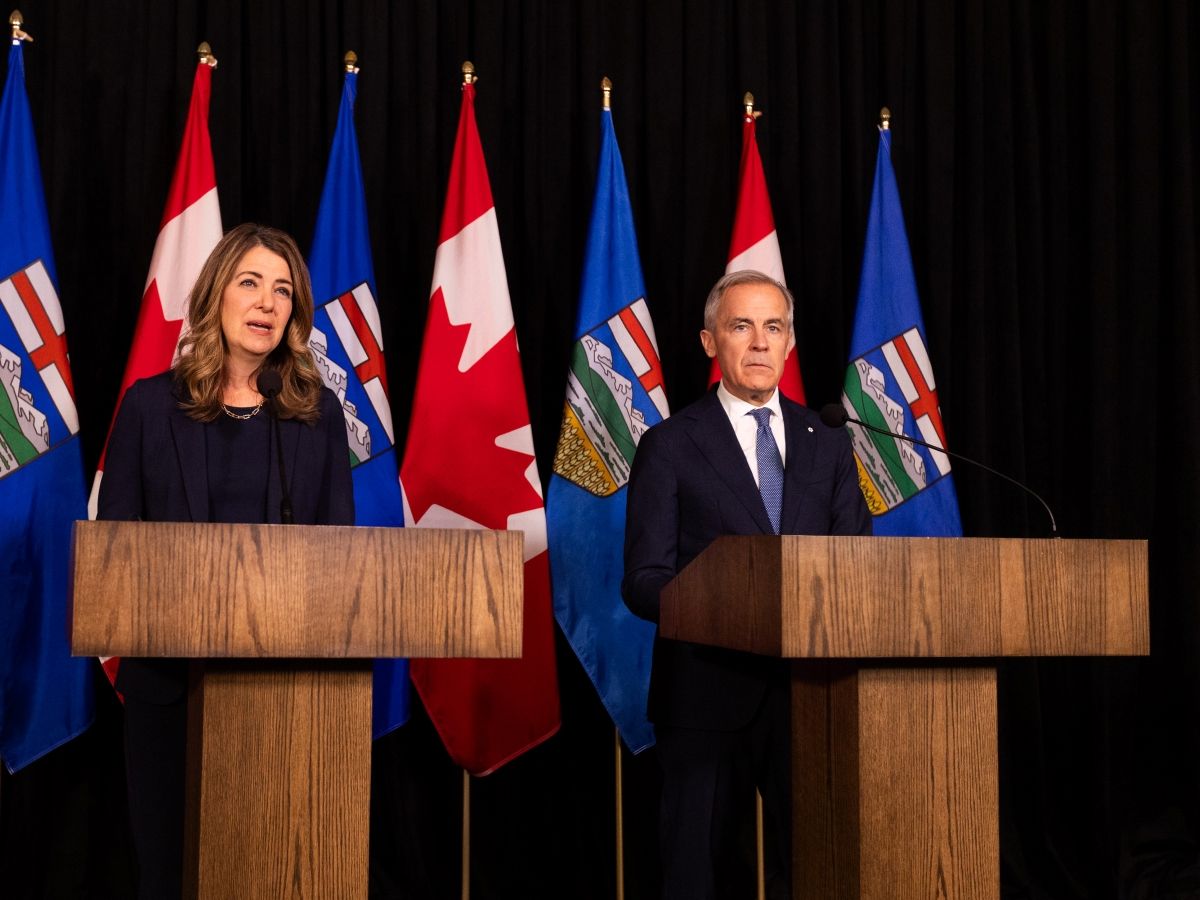
Alberta Premier Smith, who wants to double oil production , pushed back the next day with a special address .
“Although I understand the need to respond strongly to these tariffs, I cannot think of a more disastrous policy decision than cutting off or taxing Alberta’s oil to the United States,” she said.
This means the metaphorical taps are now in Prime Minister Mark Carney’s hands. But can Carney really cut off or put an export tax on Alberta oil without violating the constitutional division of powers? The answer is probably yes, but don’t expect Alberta to go down without a fight.
The Constitution Act of 1867 assigns all matters that governments may regulate exclusively to either the provinces or the feds, and provides a residual power to Parliament to “make laws for the peace, order, and good government of Canada, in relation to all matters not coming within the classes of subjects by this act assigned exclusively to the legislatures of the provinces.”
It’s not always easy to assign a matter exclusively to one level of government. The court has developed certain rules to deal with this reality, but it’s not always clear how they will be applied. For example, if two laws are in conflict and it’s impossible to comply with both laws, the federal law may prevail under the doctrine of paramountcy. That said, if a law intrudes on the “core” or the “basic, minimum and unassailable content” of the other order of government’s powers, it may be deemed inapplicable under the doctrine of interjurisdictional immunity.
One thing that’s clear under the Constitution is who owns the oil (and forests … and potash). Canada transferred ownership of natural resources to the Prairie provinces through the Natural Resources Transfer Agreements and related acts, which became part of the Constitution in 1930.
It’s also clear that Alberta has exclusive control over the “development, conservation and management of non-renewable natural resources and forestry resources in the province.” That’s from the text of Section 92A, which was added to the Constitution Act of 1982 at Alberta’s insistence.
If the provinces own their natural resources and have control over their development , how can Ottawa impose embargoes or taxes that would stifle their sale or development?
It turns out, Ottawa would have a number of strong arguments. First, it could point to the 1982 Supreme Court decision in the Exported Natural Gas Tax Reference, where the court examined a federal tax proposed by the Pierre Trudeau government on natural gas, including on exported natural gas, which Alberta opposed. Alberta argued that Section 125 of the Constitution Act of 1867, which says, “No lands or property belonging to Canada or any province shall be liable to taxation,” blocked the proposed tax. The Supreme Court ruled that the proposed tax was a valid exercise of the federal taxation power outlined under Section 91(3) of the act.
The court also reasoned that this was not an export tax because it applied also to Canadian consumers, but had it been an export tax, the federal government may have been able to impose that anyway under its “trade and commerce” power, as it had long done with customs duties.
So what about a total embargo? Here Alberta’s argument would be stronger, but one would expect the federal government to push back by arguing the embargo is within its jurisdiction under peace, order and good government, either because it’s an emergency or a national concern.
In 1976, a majority of the Supreme Court held in the Anti-Inflation Act Reference that the Pierre Trudeau government’s price controls aimed at runaway inflation were a valid exercise of that power. More recently, in 2021, the Supreme Court upheld the federal carbon tax as a national concern in the Greenhouse Gas Pollution Pricing Act References .
Of course, legal arguments aside, it seems obvious the Carney government would be playing with fire by blocking oil exports. While such a move might play well in Ontario and Quebec, Albertans are angry enough about the lost years of oil sands production that have already occurred. Any move Carney makes now could antagonize Alberta right before it votes on whether to hold a separation referendum. Whether constitutional or not, it could be very bad for the federation.
National Post
Josh Dehaas is Interim Litigation Director with the Canadian Constitution Foundation, a charity that fights for Canadians’ rights and freedoms.

