


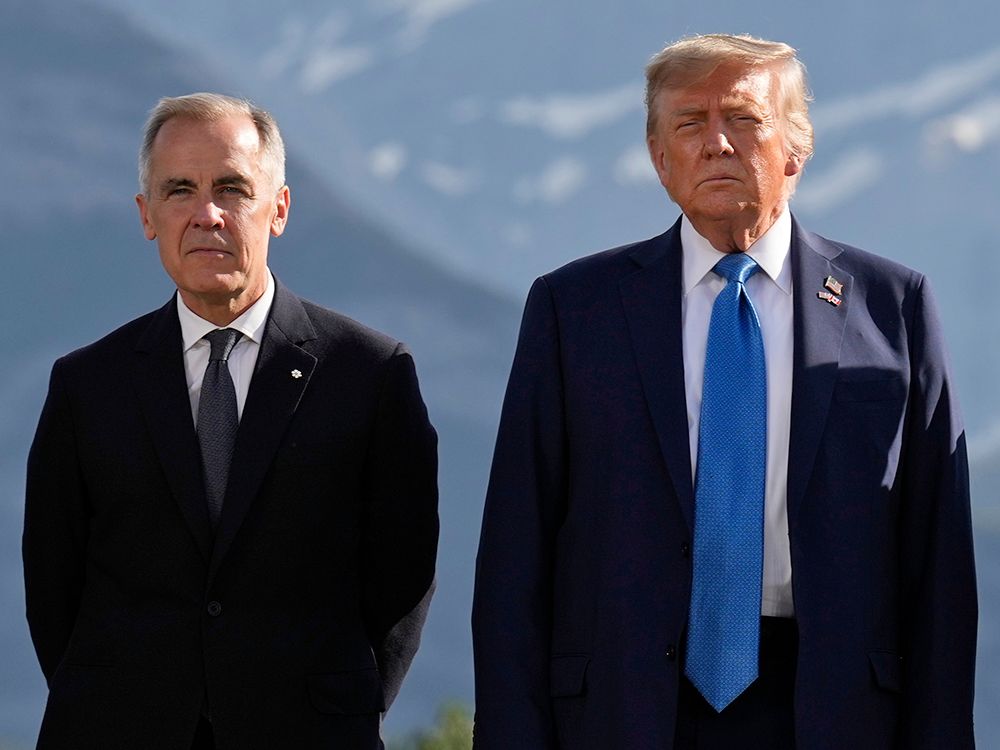
On day two of the G7 meeting in Kananaskis, Alta.,
Prime Minister Mark Carney issued a statement
saying that, as global threats grow, unity among the world’s most advanced economies matters more than ever.
The G7’s origins date back to 1973, when then U.S. Secretary of the Treasury, George Shultz, convened an informal gathering of finance ministers to promote free trade, multilateralism and co-operation with the developing world (Canada was invited to join in 1976).
But at the G7’s 51st meeting this week, there was no real unity, because its predominant member doesn’t advocate for any of those things anymore.
President Donald Trump headed back to Washington on Monday night, claiming he had “big stuff” to sort out in regard to the Israel and Iran confrontation.
It was a legitimate pretext, but the feeling is that he would have gone anyway. He was like the embarrassing uncle at the wedding who, to everyone’s relief, leaves early.
“I wish I could stay for tomorrow,” the president said, as
Carney turned to French president Emmanuel Macron and winked
.
Macron barely hides his belief that Trump is depriving a village somewhere of an idiot.
The French president had already upset the president by stopping off in Greenland on his way to Alberta, responding to Trump’s threats to the island’s sovereignty by saying that seizing territory “is not what allies do.”
Macron told reporters in Kananaskis that things are not going in the right direction, “whether it’s Canada or Greenland or our friends in Denmark. That’s why I was there two days ago. We need respect,” he said.
Only Macron and Italian prime minister Giorgia Meloni can know what he was talking about when the leaders gathered on Monday morning, and she
. But it’s not hard to guess.
Trump’s presence in Kananaskis had the intense gravitational pull of a black hole. The president sat at the centre of this universe, caring nothing for matters beyond the boundaries of his personal event horizon.
The Americans signed on to a
leaders’ statement on Israel and Iran
that called for a “de-escalation of hostilities,” but it was a diluted effort that stopped short of urging a ceasefire.
On his way home, Trump had his revenge upon Macron, by saying on social media that the “publicity-seeking French president” was mistaken in suggesting Trump had left early to work on a ceasefire. “Much bigger than that,” he said. “Whether purposely or not, Emmanuel always gets it wrong.”
Such pettiness undermines the sense of G7 unity, but it doesn’t put pressure on its shared values of pluralism and liberal democracy.
But Trump did that too. Earlier on Monday, in his meeting with Carney,
he complained how unfair it was that Vladimir Putin’s Russia had been kicked out of the then G8
— a subject he raised three times.
“Putin speaks to me; he doesn’t speak to anybody else. He was very insulted when he got tossed out of the G8, as I would be … He’s not a happy person about it,” Trump said.
Such affinity for an autocrat who has the face of a man who enjoys clubbing baby seals to death is baffling.
On Monday night, Russia unleashed one of the most intense barrages of the war against Ukraine’s major cities:
deliberate attacks against the civilian population
that killed 12 and injured 138, according to Volodymyr Zelenskyy.
The Ukrainian president met with Carney on Tuesday morning and called it “a difficult night.” He looked bereft, in part because he’d flown halfway round the world to meet a U.S. president who was no longer there.
Carney condemned the “barbarism” of the Russians and revealed a
new package of military and financial aid
— including $2-billion worth of drones, helicopters and ammunition and $2 billion in additional financing — as a sign of Canada’s “unwavering” support.
Macron said that “the common push that is emerging is to say: ‘we need to strengthen sanctions’,” and that the Europeans are preparing much stronger sanctions against Russia than the U.S. has imposed.
However, Zelenskyy was looking for a united G7 front to pressure Russia into an unconditional ceasefire, and Trump’s support for Putin was a signal that there is no such front.
Canadian officials said there would be no G7 leaders’ statement on Ukraine because the Americans wanted to water down comments critical of Russia —
although they later retracted that claim
. Carney issued a chair’s statement at the end of the summit that called on Russia to commit to an unconditional ceasefire, but admitted that some allies wanted comments included that went “above and beyond what is said in the chair’s summary.”
Zelenskyy ended up leaving Kananaskis early too, without receiving the one-on-one with Trump he sought or the moral backing of leaders’ statement of support that included the U.S.
The G7 represents half of worldwide nominal net wealth. It has been a powerful force for international order for more than 50 years.
It still does good work on the margins: a
was released in Kananaskis and endorsed by “outreach” countries like India, as was a strategy on
.
But Trump’s rejection of the G7’s founding principles puts its future effectiveness in doubt, especially two years from now when the U.S. will hold the rotating presidency.
In his closing press conference, Carney made the case for the G7. He said having just nine people in the room allowed for “direct dialogue and frank exchanges.”
“That is particularly valuable, in my opinion,” he said. By all accounts, he handled himself well. Macron told reporters the prime minister “pacified” debates that got too contentious.
But what hope for free trade, multilateralism and representative government is there when the leader of the free world is a protectionist with despotic tendencies
who has said he believes, as Napoleon did
, that “he who saves his country does not violate any law”?
National Post

