



The most important thing happening in Canada this week is not the threat of 50 per cent tariffs on US$20 billion of this country’s products by President Donald Trump.
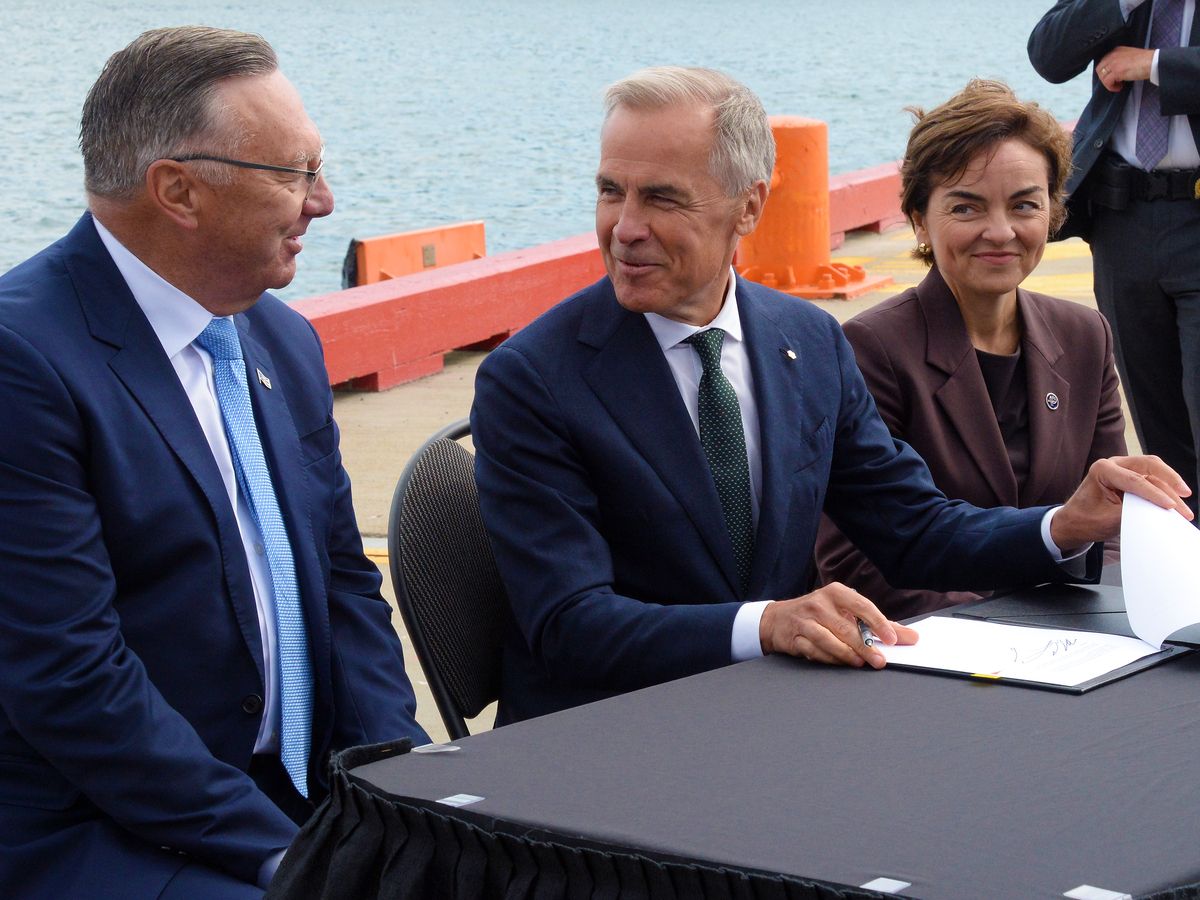
Rather, according to Prime Minister Mark Carney, the most consequential event was Monday’s announcement in St. John’s, N.L., of a multi-billion-dollar clean energy deal with Quebec that will see a tripling of the generating capacity of the Churchill Falls hydro-electric project. The additional power generated by the expansion would be enough power to light, heat and cool Toronto, Montreal and Vancouver combined, Carney said.
The deal replaces the notorious 1969 Churchill Falls power contract that heavily favoured Hydro-Quebec at the expense of Newfoundland and Labrador. It will see the average rate paid per kilowatt hour rise from 0.2 cents to around 6 cents.
The benefit for Quebec is that it secures additional clean power for the province until 2077. Even allowing for the price increase, Hydro Québec will still be paying much less than any alternative source of power, Premier Christine Fréchette said.
Quebec runs on cheap hydro and the deal guarantees predictable, stable energy for the next 50 years. The 10,000 MW provided for by the deal is more than one-quarter of Hydro-Québec’s current output.
In that sense, Carney is right — it is historic in ending nearly 60 years of enmity between the provinces and offers increased economic development opportunities for both.
The deal was stalled until the federal government stepped forward with $10 billion in financing. Ottawa will expand the Churchill Falls plant; construct a transmission line to the Labrador West mining trough; support the construction of a new dam at Gull Island; build a 2,000 MW onshore wind energy project; and refer the whole series of interlocking investments to the Major Projects Office to coordinate funding and accelerate permitting.
It appears to be no coincidence that Carney, Fréchette and Newfoundland and Labrador Premier Tony Wakeham stood shoulder to shoulder to make the announcement two days before Trump’s new tariffs were due to land.
Wakeham said that the deal would not have reached fruition without Carney’s leadership. “You helped bridge the gap between the two sides,” he said. “This is a partnership between two provinces and a federal government that is dreaming big for Canada and executing big for Canada. That, sir, will be your legacy and I’m proud to be a partner in it.”
Fréchette acknowledged that a Parti Québécois government could tear up the agreement after October’s election. “But where will they get 10,000 MW of power, and at what cost?” she said.
The veracity of the claim that this is a “win-win-win” deal is debatable — it involves huge federal investments and it will be years before taxpayers see any return.
But it is absolutely the kind of “nation-building investment” that Carney promised when he sought election last year. “We are giving ourselves more than any other nation can take away,” he said.
The deal will also build trust between the provinces, “the most valuable commodity in an increasingly volatile and unreliable world,” the prime minister said.
Carney outlined how the increase in power would help industry access iron ore and graphite reserves in Labrador. “Each investment unlocks the others,” he said.
He was asked if he planned to talk to Trump before Wednesday’s deadline.
He said he did, “and the first thing I will talk about is this historic investment. I say that in all seriousness… Maybe I’ll translate ‘maîtres chez nous’ for the president as well. This is what a good deal looks like,” he said.
Carney didn’t directly link the supply of critical minerals, including high purity iron ore, to the current negotiations with Trump, but it’s clear he intends to impress on the president that Canada is not a supplicant. Rather, the message from Monday’s announcement is that this country is united in its determination to forge an independent future.
The pressure is already building on Trump not to proceed with the threatened section 338 tariffs under the Smoot-Hawley Act. The U.S. Chamber of Commerce issued a statement saying that new tariffs would drive up costs for U.S. families, disrupt supply chains and risk jobs that are dependent on trade with Canada and Mexico.
Yields on the 30-year U.S. Treasury bill hit a two-decade high of 5.3 per cent on Tuesday, over persistent inflation, geopolitical and borrowing fears.
The prospect of an extension to Wednesday’s deadline is considered a reasonable bet. But senior sources have reiterated that the two sides are far apart when it comes to lowering the sectoral tariffs on steel, aluminum, autos and forestry, in large part because the Trump administration believes they are working when it comes to re-shoring investment.
The president clearly believes an incremental bump in light vehicle production is worth risking a trade war with his nearest neighbour.
But he is also the man who has threatened to bomb Oman (an ally), backed the world’s worst regime (North Korea) and told reporters to mind their own business when they asked how his 20-year-old son Barron has accumulated $150 million. All within the past 48 hours.
Whatever comes out of the White House this week will be transitory. The Churchill Falls deal will outlast us all.
National Post
jivison@criffel.ca
Twitter.com/IvisonJ

