



It is an almost immutable law of politics that as a leader’s reputation flourishes abroad, it deteriorates at home.
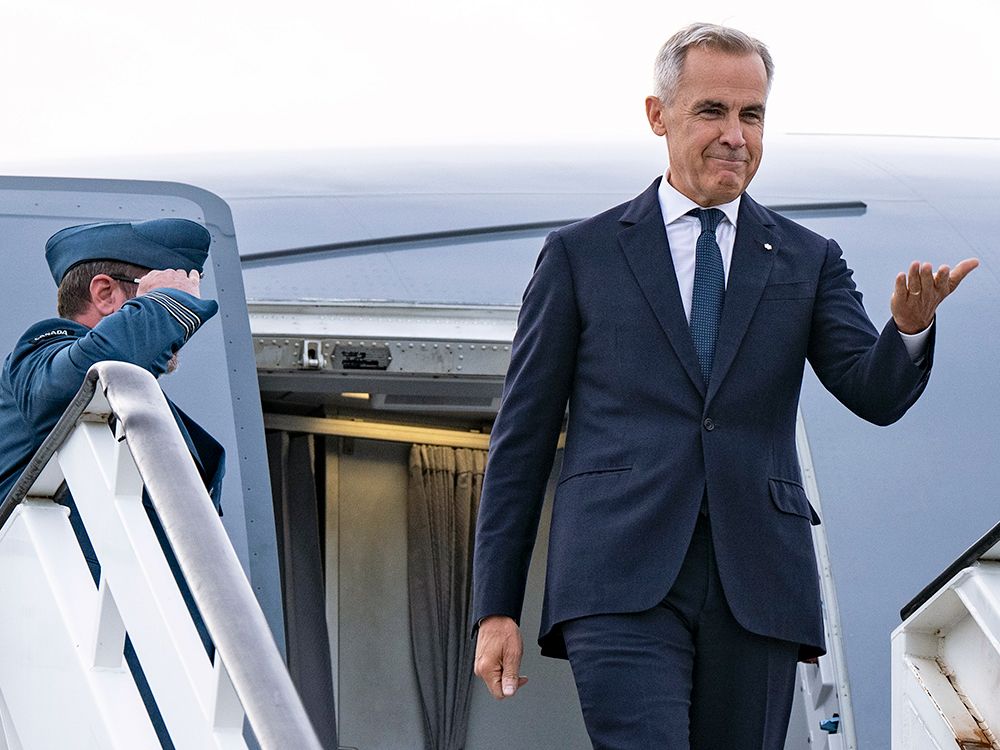
In the last week of summer, Prime Minister Mark Carney won plaudits for his
trip to Ukraine to help celebrate
that beleaguered nation’s independence day. He was the only world leader in Kyiv and his
message that Canada will always stand in solidarity with Ukraine
was well-received.
“(Russian President Vladimir) Putin can be stopped,” he said. “Russia’s economy is weakening. He is becoming more isolated and our alliance is hardening … When peace comes, we cannot simply trust and verify, we must deter and fortify — deter Russia from thinking it can ever again threaten Ukraine and Europe’s freedom.”
The trip was hailed in Europe. On their popular
podcast, former British Conservative MP Rory Stewart and ex-Labour spin doctor Alastair Campbell discussed whether their “mutual hero” Carney is the leader the West needs to drive consensus.
“Mark Carney is in a very interesting position,” said Stewart. “He’s got the credibility and international leadership in a time of Trump and we desperately need Canada to help form these international coalitions with the U.K., Europe, South Korea and Japan.”
If the prime minister was tempted to bask in the glowing reviews,
and a tranche of articles at home wondering whether the
will have sobered him up.
Statistics Canada’s GDP numbers for the second quarter are not unexpected but they reinforce the challenges on multiple fronts facing the Liberal government.
Real GDP declined 0.4 per cent, in line with the Bank of Canada’s expectations. The slowdown was driven by significant declines in the export of goods (down 7.5 per cent for the quarter) and decreased investment in machinery and equipment (down 9.4 per cent).
The economy might have slowed further if not for an increase in government spending, which clearly does not help the fiscal situation, particularly when it was accompanied by a fall in federal government revenues.
The quarterly release showed government income declined 4.2 per cent, due to removal of the federal carbon tax and lower income tax receipts.
Now that the Carney government has
abandoned retaliatory import tariffs
, which were expected to bring in $20 billion this year, revenues are set to tumble further.
Spending rose 1.8 per cent in the second quarter, thanks to higher wages and the cost of covering Canada Post’s problems. The combination of reduced income and rising expenses increased net borrowing and led to a general government deficit of $34.5 billion, the StatCan report said.
The gloom will hardly have been lifted by a paper from the
showing that the federal government’s largest spending outlay, personnel expenses, hit $71.1 billion last year and will rise to $76.2 billion within five years if left unchecked (the number of full-time equivalent staff is forecast to be 442,000 by that time, with an average compensation of $172,000 a year, including pension and benefits).
Carney is still being given the most precious gift in politics: the benefit of the doubt.
A
released last week suggested the vast majority of voters acknowledge that the country is facing far more intense political challenges than it has for many years. The Liberal government was subsequently given a passing grade on 21 performance measurement questions, ranging from investing in the military to working with the provinces; from diversifying trade relations to building major projects.
Yet as commentator Sean Speer noted in
, the prime minister’s political authority rests on the perception of competence and, if the economy slows further, Canadians will start to doubt the steadiness of his hand.
The weakest score Carney received in the Spark poll was on his handling of the cost of living, the No. 1 concern of most voters.
Canadians are aware of the frustrations of dealing with President Donald Trump but that patience is likely to be stretched wafer thin, unless there are signs of progress on trade or big projects.
The prime minister said a deal with the United States was coming in July, then August. We are now moving into the fall with no agreement in sight.
That is not a disaster: most of Canada’s exports fall under the CUSMA trade agreement, which means our effective tariff rate is around six per cent,
of 18.6 per cent.
RBC
noted that Canada’s relatively favourable tariff position
should reduce the risk of a slide into recession.
But the CUSMA does not cover Trump’s security-related Section 232 tariffs on steel, aluminium and autos, which are getting killed (international exports of passenger cars and light trucks plummeted 25 per cent in the second quarter). Ontario lost more than 45,000 manufacturing jobs last spring, mainly in steel and autos.
CUSMA is up for renegotiation next year and the uncertainty about what comes next is an anathema to business investment.
Capital expenditures by the
for the second quarter showed a 14 per cent fall from the same period last year, Statistics Canada reported Monday.
There are some encouraging signs. Carney announced the major projects office has opened in Calgary,
headed by former Trans Mountain president Dawn Farrell
, and the energetic energy minister, Tim Hodgson, has promised there will be “no more sequential reviews; no more agency maze between departments and regulators.”
Hodgson met recently with the Ontario Teachers’ Pension Plan board to talk about how pension funds can draw in private investment.
Canada is not exactly a low-tax jurisdiction: combined federal and provincial income tax is the fifth highest of 38 high-income countries at 53.53 per cent, while the combined federal-provincial corporate tax rate at 26.14 per cent is higher than the OECD average.
But Canada has one thing going for it: it is not the United States.
U.S. Treasury Department data show that the sense of American exceptionalism among investors remains strong. Foreigners plowed a net US$311 billion into U.S. securities in May and another net US$77.8 billion in June, despite concerns about tariffs that sparked an exodus in April.
But while the bar to genuine capital flight is high, Trump’s attempts to control the Federal Reserve might just lower it. The president has repeatedly pressured chairman Jerome Powell to lower interest rates and is now trying to fire Fed governor Lisa Cook on allegations of false mortgage application statements.
The market knows that there is a strong historical link between central bank independence and lower inflation. If there are signs that the U.S. is going to emulate Turkey and compromise that independence, we could see currency volatility and capital looking for safer havens.
Carney’s burgeoning international reputation would be an advantage in that scenario.
But that acclaim will be for nothing if he becomes a prophet without honour in his own country, because he has failed to make progress on building a more resilient, more productive and more prosperous Canada.
National Post

