


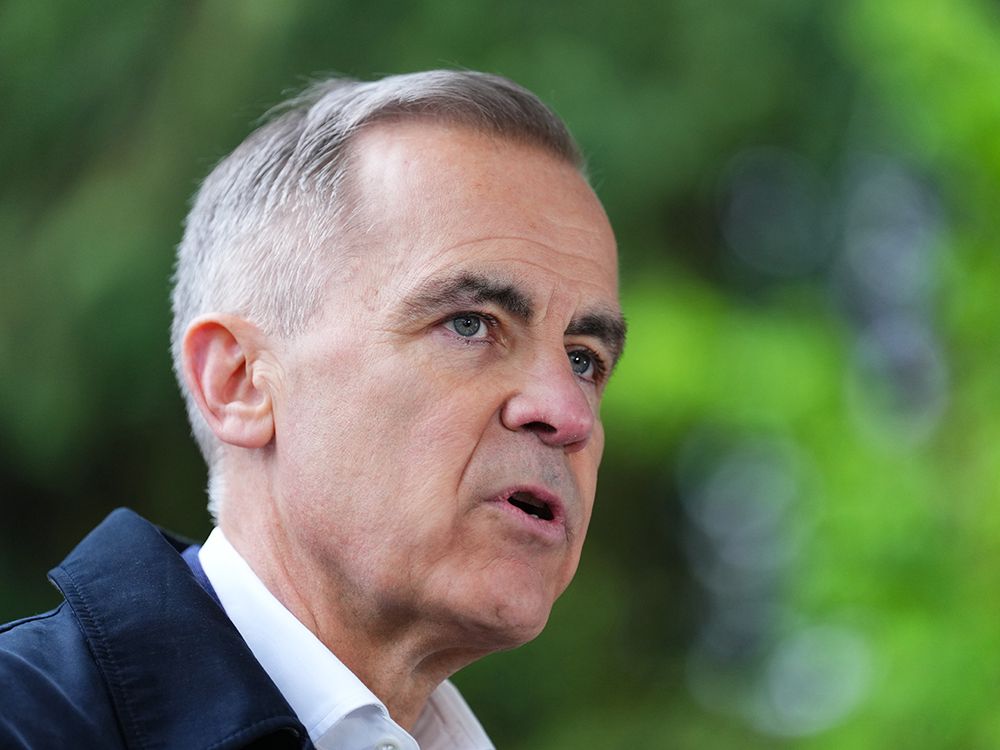
Liberal Leader Mark Carney heads into Alberta this week and is more likely to be the proverbial prophet without honour in his own province than the prodigal son returning home to a warm welcome.
Feelings are running so high in the region that Preston Manning, a former leader of Her Majesty’s Opposition, warned that if Carney wins, Westerners should convene a constitutional conference to consider ways to
“Large numbers of Westerners simply will not stand for another four years of Liberal government, no matter who leads it,” he said.
Carney and Conservative Leader Pierre Poilievre have both distanced themselves from the comments and urged national unity, as should be expected of anyone with ambitions to run Canada.
Breaking up the country because you don’t agree with the result is the kind of undemocratic impulse that leads to chaos.
Canada already has a law on secession: the Clarity Act, which calls for a referendum with a clear question and a clear majority.
A new poll by the Angus Reid Institute, released on Sunday, suggests that we are nowhere near those conditions in the West or Quebec, where
want to form their own country, or join the U.S., if the Liberals win.
But, if there is no imminent danger of the country imploding, there is widespread division and disaffection. The poll says only one in four Albertans and Saskatchewanians feel their provinces are respected.
The Liberals are hoping to pick up more seats in Calgary and Edmonton, but Carney’s visit is much more important than winning marginal advantage in a couple of ridings.
As the favourite to be prime minister after April 28, he has to capitalize on the surge of patriotism that has spread across the country, including across the Prairies.
“We have to find a way to make sure we preserve that because it’s a very powerful force,” said David MacNaugton, Canada’s former ambassador in Washington, in
“That means making sure that Albertans and people in Saskatchewan and people from Newfoundland and New Brunswick feel as if they’re part of this, and that the government of Canada is sensitive to their needs.”
In practical terms, in the West that means supporting the development of the resource industry.
“We have got to stop this silliness about not wanting to export natural gas and having emissions caps,” said MacNaughton. He said exports of gas will reduce global emissions by reducing the use of coal.
Yet on Monday, while Poilievre was in northern British Columbia saying he would guarantee project approval decisions within a year, Carney was in Victoria, B.C., talking about environmental sustainability.
This is not to suggest that the Liberal leader should support the befouling of air and water in the ceaseless quest for profit.
But it was a mistake to have him sounding like Justin Trudeau talking about how “nature is our nature” and how we should “strive to do things, not because they’re easy but because they’re right.”
In the question and answer with reporters, he said that a government has to be able to do more than one thing at a time, such as putting a cap on emissions at the same time as it develops conventional energy.
He said 30 per cent of carbon emissions come from the production and transportation of oil and gas.
“We need to get those emissions down,” he said, through technology like carbon capture and storage. “That’s how we can reconcile this.”
But it may be that he has not yet reconciled some of these things in his own mind.
One thing is clear: he is potentially ceding leadership on economic development to Poilievre.
For Carney, much seems to rest on the success of carbon capture. But a final investment decision has not yet been made on the
is being developed by a consortium of the major oil producers who account for 95 per cent of oil sands production.
As far back as 2011, when he appeared before the House finance committee as the Bank of Canada governor, Carney has promoted trade diversification, including major pipelines (though
he told the same committee in 2021
that he supported Trudeau’s decision to veto the Northern Gateway project).
He is now pushing the idea of Canada as a superpower in conventional and clean energy, mentioning the need for pipelines, trade corridors and energy infrastructure.
Yet, he has said he won’t repeal C-69, the Impact Assessment Act that is blamed for blocking big projects. This is a law that the Supreme Court has ruled is mostly unconstitutional. Carney would be taking a line of weak resistance if he were to say that he will overhaul the act to bring it into compliance with the highest court in the land.
He is also in favour of an emissions cap that opponents say would mean production will be 10 per cent lower in 2030 than it would otherwise be.
This was a 2021 campaign commitment by the Trudeau Liberals that Carney is not beholden to enact. Even
groups in favour of lower emissions
have spoken out against a new cap and trade system that would be layered on top of the existing Alberta TIER industrial emitters regime that covers 600 regulated facilities.
Carney is unlikely to follow Poilievre in saying he will remove the federal carbon tax backstop for large emitters, which covers up to 40 per cent of the country’s emissions. But he could go a long way toward showing that Ottawa is sensitive to Western needs by shifting his position on C-69 and the emissions cap.
Poilievre is making a major effort to appear more prime ministerial. But even the more mellow Poilievre could not resist the temptation of attacking Carney and the Liberal party’s “radical environmentalism,” which has prevented them from supporting resource projects.
“It’s the same Liberal ministers, the same Liberal MPs and they will have the same Liberal results,” he said.
A Conservative government will introduce a “rapid resource project office” that will handle regulatory approvals for all levels of government, he said. This “one and done” approach would produce decisions for major projects within a year, with a target of six months.
“No more delays, no more uncertainty, no more caps on Canadian growth and ambition,” he said.
From the perspective of national unity, and his own political hopes, Carney has to address his own previous declaration that
one-half of all oil reserves will have to be left in the ground
.
Does he still believe that? Can oil and gas production increase, if carbon capture fails to reduce emissions?
It could be a rough homecoming, especially after
he appeared to mock Alberta Premier Danielle Smith
during a campaign speech. Smith hit back by saying “progressive men” like Carney and Trudeau couldn’t handle “
It’s the type of nonsense that Canada can’t afford. Carney may not exactly be the prodigal son, given his absence of riotous living, but reconciliation and restoration are very much in order.
National Post
Get more deep-dive National Post political coverage and analysis in your inbox with the Political Hack newsletter, where Ottawa bureau chief Stuart Thomson and political analyst Tasha Kheiriddin get at what’s really going on behind the scenes on Parliament Hill every Wednesday and Friday, exclusively for subscribers. Sign up here.

