



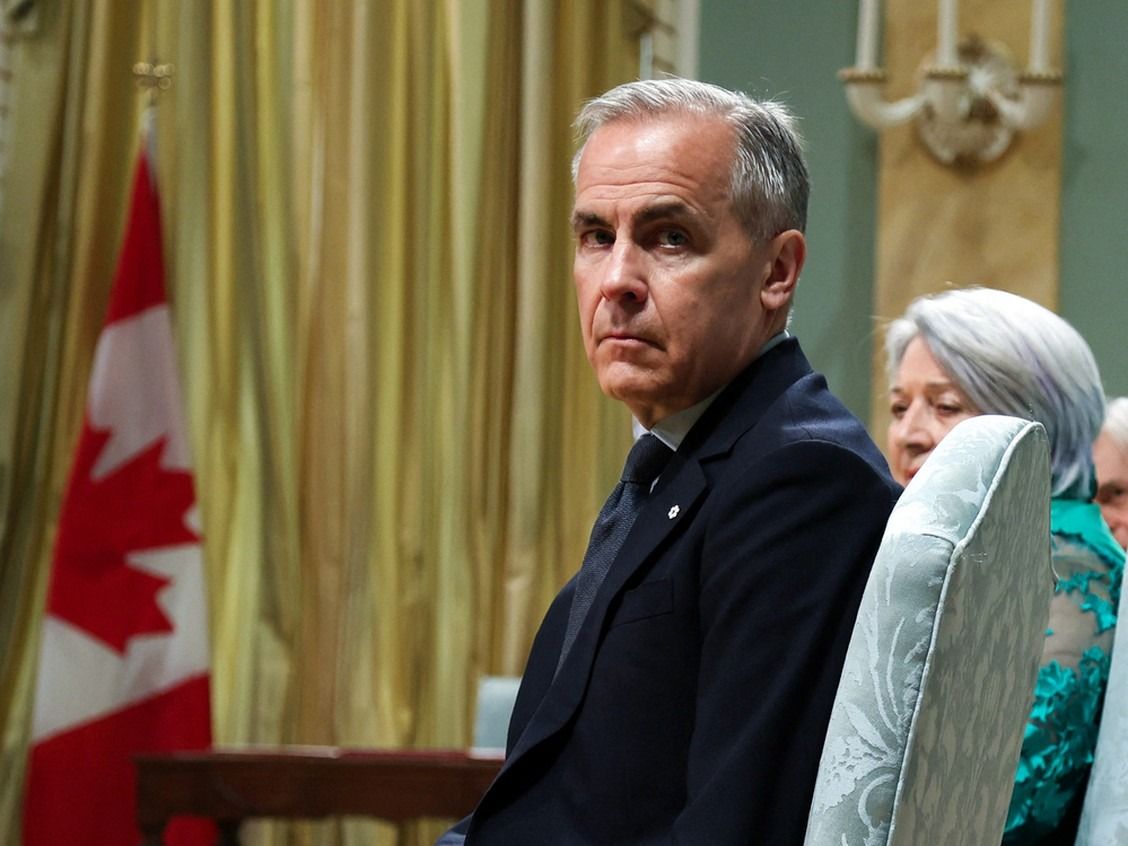
Canada may have severed its feudal ties less violently, but like America, it experienced far less sustained aristocratic domination than either of its two mother countries, France and Great Britain. But now, particularly with the rise of the ultimate establishmentarian, Mark Carney, as prime minister, Canada’s feudal future seems increasingly assured.
Carney’s election places power in the hands of the “
” a habitue and beneficiary of the elite financial and real estate. He is a reliable advocate for the kinds of strenuous climate, tax and regulatory policies undermining Canada’s middle class.
Canadians like to boast that their country as more egalitarian — in terms of distribution of wealth — than the United States. And to be sure, America’s more ruthless capitalism tends to create both a great many winners and a lot of losers, with the middle classes struggling in between. Yet, despite the aspersions of Trumpian fascism, it has been Canada, and
, who allow the clerisy — the modern-day Church — and the bureaucracy, to limit free speech, a classic fascist tactic.
But the essence of feudalism lies in the marginalization of the middle and working classes. Here,
is failing; its per capita income relative to the United States has been slipping for decades, and is now at the lowest level on record. Nor is it living up to its oft-repeated egalitarian image. Rather, today, Canada is well on its way to feudalism, having its
highest income inequality ever recorded
, with the top 20 per cent of households holding more than two-thirds of all wealth, while the bottom 40 per cent holds only 2.8 per cent. At the bottom, notes the left-leaning Policy Option thinktank, up to
Canadians suffer from “a poverty level standard of living.”
Canada not only lacks corporate headquarters, but it is also hardly an entrepreneurial hotbed like the US. Canadian small businesses, notes one recent analysis, are less productive than those in the US, one reason why few, particularly in manufacturing, become large. A
by the Business Council of Alberta identifies trade, financing, institutional, regulatory, or taxation constraints. Overall Canadian poor
, particularly among high end workers, also contributes to the country’s mediocre performance.
Not surprisingly, job creation outside government employment has been
. Overall, as the bureaucracy has thrived under the Liberals, the people, in general
. In 2002, Canada’s GDP per capita was about 80 per cent of the US’s, but has dropped by 2022, to 72 per cent of that of its neighbor to the south.
But perhaps nothing so reflects Canada’s feudal dilemma than housing. Despite being a country with enormous reserves of land, even in British Columbia, Ontario and Quebec, Canadian climate and regulatory policies, coupled with
, have made building new homes
by putting more pressure on an already inadequate supply. Although immigration levels may now be
,
, including those fleeing the Trump immigration policies, is already overwhelming border cities like Niagara Falls.
In this shift towards oligarchy,
and
play a major role. This is particularly true in terms of housing, where the Liberal Party has long championed “urban containment,” a policy that seeks to limit suburban and exurban development while promoting dense urban growth. The result, notes a new
by demographer Wendell Cox, has been housing prices that, in terms of the relationship between median home prices and household income, are increasingly out of reach for the average Canadian.
Immigration, key to Canada’s population surge, has contributed to this shortage. While the country’s working population
by a record 3.7 per cent at the start of this year, housing starts remained essentially flat. At one housing start for every 4.9 people entering the working-age population, “there is no precedent for a housing supply deficit of this magnitude,” notes National Bank of Canada economist Stéfane Marion. The biggest losers have been
for whom the homeownership rate has dropped to around 50 per cent, almost 10 per cent less than a decade before. It also helps to have wealthy parents who own a home; children of homeowners are
to acquire a home as those who do not.
If you wish to live in Canada’s two great international cities, and are not of aristocratic stock, it’s getting tough to get shelter. Four of the six major markets in Canada have a median multiple — a ratio of the median house price by the median gross (before tax) annual household income — of 5.4, considerably higher than the US’s 4.8. Vancouver now ranks fourth among all anglophone markets at 11.8, behind Hong Kong, Sydney, and San Jose. Toronto, at 8.4, stands as the second-least affordable market in Canada and ranks 84th out of 95 markets in international affordability, with a severely unaffordable median multiple of 8.4. As late as about 1990, national price-to-income ratios were “affordable,” at 3.0 or less in Australia, Canada, Ireland, New Zealand, the United Kingdom, and the United States.
This pattern
severely restricts homeownership
, which has been declining since 2021. Not surprisingly, rates are lower in
than in much of the country. Clearly densification, the preferred growth option of the elites, does not help a housing shortage or reduce prices as Patrick Condon of the University of British Columbia has
. Indeed, now Vancouver is now producing
the housing units needed to meet demand, one reason for the high prices even in a weak economy. Condon, an eloquent advocate of densification, cites the “indisputable” evidence that “upzoning” increases the value of land (by increasing the development value).
Concentrations of property and wealth are likely to worsen under the renewed Liberal regime. Planners and climate activists, as in California, a place which almost rivals Toronto and Vancouver in their progressive domination, will likely get even stronger with “net zero” devotee Carney in charge. Similarly, industries that tend to create high-wage jobs, notably in oil and gas, will find themselves constrained, leaving the big money to financial institutions and those firms who rely on protectionism to shield themselves from both Chinese and American competition.
It may comfort the current ruling elites in Canada to bloviate over Trumpian idiocy, but none of this will slow the country’s growing shift to feudalism. Blaming Trump, or the big nasty neighbor to the north, may deflect the suffering public from identifying the real culprits, the property and financial elites, and their political operatives like Carney, whose preferred policies threaten to stymie the progress of most Canadians.
National Post

