


In Edmonton last month, a judge laid the groundwork to acquit a man who, while sporting clear hallmarks of drug dealing, was caught by police packing a loaded Glock. If you’re ever wondering why crime is on the rise in Canada, you can look straight to decisions like these by our courts.
This
comes to us from 30-year-old Haider Aftab Khan, who was recently acquitted of a pile of gun and drug charges. On June 11, he succeeded in convincing Justice Derek Jugnauth, a former criminal defence lawyer
by then-Prime Minister Justin Trudeau to the Alberta Court of King’s Bench, to exclude the gun and drug evidence from his trial. This collapsed the Crown’s case.
Khan had been pulled over in a Ford Explorer in the early hours of April 24, 2022. The vehicle had a license plate covering, an illegal addition that caught the attention of a pair of police on patrol. The officers ran the plate number and found the SUV was registered to a Calgary owner who was “subject to ‘a large paragraph’ of court ordered conditions related to weapons and violence.” They pulled Khan over, and both approached the car.
One officer approached the car asked Khan for his license, insurance and registration; Khan couldn’t find his license, however, and provided an expired insurance slip; frantic, he searched his car, then his phone. The officer followed Khan’s hands with his flashlight (this was around 1 a.m.) — and saw a blue pill bottle without a lid that “looked like it had the paper scratched off” under the radio dash. Inside the bottle, the officer testified, were two baggies: one with pills, another with white powder.
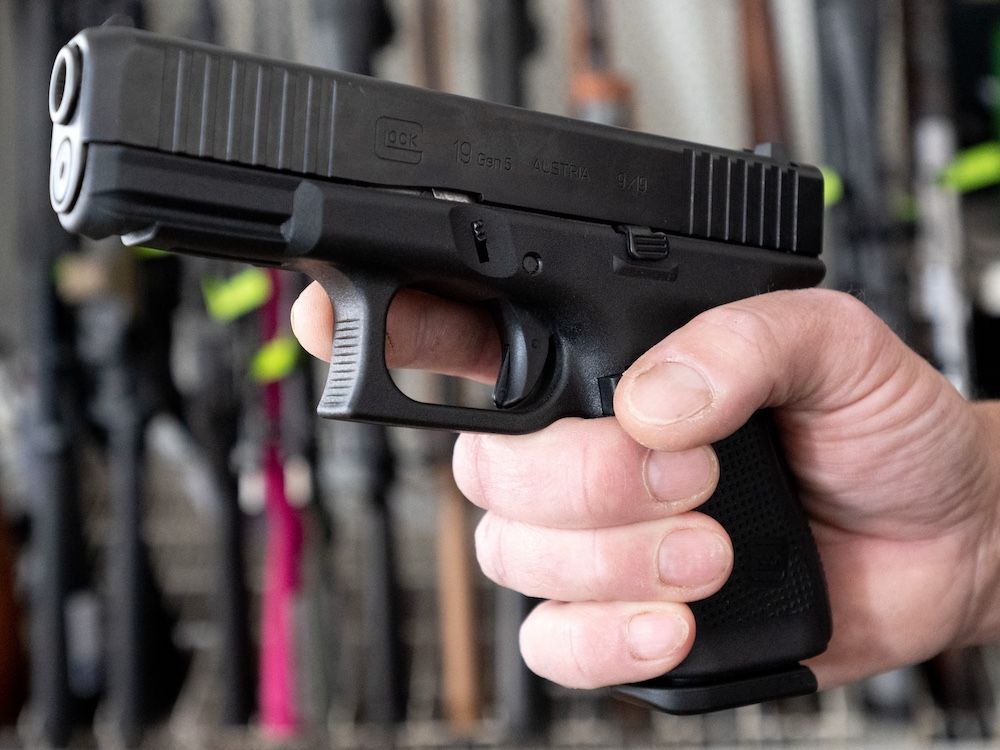
At that point, Khan was arrested for drug possession. He was then patted down by the other officer, who found a Glock 9mm handgun loaded with four bullets.
Officers then searched the SUV, finding 40 oxycodone tablets and a gram of cocaine in the pill bottle — the label that was worn, illegible in some places, but not torn — along with a box of 30 45-calibre rounds from the centre console.
Khan was charged with improper storage of a firearm, unauthorized possession of a firearm, unauthorized possession of a firearm in a vehicle, carrying a concealed weapon without authorization, and possession of a restricted firearm with ammunition (which carries a maximum sentence of 14 years). He was also slapped with two counts of drug possession.
When his day in court came along, Khan gave a different version of events — which the court didn’t buy. The SUV, he testified, was his cousin’s, and he had driven it to Edmonton to be worked on by a preferred mechanic; he’d been followed by three cruisers, not one; he had his phone recording during the traffic stop; he was dragged from his car, punched several times by the arresting officer, and then punched again several times by three other officers while handcuffed in the back of the cruiser; he’d sustained cuts to his face.
The pill bottle, Khan testified, wasn’t sitting under the radio in the front of the car — in fact, he claimed to have never seen it before.
The judge called BS: Khan’s story was “implausible” and “internally inconsistent.” No phone video was filed as evidence in his defence, the beat-down story didn’t make sense and no medical evidence supported the brutality allegations.
But on Khan’s side was the Charter — and Justice Jugnauth’s liberal reading of it.
To justify an arrest, an officer must have reasonable grounds to do so, supported by sufficient evidence that causes them to believe an offence has been committed.
The basis for Khan’s arrest was the pill bottle, which the officer believed had been tampered with. And, fair enough. Canadian police seize bottles with scratched labels in busts all the time. In
B.C., in
Alta., in
Ont.,
Ont., in
N.L. — to name a few cases. But it turned out the label in this case wasn’t scratched (though it was weathered), and its lidless quality with plastic sticking out the top
to satisfy the judge, who also thought the arresting officer didn’t have the training or experience to identify a suspicious bottle.
The cocaine baggie, in the judge’s view, was the only item that, if spotted, would have warranted a lawful arrest — but he didn’t believe that the officer could have seen it inside the bottle from his angle. No reasonable grounds were secured, which meant that all evidence stemming from the arrest — the gun, the drugs — was obtained illegally.
This wasn’t necessarily fatal to the case: judges have the option of allowing evidence borne from a Charter violation into trial if society’s interest in the prosecution is great enough. Heck, the Supreme Court of Canada
that unlawfully beating a non-compliant intoxicated driver to the point of breaking his ribs and puncturing a lung isn’t enough to get evidence tossed out.
However, Jugnauth found the police misconduct to be “serious,” and the breach of Khan’s rights to be on the extreme end of the state-intrusion spectrum. These factors were so heavy, in the judge’s view, they outweighed the
concealed loaded handgun
that posed an objective danger to society — and, in particular, the officers, had the traffic stop gone another way.
“Unlawfully carrying a loaded handgun on one’s person is an extremely serious offence that strikes at the heart of the community’s sense of security….
“In my view, society’s interest in bringing Mr. Khan to trial on the merits of this case strongly favours admitting the evidence. However, the strength of that pull is ameliorated to a degree by the importance of the public’s interest in knowing that citizens’ fundamental rights have meaning and the rule of law governs.”
And so, Jugnauth neutered the Crown’s case and acquitted Khan. The Alberta Crown Prosecution Service has not yet decided whether to appeal.
It’s not a major case, nor a bloody one, but it’s a decent demonstration of just how hard it is to manage public safety in Canada: even if a person is caught with a loaded gun strapped to the chest with illegal drugs semi-visible below the dash, that’s no guarantee they’ll be held to account for it.
We don’t need more gun bans targeting lawful owners — we need better judges.
National Post

